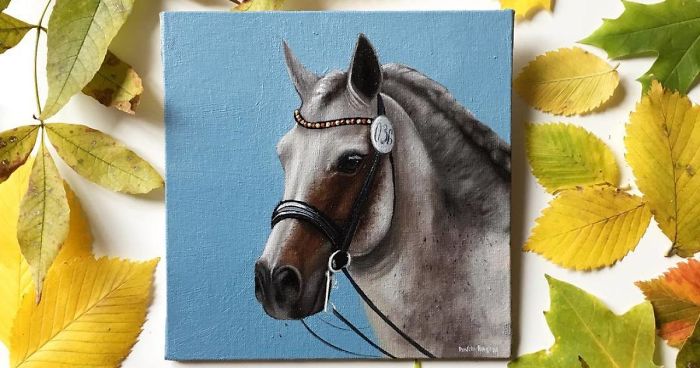
Some people start the year with a gym membership, a new planner, and heroic promises about eating more kale. I started mine with a stack of canvases, a suspicious amount of coffee, and one wild idea: paint one horse portrait every single day for 365 days. Not “when I feel inspired.” Not “when the lighting is perfect and Mercury is behaving.” Every day.
The challenge sounded simple at first. Horses are beautiful. I love painting. What could possibly go wrong? As it turns out, plenty. Horses have complicated anatomy, expressive faces, shiny coats, dramatic personalities, and ears that can change the entire mood of a portrait. Paint the ears wrong, and suddenly your noble stallion looks like he just heard gossip at the barn.
But that was exactly the point. I wanted to push beyond occasional inspiration and build a real daily painting practice. I wanted to study horse portraits deeply: the curve of the jaw, the softness of the muzzle, the shine in the eye, the strength of the neck, and the quiet emotional power that makes equine art so timeless. What began as a creative challenge became a year-long education in discipline, observation, humility, and the strange fact that paint always lands on your sleeve even when you are absolutely sure it will not.
Why I Chose Horse Portraits for a 365-Day Art Challenge
Horses are not easy subjects, which is precisely why they make excellent teachers. A horse portrait is more than a pretty face. It is a test of proportion, anatomy, expression, gesture, texture, and emotional storytelling. The viewer may not know the technical details of equine anatomy, but they can instantly sense when something feels “off.” A slightly misplaced eye, a stiff neck, or a muzzle without structure can turn a graceful horse into a mysterious sofa with nostrils.
Artists have admired horses for centuries because they represent movement, power, loyalty, freedom, and elegance. From classical equestrian paintings to modern animal portrait commissions, horses remain one of the most beloved subjects in animal art. They are also emotionally rich. A horse can look proud, gentle, curious, stubborn, sleepy, mischievous, or deeply wise, sometimes within the same five minutes.
I chose horse portraits because I wanted a narrow enough theme to create focus, but a rich enough subject to avoid boredom. Every horse is different. A chestnut mare with a blaze has a completely different visual personality from a gray gelding with soft eyes or a black stallion with a dramatic mane. The challenge was never really “paint the same thing 365 times.” It was “notice 365 different things about one magnificent subject.”
The Rules of the Challenge
To keep myself honest, I created a few simple rules. First, I had to paint one horse portrait every day. Sketches did not count unless they included paint. Second, each piece had to focus primarily on the horse’s head, neck, expression, or personality. Third, I could experiment with different materials, sizes, color palettes, and levels of finish. Some days called for acrylic. Some days wanted watercolor. Some days demanded oil paint and patience. Some days received neither patience nor dignity, but they still received paint.
I also allowed myself to create small works on busy days. This was essential. A daily art challenge becomes far more sustainable when the goal is consistent practice, not daily perfection. A 20-minute study of a horse’s eye could be just as valuable as a full portrait. In fact, some of the smallest paintings taught me the most because they forced me to simplify.
What Painting a Horse Every Day Taught Me About Anatomy
Before this challenge, I thought I understood horse anatomy fairly well. After week two, I realized I had been confidently incorrect in several creative ways. Horses are built with elegant complexity. Their skull structure, eye placement, cheekbones, nostrils, lips, ears, and neck muscles all work together to create that unmistakable equine presence.
The head is not just a long rectangle with eyelashes. It has planes, angles, curves, and subtle transitions. The muzzle is soft but structured. The nostrils are expressive. The jaw has weight. The eye sits in a bony socket and reflects both light and emotion. The ears are directional antennas for mood. Forward ears can suggest curiosity. Pinned ears say, “Please respect my personal space, human.” One relaxed ear and one tilted ear can make a portrait feel alive.
Daily repetition helped me memorize these forms. I began using the length of the horse’s head as a measuring guide. I paid closer attention to how the forehead slopes, how the cheek narrows toward the muzzle, and how the neck connects behind the jaw. I studied reference photos, equine art, anatomy diagrams, and real horses whenever possible. Slowly, my portraits stopped looking like guesses and started looking like horses with actual skeletons under their skin. A major victory for everyone involved.
The Emotional Side of Equine Art
A good horse portrait is not only accurate; it feels present. The best equine paintings capture character. That character may come through the eye, the posture, the angle of the head, or even the way light touches the coat. Horses are sensitive animals, and their expressions can be surprisingly nuanced. They do not need human facial expressions to communicate. A quiet gaze can carry enormous feeling.
During the challenge, I learned to ask better questions before painting. Is this horse alert or relaxed? Is the pose proud or tender? Is the lighting dramatic or peaceful? Is the mane wild and windswept, or neatly braided for a show ring? Is this a portrait of strength, companionship, grace, memory, or humor?
Those questions changed the way I painted. I stopped thinking only about “getting the horse right” and started thinking about what the portrait should say. Some paintings became tributes to beloved horses. Others felt like character studies. A few looked as if the horse was judging my life choices, which, frankly, was fair.
How Daily Painting Improved My Technique
Painting every day forced improvement in a way casual practice never had. When you paint occasionally, every session feels like a grand event. When you paint daily, you become less precious and more practical. You stop waiting for perfect conditions. You learn to solve problems quickly. You discover which brushes actually help and which ones are just decorative sticks with opinions.
Brushwork Became More Confident
At first, I overworked everything. I blended too much, fussed over details, and tried to rescue weak paintings with more paint. Spoiler: more paint is not always rescue. Sometimes it is just a landslide. Over time, I learned to make fewer, stronger strokes. A single confident mark could describe the bridge of the nose better than twenty nervous ones.
Color Choices Became Braver
Horses are not simply brown, black, white, or gray. A bay coat can contain copper, violet, gold, blue shadow, and reflected green from grass. A gray horse may include warm cream, cool lavender, soft charcoal, and pale silver. A black coat is rarely pure black; it reflects everything around it. Once I stopped painting “horse color” and started painting light, my portraits became more vibrant.
Values Became the Foundation
One of the biggest lessons was value control. If the lights and darks are strong, the painting can survive loose detail. If the values are weak, even beautiful brushwork may look flat. I began doing quick value studies before painting, especially for dramatic portraits. This helped me place highlights in the eyes, shadows under the jaw, and form along the neck with more confidence.
The Hardest Days of the 365-Day Horse Painting Challenge
Not every day felt romantic. Some days I painted while tired, uninspired, grumpy, busy, or covered in the emotional dust of ordinary life. There were days when the horse looked wrong from the first sketch and continued looking wrong with impressive commitment. There were days when the paint dried too fast, the reference photo was poor, or my hand simply refused to cooperate.
The hardest part was not the painting itself. It was showing up. A 365-day art challenge is a negotiation with your own excuses. “I am too tired.” “I will do two tomorrow.” “This one does not count.” “Maybe horses are overrated.” The trick was to make the daily action small enough that I could not talk myself out of it.
Some nights, I painted a tiny horse head study before bed. Some mornings, I blocked in a portrait before breakfast. On chaotic days, I focused on one feature: an eye, a muzzle, an ear, a forelock. The challenge taught me that consistency is not glamorous. It is built in small, stubborn acts.
What I Learned About Style
At the beginning, I worried about finding my “style.” By the middle of the year, I realized style is not something you chase like a runaway pony. It develops through repeated choices. The colors you return to, the edges you soften, the details you emphasize, the mistakes you keep making until they become personalitythese all shape style.
Painting one horse portrait every day gave me enough volume to notice patterns. I liked expressive eyes, strong lighting, loose backgrounds, and visible brush marks. I enjoyed portraits that felt intimate rather than overly polished. I found myself drawn to the moment when a painting still looked alive, before too much detail pinned it down.
That discovery was freeing. Instead of trying to paint like someone else, I began trusting the marks that felt honest. The challenge did not give me one fixed style. It gave me a clearer artistic voice.
How the Challenge Changed My Relationship With Mistakes
When you create 365 paintings, some of them will be bad. This is not pessimism; it is math. But bad paintings are not failures. They are information. They show you where your eye needs training, where your hand hesitates, and where your process needs adjustment.
One painting taught me that I was making eyes too large. Another revealed that I was flattening the bridge of the nose. Several informed me, with great enthusiasm, that I did not yet understand chestnut highlights. I kept the unsuccessful pieces because they became part of the story. They were proof that growth was happening.
By the end of the year, I no longer panicked when a painting went sideways. I knew I could paint another one tomorrow. That is the gift of daily practice: it reduces the pressure on any single piece. Art becomes less about one perfect result and more about long-term movement.
Tips for Starting Your Own Daily Painting Challenge
If you want to start a daily painting challenge, choose a theme that excites you and has enough variety to sustain your curiosity. It could be horses, birds, flowers, landscapes, pets, portraits, or small still-life objects. The theme matters less than your willingness to return to it every day.
Keep the Rules Simple
Do not create a challenge so complicated that it collapses by day six. Decide what counts, how much time you can realistically spend, and what size works for your schedule. Small paintings are not cheating. They are strategy.
Track Your Progress
Number each piece, photograph it, and keep a digital folder or physical archive. Seeing the work accumulate is motivating. It also helps you recognize improvement that may be invisible day to day.
Use References Wisely
Good reference images are essential, especially for animal art. Study anatomy, lighting, coat texture, and expression. Do not simply copy; interpret. Ask what matters most in the image and how you can translate that into paint.
Let Some Paintings Be Studies
Not every daily piece has to be gallery-ready. A study of a horse’s eye, mane, muzzle, or ear can be incredibly useful. The purpose of daily practice is growth, not constant performance.
The Joy of Seeing 365 Horse Portraits Together
At the end of the year, I laid out the paintings and felt something between pride, disbelief, and mild concern for my storage situation. There they were: 365 horse portraits. Some bold, some quiet, some polished, some awkward, all part of the same journey.
Seeing them together was powerful. The collection showed more than horses. It showed days. It showed moods. It showed discipline. It showed experiments with color, texture, composition, and emotion. It showed improvement, but it also showed persistence, which may be even more important.
The project reminded me that creativity is not a lightning strike. It is a relationship. You show up, you listen, you work, you fail, you adjust, and occasionally you paint a horse so beautifully that you forgive yourself for the six strange ones that came before it.
Extra Reflections: Experiences From Painting One Horse Portrait Every Day for 365 Days
One of the most unexpected experiences from this challenge was how personal the horses began to feel. Even when I was working from reference images, each portrait developed its own identity. A slight tilt of the head suggested curiosity. A soft shadow across the eye created tenderness. A windblown mane brought drama. I started naming some of them in my mind, which may sound charming or alarming depending on how many paint fumes you believe were involved.
The routine also changed the rhythm of my days. Painting stopped being an event I had to prepare for and became part of normal life, like brushing my teeth or checking whether I had accidentally dipped my brush in my coffee. I learned to protect creative time without making it precious. Some sessions were quiet and focused. Others happened between errands, deadlines, and dinner. The important part was that I kept the promise.
I also became more observant outside the studio. I noticed the way sunlight hit animals at different times of day. I noticed the color shifts in shadows. I noticed how horses carry emotion through posture rather than expression alone. Even watching a horse lower its head to graze became a lesson in movement, weight, and anatomy. The challenge trained my eyes as much as my hands.
There were practical lessons too. I learned to prepare surfaces in advance, clean brushes immediately, organize references, and keep a limited palette ready for fast sessions. I discovered that decision fatigue is the enemy of consistency. If I had to spend 30 minutes choosing materials, the painting was already in danger. A simple setup made it easier to begin.
Emotionally, the project taught patience. Improvement did not arrive with fireworks. It arrived quietly. A better edge here. A stronger highlight there. A more believable nostril after weeks of questionable nostrils. The progress was cumulative, almost invisible until I looked back at earlier work. That was encouraging because it proved that small daily effort matters.
The challenge also created a healthier relationship with finished work. Before, I sometimes judged each painting as a final statement about my ability. During the challenge, each piece became one step in a long conversation. If today’s portrait failed, tomorrow’s portrait was already waiting. This softened perfectionism and made the studio feel more playful.
My favorite experience was realizing that repetition does not kill creativity. It deepens it. Painting horses every day did not make the subject smaller; it made it bigger. I found endless variation in markings, moods, angles, breeds, colors, and personalities. The more I painted, the more there was to see.
Would I recommend painting one horse portrait every day for 365 days? Absolutely, though I would also recommend snacks, backup brushes, and a sense of humor. A year-long art challenge will test your discipline, but it will also reward you with skill, confidence, and a body of work that tells a real story. Mine was a story about horses, paint, persistence, and learning to keep going even when the mane looked like a haunted broom.
Conclusion
Painting one horse portrait every day for 365 days changed the way I understand art, animals, and creative discipline. It taught me that skill grows through steady repetition, not dramatic bursts of inspiration. It showed me that horse portrait painting requires anatomy, emotion, observation, and patience. Most of all, it reminded me that creativity becomes stronger when it has a daily place to live.
By the end of the challenge, I had more than a collection of equine paintings. I had a visual diary of effort, curiosity, mistakes, breakthroughs, and small victories. Every portrait carried a lesson. Every brushstroke brought me closer to the artist I wanted to become. And every horse, even the awkward ones, had something to teach.