Note: This article is written as a publish-ready travel photo essay based on real historical, cultural, conservation, and travel information about Bagan, Myanmar. Because conditions in Myanmar can change quickly, readers should check current official travel advisories before planning any trip.
Bagan: Where Time Forgot to Pack Its Bags
There are places that look beautiful in photographs, and then there is Bagan, Myanmara place that looks as if history got carried away, built thousands of temples, and then quietly disappeared into the morning mist. Capturing the ancient city of temples in 36 pictures and a video felt less like a normal photography project and more like trying to photograph a dream before it woke up.
Bagan sits on a bend of the Ayeyarwady River in central Myanmar, an arid plain scattered with stupas, pagodas, monasteries, murals, carved Buddhas, and brick temples that have survived centuries of sun, earthquakes, kings, restorations, and travelers with overly ambitious camera bags. It was once the heart of the Pagan Kingdom, which flourished from the 11th to the 13th centuries and helped shape the cultural and religious identity of Myanmar.
Today, the Bagan Archaeological Zone remains one of Southeast Asia’s most extraordinary temple landscapes. More than 3,000 recorded monuments are associated with the UNESCO World Heritage property, while many travel guides describe the wider plain as home to more than 2,000 surviving temples and pagodas. Numbers aside, the first impression is simple: there are temples everywhere. Big temples. Tiny temples. Golden stupas. Brick ruins. Domes peeking out of tamarind trees. The place has more silhouettes than a detective movie.
Why Bagan Matters
Bagan is not just a pretty backdrop for sunrise photos. It is a sacred cultural landscape, built around Buddhist worship, merit-making, royal patronage, and community life. During its golden age, rulers, nobles, monks, and ordinary believers sponsored religious monuments as acts of devotion. The result was an architectural boom so intense that the plain became one of the densest concentrations of Buddhist monuments in the world.
The rise of Bagan is often linked to King Anawrahta, who ruled in the 11th century and is widely associated with the growth of Theravada Buddhism in the region. Under his rule and those of later kings, Bagan became a political, religious, and artistic center. Temples were not built merely to impress visitors centuries laterthough, honestly, mission accomplished. They were part of a living system of faith, governance, education, inscription, donation, and ritual practice.
This is what makes Bagan different from a simple ruin field. It is still alive. Monks still walk through temple courtyards. Worshippers still leave flowers and incense. Farmers still work the surrounding land. Children still ride bicycles past brick walls older than many modern countries. The temples are ancient, but the place does not feel frozen. It breathes.
The First Sunrise: A Camera, A Scooter, And A Questionable Sense Of Direction
My first morning in Bagan began before sunrise, which is a polite way of saying I was awake at an hour usually reserved for bakers, monks, and people who have made poor flight-booking decisions. The air was cool, the sky was still deep blue, and my e-bike made a tiny electric whine as I rolled through sandy paths toward a viewpoint.
Photography in Bagan rewards early effort. The best light arrives before the sun clears the horizon, when the temple spires are still dark shapes against a slowly brightening sky. Mist settles low across the plain during cooler months, and when hot-air balloons are operating, they drift upward like colorful punctuation marks in a very old sentence.
The challenge is that Bagan is enormous. Even if you mark a location the night before, the pre-dawn roads can make every dirt track look like the entrance to either a masterpiece or a goat’s private driveway. Eventually, I found a quiet spot with a view across the temple plain. I set up the camera, checked the frame, cleaned the lens, checked the frame again, and pretended I was calm. I was not calm. Bagan sunrise does not encourage calm. It encourages whispering “wow” repeatedly until you run out of vocabulary.
What The 36 Pictures Try To Capture
A 36-picture series sounds generous until you stand in Bagan and realize you could shoot 360 images before breakfast and still feel underprepared. For this photo essay, the goal was not to document every monument. That would require a longer lens, better shoes, and possibly reincarnation. Instead, the collection focuses on atmosphere, scale, texture, and human presence.
1. The Skyline Of Spires
The first group of images captures Bagan’s famous skyline: temple towers, bell-shaped stupas, and pointed finials rising from the plain. At sunrise, these structures turn into layered silhouettes. The effect is cinematic, but not in a loud way. Bagan does not shout. It slowly adjusts the light until you forget to blink.
2. The Brickwork And Scars
Bagan’s temples are not polished museum objects. Many show repairs, cracks, missing corners, faded plaster, and earthquake scars. That texture matters. The brickwork tells a story of craftsmanship and endurance. Some monuments have been strengthened carefully; others carry evidence of earlier restoration choices that conservation experts now study with caution. These details make close-up photography just as meaningful as the grand panoramas.
3. The Sacred Interiors
Inside several temples, the mood shifts from epic landscape to intimate silence. Buddha images sit in shadow. Faint murals cling to walls. Sunlight slips through narrow openings and lands on dust, stone, and gold leaf. A wide-angle lens helps show the architecture, but patience is more important than gear. You wait for light. You wait for footsteps to fade. You wait for your own breathing to stop sounding like a documentary soundtrack.
4. Local Life Among The Monuments
The best Bagan photographs are not only about buildings. They include the daily rhythm around them: a vendor arranging postcards, a monk crossing a sandy path, a farmer moving through a field, a dog sleeping like it owns the 12th century. These moments remind viewers that Bagan is not an abandoned stage set. It is a heritage landscape with living communities.
5. The Video: Movement In A Place That Feels Eternal
The video portion adds what still photographs cannot fully show: the slow drift of balloons, the changing light, the crunch of sand underfoot, the flutter of leaves, and the way the camera reveals one temple after another as if Bagan is politely refusing to end. A still image freezes wonder; video lets it unfold.
Important Temples And Pagodas In Bagan
Bagan has far too many monuments to rank neatly, but several major sites help visitors understand the scale and variety of the ancient city.
Ananda Temple
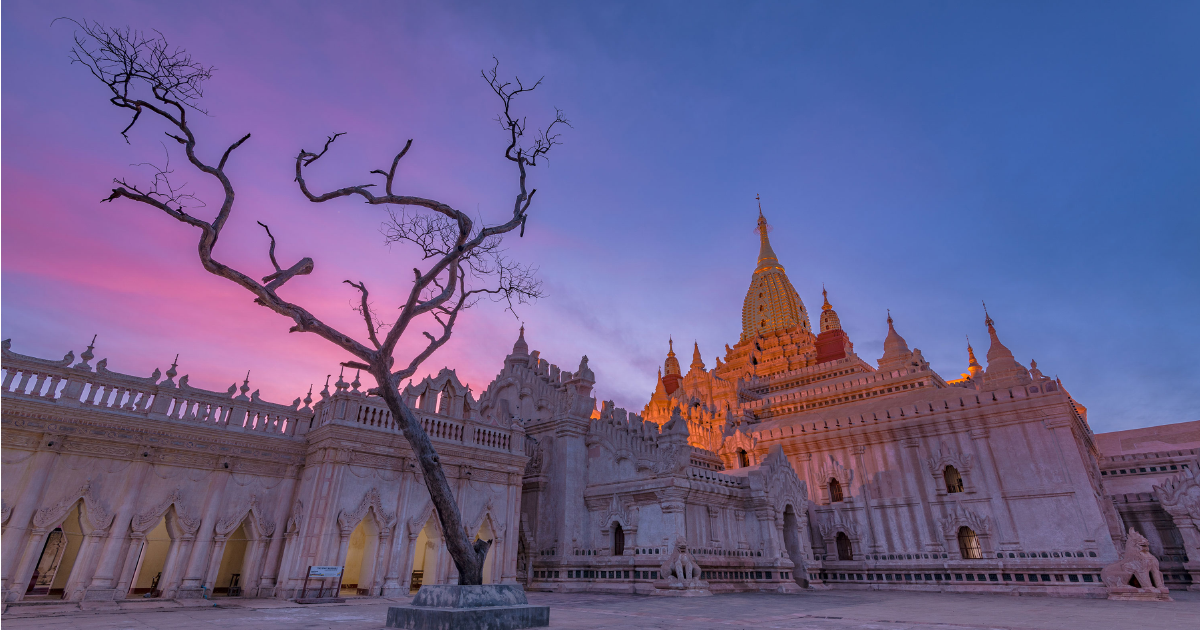
Ananda Temple is one of Bagan’s most celebrated monuments, admired for its elegant proportions, whitewashed exterior, gilded tower, and four standing Buddha images facing the cardinal directions. It is often described as one of the finest surviving examples of Bagan architecture. Photographing Ananda is a lesson in patience because its beauty attracts everyone, including travelers, worshippers, guides, and that one person who always walks into your wide shot at the exact wrong moment.
Dhammayangyi Temple
Dhammayangyi is massive, brooding, and unforgettable. It is the largest temple in Bagan and has a heavy, pyramid-like presence that makes it especially dramatic at sunrise and sunset. Its brickwork is famously tight, and its shadowy corridors give the building a mysterious energy. If Ananda is graceful, Dhammayangyi is the friend who shows up wearing black and says very littlebut somehow dominates the room.
Shwezigon Pagoda
Shwezigon Pagoda shines with a golden presence that feels different from the red-brick monuments scattered across the plain. It remains an active religious site and is important in the history of Burmese Buddhist architecture. It is best photographed with respect for worshippers, avoiding intrusive angles and remembering that the goal is not to “get the shot” at any cost. Temples are not props. Even very photogenic ones.
Thatbyinnyu Temple
Thatbyinnyu is one of Bagan’s tallest temples and a landmark of the skyline. Its vertical form makes it visible from many points across the archaeological zone. In wider landscape photos, it often acts as a visual anchor, helping the viewer understand depth and scale.
Sulamani Temple
Sulamani is loved for its balanced design and interior artwork. The temple’s name is often translated as “crowning jewel,” and that feels appropriate. It is beautiful without being flashy, detailed without feeling overcrowded, and rewarding for both architectural photography and quiet observation.
How To Photograph Bagan Without Losing Your Mind
Photographing Bagan is thrilling, but it can also be overwhelming. There are too many temples, too many angles, and too many moments when the light becomes perfect while your lens cap is still on. The key is to slow down.
Plan Sunrise The Night Before
Do not wait until morning to choose your location. Study maps, ask local guides which viewpoints are currently open, and confirm whether climbing is allowed. Many temples have restrictions to protect both visitors and fragile monuments. Responsible photography means respecting those limits, even when your inner photographer whispers, “But the composition!” Tell your inner photographer to drink some water and behave.
Use A Mix Of Wide And Tight Shots
A wide lens captures the scale of the plain, while a telephoto lens compresses layers of temples and creates those magical stacked silhouettes. Close-ups of brick, carved details, doorways, and offerings help balance the gallery. Without detail shots, every image becomes “temple, temple, temple, slightly different temple.” Beautiful, yesbut your readers deserve variety.
Return To The Same Place Twice
Bagan changes constantly with light, haze, weather, and season. A viewpoint that looks flat at noon may become spectacular at sunset. A temple that seems ordinary in harsh sunlight may glow warmly in late afternoon. Great travel photography often comes from repetition, not luck. Luck helps, but planning pays the rent.
Include People Carefully
Human figures add scale and emotion, but photography should be respectful. Ask permission for close portraits. Avoid interrupting worship. Do not treat monks, vendors, or local residents as decorative accessories. The best images come from awareness, not intrusion.
Culture, Conservation, And The Responsibility Of Seeing
Bagan’s beauty is inseparable from its vulnerability. The region has been affected by earthquakes, including a major 6.8-magnitude quake in 2016 that damaged hundreds of monuments. Conservation teams have since worked on assessment, stabilization, and restoration, while also learning from past interventions that may not have used ideal materials or methods.
This matters for travelers and publishers. A photo essay about Bagan should not present the temples as an indestructible fantasyland. They are historic structures facing pressure from weather, seismic risk, tourism, development, and time itself. The respectful visitor does not climb forbidden walls, touch murals, fly drones without permission, or treat sacred spaces like a personal movie set.
Responsible travel writing also means acknowledging current realities. Myanmar has faced serious political instability and safety concerns in recent years. Anyone considering travel should review official advisories, local conditions, insurance requirements, and ethical considerations before making plans. Bagan is magnificent, but good judgment should always be packed before the camera.
What Makes Bagan So Photogenic?
Some places are photogenic because they have one famous angle. Bagan is photogenic because it has thousands of conversations happening at once. The geometry of stupas, the warmth of brick, the dust in the air, the flatness of the plain, the bend of the river, and the rise of distant hills all work together. The landscape gives photographers layers: foreground ruins, middle-distance temples, faraway silhouettes, and skies that change from blue to pink to gold in a matter of minutes.
Bagan also has emotional contrast. It feels grand and humble, ancient and alive, silent and busy, fragile and enduring. You can photograph a monumental temple one minute and a pair of sandals outside a shrine the next. Both images matter. One shows scale; the other shows presence.
The Experience: Capturing Bagan In 36 Pics And A Video
By the second morning, I had learned one important rule: Bagan rewards people who wake up early, but it does not reward people who wake up early and forget to charge their camera battery. Fortunately, I avoided that tragedy by becoming the kind of traveler who checks batteries, memory cards, lenses, weather, and sunrise time with the seriousness of a NASA launch director.
My 36-picture sequence began with darkness. The first frames were barely photographs at alldeep blue outlines, temple roofs, the faintest suggestion of a horizon. Then the sky lifted. A thin orange line appeared. Birds moved across the frame. Somewhere behind me, another traveler whispered something in a language I did not understand, but the tone was universal: this is ridiculous, in the best possible way.
When the balloons appeared, they did not burst into the scene. They rose slowly, almost shyly, as if asking permission from the temples. The wide shots captured the classic Bagan view: balloons floating over pagodas while the sun warmed the mist. But my favorite images came later, after the obvious drama had passed. A monk walking beside a wall. A doorway framing a golden Buddha. A small stupa leaning slightly, still dignified, like an elderly professor who refuses to retire.
Filming the video changed how I moved through Bagan. With still photography, I chased decisive moments. With video, I had to notice transitions: light sliding down a brick surface, dust rising behind an e-bike, palm leaves moving in the wind, shadows stretching across a temple courtyard. The camera became less of a net and more of a witness.
There were funny moments too. Sand got everywhere. My shoes collected half the archaeological zone. I tried to look graceful while climbing a small approved viewing mound and instead performed what can only be described as “confused flamingo with camera strap.” A local dog followed me for ten minutes, judged my composition choices, and then abandoned me for someone with snacks. Fair decision.
The most powerful moment came near sunset. I had stopped trying to capture everything. That is when Bagan finally felt manageable. Not smallernever smallerbut more human. The temples were no longer a checklist. They were presences. Some stood restored and proud. Some were cracked and quiet. Some seemed almost swallowed by scrub and shadow. As the sun dropped, the bricks turned warm red, then copper, then brown. The sky softened. The plain became a layered memory.
Looking back at the 36 pictures, I do not see a complete record of Bagan. That would be impossible. I see an introduction. A handshake. A respectful attempt to translate awe into frames. The video helps, but even moving images cannot fully hold the stillness of standing there. Bagan is not only seen; it is felt in the quiet between shutter clicks.
That is the strange gift of photographing ancient places. You arrive thinking you will capture them. Then you realize they are capturing youyour attention, your patience, your sense of scale, and maybe even your ego. Bagan has survived kings, earthquakes, empires, restorations, and countless sunrises. It does not need your camera. But if you are lucky, careful, and respectful, it will lend you a little light.
Conclusion: More Than A Photo Essay
Bagan is one of the world’s great temple landscapes, but calling it beautiful is almost too small a compliment. It is historic, sacred, fragile, cinematic, dusty, quiet, overwhelming, and strangely personal. Through 36 pictures and a video, this journey captures only a fraction of what makes the ancient city unforgettable: the sunrise silhouettes, the golden stupas, the scarred brickwork, the living rituals, and the feeling of standing inside a landscape shaped by devotion.
For photographers, Bagan is a masterclass in light and patience. For travelers, it is a reminder that the best destinations are not just places to visit but places to understand. For anyone seeing it through a screen, it is proof that some corners of the world still have the power to make us stop scrolling and simply stare.