Note: This article is written as a narrative-style feature based on real-world lynx rescue, animal welfare, exotic pet care, and fur farm information. It is not advice to keep wild cats as pets. Lynxes are wild animals with specialized needs, and in many places, private ownership is restricted or illegal.
From Fur Farm Fate to a Second Chance
There are cat people, and then there are people who look at a wild lynx and think, “Yes, that enormous snow-footed forest ghost should definitely live in my house.” Most of us stop at adopting a rescue tabby with a judgmental face and a talent for knocking water glasses off tables. But some rescue stories are much bigger, fluffier, and more complicated than the average pet adoption tale.
The story of adopting two lynxes from a fur farm sounds like the opening line of a movie nobody believes until the end credits roll. Two wild cats, bred not for companionship but for their pelts, were given a second chance at life. Instead of becoming a luxury coat, they became living, breathing, purring chaos machines with giant paws, tufted ears, and enough personality to fill a small zoo.
Living with lynxes is not the same as living with house cats. A domestic cat may steal your chair. A lynx may steal your chair, your blanket, your raw meat storage plan, and possibly your entire schedule. They are not oversized kittens with better cheekbones. Lynxes are wild felines, designed by nature for forests, snow, hunting, solitude, and stealth. Their bodies are built for survival, not sofa etiquette.
Still, the emotional pull of a fur farm rescue is hard to ignore. When an animal is born into a system where its future is measured in fur value, saving even one life feels powerful. Saving two feels like opening the door to a beautiful, difficult, muddy, expensive, heart-expanding adventure.
Meet the Lynx: Not a House Cat in a Luxury Coat
Lynxes are medium-sized wild cats known for their dramatic ear tufts, short tails, long legs, and wide paws that work almost like natural snowshoes. Depending on the species, they can live in boreal forests, mountain regions, and cold northern habitats. In the wild, lynxes are skilled hunters, often relying on stealth, hearing, and explosive bursts of movement to catch prey.
One of the most famous lynx species in North America, the Canada lynx, is closely tied to snowshoe hare populations. These cats are so specialized for snowy landscapes that their oversized paws help them move across powder where other animals sink like badly planned camping trips. Their thick fur, strong legs, and quiet hunting style make them perfectly suited for cold wilderness.
That wild design is exactly why keeping a lynx is such a serious responsibility. A lynx may use a litter box. A lynx may walk on a leash. A lynx may even purr loudly enough to make your walls vibrate like a tiny motorcycle convention. But none of that changes the fact that the animal is still a predator with instincts, strength, territorial behaviors, and needs that go far beyond ordinary pet care.
Why Fur Farm Rescue Is So Complicated
Fur farms have long been criticized by animal welfare organizations because wild or semi-wild animals are often kept in confined environments that do not allow normal behavior. Animals bred for fur may spend their lives in small cages, with limited enrichment, poor social conditions, and health concerns that are not always treated with the urgency they deserve.
When a lynx comes from that background, rescue is not just a cute “before and after” photo. It is medical care, quarantine, nutrition planning, behavior observation, legal paperwork, enclosure design, emergency preparation, and a lifetime commitment. The rescue moment may be emotional, but the real work begins after the camera stops clicking.
Many animals rescued from fur farms or exotic pet situations arrive with hidden problems. Some have weak bones, injuries, parasites, digestive issues, stress behaviors, or poor muscle development. Others have never learned how to interact safely with humans, dogs, other cats, or open spaces. A rescued lynx may be curious one minute and overwhelmed the next. Basically, imagine adopting a nervous athlete with knives on its feet and opinions about dinner.
The First Days: Tiny Paws, Big Responsibilities
When a lynx cub is rescued young, people sometimes assume taming will be easy. The cub is small, soft, playful, and ridiculously photogenic. That is the dangerous part. Baby wild animals are adorable in the same way thunderstorms are pretty from a distance. You can admire them, but you should never forget what they become.
The first days with a rescued lynx require calm routines. Feeding times must be consistent. The environment must be secure, clean, and quiet. Veterinary checks are essential. The animal needs a safe place to retreat, not constant handling from excited visitors. Socialization, if appropriate, must be slow and respectful.
With two lynxes, the challenge doubles. If one is bold and the other is shy, their needs may differ completely. One may want to explore every corner like a furry detective. The other may hide, hiss, and judge everyone from behind a door. The rescuer’s job is not to force affection, but to create trust. Trust with wild animals is earned slowly, often through food, patience, and the heroic ability to not take hissing personally.
Living With Lynxes: Beautiful, Messy, and Not for Beginners
Daily life with lynxes is a mix of wonder and logistics. They need species-appropriate nutrition, often including raw meat, bones, organs, and supplements under veterinary guidance. They need enrichment that encourages natural behaviors, such as climbing, scratching, scent exploration, puzzle feeding, and safe outdoor access. They also need strong containment because a bored lynx is not a pet problem. It is a neighborhood headline waiting to happen.
Unlike domestic cats, lynxes have physical power that can surprise even experienced handlers. A playful swat can injure. A leap can cover more distance than expected. Their teeth and claws are not decorative accessories; they are tools made for hunting. Even when a lynx is affectionate, boundaries matter.
That does not mean life with rescued lynxes is joyless. Quite the opposite. People who care for them responsibly often describe them as intelligent, expressive, playful, and deeply individual. They chirp, purr, stalk toys, climb platforms, stretch dramatically, and nap with the confidence of animals who know they are the main characters.
Can Lynxes Bond With Dogs and Other Animals?
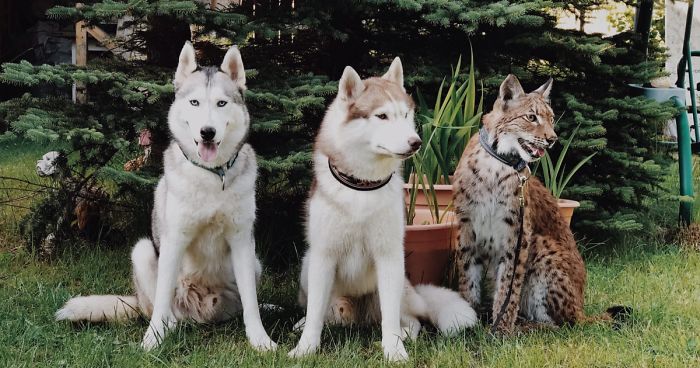
Some rescue stories include lynxes living around dogs, horses, or other animals. In rare, carefully managed cases, a young lynx may grow comfortable with certain dogs, especially calm animals introduced under supervision. But this should never be treated as a universal rule. A viral photo of a lynx cuddling a husky does not mean every lynx wants a dog roommate. Social media shows the cute second, not the months of supervision behind it.
Wild cats are usually solitary by nature. Even when two lynxes get along, that relationship depends on individual temperament, age, sex, space, health, and careful introductions. A pair may become inseparable, or they may need separate areas for safety. Responsible care means planning for both possibilities.
Horses and lynxes can sometimes exist near each other with barriers and supervision, but again, this is not casual backyard pet mixing. Large animals can injure each other accidentally. Predators can trigger prey responses. Prey animals can panic. The safest approach is always controlled distance, secure fencing, and professional guidance.
The Legal Side of Owning or Rescuing a Lynx
Anyone inspired by a lynx rescue story should pause before searching “lynx for sale,” which is a phrase that should probably trigger a fire alarm. Laws around wild cat ownership vary widely by country, state, province, and city. In the United States, federal law strictly regulates certain big cats, and state laws may ban or restrict private possession of lynxes, bobcats, servals, caracals, and other wild felines.
Even where ownership is technically legal, permits, inspections, enclosure standards, veterinary documentation, zoning rules, and insurance requirements may apply. Some places allow licensed sanctuaries or educational facilities to keep wild cats but prohibit private pet ownership. Others ban possession entirely. The legal landscape can change, so responsible rescuers must check current rules before taking action.
The ethical question is just as important as the legal one. A person may be legally allowed to keep a lynx and still be completely unprepared to meet its needs. Rescue should never become a loophole for collecting exotic animals. The goal must be the animal’s welfare, not the human’s desire for unusual content, attention, or the world’s most intimidating lap cat.
Why “Rescue” Does Not Mean “Pet”
One of the biggest misunderstandings around exotic animal rescue is the idea that saving an animal automatically makes it a pet. A rescued lynx may become comfortable with certain people, but it remains a wild animal. Domestication is not the same as taming. Domestic cats developed over thousands of years alongside humans. A lynx raised by a person is still only one generation away from the forest.
That difference matters. Domestic cats have adapted to human homes, human schedules, and human nonsense. Lynxes have not. They need more space, stronger enrichment, specialized diets, and handlers who can read wild feline body language. They may spray, scratch, chew, leap, pace, hide food, guard resources, or react unpredictably to stress.
A good rescue story should inspire compassion, not imitation. The lesson is not “everyone should live with lynxes.” The lesson is “wild animals deserve lives beyond cages, coats, and careless ownership.”
The Emotional Reality: Love With Limits
Living with rescued lynxes can be emotionally intense. There is joy in watching a frightened animal become curious. There is pride in seeing a rescued cub grow strong. There is comedy in discovering that a wild cat can be both majestic and deeply ridiculous, especially when it attacks a toy with the seriousness of a military operation.
But there is also worry. Health issues can be expensive and hard to treat. Exotic veterinarians may be far away. Travel becomes complicated. Visitors must be managed. Enclosures require maintenance. Emergencies require plans. A rescued lynx is not a weekend hobby; it is a long-term responsibility measured in years.
Real love for a wild animal includes accepting limits. It means not forcing cuddles for photos. It means saying no to visitors who want dangerous interactions. It means building better enclosures before buying better cameras. It means understanding that the animal’s needs come first, even when those needs are inconvenient, expensive, or not very Instagram-friendly.
What Responsible Lynx Care Looks Like
Responsible care starts with proper space. A lynx needs secure indoor and outdoor areas, climbing structures, hiding spots, weather protection, and enrichment. The enclosure must prevent escape and protect the animal from outside threats. It should also allow natural behaviors instead of simply containing the cat like a decorative prisoner.
Nutrition is another major pillar. Lynxes are carnivores, and feeding them is not as simple as opening a can of supermarket cat food. A balanced diet may require whole prey, raw meat, bones, organs, vitamins, minerals, and guidance from veterinarians or exotic carnivore nutrition specialists. Poor nutrition can lead to bone disease, organ problems, dental issues, and immune weakness.
Veterinary care must be planned in advance. Not every veterinarian can safely treat a lynx. Handling may require sedation. Transport must be secure. Preventive care, parasite control, vaccinations where appropriate, injury treatment, and dental exams all matter.
Finally, responsible care includes an exit plan. What happens if the owner becomes ill, loses housing, faces legal changes, or cannot afford care? Accredited sanctuaries are often already full. A wild cat should never be placed in danger because someone failed to plan beyond the cute cub stage.
What This Rescue Story Teaches Us About Fur and Fashion
The story of two lynxes rescued from a fur farm also raises a larger question: why should any animal live and die for a coat? Modern consumers increasingly reject real fur because the cost to animals is impossible to ignore. Fashion has alternatives. Animals have only one life.
Fur farming often hides behind distance. People see finished garments, not the animals behind them. Rescue stories make that invisible life visible. A lynx is not a trim, a collar, or a luxury detail. It is a breathing predator with preferences, fear, curiosity, and a very strong opinion about dinner.
Choosing fur-free fashion, supporting legitimate sanctuaries, and sharing accurate information can help reduce demand. Not everyone can rescue a wild animal, and frankly, not everyone should. But everyone can make choices that reduce suffering.
Should Anyone Adopt a Lynx?
In almost every ordinary situation, the answer is no. A lynx is not an upgrade from a Maine Coon. It is not a conversation piece. It is not a “spicy cat” for people bored with normal pets. The best home for a wild cat is the wild. When that is not possible because the animal was captive-bred, injured, imprinted, or rescued from poor conditions, the next best option is usually a qualified sanctuary or licensed facility.
Private rescue may be possible in some regions under specific legal and welfare conditions, but it should be rare, carefully evaluated, and guided by experts. The person taking in the animal must have the money, land, permits, veterinary access, emergency plans, and experience required. Love alone is not enough. Love is lovely, but it does not build fencing, pay medical bills, or stop a lynx from redecorating your house with claw marks.
Additional Experiences: What Life With Two Rescued Lynxes Really Feels Like
The longer you live around rescued lynxes, the more you understand that every day is a negotiation between affection and instinct. Morning does not begin with a gentle alarm clock. It begins with sounds: paws moving, claws tapping, bodies stretching, and two intelligent predators reminding you that breakfast is not a suggestion. If domestic cats act like they own the house, lynxes act like they own the house, the forest behind it, the weather system above it, and possibly your soul.
One of the first lessons is that routine is everything. Feeding, cleaning, enrichment, inspection, and quiet time must happen consistently. Lynxes notice changes. Move a platform, change a scent, invite a new person, or delay a meal, and they may react immediately. Sometimes the reaction is curiosity. Sometimes it is suspicion. Sometimes it is the kind of stare that makes you apologize for things you did not do.
Another experience is learning how physical their world is. Lynxes do not simply enter a room; they occupy it. They climb, leap, rub, scent-mark, drag toys, hide food, and test surfaces. A toy that would entertain a house cat for a week may survive a lynx for four heroic minutes. Enrichment has to be durable, varied, and safe. Puzzle feeders, hanging scents, logs, platforms, bones, and supervised exploration can help keep their minds engaged.
Health care becomes a constant background concern. A small limp matters. A change in appetite matters. A shift in behavior matters. Because wild cats often hide weakness, caregivers must become detectives. You learn the normal rhythm of each animal: how they walk, how they eat, how they rest, how they greet you, and how they behave when something feels wrong. The relationship becomes less about command and more about observation.
There are funny moments too. Lynxes can be dignified one second and completely ridiculous the next. They may stalk a feather toy as if it owes them money. They may purr with shocking volume. They may squeeze into places that do not match their body size, proving that all cats, wild or domestic, share a mysterious belief in liquid physics. Watching two rescued lynxes nap together can feel like witnessing peace itself, only with whiskers and murder mittens.
But the most meaningful experience is seeing trust develop. A rescued animal does not owe humans affection. When a lynx chooses to relax near you, accept food calmly, respond to its name, or approach without fear, it feels earned. That trust is not ownership. It is a fragile agreement. You provide safety, food, space, respect, and care. The lynx provides presence, personality, and the daily reminder that wildness is not something humans should try to erase.
Living with two lynxes from a fur farm is not a fairy tale, even if it looks magical from the outside. It is work, responsibility, sacrifice, and humility. It is also a powerful reminder that animals bred for profit are still individuals. They have names, preferences, fears, habits, and the ability to surprise us. Their lives matter far beyond what any industry assigns to their fur.
Conclusion: A Rescue Story With a Bigger Message
Adopting two lynxes from a fur farm is an extraordinary story, but its real value is not the novelty of living with wild cats. The real value is what it reveals about compassion, responsibility, and the hidden lives of animals used by the fur trade. These lynxes were not accessories. They were not products. They were living beings who deserved safety, medical care, space, and dignity.
The image of two rescued lynxes playing, purring, and growing strong is heartwarming, but it should also make us think carefully. Wild animals do not belong in fashion supply chains. They do not belong in careless private ownership. When rescue is necessary, it must be done with knowledge, resources, legal compliance, and lifelong commitment.
In the end, the best rescue stories are not about humans becoming heroes. They are about animals finally getting the chance to live as more than someone else’s profit. And if those animals happen to have giant paws, dramatic ear tufts, and the ability to make your sofa look very small, well, that is just part of the adventure.