Numbers are everywhere: on receipts, homework pages, science charts, bank statements, sports stats, and that one “estimated delivery time” that keeps changing like it has a dramatic personality. To understand numbers clearly, you need to know how to write them in standard form.
In everyday American math, standard form usually means writing a number using digits, such as 4,582 instead of “four thousand five hundred eighty-two” or 4,000 + 500 + 80 + 2. In higher-level math and science, people sometimes use the phrase “standard form” to mean a number written in scientific notation, such as 4.582 × 10³. That sounds confusing at first, but do not panic. Math has a talent for using one phrase in two slightly different ways, because apparently one definition was too peaceful.
This guide explains both meanings clearly, with step-by-step examples, place value tips, decimal examples, scientific notation examples, common mistakes, and real-world practice. By the end, you will know how to write numbers in standard form without treating commas and decimal points like tiny emotional obstacles.
What Is Standard Form in Math?
Standard form is the usual way of writing a number with numerals. It is the form most people recognize immediately.
Example:
Word form: seven thousand three hundred twenty-one
Expanded form: 7,000 + 300 + 20 + 1
Standard form: 7,321
Standard form is useful because it is short, clear, and easy to compare. Instead of reading a long written phrase or adding expanded parts, you can see the number at a glance.
For younger students, standard form is usually taught alongside word form and expanded form. For older students, standard form may also appear when converting from scientific notation back into ordinary decimal notation.
Standard Form vs. Word Form vs. Expanded Form
Before learning how to write numbers in standard form, it helps to understand the three main ways numbers are commonly shown.
1. Standard Form
Standard form uses digits.
Example: 12,406
2. Word Form
Word form spells out the number in words.
Example: twelve thousand four hundred six
3. Expanded Form
Expanded form breaks the number into the value of each digit.
Example: 10,000 + 2,000 + 400 + 6
Think of standard form as the finished sandwich, word form as the menu description, and expanded form as the ingredients spread across the kitchen counter. All three describe the same number, but standard form is usually the cleanest way to write it.
How Place Value Helps You Write Numbers in Standard Form
Place value is the backbone of standard form. Every digit in a number has a value based on its position. In the number 58,294, each digit has a different job:
- 5 is in the ten-thousands place, so it means 50,000.
- 8 is in the thousands place, so it means 8,000.
- 2 is in the hundreds place, so it means 200.
- 9 is in the tens place, so it means 90.
- 4 is in the ones place, so it means 4.
When you combine those values, you get:
50,000 + 8,000 + 200 + 90 + 4 = 58,294
That final number, 58,294, is the standard form.
How to Write a Number in Standard Form from Word Form
To convert from word form to standard form, read the number by groups. In American English, large numbers are often grouped by thousands, millions, billions, and so on.
Step-by-Step Method
- Find the largest place value named in the phrase.
- Write each group of numbers in order.
- Use commas to separate thousands, millions, and billions.
- Make sure each group after the first has three digits when needed.
Example 1: Simple Whole Number
Word form: six hundred forty-two
Standard form: 642
Example 2: Thousands
Word form: twenty-five thousand nine hundred eight
Standard form: 25,908
The phrase “twenty-five thousand” gives us 25,000. The phrase “nine hundred eight” gives us 908. Together, they make 25,908.
Example 3: Millions
Word form: three million forty-two thousand sixteen
Standard form: 3,042,016
Notice that “forty-two thousand” becomes 042 in the middle group because each group after the first should contain three digits. Without the zero, the number would accidentally shrink into something else. Zeros may look like they are doing nothing, but in place value, they are holding the seats.
How to Write a Number in Standard Form from Expanded Form
Expanded form shows the value of each digit. To write it in standard form, combine the parts.
Example 1:
Expanded form: 5,000 + 300 + 20 + 9
Standard form: 5,329
Example 2:
Expanded form: 80,000 + 4,000 + 600 + 70 + 2
Standard form: 84,672
Example 3 with Missing Places:
Expanded form: 40,000 + 900 + 8
Standard form: 40,908
This example is a favorite hiding spot for mistakes. There is no thousands value and no tens value, so we need zeros in those places. The number is not 4,908 and not 49,8, because math is not a freestyle dance competition. The correct standard form is 40,908.
How to Write Decimals in Standard Form
Decimals can also be written in standard form. The key is understanding places to the right of the decimal point.
To the left of the decimal, places get larger: ones, tens, hundreds, thousands. To the right of the decimal, places get smaller: tenths, hundredths, thousandths, ten-thousandths, and so on.
Example 1:
Word form: four and seven tenths
Standard form: 4.7
Example 2:
Word form: twelve and thirty-five hundredths
Standard form: 12.35
Example 3:
Word form: six and nine thousandths
Standard form: 6.009
The word “thousandths” means there must be three decimal places. Since the number is nine thousandths, we write .009, not .9. The zeros are not decorations. They tell us exactly where the 9 belongs.
How to Write Numbers in Standard Form from Scientific Notation
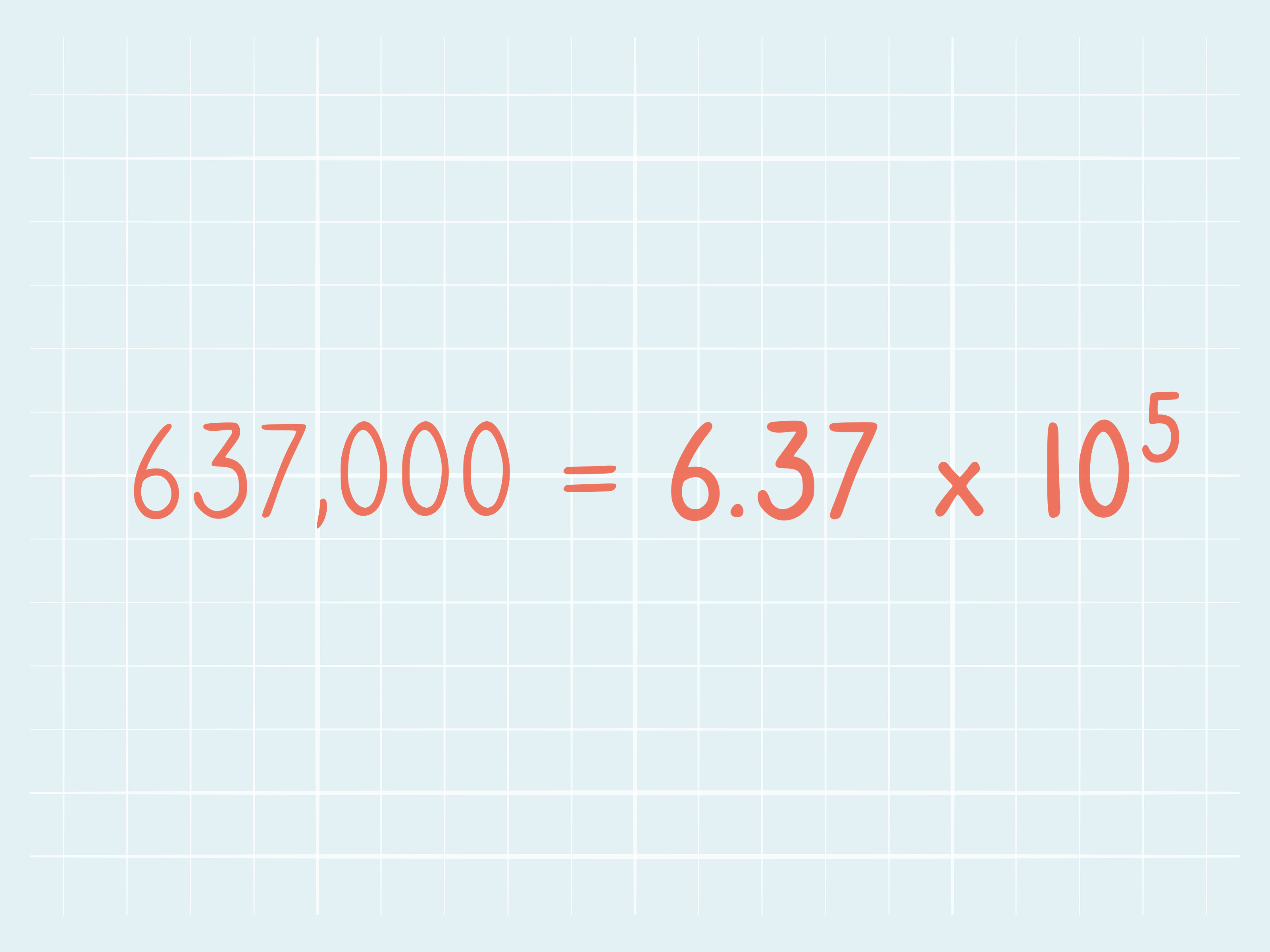
In science and advanced math, standard form often means the ordinary decimal version of a number written in scientific notation. Scientific notation expresses very large or very small numbers using a number multiplied by a power of 10.
Scientific notation format: a × 10n
The number a is usually at least 1 but less than 10, and n is an integer. For example:
4.2 × 10⁵
To convert this to standard form, use the exponent to move the decimal point.
Positive Exponents
If the exponent is positive, move the decimal point to the right.
Example: 4.2 × 10⁵
Move the decimal 5 places to the right:
4.2 → 420,000
Standard form: 420,000
Negative Exponents
If the exponent is negative, move the decimal point to the left.
Example: 6.3 × 10⁻⁴
Move the decimal 4 places to the left:
6.3 → 0.00063
Standard form: 0.00063
More Scientific Notation to Standard Form Examples
| Scientific Notation | Decimal Movement | Standard Form |
|---|---|---|
| 3.5 × 10³ | Move right 3 places | 3,500 |
| 8.91 × 10⁶ | Move right 6 places | 8,910,000 |
| 2.04 × 10² | Move right 2 places | 204 |
| 7.1 × 10⁻³ | Move left 3 places | 0.0071 |
| 9.8 × 10⁻⁵ | Move left 5 places | 0.000098 |
How to Write Standard Form from a Place Value Chart
A place value chart is one of the easiest tools for writing numbers in standard form. It gives every digit a labeled home, which is helpful because digits, like people at a crowded airport, get confused when no one tells them where to stand.
Suppose a chart shows:
- Millions: 2
- Hundred thousands: 4
- Ten thousands: 0
- Thousands: 7
- Hundreds: 3
- Tens: 0
- Ones: 5
Write the digits in order:
2,407,305
That is the standard form. The zeros are necessary because they show that there are no ten-thousands and no tens in the number.
Common Mistakes When Writing Numbers in Standard Form
Mistake 1: Leaving Out Zeros
Word form: four thousand six
Incorrect: 46
Correct: 4,006
The zeros hold the hundreds and tens places.
Mistake 2: Putting Commas in the Wrong Place
Incorrect: 12,34,567
Correct in U.S. style: 1,234,567
In standard American English, commas separate numbers into groups of three from the right.
Mistake 3: Confusing Tenths and Hundredths
Word form: five and six hundredths
Incorrect: 5.6
Correct: 5.06
Six hundredths means 6 in the hundredths place, not the tenths place.
Mistake 4: Moving the Decimal the Wrong Way in Scientific Notation
3.2 × 10⁻⁴ becomes 0.00032, not 32,000. Negative exponents move the decimal left.
Practice Problems: Write Each Number in Standard Form
Problem 1
Word form: nine hundred fifteen
Answer: 915
Problem 2
Expanded form: 60,000 + 2,000 + 500 + 30 + 4
Answer: 62,534
Problem 3
Word form: one million eight thousand twelve
Answer: 1,008,012
Problem 4
Scientific notation: 5.67 × 10⁴
Answer: 56,700
Problem 5
Scientific notation: 4.9 × 10⁻³
Answer: 0.0049
Why Standard Form Matters in Real Life
Standard form is not just a classroom skill. It appears constantly in real life. You use it when reading prices, measurements, population numbers, account balances, distances, test scores, and scientific data. If you work with spreadsheets, budgets, coding, engineering, medicine, chemistry, or finance, standard form helps keep numbers readable and precise.
For example, a city population written as 1,250,000 is easier to scan than “one million two hundred fifty thousand.” A tiny measurement like 0.0000045 meters may be easier to understand in scientific notation, but you still need to know how to convert it back into standard decimal form.
Standard form also helps prevent mistakes. A missing zero in a bank transfer, medicine dosage, lab result, or engineering measurement can create a serious problem. Math teachers are not being dramatic when they care about place value. Well, maybe a tiny bit dramatic, but they have a point.
Tips for Learning How to Write Numbers in Standard Form
- Read numbers in groups of three. This helps with thousands, millions, and billions.
- Use a place value chart. It keeps digits organized.
- Do not ignore zeros. Zeros often hold important places.
- Check decimal words carefully. Tenths, hundredths, and thousandths are different.
- For scientific notation, follow the exponent. Positive moves right; negative moves left.
- Say the number out loud. If it sounds different from the original, check your work.
Experience-Based Learning: What Actually Helps Students Master Standard Form
From working through standard form examples with learners, one pattern becomes clear: students usually do not struggle because the idea is too hard. They struggle because numbers look simple until one sneaky zero walks into the room and starts rearranging furniture. The best way to learn standard form is to slow down and treat every digit as meaningful.
One helpful experience is using real numbers from daily life instead of only textbook examples. A grocery receipt, for instance, can show decimals in prices. A sports article can show large numbers like attendance figures or player salaries. A science article can show tiny measurements or enormous distances. When students see that standard form is not just “math homework language,” the concept becomes more practical.
Another useful habit is reading numbers aloud before writing them. For example, if the phrase is “two million six hundred three,” saying it slowly helps reveal the structure: two million, zero thousands, six hundred three. That becomes 2,000,603. Many mistakes happen because students rush from words to digits without noticing the missing groups. Reading aloud forces the brain to hear the place values.
Expanded form is also a powerful bridge. If someone cannot immediately write “four hundred seventy-two thousand thirty-one” in standard form, they can first write 400,000 + 70,000 + 2,000 + 30 + 1. Then it becomes much easier to combine the parts into 472,031. This step may feel longer, but it builds confidence. It is like using training wheels, except the bicycle is made of commas.
For decimals, visual spacing helps. Writing place labels above the digits can prevent confusion between 0.6, 0.06, and 0.006. These numbers may look similar, but they are very different. Six tenths is much larger than six thousandths. A small decimal point can change everything, which is why decimals deserve respect, even when they look tiny and harmless.
Scientific notation becomes easier when learners stop memorizing and start visualizing. A positive exponent means the number is getting larger, so the decimal moves right. A negative exponent means the number is getting smaller, so the decimal moves left. For example, 7.4 × 10³ becomes 7,400, while 7.4 × 10⁻³ becomes 0.0074. Same 7.4, totally different destination. The exponent is basically the GPS.
The biggest lesson from practice is this: standard form rewards patience. Students who pause to check place value, commas, zeros, and decimals usually improve quickly. It is not about being a “math person.” It is about building a reliable process. Once that process becomes familiar, writing numbers in standard form feels less like decoding a secret message and more like organizing a very well-behaved line of digits.
Conclusion
Learning how to write numbers in standard form is one of the most useful math skills you can build. It helps you turn word form, expanded form, decimals, and scientific notation into clear, readable numbers. Whether you are writing 6,405, 0.009, or 430,000,000, the same core idea applies: understand place value, keep digits in the right positions, and let zeros do their quiet but important work.
Standard form makes numbers easier to compare, calculate, communicate, and use in real life. Once you understand the pattern, numbers become far less intimidating. They may still look serious in a spreadsheet, but now you know their tricks.