Learning how to wakeboard as a beginner can feel like trying to stand up on a dinner tray while a speedboat politely kidnaps you across a lake. The good news? Wakeboarding is much easier when you understand the basics before you jump in: the right gear, the correct body position, a patient driver, and one very important ruledo not try to muscle your way out of the water like a superhero exiting a swimming pool.
Wakeboarding combines pieces of snowboarding, surfing, and water skiing, but it has its own rhythm. Your job is not to fight the boat. Your job is to let the boat do the work while you stay compact, relaxed, and balanced. Once that clicks, the sport becomes less mysterious and a lot more addictive.
This beginner guide walks you through the essential wakeboarding tips, safety rules, stance setup, deep-water start technique, common mistakes, and first-session practice goals. By the end, you will know how to prepare, how to get up on a wakeboard, and how to avoid the classic beginner face-plant that makes everyone on the boat say, “Ooooh,” while pretending not to laugh.
What Is Wakeboarding?
Wakeboarding is a tow sport where the rider stands sideways on a wakeboard while being pulled by a boat or cable system. For beginners, boat wakeboarding is the most common introduction. The boat creates a wake, and as your skills grow, that wake becomes your playground for carving, crossing, jumping, and eventually learning tricks.
Unlike water skiing, both feet are attached to one board. Unlike surfing, you are not waiting for waves. Unlike snowboarding, the mountain does not close at 4 p.m.although your arms may file a complaint much earlier.
Essential Wakeboarding Gear for Beginners
Wakeboard
A beginner wakeboard should be forgiving, stable, and matched to your weight. Wider boards and continuous rocker shapes are often easier for new riders because they help with smooth starts and predictable turns. Avoid choosing an advanced board too soon. A pro-level board may look cool, but if it is too aggressive, it can make learning feel like negotiating with an angry alligator.
Bindings
Bindings should fit snugly without cutting off circulation. Open-toe bindings are popular for families or shared boards because they fit a range of shoe sizes. Closed-toe bindings offer more support and control but are usually sized more specifically. For a beginner setup, place the bindings slightly wider than shoulder width with the toes angled outward in a comfortable duck stance.
Life Jacket
A U.S. Coast Guard-approved life jacket is non-negotiable. Choose one designed for watersports, make sure it fits tightly, and wear it every ride. A loose life jacket can ride up when you fall, which is both unsafe and deeply annoying. Think of your life jacket as your best friend: supportive, buoyant, and not impressed by excuses.
Tow Rope and Handle
Wakeboard ropes are designed with minimal stretch, giving riders a more consistent pull. Beginners often do well with a shorter rope because it places them in a cleaner and narrower part of the wake. A starting range around 55 to 65 feet is common, depending on the boat and rider comfort.
Helmet for Cable Parks or Obstacles
If you are wakeboarding at a cable park, especially around ramps or rails, wear a helmet. For boat wakeboarding in open water, helmet use depends on the situation, local rules, and personal comfort. When in doubt, choose safety over style. Nobody ever regretted protecting their brain.
Safety First: Before You Start Wakeboarding
Wakeboarding is fun, but it happens behind a moving boat, so safety matters. Make sure there is a sober, experienced driver and a spotter watching the rider. The driver should accelerate smoothly and avoid sudden jerks. The spotter should keep eyes on the rider, communicate falls, and help manage the rope.
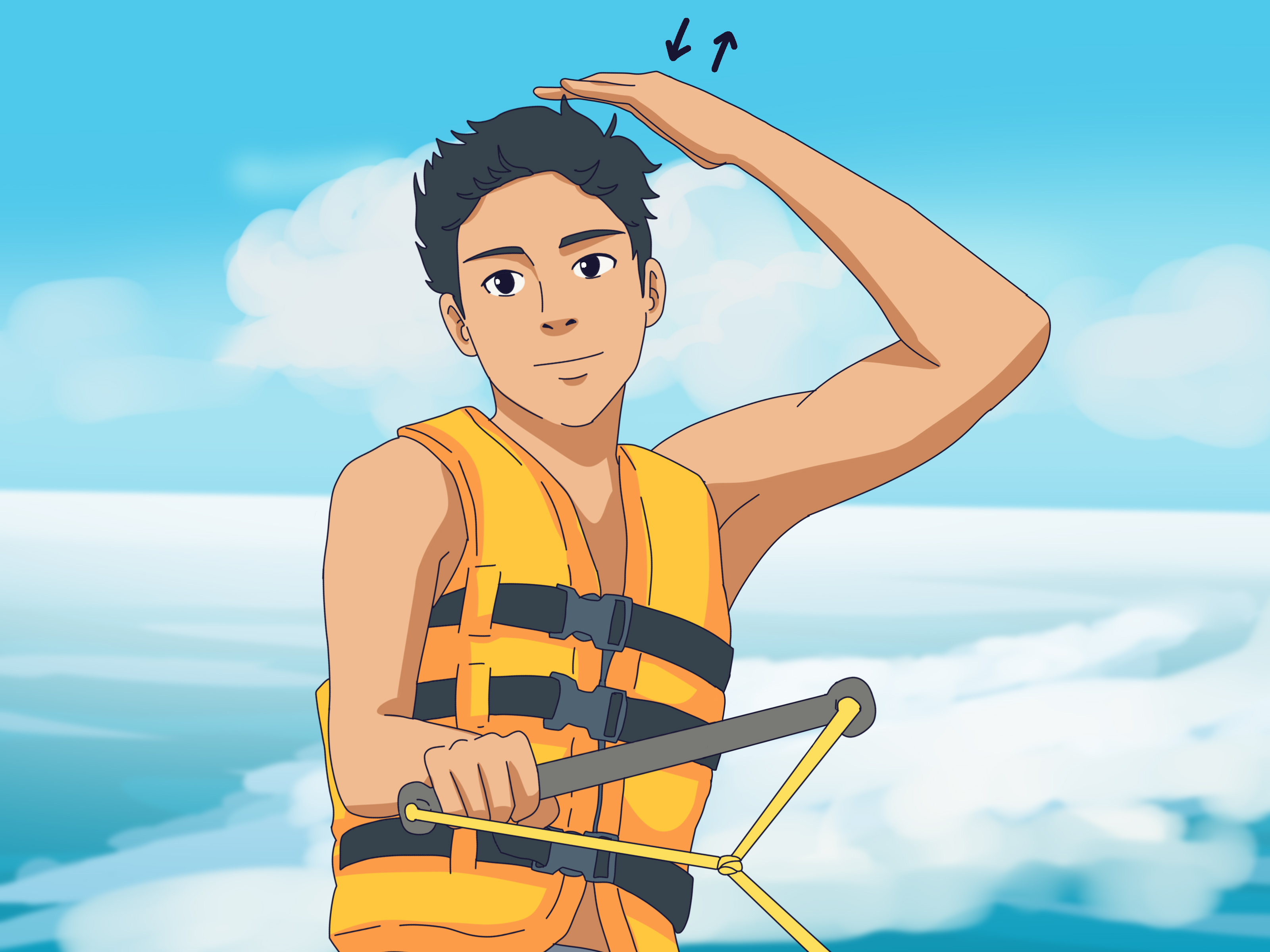
Always check local boating laws, water conditions, and traffic. Avoid shallow areas, docks, swimmers, rocks, and crowded zones. Never ride after dark or in poor visibility. Before starting, agree on basic hand signals for “faster,” “slower,” “stop,” and “I’m okay.” Shouting over engine noise rarely works, and dramatic waving can be misinterpreted as either “slow down” or “there is a dragon behind me.”
How to Set Up Your Wakeboard Stance
Your stance determines how natural the board feels under your feet. Most riders are either regular-footed, with the left foot forward, or goofy-footed, with the right foot forward. If you skateboard, snowboard, or surf, use the same lead foot. If not, try this simple test: have someone gently nudge you from behind while you stand relaxed. The foot you step forward with is often your natural lead foot.
For your first session, keep the bindings centered and symmetrical. A duck stance, where both feet angle slightly outward, helps your knees track naturally and makes it easier to ride in either direction. Do not set the stance too narrow; a wider stance creates stability. Do not set it painfully wide either; you are wakeboarding, not auditioning for a cowboy movie.
Beginner Boat Speed and Rope Length
Boat speed should be comfortable, controlled, and appropriate for the rider. Many beginners start in the slower range, often around 15 to 18 mph, while more comfortable beginners may ride closer to 18 to 21 mph. The exact number depends on rider size, board size, boat wake, and water conditions.
The goal is not to go fast. The goal is to create enough speed for the board to plane smoothly on top of the water. Too slow, and the board may drag or feel unstable. Too fast, and falls become more intimidating. A patient driver should gradually adjust speed based on the rider’s feedback.
For rope length, many new riders start around 55 to 65 feet. A shorter rope can make the wake easier to manage and keeps the rider closer to the boat, where communication is simpler. As you improve, you can experiment with longer rope lengths and slightly faster speeds.
How to Get Up on a Wakeboard
Step 1: Start in the Water
Float on your back with the wakeboard in front of you. The board should be sideways to the boat, with the bottom of the board facing the boat. Bend your knees and bring them close to your chest. Keep your arms straight, with the handle held low near your front hip or knees.
Step 2: Stay Small and Relaxed
The biggest beginner mistake is trying to stand up too early. Instead, stay curled up like a happy little shrimp. Let your knees bend deeply and keep your body compact. The boat’s pull will gradually lift you onto the surface.
Step 3: Let the Boat Pull You
Do not pull the rope toward your chest. Do not straighten your legs immediately. Do not perform a heroic biceps curl against physics. Keep your arms straight and allow the boat to bring you forward. Your job is to stay patient while the board rises.
Step 4: Rotate Into Riding Position
Once the board begins to plane on top of the water, gently turn your lead hip and shoulder toward the boat. Pull the handle toward your lead hip. Your board will naturally shift from sideways to a forward riding stance. Keep your head up and look toward the boat, not down at your feet.
Step 5: Stand Slowly
As you gain balance, stand gradually. Keep your knees soft, chest up, and hips under your shoulders. Your weight should feel centered, with slightly more pressure on your back foot once you are riding. Think “athletic stance,” not “statue on a floating plank.”
Common Beginner Wakeboarding Mistakes
Standing Up Too Soon
This is the classic error. If you stand before the board planes, the water pushes against the board and you topple forward. Stay low until you feel the board glide.
Pulling With Your Arms
Wakeboarding is not a tug-of-war. Pulling the handle toward your body often throws you off balance. Keep your arms straight and relaxed.
Looking Down
Your body follows your eyes. If you stare at the board, you often fold at the waist and fall. Look toward the boat or the horizon.
Locking Your Knees
Straight legs make every bump feel bigger. Bent knees absorb movement and give you control. Soft knees are your suspension system.
Using the Wrong Speed
If the boat accelerates too aggressively, beginners get yanked forward. If it is too slow, the board may not rise cleanly. Smooth acceleration is the secret sauce.
Your First Riding Goals
Once you can get up consistently, focus on simple control rather than tricks. Practice riding in a straight line with your knees bent and handle low. Then try small heel-side and toe-side edges. Heel-side edging means leaning gently against your heels; toe-side edging means shifting pressure toward your toes.
Next, learn to cross the wake slowly. Start by moving outside the wake on your heel side, then return to the center. Keep your handle close to your front hip and use gradual pressure. Do not attack the wake like it owes you money. Smooth movement beats dramatic movement every time.
How to Fall the Right Way
Falling is part of wakeboarding. In fact, it is practically the cover charge. When you feel yourself losing balance, let go of the handle. Do not try to save every fall. Holding on too long can twist your body awkwardly or drag you through the water.
After falling, relax, float, and raise one hand to show the boat you are okay. Wait for the boat to circle back and keep your board visible. Never swim toward a moving boat unless the driver has clearly stopped and signaled that it is safe.
Beginner Wakeboarding Practice Plan
Session One: Learn the Start
Your first goal is not to ride for five minutes. Your first goal is to understand the deep-water start. Practice staying compact, keeping arms straight, and letting the boat pull you up. Even two or three successful starts are a great first day.
Session Two: Build Balance
Once you can get up, work on riding longer. Keep your posture tall but relaxed. Practice handle position, knee bend, and gentle edges.
Session Three: Cross the Wake
When you feel stable, start crossing the wake slowly. Begin with small movements. The wake may look intimidating, but at beginner speed it is simply a moving bump with a dramatic personality.
Session Four: Add Style and Control
After several sessions, experiment with carving wider outside the wake, changing edges, and riding switch for short distances. Do not rush tricks. Strong fundamentals make everything easier later.
Beginner Wakeboarding Tips That Actually Help
Take a lesson if you can. A good instructor can fix in five minutes what you might struggle with all afternoon. Use a beginner-friendly board, ride in calm water, and start early in the day before boat traffic creates chop.
Keep sets short. Wakeboarding uses muscles you may not know you own. If your grip is fading or your legs are shaking, take a break. Tired riders make sloppy decisions, and sloppy decisions create splashy consequences.
Also, communicate with your driver. A beginner needs smooth acceleration, steady speed, and patience. A great driver makes learning feel calm. A bad driver makes learning feel like being launched from a toaster.
What to Wear Wakeboarding
Wear a comfortable swimsuit or board shorts that stay secure. A rash guard can help prevent sunburn and irritation from the life jacket. In cooler water, wear a wetsuit. Use sunscreen, but avoid making your hands so slippery that the handle feels like a greased pickle.
Remove jewelry, secure long hair, and avoid loose items that can fly away during a fall. Bring water, snacks, towels, and a dry change of clothes. Wakeboarding is more fun when you are not cold, dehydrated, or hunting for a missing sandal.
How Long Does It Take to Learn Wakeboarding?
Some beginners get up on the first few tries. Others need several sessions. Both are normal. Your progress depends on fitness, comfort in the water, board setup, boat driver skill, and how well you resist the urge to stand too early.
The fastest learners usually stay relaxed and listen to instructions. They do not fight the rope, panic during the pull, or treat every fall as a personal insult. Wakeboarding rewards patience. The water is not judging you; it is simply waiting for you to bend your knees.
Beginner Experience Notes: What Wakeboarding Really Feels Like
The first time you try wakeboarding, expect a strange mix of excitement, confusion, and very wet humility. You may understand the instructions perfectly while sitting in the boat, then forget every single one the moment the rope tightens. That is normal. Your brain is busy processing water, speed, balance, noise, and the sudden realization that your arms are not in charge of the universe.
One of the most useful beginner experiences is learning to trust the pull. New riders often try to help the boat by standing, pulling, twisting, or kicking. Unfortunately, “helping” usually makes things worse. The moment you relax and let the boat lift you, the start becomes smoother. It almost feels too easy, which is why beginners sometimes overcorrect and fall anyway. The sweet spot is calm patience: knees bent, arms straight, handle low, eyes up.
Another real-life lesson is that your first successful ride may last only a few seconds, and it will still feel amazing. You pop onto the surface, the board begins to glide, and suddenly the lake stops being an opponent and becomes a runway. Then you might lean back too far, catch an edge, and disappear in a spectacular splash. Congratulationsyou are officially wakeboarding.
Expect your muscles to feel it later. Wakeboarding uses your forearms, shoulders, core, hips, and legs. Beginners often grip the handle too tightly because they feel nervous. Try to relax your hands and keep the handle close to your lead hip. A death grip will tire you out quickly and make your riding stiff.
The best beginner sessions usually happen with supportive people in the boat. A calm driver, a helpful spotter, and friends who cheer more than they tease can make a huge difference. Falling is easier when the boat culture is fun and encouraging. If someone laughs, make sure they also clap when you get up. That is lake law, or at least it should be.
Keep your expectations simple. On day one, success might mean floating comfortably, setting up correctly, and getting halfway out of the water. On day two, success might mean riding for ten seconds. On day three, you may cross the wake for the first time and feel like you have unlocked a secret level of summer.
The biggest beginner breakthrough usually comes when you stop thinking of wakeboarding as “standing up” and start thinking of it as “being pulled into position.” You are not climbing out of the water. You are allowing the board to rise while you stay balanced over it. Once that idea clicks, your starts improve, your falls become less dramatic, and your confidence grows quickly.
Most importantly, enjoy the process. Wakeboarding is supposed to be fun. You will fall. You will swallow some lake water. You will make weird faces in photos. But you will also experience the unforgettable feeling of gliding across the water with the rope in your hands, the sun on your shoulders, and the boat wake rolling beside you. That first clean ride is worth every splash.
Conclusion
Learning how to wakeboard as a beginner is all about preparation, patience, and proper technique. Start with safe gear, a correctly fitted life jacket, a beginner-friendly wakeboard, and a driver who understands smooth acceleration. Set your stance comfortably, keep your knees bent, hold the handle low, and let the boat pull you up instead of fighting the rope.
The early stages are not about tricks or big air. They are about learning the deep-water start, riding with control, edging gently, and building confidence one attempt at a time. Stay relaxed, laugh at the falls, and celebrate the small wins. Before long, you will go from “How do I even get up?” to “Can I take one more set?” And that is the moment wakeboarding officially has you hooked.