Building a brand-new house with old materials sounds a little contradictory, like buying a new car and insisting that it come with your grandfather’s steering wheel. Yet when it is done thoughtfully, using salvaged building materials in new construction can create something that brand-new products often struggle to deliver: character, history, lower material consumption, and a genuinely one-of-a-kind finished space.
Salvaged materials can include reclaimed lumber, old brick, stone, doors, cabinets, flooring, structural timbers, hardware, plumbing fixtures, architectural trim, corrugated metal, and even components recovered from commercial buildings. Instead of being crushed, dumped, or recycled into lower-value products, these materials get another useful life.
The trick is understanding that salvage is not simply a shopping strategy. It affects design, scheduling, storage, engineering, code compliance, labor, and budgeting. Here is how to use reclaimed and salvaged building materials successfully without turning your construction site into an extremely expensive antique store.
Why Use Salvaged Materials in New Construction?
Construction and demolition generate an enormous stream of material in the United States. Reuse keeps useful products in circulation longer and can reduce demand for newly manufactured building products. Unlike recycling, which generally breaks materials down and processes them into something else, direct reuse preserves more of the original product and the work already invested in making it.
There are practical benefits, too. Locally salvaged products may reduce purchasing costs, although savings are never guaranteed because cleaning, transportation, refinishing, testing, and installation require labor. Reclaimed materials can also provide dimensions, species, craftsmanship, colors, and textures that are difficult to duplicate with modern mass-produced products.
Then there is the visual payoff. A new kitchen with one salvaged timber beam can suddenly feel established rather than freshly unboxed. Century-old brick can soften a contemporary exterior. Reclaimed oak flooring may contain knots, saw marks, nail holes, color variations, and other imperfections that designers politely call “patina” and homeowners eventually call “the reason everyone compliments the floor.”
Start With Salvage During the Design Phase
The biggest mistake is designing an entire building with standard dimensions and then attempting to squeeze salvaged materials into it afterward.
A better strategy is to identify significant reclaimed materials early enough for the architect, designer, engineer, and contractor to accommodate them.
Inventory Before You Design Around It
Create a detailed salvage inventory. Record:
- Material type
- Quantity
- Dimensions and thickness
- Condition
- Species or composition, when known
- Previous use
- Visible defects
- Required cleaning or refinishing
- Potential new application
If you have 700 square feet of reclaimed flooring, for example, do not design an 850-square-foot floor and hope optimism produces the missing boards. Salvaged products rarely come with unlimited matching inventory.
Allow extra material for cuts, damage, unusable pieces, and installation waste.
Design for Irregularity
New materials are manufactured to predictable dimensions. Old materials sometimes have other ideas.
Reclaimed boards may vary slightly in width and thickness. Salvaged doors may not match modern rough openings. Old bricks may vary in size. Antique hardware may require custom mounting.
Experienced designers treat those differences as design inputs instead of defects. A mixed-width reclaimed floor, for instance, can look intentional and beautiful. Trying to make every historic plank behave like factory-new flooring may create unnecessary cost and frustration.
Choose Salvaged Materials That Make Sense
Almost anything can theoretically be reused. That does not mean almost anything should be reused.
Reclaimed Lumber and Timber
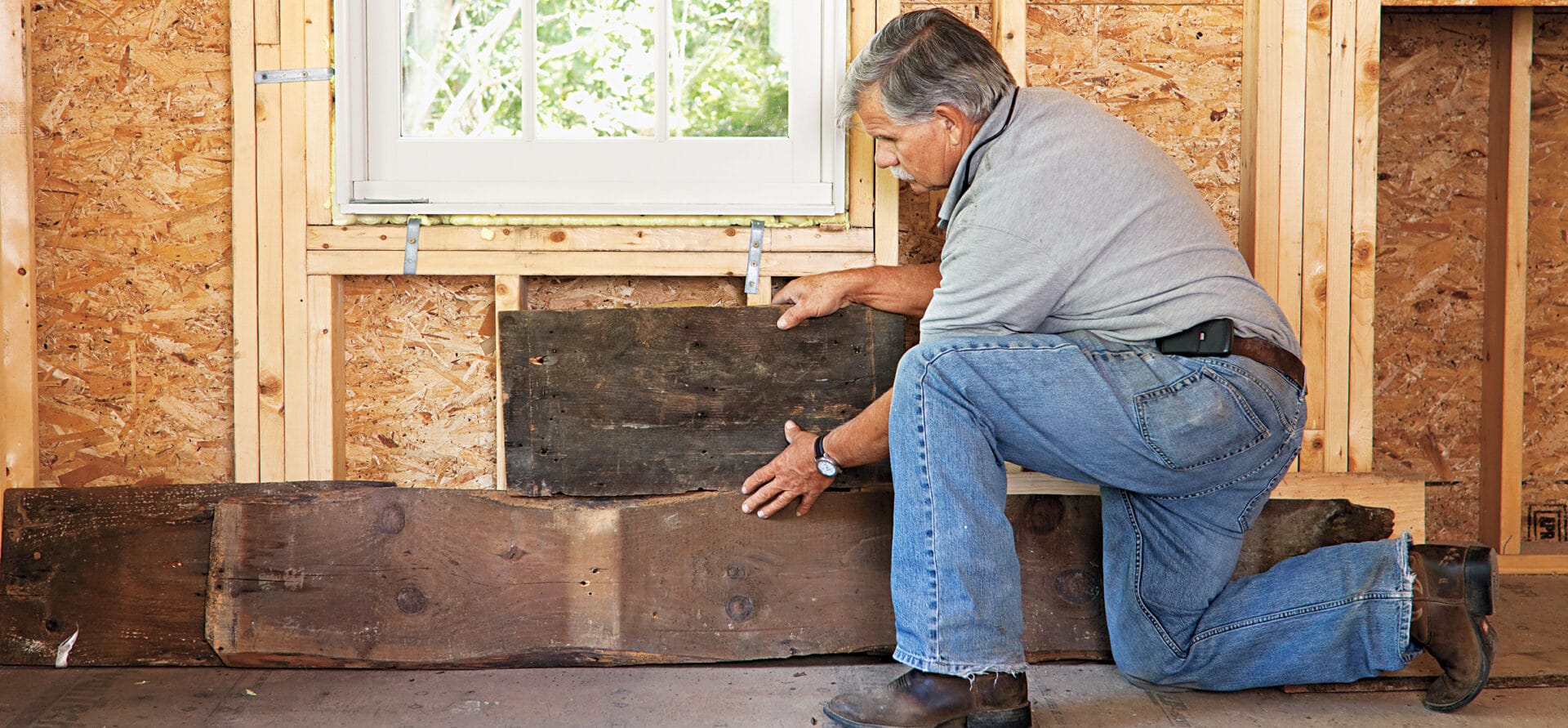
Old-growth lumber and heavy timber are among the most desirable salvaged building materials. They may come from barns, warehouses, factories, houses, bridges, or dismantled commercial structures.
Common applications include:
- Flooring
- Wall paneling
- Ceilings
- Stair components
- Furniture and cabinetry
- Decorative beams
- Structural framing when properly evaluated
Structural reuse requires much greater care than decorative reuse. A reclaimed beam may look impressive while concealing checks, rot, insect damage, previous fastener holes, or unknown grading characteristics. Structural components may therefore need evaluation by an engineer, grading professional, testing agency, or building official depending on the project and jurisdiction.
For decorative applications, requirements are usually less complicated, but moisture content, insects, embedded metal, coatings, and stability still matter.
Brick and Stone
Salvaged masonry can give new construction instant depth and texture. Old brick works particularly well for fireplaces, interior feature walls, patios, landscape features, and selected exterior applications.
However, bricks manufactured for interior use or older soft bricks may not perform well when exposed to freeze-thaw cycles or severe weather. Mortar residue must also be removed carefully without damaging the units.
Natural stone is often more forgiving. Reclaimed limestone, granite, slate, and fieldstone can be excellent choices for walls, hearths, paving, landscaping, and architectural accents when their condition is appropriate.
Doors and Architectural Millwork
Old solid-wood doors are salvage-store celebrities for good reason. They can be beautifully made and dramatically heavier than many inexpensive modern doors.
Before committing, verify the width, height, thickness, swing, hinge locations, condition, and required hardware. Exterior doors must also satisfy the performance demands of their new location.
Interior doors offer more flexibility and can become closet doors, pantry entrances, pocket doors, sliding doors, headboards, or decorative wall panels.
Salvaged baseboards, mantels, columns, brackets, and moldings are similarly useful when dimensions are documented early.
Cabinets and Casework
Kitchen cabinets are frequently removed during remodeling even when the boxes remain perfectly usable.
Reusing cabinets successfully requires accurate measurements and a layout flexible enough to accept fixed cabinet sizes. Sometimes the best strategy is not to recreate an entire kitchen from salvaged cabinets but to use them in a laundry room, workshop, pantry, garage, mudroom, or basement.
A fresh finish, new hardware, and a new countertop can transform them dramatically.
Metal Components
Steel beams, railings, gates, corrugated panels, grates, and architectural metalwork can all have second lives.
Decorative metal is comparatively straightforward. Structural steel requires identification, inspection, engineering, connection design, and potentially testing before reuse.
Rust is not automatically a death sentence. Surface oxidation can sometimes be cleaned and treated. Significant section loss, deformation, cracks, or unknown structural characteristics deserve professional evaluation.
Know the Difference Between Salvage, Reuse, and Recycling
These terms often get tossed into the same sustainability soup, but they describe different strategies.
Salvage means carefully removing materials so they remain useful.
Reuse means installing a product again for the same or another useful purpose.
Recycling means processing material into a feedstock or new product.
Imagine an old wood floor. Carefully removing the boards and installing them in another house is reuse. Grinding unusable clean wood into another product is recycling. Sending everything directly to a landfill is the option you are generally trying to avoid.
Work With Your Building Department Early
Do not wait until inspection day to reveal that half your structure originally lived in a 1920s warehouse.
Building codes used across the United States can permit used materials when they satisfy requirements applicable to new materials, while reused equipment may require approval or testing. Actual requirements depend on the code adopted by your state or municipality.
Talk with the architect, engineer, contractor, and local building official before purchasing major structural salvage. Documentation might include photographs, dimensions, grading information, engineering calculations, testing results, provenance, or proposed installation details.
Nonstructural decorative materials are generally easier to integrate. Structural components, fire-rated assemblies, safety glazing, electrical equipment, plumbing fixtures, and mechanical equipment deserve considerably more scrutiny.
Inspect for Hazardous Materials Before Reuse
The romance of architectural salvage disappears rapidly when the vintage charm contains lead or asbestos.
Lead-Based Paint
Painted materials recovered from older buildings may contain lead-based coatings. Doors, windows, trim, siding, railings, cabinets, and painted hardware deserve particular attention.
Do not assume that sanding an old painted board until it looks rustic makes it safe. Disturbing lead-containing coatings can create hazardous dust. Appropriate testing and lead-safe work practices may be necessary.
Asbestos
Older buildings can contain asbestos in floor tiles, insulation, mastics, pipe insulation, roofing products, cement products, textured materials, and other components. Appearance alone cannot reliably determine whether a material contains asbestos.
Suspect materials should be evaluated appropriately before disturbance or reuse. In many circumstances, trained professionals and laboratory analysis are the appropriate route.
Other Contaminants
Depending on the source building, also consider mold, pesticides, oil, industrial chemicals, mercury-containing components, PCB-containing materials, and unknown coatings.
If you cannot identify where something came from, treat mystery as a reason for investigation, not as an exciting design feature.
Source Salvaged Building Materials Strategically
Good salvage rarely appears exactly when the construction schedule wants it.
Useful sources include architectural salvage yards, nonprofit reuse centers, deconstruction contractors, demolition projects, remodeling contractors, municipal reuse programs, auctions, reclaimed-lumber suppliers, and direct purchases from property owners.
Habitat for Humanity ReStore locations are one familiar U.S. source for donated building products, although inventory varies widely by store.
For large projects, direct deconstruction can be especially productive. Instead of waiting for useful material to reach a resale shop, a project team may identify items in a building scheduled for removal and carefully recover them beforehand.
The golden rule is simple: never assume inventory will still be there next month. Salvage is fundamentally a one-off marketplace.
Budget for the Entire Reuse Process
A salvaged beam that costs $300 is not necessarily a $300 beam.
Your true installed cost may include:
- Removal
- Loading
- Transportation
- Storage
- Cleaning
- De-nailing
- Metal detection
- Kiln treatment when needed
- Milling
- Grading or engineering
- Refinishing
- Custom installation
Sometimes reclaimed material costs less than a comparable premium new product. Sometimes it costs more. Its value may instead come from durability, historic character, avoided waste, or an appearance that cannot easily be purchased new.
Plan Storage Before Buying Anything
Nothing destroys a beautiful batch of reclaimed flooring faster than poor storage.
Wood should usually be protected from rain and ground moisture while maintaining appropriate airflow. Doors should be stored to reduce warping. Hardware needs labeling. Fragile masonry should be stacked safely. Components destined for particular rooms should be grouped and inventoried.
Label everything.
Six months into a build, “those brackets from the old school somewhere behind the stack of oak” is not an inventory management system.
Combine Salvage With New Materials
A successful reclaimed-material building does not need to look entirely old.
In fact, contrast often creates the best results.
Consider combining:
- Reclaimed timber with clean modern drywall
- Historic brick with contemporary steel
- Old flooring with minimalist cabinetry
- Salvaged doors with new high-performance wall assemblies
- Vintage hardware with modern electrical and plumbing systems
- Reclaimed wood ceilings with large modern windows
This strategy allows old materials to become visual focal points while new products handle applications requiring strict performance specifications.
Prioritize High-Impact Reuse
If your budget or schedule cannot support extensive salvage, concentrate your effort where it matters most.
A single major architectural element can define an entire room. Reclaimed beams, flooring, stair treads, brick walls, mantels, doors, or cabinetry often produce more visual value than dozens of tiny reused accessories.
You can also prioritize materials that require relatively little modification. A door that already fits is far more economical than one requiring reconstruction of the surrounding wall.
Design the New Building for Future Reuse
The circular approach should not end with materials rescued from previous buildings.
Design your new construction so its components can someday be repaired, adapted, removed, and reused again.
Strategies include mechanical fasteners instead of permanent adhesives where practical, accessible connections, standardized dimensions, replaceable components, documented assemblies, durable products, and avoiding unnecessary layers of inseparable materials.
In other words, build as though someone 80 years from now might want your materials. Give that future contractor a fighting chance.
Experience-Based Lessons From Salvaged-Material Projects
The most useful lesson from real-world material reuse is that flexibility beats perfection. Salvage almost always introduces surprises, and the teams that succeed are generally the ones willing to adjust the design rather than force every recovered component into a predetermined plan.
Experience Lesson 1: Buy the Important Salvage Early
If a reclaimed item controls dimensions, obtain it before construction reaches that part of the building.
Imagine designing a dramatic entrance around a pair of antique doors supposedly measuring 36 inches each. Framing is completed, drywall starts, and the doors finally arrive measuring 35 1/4 inches, with a slight taper and unusually thick stiles. Congratulations: your “money-saving salvage” has just introduced custom carpentry.
Having critical materials physically on site allows contractors to measure reality instead of relying on optimistic descriptions.
Experience Lesson 2: Sort First, Clean Second, Mill Third
Reclaimed lumber is frequently handled too many times. A better workflow is to sort pieces by species, dimension, quality, and planned use before spending money processing them.
Boards destined for wall paneling do not require the same preparation as flooring. Structural timbers require different evaluation than decorative beams.
Removing nails is especially important before milling. A hidden steel fastener and an expensive planer blade are natural enemies.
Experience Lesson 3: Expect More Labor Than You Think
Installing identical new boards is predictable. Installing 80-year-old boards with slight variations is craftsmanship.
That does not make salvage impractical. It simply means labor needs to be budgeted honestly. Material that costs almost nothing can become surprisingly expensive when every piece needs cleaning, trimming, sorting, patching, and fitting.
This is why reclaimed material works best when its unique value justifies the extra effort.
Experience Lesson 4: Mockups Prevent Expensive Regrets
Before installing hundreds of square feet of reclaimed brick or wood, build a sample.
Test cleaning techniques, finish colors, joint sizes, board combinations, sealers, and installation patterns.
A finish that looks fantastic on freshly sanded wood may emphasize stains or nail marks differently after curing. Reclaimed brick may change dramatically after mortar is introduced.
A small mockup allows everyone to agree on what “beautifully imperfect” actually means before 1,000 square feet of it appears.
Experience Lesson 5: Do Not Erase All the History
People sometimes spend considerable money buying reclaimed material and then spend even more money making it look completely new.
Cleaning and stabilizing are important, but not every nail hole, saw mark, color variation, or weathered edge needs to disappear.
Those traces are precisely what differentiate genuine architectural salvage from factory-made products designed to imitate it.
Experience Lesson 6: Know When to Walk Away
Successful salvage involves rejecting material, too.
A component should not be reused merely because it is old. Extensive rot, contamination, major structural damage, unsuitable performance characteristics, or excessive restoration requirements can make a material a poor choice.
Reuse should extend the useful life of good materials, not create heroic new careers for products that were ready to retire.
Experience Lesson 7: Keep the Story
If provenance is known, document it.
A dining table made from anonymous old lumber is attractive. A dining table made from beams recovered from a neighborhood warehouse built in 1910 carries an additional story.
Photograph the source building, save relevant records, label unusual components, and give future owners a simple material history. The emotional connection created by that story is one reason salvaged building materials can become the most memorable pieces in a new home.
Conclusion: Make Old Materials Part of a Better New Building
Learning how to use salvaged building materials in new construction begins with a shift in thinking. Old buildings are not automatically piles of waste waiting for demolition. They can also be inventories of lumber, masonry, metal, doors, flooring, fixtures, hardware, and craftsmanship waiting for another useful life.
The best projects identify salvage early, evaluate condition carefully, involve building officials and engineers when necessary, account for hazardous materials, budget for processing and installation, and design around the realities of recovered components.
You do not need to construct an entire house from rescued materials to make reuse worthwhile. One reclaimed floor, a collection of old-growth beams, a carefully restored front door, or a wall of salvaged brick can preserve resources while giving new construction something increasingly difficult to manufacture: a believable past.
And if somebody asks why your brand-new house contains a door older than their grandparents, consider that a design victory.
Note: This article synthesizes current U.S. guidance and professional practices related to construction and demolition material reuse, deconstruction, building codes, hazardous-material awareness, green building, and reclaimed-material construction. Requirements vary by state and municipality, so structural and regulated materials should always be evaluated under applicable local codes and professional guidance.