Note: This article describes a science-based thought experiment, not a survivable travel plan. No known technology can carry a person safely into a black hole, and crossing an event horizon is irreversible. “Safely” therefore means minimizing hazards and extending survival for as long as established physics allows.
Jumping into a black hole sounds wonderfully simple. Point the spaceship toward the darkest object available, fasten every seat belt, and allow gravity to handle the driving. Unfortunately, the universe has hidden several alarming details in the fine print.
A black hole is not a cosmic drain that automatically vacuums up everything nearby. From a sufficient distance, its gravity behaves like that of any other object with the same mass. A spacecraft could orbit a black hole just as planets orbit stars. The real trouble begins when the craft approaches the event horizonthe boundary beyond which no signal, traveler, or strongly worded complaint can return.
There is no completely safe way to enter a black hole. However, a carefully designed hypothetical mission could avoid the worst radiation, choose a black hole with relatively gentle tidal forces, and permit an astronaut to cross the event horizon alive. Survival after that would be temporary, but in black-hole tourism, temporary is the deluxe package.
First, Understand What You Are Jumping Into
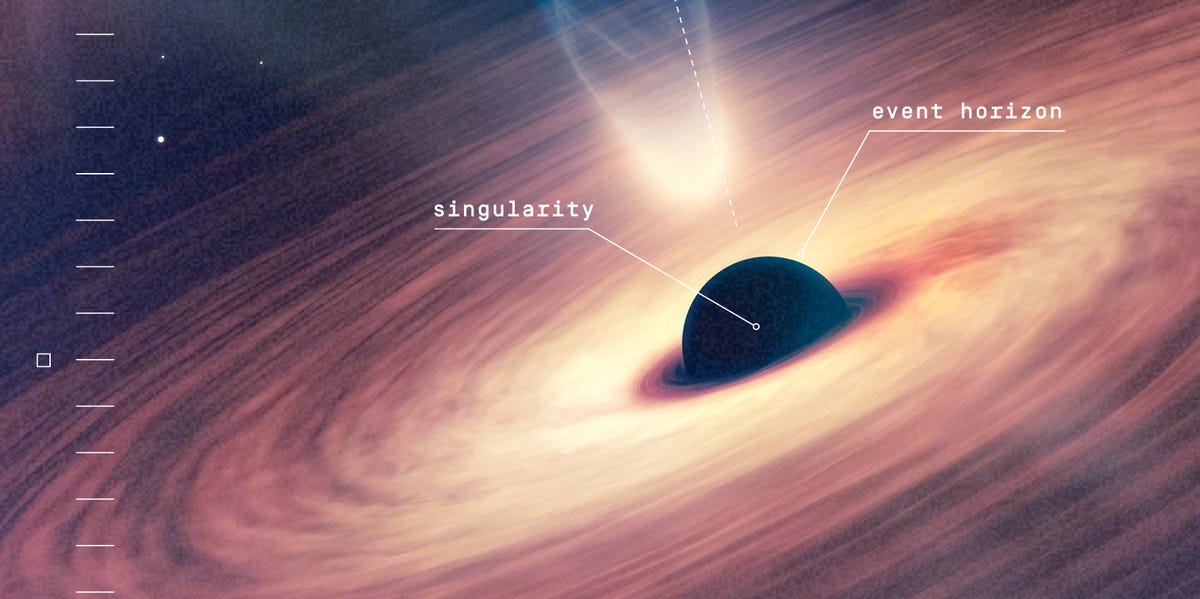
A black hole is a region where spacetime is curved so severely that all future-directed paths inside its event horizon lead farther inward. It does not have a solid surface waiting to make a dramatic dent in your spacecraft. The event horizon is a one-way boundary in spacetime.
For a simple, nonrotating black hole, the event horizon lies at the Schwarzschild radius:
R = 2GM/c²
In plain English, the horizon grows with the black hole’s mass. A black hole containing one solar mass would have a Schwarzschild radius of roughly three kilometers. Increase the mass by a million, and the radius also becomes a million times larger.
This relationship creates a surprising survival advantage. Although a supermassive black hole contains vastly more mass, its event horizon is much farther from the central region. The difference in gravity between two nearby pointsknown as the tidal forcecan consequently be far weaker at its horizon than at the horizon of a small black hole.
The Event Horizon Is Not the Singularity
The event horizon and singularity are often mixed together, but they are not interchangeable. The horizon is the boundary of no return. In classical general relativity, the singularity is the innermost region where spacetime curvature becomes extreme and the theory ceases to provide a physically complete description.
An astronaut crossing the horizon of a sufficiently large black hole might notice no sudden wall, flash, or cosmic turnstile. Locally, the crossing could feel uneventful. The dreadful part is that every possible route now points inward. Turning the engines around would be emotionally satisfying but physically useless.
Choose the Right Black Hole
The first rule of surviving a black-hole plunge is to be extremely picky. Stellar-mass black holes, active galactic nuclei, and merging black holes are spectacular scientific targets but terrible vacation properties.
Select a Supermassive Black Hole
A stellar-mass black hole may contain several to dozens of solar masses. Its horizon is comparatively small, so gravity changes sharply over the length of a human body. Your feet could experience a much stronger inward pull than your head. The resulting tidal stretching is popularly called spaghettification.
Near a supermassive black hole, tidal forces at the event horizon can be much gentler. For a nonrotating black hole, the tidal gradient at the horizon decreases approximately with the inverse square of the black hole’s mass. Bigger really can be betteralthough “better” still ends with the destruction of the traveler.
The ideal target would contain millions or billions of solar masses. Sagittarius A*, the black hole at the center of the Milky Way, has roughly four million solar masses. M87* is billions of times as massive as the Sun. Both demonstrate the scale astronomers mean when they say “supermassive,” though neither is conveniently located for an afternoon launch.
Find a Quiet, Isolated Target
The black hole itself may be dark, but its neighborhood can be brighter and more dangerous than almost anything in the universe. Gas falling inward often settles into an accretion disk. Friction, turbulence, and magnetic activity can heat that material to extraordinary temperatures, producing intense ultraviolet and X-ray radiation.
Some feeding black holes also power relativistic jetsnarrow beams of particles and radiation moving close to the speed of light. Flying into one would be less “historic expedition” and more “instant conversion into complicated plasma.”
A safer hypothetical target would therefore be:
- Supermassive, so tidal forces near the horizon are relatively mild
- Quiescent, with little material actively falling into it
- Isolated from bright stars, dense gas clouds, and nearby compact objects
- Not participating in a black-hole merger
- Surrounded by no powerful jets or luminous accretion disk
The mission would need years of remote observations across radio, infrared, visible, ultraviolet, and X-ray wavelengths. Astronomers would map orbiting matter, magnetic fields, radiation levels, and the black hole’s mass and spin before anyone considered pressing the large red button marked “INWARD.”
Plan an Approach That Avoids the Cosmic Hazards
Black-hole entry is not simply a matter of aiming at the center. The trajectory must avoid hot plasma, unstable orbits, jets, and debris traveling at relativistic speeds.
Stay Away From Both the Disk and the Jets
The dense part of an accretion disk generally occupies the black hole’s equatorial region. Jets, when present, tend to emerge near the rotational poles. That makes both the disk plane and polar axis undesirable approach lanes.
A probe would search for a comparatively clean corridor at an intermediate angle, adjusted according to actual observations. There is no universal “safe side” of a black hole. Its spin, magnetic field, surrounding gas, and companion objects determine the local hazards.
Do Not Try to Hover Near the Horizon
Hovering close to a black hole requires continuous acceleration. As a stationary craft approaches the event horizon of an ideal nonrotating black hole, the acceleration needed to remain in place grows without limit. Engines powerful enough to attempt the maneuver would also create engineering, heat, and fuel problems large enough to make the original black hole seem almost reasonable.
Free fall is the more comfortable option. Once the final trajectory is established, the craft should shut down unnecessary propulsion and follow a natural path through curved spacetime. An astronaut in free fall would feel weightless except for tidal forces, much as orbiting astronauts feel weightless around Earth.
Account for the Black Hole’s Spin
Real black holes are expected to rotate. A rotating, or Kerr, black hole drags nearby spacetime around with it, an effect called frame-dragging. Outside its event horizon lies an ergosphere, where remaining stationary relative to distant space becomes impossible.
Spin changes the shape and location of critical orbits, affects the horizon, and complicates navigation. Entering in the same general direction as the rotation may allow different trajectories from entering against it. A mission would require a precise numerical model rather than directions scribbled on the back of a star chart.
Prepare the Spacecraft and Astronaut
No material can protect a traveler indefinitely inside a black hole. Nevertheless, ordinary space hazards would probably become lethal before exotic relativity did unless the spacecraft were designed carefully.
Use a Compact, Robotic-First Vehicle
A small spacecraft experiences a smaller difference in gravity from one end to the other. Keeping the vehicle compact could delay structural damage from tidal forces. It should also have substantial radiation shielding, autonomous navigation, redundant sensors, and no delicate wings, booms, or decorative hood ornaments.
Robotic probes should make the first descents. They could measure radiation, plasma density, gravitational lensing, clock rates, and tidal acceleration while transmitting results outward. Human entry would only follow if the environment near the horizon matched the models.
Transmit Everything Before Crossing
Signals sent outward become increasingly redshifted and delayed as the craft approaches the horizon. To a distant observer, the astronaut appears to slow, dim, redden, and fade. The observer never receives a signal showing the traveler cross the event horizon.
The astronaut’s own clock tells a different story. The traveler crosses the horizon after a finite amount of personal time. Nothing magical happens to that clock at the boundary. The disagreement is not an optical trick; it arises because the observers follow different paths through curved spacetime.
All useful data must be transmitted before the crossing. After the horizon is passed, no message can reach the external universenot radio, laser light, emergency beacon, or a final review complaining about the legroom.
What Happens During the Fall?
Gravitational Lensing Distorts the View
As the spacecraft approaches, light from stars and surrounding material follows strongly curved paths. The sky may appear warped into arcs, rings, and multiple images. Light from behind the black hole can bend into view, while rapidly moving material may look brighter on one side because of relativistic beaming.
The dark region visible in black-hole images is not a photograph of the event horizon itself. It is a shadow-like feature produced by captured light and strongly bent radiation from hot surrounding material. The actual horizon is smaller than the observed shadow.
Time Dilation Separates the Observers’ Stories
The astronaut would see external events altered by gravitational and motion-related effects, but would not necessarily watch the entire future of the universe flash by. That popular claim oversimplifies which incoming light can actually reach the falling traveler.
Meanwhile, distant mission control receives signals at progressively lower energy and longer intervals. The traveler fades from view. From the astronaut’s perspective, however, the horizon arrives on scheduleand astonishingly, it may arrive without a noticeable bump.
Spaghettification Eventually Wins
Crossing the event horizon of a huge black hole may be survivable, but continuing inward is not. Tidal forces increase as the distance to the center decreases. Eventually, the radial pull stretches the spacecraft while transverse forces squeeze it.
Molecules, atoms, and ultimately subatomic structures would be disrupted as the gradient became sufficiently severe. Classical general relativity predicts that the traveler reaches the singularity after a finite amount of proper time. What fundamentally occurs there remains unknown because a successful theory combining gravity with quantum physics is still missing.
A Practical Black-Hole Safety Checklist
- Choose size over convenience: Target a supermassive black hole rather than a stellar-mass one.
- Avoid active feeding: Reject targets with brilliant accretion disks, powerful flares, or relativistic jets.
- Map the environment: Observe the target across multiple wavelengths before approaching.
- Model mass and spin: These properties control the horizon, frame-dragging, and available trajectories.
- Send robots first: Let expendable probes identify radiation and tidal hazards.
- Use a compact craft: Minimize its radial length and eliminate fragile external structures.
- Enter in free fall: Do not attempt to hover near the event horizon.
- Transmit early: Every scientific result must leave before the craft crosses the horizon.
- Cancel the return ticket: No trajectory leads back outside after horizon crossing.
The Experience: A Scientifically Grounded Mission Log
The following approximately 500-word account is fictional, but its major effects are based on general relativity and astrophysical models.
Approach
The black hole does not resemble a hole at first. It is an absence surrounded by evidence: bent starlight, a dim ring of hot gas, and a star field that refuses to remain where the navigation charts placed it.
Our target is a quiet supermassive black hole with no detectable jet and only a thin, weakly glowing flow of material. Months earlier, robotic probes crossed the planned route. Their instruments found radiation levels the ship’s shielding could tolerate. Each probe transmitted until its signal stretched into longer wavelengths and disappeared beneath the background noise.
I release the final navigation controls to the computer. The engines stop. My body becomes weightless, although the ship is accelerating inward under gravity. A mug floats beside my shoulder. Humanity has crossed interstellar space to conduct the most extreme experiment imaginable, and I am still being pursued by an unsecured beverage.
The Warped Sky
The view ahead and behind loses its familiar meaning. Stars appear in curved bands. Some are visible in more than one location because their light has traveled around different sides of the black hole. The faint material near the target looks brighter on one edge, distorted by its speed and the curvature of spacetime.
Mission control reports that my clock is running slowly compared with theirs. Mine seems perfectly normal. My pulse, thoughts, and sarcastic comments arrive at one second per second. Their messages, corrected by the computer, sound ordinary for now, but the raw signal tells a different story.
I transmit measurements continuously: radiation levels, external images, tidal readings, and comparisons between atomic clocks. The data matters more than my description. Science has learned to be suspicious of travelers who begin sentences with, “You had to be there.”
The Last Outgoing Signal
The horizon has no visible surface, so the computer marks its predicted position on the display. A warning appears: OUTBOUND COMMUNICATION WINDOW CLOSING.
I send the final high-bandwidth packet. Mission control will never observe me crossing. My signals will arrive progressively delayed, weakened, and redshifted until I seem frozen and then fade away. From their viewpoint, the mission dissolves at the boundary.
From mine, the boundary passes.
Nothing strikes the hull. No alarm announces that the laws of escape have changed. The stars remain visible because light can still travel inward. Yet every future course now leads deeper into the black hole. The engines fire once as a test. They work perfectly and accomplish nothing useful.
Inside
The first tidal reading after the crossing remains manageable, just as the models predicted. That is the advantage of choosing an enormous black hole: its horizon is spacious, and the local gravity gradient there is comparatively gentle.
Later, the numbers climb. The craft begins to creak. The gravitational pull on its inward side becomes measurably stronger than on its outward side. I rotate into the compact restraint position, though this can only delay the inevitable.
The star field compresses and shifts as the computer struggles to display a sensible view. No signal I send now can reach home. The recorder continues anyway, creating a scientific archive with no surviving reader.
The experience ends not with a doorway to another universe, as far as established physics can say, but with tidal forces overwhelming the spacecraft and its passenger. The exact final description belongs to a theory of quantum gravity humanity does not yet possess. The safest black-hole jump therefore achieves only a narrow victory: crossing the horizon alive, observing the impossible for a little longer, and accepting that the discovery cannot be shared.
Conclusion: “Safe” Is a Relative Term
The safest theoretical way to jump into a black hole is to select an enormous, quiet target; avoid its accretion disk and jet axes; approach through a carefully mapped corridor; enter in free fall; and transmit every measurement before reaching the event horizon.
A traveler could conceivably cross the horizon of a supermassive black hole without immediate injury. That does not make the trip survivable. Once inside, escape is forbidden by the causal structure of spacetime, and growing tidal forces eventually destroy both spacecraft and astronaut.
Black holes are valuable precisely because they push successful physical theories to their limits. We can image their shadows, detect collisions through gravitational waves, and model journeys across their horizons. Actually taking the plunge, however, remains a one-way experiment whose most interesting results could never be mailed home.
Research basis
This article synthesizes established information from the following U.S. scientific and educational resources:
- NASA Science: What Happens Near a Black Hole
- Chandra X-ray Observatory: Black Hole Tidal Forces
- LIGO Laboratory: Black Holes and Gravitational Waves
- Smithsonian Institution: Voyage Into the Black Hole
- American Museum of Natural History: Journey to a Black Hole
- UC Davis: What Happens Inside a Black Hole
- University of Maryland: Schwarzschild Black Holes
- University of Texas: Time Dilation Near a Black Hole
- Yale Astronomy: Black Holes
- American Physical Society: Tidal Disruption by Black Holes
- Event Horizon Telescope: Black Hole FAQ
- Space Telescope Science Institute: Black Hole Glossary
- National Radio Astronomy Observatory: Accretion Disks and Jets
- Fermilab: Imaging Sagittarius A*