If there were a legal requirement for every new guitarist to learn one riff before buying their third pick pack and first questionable distortion pedal, Seven Nation Army would probably win by a landslide. The White Stripes classic is catchy, moody, loud without being complicated, and somehow cool enough to survive dorm rooms, garages, sports stadiums, and that one friend who insists on playing it every time a guitar appears at a party.
The good news is that learning How to Play Seven Nation Army on Guitar does not require wizard-level chops. The main riff is approachable, memorable, and perfect for working on timing, fretboard awareness, picking control, and tone. The even better news? It sounds impressive fast. That means you get the rare beginner victory of playing something recognizable before your fingertips begin drafting a formal complaint.
This guide walks you through the riff, the rhythm, the tone, the power chords, and the practice habits that make the song sound tight instead of “I almost had it until my hand panicked.” Whether you are a total beginner or a rusty player coming back to guitar, this is one of the best songs to build confidence with.
Why This Song Is So Good for Beginners
The main reason this track is so beginner-friendly is simple: the famous hook is built around a small set of notes and is often taught on one string. That means you do not have to worry about giant chord grips, wild string skips, or the kind of finger gymnastics that make your left hand feel like it is filling out tax forms.
On top of that, the riff teaches several useful guitar fundamentals at once:
- Single-note accuracy, because every note is exposed.
- Steady rhythm, because the magic of the riff is in the groove, not just the pitches.
- Position shifting, since your fretting hand moves from the 10th fret down toward the nut.
- Power chord basics, if you want to add the heavier ending figures.
- Tone awareness, because this song sounds huge when played cleanly and messy when played sloppily.
In other words, this is not just a riff you learn to show off. It is a riff that quietly teaches you how to play better. Sneaky. Efficient. Very rock and roll.
What You Need Before You Start
1. A guitar in tune
For the easiest version, use standard tuning: E-A-D-G-B-E. Even though Jack White is associated with alternate tunings and special effects, beginners can absolutely learn the main riff in standard tuning without any drama. And frankly, beginner life already has enough drama.
2. A pick
You can play the riff with your fingers, but a pick usually gives the notes a sharper, more confident attack. A medium pick is a safe bet.
3. Light overdrive or clean tone
The original sound is famous for its bass-like weight, which comes from an octave effect. If you do not have that pedal, do not worry. A clean or slightly dirty electric guitar tone works perfectly for learning. Focus on playing clearly first. Fancy tone is dessert, not dinner.
4. A metronome
If you want the riff to sound powerful rather than wobbly, practice with a metronome. Timing turns a good riff into a great one. Without timing, even iconic music can sound like a shopping cart with a flat wheel.
The Main Seven Nation Army Riff
The easiest way to learn the signature line is to play it all on the A string, which is the fifth string on your guitar.
Main riff frets on the A string: 7 – 7 – 10 – 7 – 5 – 3 – 2
That is the famous hook. Play each note as a separate, clean strike. Let them ring just enough to connect musically, but not so much that everything turns into a blurry soup of sadness.
Suggested fingering
- 7th fret: index or ring finger
- 10th fret: pinky if you want less hand shifting, or ring finger if that feels stronger
- 5th, 3rd, and 2nd frets: slide your hand down smoothly and keep your thumb relaxed behind the neck
A simple beginner fingering looks like this:
- 7th fret with your index finger
- 10th fret with your pinky
- Move your hand down and play 5th fret with index
- 3rd fret with ring
- 2nd fret with index
If that feels awkward, that is normal. Guitar is basically a long-term relationship with temporary awkwardness.
How to Play the Rhythm Correctly
Many beginners get the notes right and still wonder why the riff does not sound right. The answer is rhythm. This riff works because of its pulse and spacing. If you rush the first three notes or hesitate on the descent, the whole thing loses its swagger.
Try this approach:
- Say the fret numbers out loud while tapping your foot.
- Play the sequence slowly and evenly.
- Listen to how the first notes feel bold and repetitive, while the last notes walk downward with purpose.
- Use a metronome at a slow tempo, then increase speed only when you can play the riff cleanly three times in a row.
That “three clean times in a row” rule is brutally effective. It also prevents the classic beginner habit of speeding up simply because the fingers got lucky once.
Adding the Power Chords
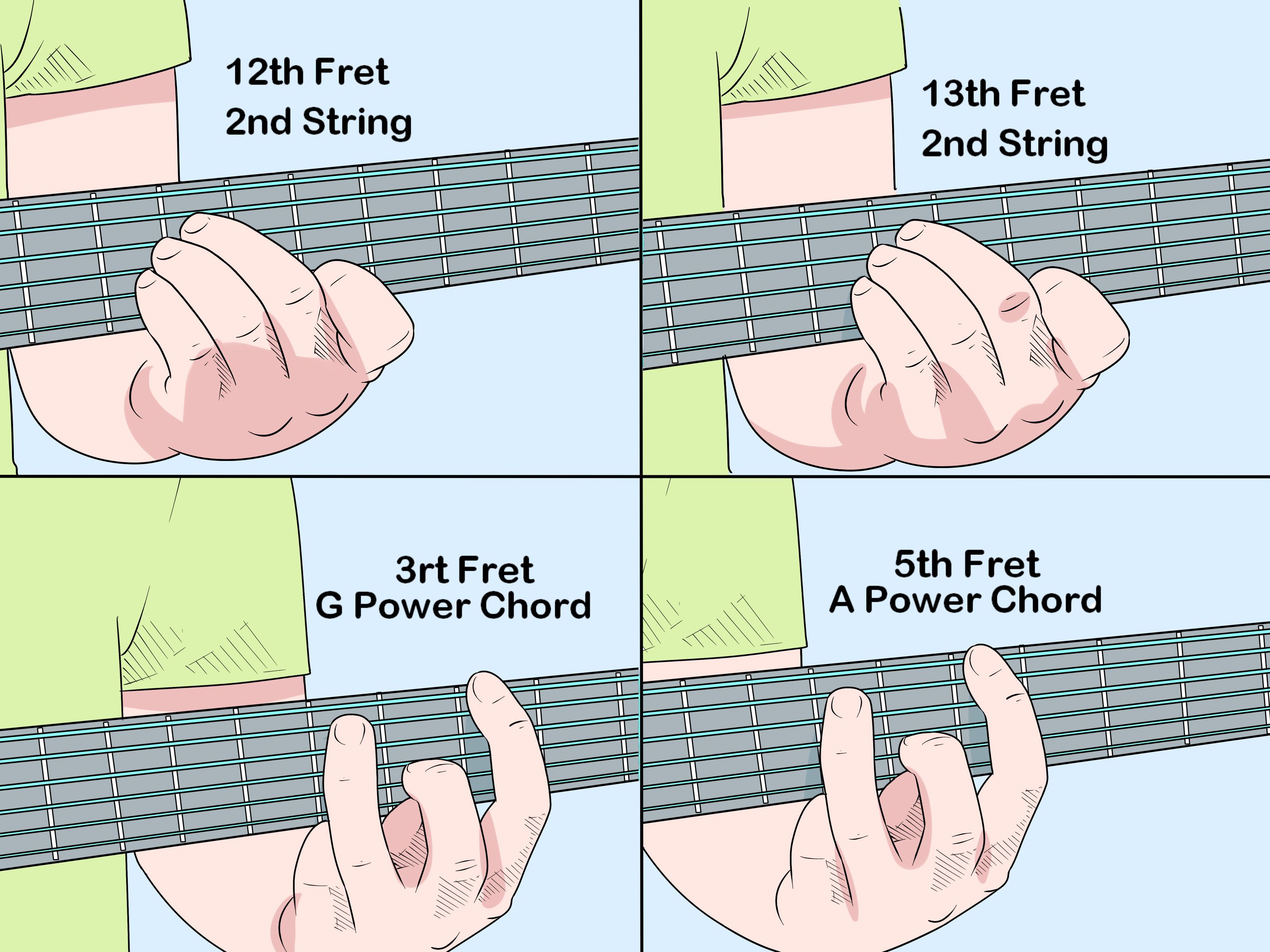
Many beginner arrangements finish the riff with G5 and A5 power chords. This adds punch and makes the part feel more like a full rock riff instead of a floating line.
How to play G5
Place your index finger on the 3rd fret of the low E string and your ring finger on the 5th fret of the A string. You can double the shape with your pinky on the 5th fret of the D string if you want a fuller sound.
How to play A5
Move that same shape up two frets so your index finger is on the 5th fret of the low E string and your ring finger is on the 7th fret of the A string. Add your pinky on the 7th fret of the D string for extra thickness.
Power chords are movable, simple, and glorious. They are the cheeseburger of rock guitar: not fancy, but deeply satisfying.
Picking Technique That Makes the Riff Sound Better
You can play the riff with all downstrokes, and many beginners find that easiest at first. That is totally fine. Once you feel comfortable, try alternate picking to build consistency: down-up-down-up.
Keep your picking hand relaxed and use small motions. The goal is not to attack the guitar like it owes you money. The goal is controlled energy. Let the pick glide through the string rather than digging too deep.
Also pay attention to muting. If nearby strings start ringing sympathetically, lightly touch them with unused fretting-hand fingers or rest part of your picking hand near the strings. Clean riffs sound bigger than noisy riffs. Always.
How to Get Closer to the Original Tone
One of the coolest facts about Seven Nation Army is that the song’s huge “bass” opening is not actually a bass guitar in the traditional sense. Jack White used an octave effect to make the guitar sound lower and heavier. That is part of why the riff feels so massive while still being simple.
If you have gear to experiment with, try this:
- A bridge pickup or a bright pickup setting
- A little overdrive or fuzz
- An octave-down effect if available
- Strong, confident picking
If you do not have pedals, no problem. Learn the part cleanly first. A well-played riff with modest tone still sounds better than a sloppy riff dressed in expensive gear. Guitar stores may disagree, but your ears will not.
Common Beginner Mistakes
Rushing the descent
The move from the 7th fret down to 5, 3, and 2 is where many players speed up. Slow it down and keep the note spacing deliberate.
Pressing too hard
You do not need to crush the strings into the fretboard like you are trying to leave a permanent record. Use just enough pressure for a clean note.
Letting every note ring forever
This riff needs control. Let notes breathe, but mute where necessary so the line stays punchy.
Ignoring the groove
If you only memorize numbers and never listen to the rhythm, the riff will sound robotic. Play along with the song once you have the notes down.
Trying to sound perfect too soon
First comes accuracy. Then comes smoothness. Then comes attitude. Do not force stage-three swagger in stage-one survival mode.
A Smart Practice Plan for This Song
Day 1: Learn the note order
Play the frets slowly on the A string until you can remember them without looking at a chart every five seconds.
Day 2: Lock the rhythm
Use a metronome and aim for consistent spacing. Record yourself if possible. What feels steady is not always steady. The microphone is a brutally honest little goblin.
Day 3: Clean up the transitions
Focus on shifting from the 10th fret down to the 7th, then to the 5th, 3rd, and 2nd. Keep the hand relaxed.
Day 4: Add power chords
Practice moving between G5 and A5 without pausing. Start with one strum each, then experiment with rhythm.
Day 5: Play with the track
Jam along with the original recording or a backing track. This helps you internalize the groove and phrasing.
Day 6 and beyond: Make it musical
Work on dynamics, attack, muting, and tone. Once the riff is under your fingers, focus on making it sound intentional and confident.
Can You Play Seven Nation Army on Acoustic Guitar?
Absolutely. It will not sound exactly like the recording, because the electric tone and octave effect are a big part of the song’s identity, but the riff still works beautifully on acoustic guitar. In fact, acoustic practice is a great way to expose weak timing and sloppy fretting. Acoustic guitars are like honest friends: occasionally rude, but usually right.
On acoustic, aim for:
- Clear single notes
- Steady rhythm
- Controlled volume
- Strong but not harsh picking
Why This Riff Sticks in Your Head
The magic of Seven Nation Army is that it feels simple without feeling boring. The line has shape. It starts with repetition, jumps upward, then walks down in a way that sounds inevitable. It is memorable, muscular, and easy for listeners to latch onto. That is why crowds sing it, sports fans chant it, and beginner guitarists keep coming back to it.
From a learning perspective, that is useful. When a riff is this recognizable, your ear tells you quickly whether you are close or not. That makes it one of the best songs for improving both technique and listening skills at the same time.
Real-World Experiences of Learning Seven Nation Army on Guitar
One of the most common experiences players have with this song is that it gives them an early confidence boost. A lot of beginner guitar work can feel slow. You tune. You learn where middle C is not. You play strings that buzz. You forget what finger was supposed to go where. Then suddenly a riff like Seven Nation Army shows up and changes the mood. Within a short practice session, a beginner can play something that friends, siblings, parents, and random people walking past the room instantly recognize. That matters more than it sounds. Recognition creates motivation, and motivation keeps the guitar out of the closet.
Another common experience is discovering that “easy” and “effective” are not the same thing. Players often learn the note sequence in a few minutes, then spend days realizing the real work is in the groove. The first time the riff feels locked in with a foot tap or backing track, it is a small revelation. Many players describe that moment as the first time they truly felt like they were not just pressing frets, but actually making music. It is a subtle shift, but an important one.
There is also the gear experience. A lot of players first try this song on whatever guitar is available: a beginner acoustic, a starter electric through a tiny amp, maybe even an unplugged guitar on the edge of a bed. Then later they try it with some gain or an octave effect and laugh because suddenly the riff sounds enormous. That contrast teaches an important lesson: technique comes first, but tone changes emotion. The same notes can feel casual, aggressive, or stadium-sized depending on the sound.
For some learners, this song becomes their gateway into bigger guitar topics. They start with one string and a handful of frets, then get curious about why the riff feels dark, why the power chords sound so strong, why alternate tuning matters, or how pedals shape tone. In that sense, Seven Nation Army often acts like a musical doorway. You do not just learn one song. You begin asking better guitar questions.
Many teachers like using this riff because it reveals growth clearly. On day one, a student may stop after every note. A week later, the line flows. A month later, the same student is adding dynamics, muting, and power chords. That visible progress is satisfying for both teacher and player. It proves that improvement on guitar is not always dramatic. Sometimes it is just one riff sounding a little more solid every day until it suddenly sounds like music.
And yes, there is the social experience too. Few riffs get requested more by people who do not even play guitar. Learn this one, and somebody will eventually grin and say, “Play that sports chant song.” That is part of the fun. Guitar can be deeply personal, but it is also communal. Seven Nation Army lives in both worlds. It is simple enough for private practice, catchy enough for public fun, and iconic enough to make a beginner feel connected to real rock history. Not bad for seven-ish notes and a whole lot of attitude.
Conclusion
If you want a song that is fun, famous, beginner-friendly, and secretly excellent for building real technique, How to Play Seven Nation Army on Guitar is a perfect place to start. Learn the frets on the A string. Keep your rhythm steady. Add the power chords when you are ready. Use a metronome. Clean up your muting. Then play it with confidence.
You do not need elite gear, advanced theory, or a mysterious desert-road music video to make this riff sound good. You just need solid timing, clean notes, and enough repetition to let the groove settle into your hands. Once it does, you will understand why this song has become a rite of passage for guitarists everywhere.