Citing a book with one author is usually peaceful. One name, one title, one publisher, and everyone goes home happy. But add a second author, then a third, then a small academic army of contributors, and suddenly your citation starts looking like a wedding guest list with punctuation issues. That is exactly why learning how to cite books with multiple authors in APA, MLA, and Chicago style matters.
The good news? Multiple-author citations are not as scary as they look. Each major citation style has a system, and once you understand the pattern, you can cite two authors, three authors, or twenty-one authors without quietly whispering, “Why does research have to be like this?” into your laptop.
This guide explains how to cite books with multiple authors in APA 7th edition, MLA 9th edition, and Chicago style. You will see clear formats, in-text citation rules, reference list examples, works-cited examples, bibliography examples, and practical tips that help you avoid common mistakes. Whether you are writing a college essay, research paper, thesis, blog post, or academic article, this guide will help your citations look polished, accurate, and not like they were assembled during a caffeine emergency.
Why Multiple-Author Book Citations Matter
Books with multiple authors are common in academic writing, especially in education, psychology, history, science, business, medicine, and social sciences. A textbook may have two authors. A research-based book may have three or more. A handbook, edited volume, or collaborative academic title may include a long list of contributors.
Correctly citing those authors is important for three reasons. First, citations give credit to the people who created the work. Second, citations help readers find the exact source you used. Third, proper citation protects your writing from plagiarism concerns. Citation style is not just decorative formatting; it is a map that tells your reader where your ideas came from.
The tricky part is that APA, MLA, and Chicago do not handle author names in exactly the same way. APA loves years and initials. MLA likes readable names and page numbers. Chicago offers two systems: notes and bibliography, and author-date. In other words, citation styles are like houseplants: they all need attention, but each one has its own watering schedule.
Quick Comparison: APA vs. MLA vs. Chicago
Before diving into examples, here is the simplest way to understand the differences.
APA Style
APA style is commonly used in psychology, education, nursing, business, and the social sciences. It emphasizes the author and publication year because the age of research often matters. In APA in-text citations, books with one or two authors list the author names. Books with three or more authors use the first author’s surname followed by et al. from the first citation onward.
MLA Style
MLA style is commonly used in literature, language studies, cultural studies, and the humanities. It emphasizes the author and page number. In MLA Works Cited entries, a book with two authors lists both names, while a book with three or more authors lists the first author followed by et al.
Chicago Style
Chicago style is widely used in history, publishing, art history, and some humanities fields. It has two systems: notes and bibliography, which uses footnotes or endnotes, and author-date, which looks a little more like APA. Chicago usually lists both authors for two-author works, but uses et al. in notes or in-text citations for works with three or more authors.
How to Cite Books with Multiple Authors in APA Style
APA style uses two major citation pieces: the in-text citation and the reference list entry. The in-text citation appears inside your paper, usually in parentheses or in the sentence itself. The reference list entry appears at the end of your paper and gives full publication details.
APA In-Text Citation for Two Authors
For a book with two authors, APA includes both authors’ surnames every time you cite the source. Use “and” in a narrative citation and an ampersand “&” in a parenthetical citation.
Narrative citation:
Garcia and Lee (2021) argue that collaborative learning improves student engagement.
Parenthetical citation:
Collaborative learning can improve student engagement (Garcia & Lee, 2021).
If you quote directly, include a page number:
(Garcia & Lee, 2021, p. 42)
APA Reference List Entry for Two Authors
The APA reference entry for a book with two authors lists both authors using last name and initials. Place an ampersand before the final author.
Garcia, M. L., & Lee, T. R. (2021). Learning together in modern classrooms. Academic Press.
APA book titles use sentence case. That means you capitalize only the first word of the title, the first word after a colon or dash, and proper nouns. This feels strange if you are used to title case, but APA is very committed to its lowercase lifestyle.
APA In-Text Citation for Three or More Authors
For a book with three or more authors, APA uses the first author’s surname followed by et al. in every in-text citation, including the first one.
Narrative citation:
Nguyen et al. (2020) explain how digital literacy develops across learning environments.
Parenthetical citation:
Digital literacy develops across learning environments (Nguyen et al., 2020).
The phrase et al. means “and others.” It has a period after “al.” because “al.” is an abbreviation. There is no period after “et.” Tiny detail? Yes. Will your instructor notice? Also yes.
APA Reference List Entry for Three to Twenty Authors
Here is where APA does something important: even though APA shortens in-text citations for three or more authors, the reference list includes all authors up to twenty authors.
Nguyen, P. T., Harris, L. M., Brooks, A. C., & Chen, S. Y. (2020). Digital literacy across learning spaces. University Learning Press.
Notice that each author is listed by surname and initials. The final author is introduced with an ampersand. The publication year comes right after the author names in parentheses.
APA Reference List Entry for Twenty-One or More Authors
If a book has twenty-one or more authors, APA lists the first nineteen authors, then an ellipsis, then the final author. Do not use an ampersand before the final author in this special long-author format.
Author, A. A., Author, B. B., Author, C. C., Author, D. D., Author, E. E., Author, F. F., Author, G. G., Author, H. H., Author, I. I., Author, J. J., Author, K. K., Author, L. L., Author, M. M., Author, N. N., Author, O. O., Author, P. P., Author, Q. Q., Author, R. R., Author, S. S., ... Author, Z. Z. (2022). Title of the book. Publisher.
This rule is especially useful for large academic collaborations. It keeps the reference readable without erasing the final author from the record.
How to Cite Books with Multiple Authors in MLA Style
MLA style uses in-text citations and a Works Cited list. The in-text citation usually includes the author’s surname and page number. The Works Cited entry gives full source information. MLA is often more streamlined than APA because it does not include the publication year in every in-text citation.
MLA In-Text Citation for Two Authors
For a book with two authors, include both surnames in the in-text citation. Use “and,” not an ampersand.
Narrative citation:
Garcia and Lee describe collaborative learning as a flexible classroom strategy (42).
Parenthetical citation:
Collaborative learning can improve classroom participation (Garcia and Lee 42).
MLA does not place a comma between the author names and the page number in a standard parenthetical citation. So write (Garcia and Lee 42), not (Garcia and Lee, 42).
MLA Works Cited Entry for Two Authors
For two authors, MLA inverts only the first author’s name. The second author appears in normal first-name-last-name order.
Garcia, Maria L., and Thomas R. Lee. Learning Together in Modern Classrooms. Academic Press, 2021.
This is one of the easiest MLA rules to forget. Do not invert both names. MLA wants the first author inverted for alphabetizing, while the second author stays reader-friendly.
MLA In-Text Citation for Three or More Authors
For a book with three or more authors, use the first author’s surname followed by et al. and the page number.
(Nguyen et al. 88)
In a sentence, it might look like this:
Nguyen et al. argue that digital reading skills depend on both access and instruction (88).
Again, no comma appears between the author element and the page number. MLA likes its parenthetical citations clean and compact.
MLA Works Cited Entry for Three or More Authors
In the Works Cited list, MLA also uses the first author’s name followed by et al. for books with three or more authors.
Nguyen, Patricia T., et al. Digital Literacy Across Learning Spaces. University Learning Press, 2020.
In MLA, book titles use title case, which means major words are capitalized. This differs from APA, where book titles use sentence case. So yes, the same book title may look different depending on the style. Citation styles enjoy keeping writers humble.
How to Cite Books with Multiple Authors in Chicago Style
Chicago style comes in two major versions: notes and bibliography, and author-date. Always check which one your instructor, publisher, or department requires. If someone just says “Chicago style,” do not assume. That tiny phrase can hide two different citation systems wearing the same trench coat.
Chicago Notes and Bibliography: Two Authors
In Chicago notes and bibliography style, a full note for a book with two authors includes both names in normal order, the title, publication details, and page number if needed.
Full note:
1. Maria L. Garcia and Thomas R. Lee, Learning Together in Modern Classrooms (New York: Academic Press, 2021), 42.
Bibliography entry:
Garcia, Maria L., and Thomas R. Lee. Learning Together in Modern Classrooms. New York: Academic Press, 2021.
In the bibliography, the first author’s name is inverted. The second author’s name remains in normal order.
Chicago Notes and Bibliography: Three or More Authors
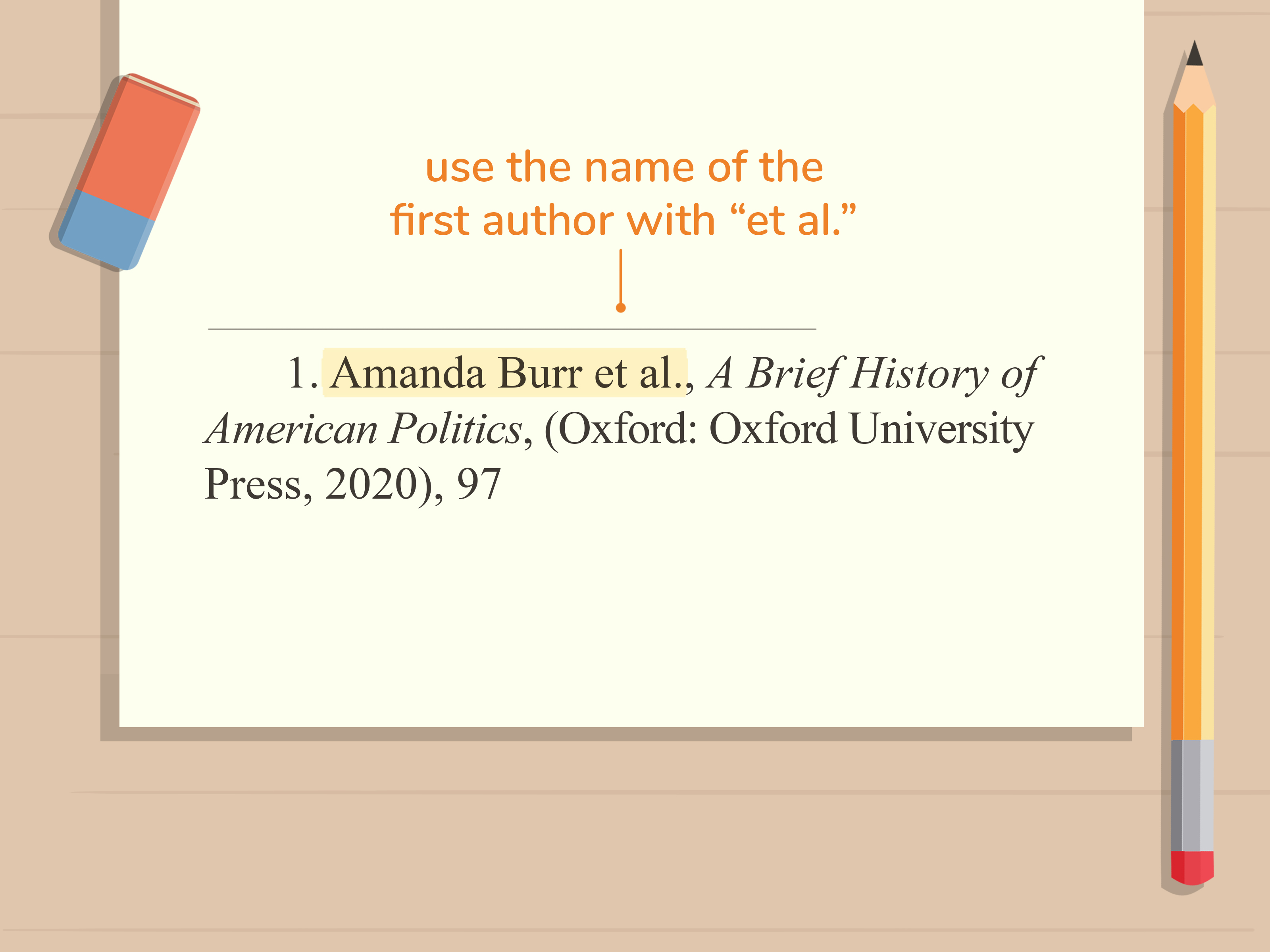
For notes, Chicago usually shortens books with three or more authors by listing the first author followed by et al.
Full note:
2. Patricia T. Nguyen et al., Digital Literacy Across Learning Spaces (Boston: University Learning Press, 2020), 88.
Shortened note:
3. Nguyen et al., Digital Literacy, 91.
For the bibliography, Chicago lists up to six authors. If there are more than six, list the first three followed by et al.
Bibliography entry with three authors:
Nguyen, Patricia T., Laura M. Harris, and Aaron C. Brooks. Digital Literacy Across Learning Spaces. Boston: University Learning Press, 2020.
Bibliography entry with more than six authors:
Nguyen, Patricia T., Laura M. Harris, Aaron C. Brooks, et al. Digital Literacy Across Learning Spaces. Boston: University Learning Press, 2020.
Chicago Author-Date: Two Authors
Chicago author-date style uses parenthetical citations in the text and a reference list at the end.
In-text citation:
(Garcia and Lee 2021, 42)
Reference list entry:
Garcia, Maria L., and Thomas R. Lee. 2021. Learning Together in Modern Classrooms. New York: Academic Press.
Unlike APA, Chicago author-date does not put the year in parentheses in the reference list. The year appears after the author names, followed by a period.
Chicago Author-Date: Three or More Authors
For three or more authors in the text, use the first author’s surname followed by et al., then the year and page number.
(Nguyen et al. 2020, 88)
In the reference list, list up to six authors. If there are more than six authors, list the first three followed by et al.
Nguyen, Patricia T., Laura M. Harris, and Aaron C. Brooks. 2020. Digital Literacy Across Learning Spaces. Boston: University Learning Press.
Common Mistakes When Citing Books with Multiple Authors
Using “et al.” Too Early in APA References
A common APA mistake is using et al. in the reference list for a book with three, four, or five authors. Do not do that. APA uses et al. in in-text citations for three or more authors, but the reference list includes all authors up to twenty.
Putting a Comma in MLA Parenthetical Citations
MLA parenthetical citations do not use a comma between the author and page number. Write (Garcia and Lee 42), not (Garcia and Lee, 42).
Forgetting the Page Number for Direct Quotes
If you quote directly, include a page number whenever the source has page numbers. This applies across APA, MLA, and Chicago. A direct quote without a location marker is like telling someone you parked “somewhere downtown.” Technically possible, deeply unhelpful.
Mixing APA and MLA Title Capitalization
APA uses sentence case for book titles in the reference list. MLA and Chicago use headline-style or title-style capitalization. If you copy one citation style into another without adjusting capitalization, the result can look suspiciously Frankensteined.
Alphabetizing by the Wrong Author
In reference lists, works-cited lists, and bibliographies, alphabetize by the first listed author’s last name. Do not rearrange authors alphabetically within a source. The order of authors usually reflects contribution, discipline convention, or publisher decision. Keep the authors in the order shown on the book.
Practical Examples: One Book in Three Styles
Let’s imagine a book with three authors:
Book details:
Authors: Patricia T. Nguyen, Laura M. Harris, and Aaron C. Brooks
    Title: Digital Literacy Across Learning Spaces
    Publisher: University Learning Press
    Year: 2020
    City: Boston
    Quoted page: 88
APA Example
In-text citation: (Nguyen et al., 2020, p. 88)
Reference list: Nguyen, P. T., Harris, L. M., & Brooks, A. C. (2020). Digital literacy across learning spaces. University Learning Press.
MLA Example
In-text citation: (Nguyen et al. 88)
Works Cited: Nguyen, Patricia T., et al. Digital Literacy Across Learning Spaces. University Learning Press, 2020.
Chicago Notes and Bibliography Example
Note: 1. Patricia T. Nguyen et al., Digital Literacy Across Learning Spaces (Boston: University Learning Press, 2020), 88.
Bibliography: Nguyen, Patricia T., Laura M. Harris, and Aaron C. Brooks. Digital Literacy Across Learning Spaces. Boston: University Learning Press, 2020.
Chicago Author-Date Example
In-text citation: (Nguyen et al. 2020, 88)
Reference list: Nguyen, Patricia T., Laura M. Harris, and Aaron C. Brooks. 2020. Digital Literacy Across Learning Spaces. Boston: University Learning Press.
How to Decide Which Citation Style to Use
If you are writing for a class, use the style your instructor assigns. If you are writing for a journal, follow the journal’s submission guidelines. If you are writing for a website, style choice depends on audience and editorial policy. Academic blogs often prefer a simplified citation style, but formal research content should still follow a recognized system.
Use APA if your field values date-sensitive research, especially psychology, education, health sciences, and social sciences. Use MLA if your paper focuses on literature, language, media, or cultural analysis. Use Chicago if you are working in history, publishing, art history, or a field that prefers footnotes. When in doubt, ask before formatting forty citations the wrong way. Future-you will send a thank-you card.
Best Practices for Citing Books with Multiple Authors
Check the Title Page, Not Just the Cover
The title page is usually the most reliable place to confirm author names and order. Covers may use shortened names, marketing-friendly layouts, or design choices that do not show full publication details.
Preserve the Author Order
Never rearrange authors by last name unless the style specifically tells you to alphabetize entries in your final list. Within a single citation, keep the authors in the same order as the source.
Use Citation Tools Carefully
Citation generators can be helpful, but they are not perfect. They may capitalize titles incorrectly, omit authors, confuse editors with authors, or format et al. incorrectly. Use them as a starting point, not as the final judge. Citation tools are like GPS: useful, but sometimes they confidently lead you into a lake.
Know the Difference Between Authors and Editors
A book may be written by multiple authors, edited by multiple editors, or contain chapters by different contributors. These are not the same citation situation. If you are citing a whole edited book, cite the editors. If you are citing one chapter from an edited collection, cite the chapter author first and then include the editors of the book.
Be Consistent
Do not switch between APA, MLA, and Chicago in the same paper unless you have a very specific reason. Consistency is one of the main signs of professional academic writing. A paper with mixed citation styles looks like three style guides got into a small but dramatic argument.
Experience-Based Tips for Citing Books with Multiple Authors
After working with academic-style content, one practical lesson becomes clear: most citation errors do not happen because writers are careless. They happen because writers wait until the end. When your paper is finished and your brain has already moved out, building a perfect reference list can feel like sorting laundry during a thunderstorm. The best habit is to capture full citation details the moment you decide a source is useful.
For books with multiple authors, I recommend creating a simple source note before you begin drafting. Include the full author list exactly as it appears on the title page, the year, the complete title, the publisher, the edition if there is one, and the page numbers you plan to use. This small step prevents a surprisingly common problem: remembering the argument but forgetting which coauthor came second. Citation styles care deeply about author order, so your notes should care too.
Another helpful habit is to separate “thinking notes” from “citation notes.” Thinking notes summarize what the source says. Citation notes record where the information came from. For example, a thinking note might say, “The authors argue that digital reading requires both access and guided instruction.” A citation note would say, “Nguyen, Harris, and Brooks, 2020, p. 88.” When you keep those two types of notes together, your future citations become much easier to build.
When switching between APA, MLA, and Chicago, the most useful mental shortcut is to ask, “What does this style value most?” APA values date and research currency, so the year appears early and often. MLA values textual location and readability, so page numbers are central and citations stay brief. Chicago values publication detail and historical traceability, especially in notes and bibliography style. Once you understand the personality of each style, the rules feel less random.
One real-world challenge is citing books with three or more authors across different styles. In APA, your in-text citation may be short, but your reference entry may be long. In MLA, both the in-text citation and Works Cited entry usually become shorter with et al.. In Chicago, the note may be short, while the bibliography may list several authors. This is why copying a citation from one format into another rarely works. The information may be the same, but the style logic is different.
My favorite editing trick is to run a “citation consistency pass” after the main writing is done. During this pass, ignore the argument, grammar, introduction, and conclusion. Look only at citations. Check every in-text citation against the final list. Make sure every cited book appears in the reference list, Works Cited list, or bibliography. Then make sure every final-list entry is actually cited in the text. This catches orphan sources, missing page numbers, and author-name mismatches before a teacher, editor, or reviewer finds them.
Finally, do not treat citations as academic decoration. A good citation is part of the reader experience. It tells readers, “Here is the evidence, and yes, you can verify it.” That confidence makes your writing stronger. Multiple-author citations may look fussy at first, but once you learn the patterns, they become manageable. Think of them as grammar with a guest list: orderly, specific, and much easier when everyone is seated in the right place.
Conclusion
Learning how to cite books with multiple authors in APA, MLA, and Chicago style is less about memorizing every possible rule and more about recognizing patterns. APA uses author-date citations and shortens in-text citations with et al. for three or more authors, while keeping fuller author details in the reference list. MLA keeps citations lean, uses page numbers heavily, and applies et al. in Works Cited entries for three or more authors. Chicago gives you two paths: notes and bibliography for footnote-friendly writing, and author-date for a more compact system.
The smartest approach is simple: confirm the style, preserve the author order, check the title page, include page numbers when needed, and proofread citations separately from the rest of the paper. Do that, and your citations will look clean, credible, and ready for academic daylight.