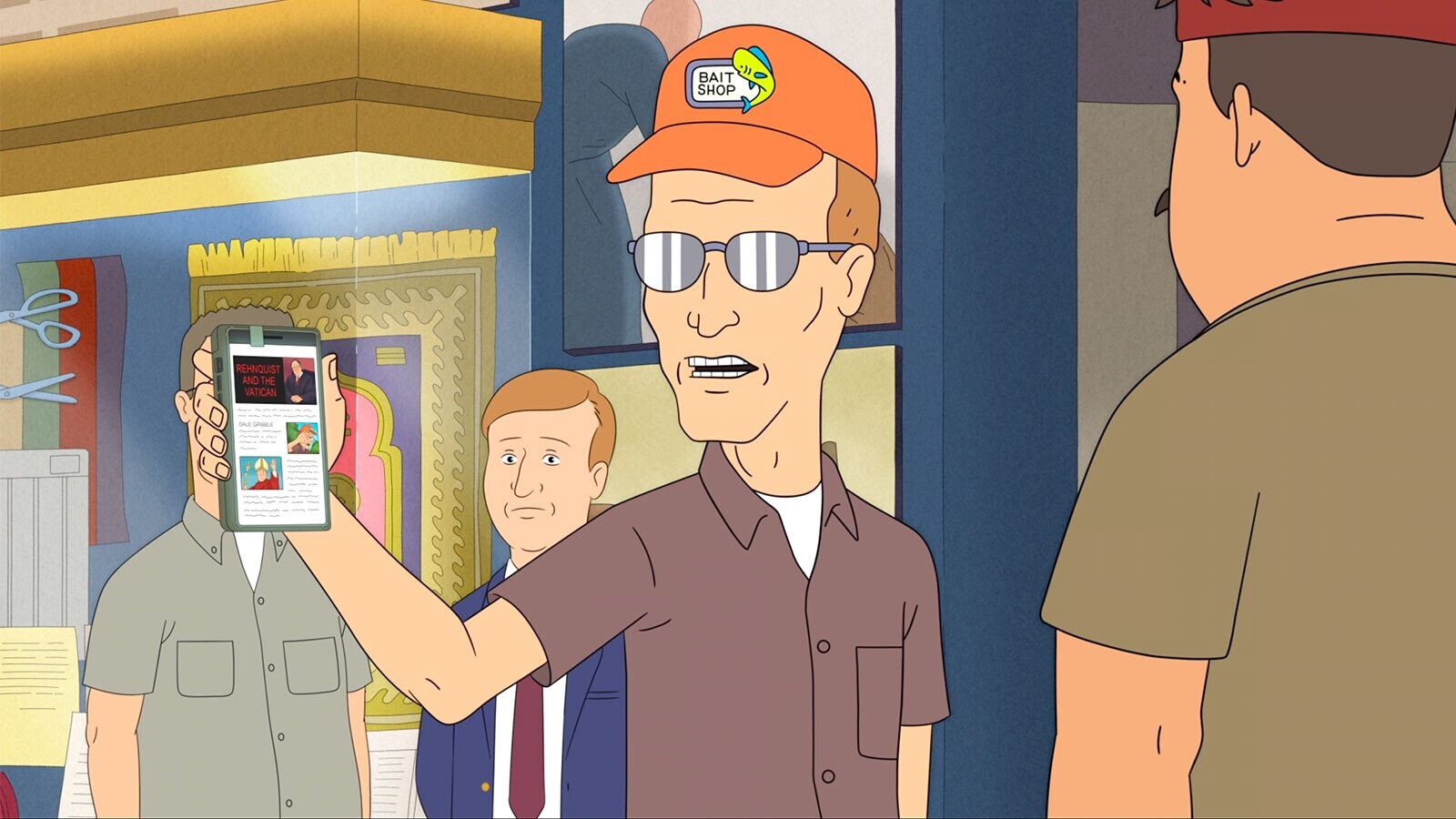
For nearly three decades, Dale Gribble has been one of television’s great comic contradictions: a man suspicious of absolutely everything except the one situation in his own life that practically came with a flashing neon sign. He distrusts the government, corporations, doctors, neighbors, weather balloons, and probably any vending machine that returns his change too quickly. Yet somehow, Dale has remained lovable.
That makes his return in the King of the Hill revival unusually complicated. The world around Dale has changed. Real-life conspiracy culture has become louder, more political, more dangerous, and considerably less funny. At the same time, the character returned under heartbreaking circumstances. Johnny Hardwick, the actor whose unmistakable voice helped define Dale, died in 2023 after recording material for the revival. Toby Huss eventually stepped into the role for the remaining episodes.
So, how hard is Dale to watch in the King of the Hill revival?
The answer is surprisingly nuanced. At times, he is emotionally difficult to watch because viewers know what happened behind the microphone. At other moments, Dale is awkward because the modern world has caught up with the kind of bizarre thinking that once made him seem uniquely ridiculous. But most of the time, the revival finds a clever way to preserve what made Dale funny without pretending that nothing has changed.
Dale Gribble Was Always a Conspiracy Theorist, but the Joke Has Changed
When King of the Hill premiered in 1997, Dale’s paranoia occupied a very different cultural space. He was the neighborhood crackpot who believed shadowy organizations were monitoring ordinary citizens while he smoked cigarettes, sprayed pesticides, and operated under the alias Rusty Shackleford.
Dale’s theories were funny because of their distance from reality. He could build an elaborate explanation for a completely ordinary event, then miss something obvious happening three feet from his face. His defining comic engine was not simply that he believed strange things. It was that his confidence was inversely proportional to his understanding.
Modern conspiracy culture complicates that joke.
Since the original series ended, fringe theories have moved from photocopied newsletters and strange corners of the internet into massive online communities and mainstream political conversation. A character who once looked like an exaggerated neighborhood eccentric can now resemble someone who spends six hours a day forwarding videos to the family group chat.
The revival understands this problem. It does not simply make Dale louder, angrier, or more extreme in an effort to compete with reality. Instead, it keeps his conspiratorial nature rooted in Dale’s familiar personality: insecure, theatrical, gullible, occasionally perceptive, and always convinced he is the smartest person within mosquito-spraying distance.
That distinction matters. King of the Hill has historically worked best when it treats politics and culture as pressures on characters rather than as substitutes for characters. The revival largely continues that approach, using an older Arlen and a changed America as environments for comedy rather than turning every neighbor into a walking social-media argument. Critics broadly praised Season 14 for retaining the original show’s combination of absurdity, warmth, and emotional realism despite its modern setting.
The Hardest Part of Watching Dale Has Nothing to Do With Politics
For longtime fans, the real difficulty is Johnny Hardwick.
Hardwick did not merely provide a funny voice for Dale. His dry Texas delivery, sudden bursts of panic, nasal certainty, and wonderfully strange rhythm became inseparable from the character. Dale could say something completely absurd and make it sound like classified information he had risked his life to obtain behind a convenience store.
Hardwick recorded Dale for six episodes of the revival before his death. Toby Huss, already a longtime member of the King of the Hill family, took over the character afterward. Huss had previously performed several memorable roles in the series, including Cotton Hill and Kahn Souphanousinphone, and approached Dale as a tribute to Hardwick rather than an attempt to erase him.
Knowing that history changes the viewing experience.
A joke can suddenly become bittersweet. A familiar line reading can remind viewers that they are hearing one of Hardwick’s final performances. Even when Dale is doing something ridiculous, there is an emotional layer sitting underneath the comedy.
That is where the revival becomes genuinely hard to watchbut not because it mishandles the character. It is hard because it handles him with enough familiarity to remind audiences what was lost.
The Voice Transition Is Noticeable, but It Does Not Break Dale
Replacing an iconic voice performer is one of animation’s least enviable tasks. The replacement must sound familiar without becoming a carnival impression. Too much imitation feels artificial. Too much reinvention makes the character seem like someone else wearing Dale’s sunglasses.
Huss has an advantage: he already understands the show’s rhythm. He knows that King of the Hill comedy rarely needs someone screaming, “Attention, audience, this is the joke.” The humor often comes from a pause, a flat reaction, or a character saying something insane with complete sincerity.
As a result, the new Dale remains recognizably Dale. The voice may strike longtime listeners as different, especially when heard close to Hardwick’s final performances, but the character’s behavioral DNA survives. Several reviews of the revival specifically found the casting changes manageable or subtle enough that they did not overwhelm the show.
That may be the best possible outcome. Nobody can truly replace Johnny Hardwick. The goal is not to pretend otherwise. The goal is to let Dale continue existing while respecting the performance that built him.
Why Dale Still Works in a Much Stranger America
The funniest thing about bringing Dale into the 2020s is that parts of society have become more Dale-like while Dale himself remains, in many ways, exactly the same.
He is still the guy in the alley who thinks he has discovered the secret structure beneath civilization. The difference is that now he has competition.
This creates a new comic tension. In the original series, Dale was frequently the most paranoid person in the room. In modern America, he can sometimes look almost quaint. The internet has industrialized the kind of rumor network Dale once had to maintain through radio chatter, personal suspicion, and probably a filing cabinet labeled “DO NOT OPEN.”
The revival reportedly allows Dale’s politics and worldview to evolve rather than simply freezing him in 2009. That is a smart choice because Dale was never best understood as a clean representative of any ideology. He is an individualist whose loyalty to a theory lasts until an even more exciting theory arrives. He is not a disciplined political thinker. Asking Dale to follow a coherent platform would be like asking a raccoon to manage a retirement portfolio.
That flexibility keeps him funny.
Instead of turning Dale into a direct parody of one modern movement, the revival can preserve his fundamental suspicion of systems, experts, trends, and anything that appears suspiciously well organized. His paranoia works because it is personal before it is political.
The Revival Avoids Turning Dale Into a Social-Media Stereotype
One of the easiest mistakes a revival could have made would be giving Dale a smartphone and spending ten episodes watching him discover increasingly alarming websites.
Thankfully, King of the Hill is usually smarter than that.
Dale’s humor has always depended on character relationships. Hank tolerates him. Bill often gets dragged along with him. Boomhauer watches the madness unfold. Nancy loves him despite their deeply strange marriage history. Joseph gives Dale’s life an emotional sincerity that prevents him from becoming a simple punchline.
Those relationships are more important than whatever conspiracy Dale happens to believe this week.
This is also why the revival’s decision to age the characters works. Hank and Peggy return to a changed Arlen after years abroad, while Bobby is now an adult chef living his own life. The characters are older, but their essential emotional dynamics remain intact. The premise gives the series a natural reason to examine modern culture without forcing every reference into dialogue like a writer frantically emptying a bag labeled “Things Young People Do Now.”
Dale benefits from this approach. He is not simply “Conspiracy Guy Updated for the Internet Age.” He is an older Dale Gribble living in a world that has changed around him.
Is Dale More Uncomfortable Now Because Conspiracies Have Real Consequences?
Sometimes, yes.
Comedy does not exist in a vacuum. A ridiculous belief that once seemed harmless can feel different after years in which misinformation has affected public health, elections, families, and everyday trust. Viewers inevitably bring that context with them.
That can make Dale’s paranoia slightly more uncomfortable than it was during the original run.
But discomfort is not necessarily failure.
The original King of the Hill frequently found comedy in contradictions that were socially awkward, politically sensitive, or emotionally painful. The show’s secret weapon was empathy without surrender. It could understand why a character behaved badly without insisting that the behavior was good.
Dale deserves the same treatment.
The character is funniest when the audience can see both the absurdity of his thinking and the vulnerability underneath it. He wants control in a world he does not fully understand. He invents hidden structures because randomness is frightening. He treats paranoia as expertise because expertise makes him feel powerful.
That is more psychologically interesting than simply saying, “Look at this crazy man.”
In fact, a modern setting potentially makes Dale more useful as a comic character. The revival can explore why conspiracy thinking is attractive without transforming the show into a lecture. Dale lets the series ask a serious question through an unserious man: What happens when someone who needs to feel uniquely informed discovers that everyone else has access to their own private universe of “secret knowledge”?
For Dale, that may be the ultimate conspiracy. The amateurs have invaded his profession.
The Emotional Weight Behind the Comedy
The revival arrived carrying more grief than most sitcom returns. Several performers closely associated with the original series had died, including Brittany Murphy, Tom Petty, Johnny Hardwick, and later Jonathan Joss, while musician and recurring guest star Chuck Mangione also received recognition. The new season incorporated tributes rather than treating those losses as production trivia.
Dale’s presence therefore becomes part of a larger theme: how do you return home when home has changed?
That question applies to Hank returning to Arlen. It applies to fans revisiting a television world after a long absence. And it applies to a production trying to continue without some of the people who gave that world its voice.
The revival cannot make 1997 return. It should not try.
What it can do is preserve the relationships and comic sensibility that made King of the Hill distinctive. Dale is central to that equation. Removing him entirely would leave an obvious hole in the alley. Recasting him carries risk, but continuing the character allows the series to honor the structure Hardwick helped create.
So, How Hard Is Dale to Watch?
Dale is not especially hard to watch because he has become offensively outdated. Nor is he hard to watch because the revival fundamentally misunderstands him.
He is hard to watch in flashes.
Sometimes the discomfort comes from hearing a conspiracy joke in a world where conspiracy culture is no longer confined to lovable fictional exterminators. Sometimes it comes from noticing a change in voice performance. And sometimes it comes from remembering that Johnny Hardwick was completing a return to one of his defining characters when his life ended.
Yet those moments do not destroy the comedy. In many ways, they deepen it.
Dale remains ridiculous because his personality, rather than any single political position, drives his paranoia. He remains sympathetic because the people around him still care about him. And he remains essential because the alley without Dale would be far too calm.
The revival’s greatest achievement may be recognizing that preserving a character does not mean pretending the world stood still. Dale can change slightly. His context can change dramatically. His voice can, sadly, have to change. What matters is whether the strange little engine inside the character keeps running.
So far, it does.
A Viewer’s Experience: Watching Dale Across the Revival
For a longtime viewer, watching Dale in the King of the Hill revival can feel like returning to an old neighborhood and discovering that the houses are still standing, the street names are familiar, and someone has installed an app-controlled refrigerator where the bait shop used to be.
The first instinct is comparison.
Does Dale sound exactly the same? Is his timing different? Would Johnny Hardwick have emphasized that word another way? Is the show trying too hard to update him? Those questions can become distracting because fans of long-running animated series develop surprisingly precise memories for voices. A person may forget where the car keys are while instantly detecting a two-percent variation in a cartoon exterminator’s nasal delivery.
The better viewing experience comes when that comparison slowly gives way to the story.
During Hardwick’s recorded episodes, there is an unavoidable sense of finality. Even a silly Dale moment may carry extra weight because the audience knows the performer behind it is gone. This knowledge can turn ordinary comedy into a kind of farewell that the scene itself was never originally designed to be.
Then comes the transition.
A new performance naturally demands adjustment. Viewers who know when the change occurs may listen more intensely than they otherwise would, searching for every difference. That is understandable, but it can also make the experience more difficult than necessary. A voice actor taking over a famous role cannot win a frame-by-frame impersonation contest against decades of audience memory.
What helps is focusing on whether Dale still behaves like Dale.
Does he leap to absurd conclusions? Yes. Does he carry himself with the confidence of a man who has personally uncovered seventeen government operations before breakfast? Absolutely. Does Hank still react to him with the exhausted patience of someone who has accepted that friendship occasionally involves hearing theories about surveillance satellites over a can of beer? Thankfully, yes.
Once those rhythms return, the character becomes easier to accept.
There is also something unexpectedly moving about seeing Dale grow older. Animated characters often live in suspended time, repeating familiar routines forever. The revival chooses another path. Years have passed. People have changed. Arlen has changed. Bobby is an adult. Hank and Peggy face a new stage of life. Dale, too, exists on the other side of all those missing years.
That makes him feel less like a museum exhibit and more like a character who continued living after the television cameras supposedly stopped.
The experience is not seamless, and perhaps it should not be. A perfectly seamless revival might feel dishonest. Too much real time has passed, and too many members of the original creative family are no longer here.
Instead, watching Dale becomes an exercise in accepting continuity and change at the same time. You can miss Johnny Hardwick while appreciating Toby Huss’s difficult job. You can find Dale funny while recognizing that conspiracy culture carries a different weight today. You can notice what has changed without deciding that change automatically ruins what came before.
That emotional mixture may be the most King of the Hill thing about the revival.
The original series was rarely about dramatic transformations. It was about ordinary people adjustingsometimes gracefully, sometimes stubbornly, and sometimes with a pocket full of extermination chemicalsto a world that kept moving.
Dale’s return works on the same principle. He is familiar but not untouched by time. Watching him can sting for a moment, especially for viewers who associate his voice with years of comfort television. Then he starts talking nonsense, Hank looks tired, the alley feels right again, and somehow the show moves forward.
Conclusion
Dale Gribble remains one of the most difficult characters in the King of the Hill revival to evaluate because the challenge is not simply whether he is still funny. He carries decades of nostalgia, the cultural baggage of modern conspiracy thinking, and the loss of Johnny Hardwick.
Yet the revival largely succeeds by refusing to reduce Dale to any one of those things. He is not merely a relic, a political symbol, or a memorial. He is still Dale: suspicious, confident, absurd, vulnerable, and absolutely certain that someone is hiding something.
Watching him may occasionally hurt. It may occasionally feel strange. But strange has always been Dale Gribble’s natural habitat.
Note: This article is an original synthesis based on publicly reported production information, cast interviews, revival coverage, and critical assessments available from reputable U.S. entertainment and news publications.