Note: Clean HTML body only for publishing. No source-markup artifacts included.
If military technology had a reputation for drama, Israel’s Iron Dome would be one of its biggest celebrities. It appears in headlines, in videos of bright streaks across the night sky, and in just about every conversation about modern air defense in the Middle East. But despite the fame, the basic question still pops up again and again: How does Israel’s Iron Dome rocket defense system work?
The short answer is that Iron Dome is a short-range rocket defense system designed to detect incoming rockets, calculate where they are likely to land, and destroy only the ones that threaten populated areas or critical infrastructure. In other words, it is not just shooting wildly into the sky like an anxious action-movie sidekick. It is making fast decisions based on radar, software, and interception physics.
That selective approach is what makes Iron Dome so fascinating. It is not merely a wall in the sky. It is more like a very intense, very expensive air-traffic controller with zero patience for incoming rockets. The system was built for a specific problem: repeated short-range rocket fire aimed at Israeli cities and towns. Over time, it became one of the best-known examples of modern missile and rocket defense.
To understand why Iron Dome matters, it helps to know what it is, what it is not, and what happens in the few seconds between a rocket launch and an attempted intercept.
What Is Iron Dome, Exactly?
Iron Dome is the lowest layer of Israel’s larger air defense network. It was designed primarily to stop short-range rockets, artillery shells, and mortars. That matters because not every threat flying toward Israel is the same. Some are crude, short-range rockets. Others are larger ballistic missiles, cruise missiles, or drones. Iron Dome handles the shorter-range threats close to the ground and close to the population centers that need protection.
The system became operational in the early 2010s after years of development by Israeli defense companies, with significant U.S. financial support and later U.S.-linked production partnerships. Since then, it has become a symbol of defensive military technology: not flashy because it starts wars, but flashy because it tries to stop explosions from landing in apartment blocks, schools, roads, and power infrastructure.
That said, Iron Dome is not a magical dome. The name is memorable, sure, but it can give the wrong impression. This is not a giant invisible shield covering the whole country like something from science fiction. It is a network of batteries placed around key areas, each protecting a limited footprint. Think umbrella, not force field.
The Three Main Parts of the Iron Dome System
Iron Dome works because three main elements cooperate at very high speed. Each one has a different job, and the magic happens in the handoff.
1. Detection and Tracking Radar
First comes the radar. When an incoming rocket is launched, the radar detects it, begins tracking it, and gathers data about its speed, direction, altitude, and likely flight path. This step happens almost immediately, because short-range rockets do not exactly send a calendar invite before arriving.
The radar’s job is to answer the most important opening question: What is coming, and where is it going?
2. Battle Management and Weapon Control
Next comes the system’s brain: the battle management and weapon control software. This is where Iron Dome earns its reputation. The software analyzes the rocket’s trajectory and predicts its likely impact point. If the incoming projectile appears headed toward an open field or another unpopulated area, the system may choose not to intercept.
That selective logic is one of Iron Dome’s defining features. It conserves interceptors, reduces unnecessary launches, and helps prevent the system from wasting resources on rockets that are dangerous mostly to dirt. Dirt, to be fair, has feelings too, but the software has priorities.
3. The Missile Firing Unit and Tamir Interceptor
If the rocket is judged to be a real threat, Iron Dome launches a Tamir interceptor missile. This is the business end of the system. Tamir is designed to fly toward the incoming rocket, maneuver in flight, and detonate close enough to destroy or disable the threat before it hits the ground.
A typical Iron Dome battery includes multiple launchers, and each launcher carries multiple Tamir interceptors. That allows the battery to respond to more than one threat, which is essential during rocket barrages.
How an Interception Actually Happens
Here is the basic sequence, stripped of jargon and drama:
- A rocket is launched toward Israeli territory.
- Iron Dome’s radar detects and tracks it.
- The control system calculates the rocket’s trajectory and likely landing point.
- If the rocket is expected to hit a populated area or strategic site, the system launches a Tamir interceptor.
- The interceptor receives guidance, closes in on the target, and detonates nearby using a proximity fuse.
- The incoming rocket is destroyed or disrupted in the air before impact.
That sounds simple on paper, but in real life it happens in seconds. The decision window can be extremely small. Iron Dome is not just detecting objects; it is running a fast triage process under pressure. During heavy barrages, it may have to sort multiple threats at once and decide which ones matter most.
Why Iron Dome Does Not Fire at Every Rocket
This is one of the most important things to understand. Iron Dome is not built to intercept everything that flies. It is built to intercept threatening projectiles.
That distinction is crucial for two reasons. First, interceptors cost money, and rocket attacks can involve large numbers of projectiles. Second, if the system launched at every single rocket, it could burn through its interceptor supply faster and become easier to overwhelm. By ignoring rockets headed for open terrain, Iron Dome preserves capacity for the attacks most likely to kill civilians or damage infrastructure.
In practical terms, that means residents may sometimes hear that rockets were launched, yet not see interceptors fired at every one of them. That does not always mean the system failed. Sometimes it means the system made a calculated choice not to engage.
What the Tamir Interceptor Actually Does
The Tamir interceptor missile is small, maneuverable, and built for quick engagements. It uses guidance from the system and then closes in on the incoming rocket. Rather than needing a dramatic, movie-style nose-to-nose collision every time, Tamir is designed to detonate near the target with a proximity-fused warhead. That blast can destroy or cripple the incoming projectile midair.
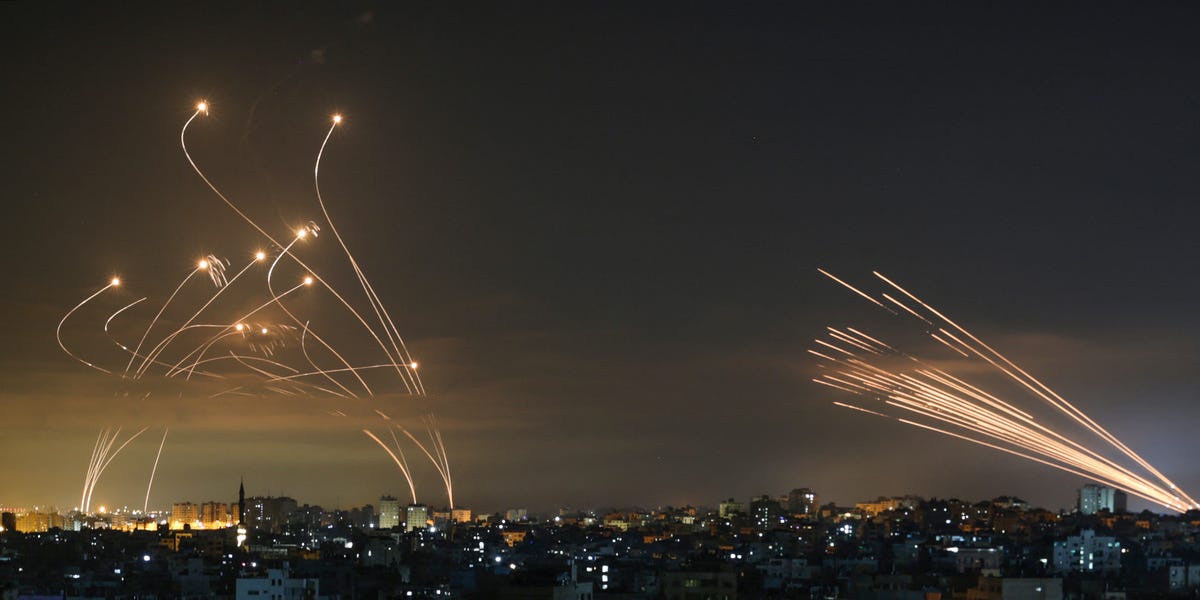
This helps explain why footage of Iron Dome interceptions often looks like sudden flashes or bursts in the sky rather than a clean, cartoonish “one missile bonks another missile.” Real interception is messier, faster, and governed by geometry, timing, and blast effects.
It also explains why debris can still fall to the ground after an interception. The goal is to prevent the rocket from reaching its intended target intact, not to make it vanish like a magician’s rabbit.
How Iron Dome Fits into Israel’s Larger Air Defense Network
Iron Dome gets the headlines, but it is only one layer in a broader layered air defense system. Israel also relies on other systems for different kinds of threats. David’s Sling covers larger or medium-range threats. Arrow is designed for longer-range ballistic missile threats higher up. Other assets, including systems such as Patriot and newer laser-related efforts, also fit into the wider defensive picture.
This layered structure matters because the Middle East threat environment is mixed. A short-range rocket from nearby territory is not the same challenge as a ballistic missile coming from much farther away. Iron Dome is excellent at the first problem. It is not the main answer to the second.
That is why major regional attacks often lead to an important clarification in news coverage: when people say “Israel’s air defenses responded,” that does not mean Iron Dome alone did all the work. In some cases, especially against larger ballistic threats, other layers of defense do much of the heavy lifting.
How Effective Is Iron Dome?
Iron Dome is widely regarded as highly effective against the kinds of threats it was designed to stop. Israeli officials and defense companies have repeatedly cited interception rates above 90 percent for rockets deemed likely to hit populated areas. Analysts broadly agree that the system has changed the battlefield and saved lives, even though experts sometimes debate exact performance numbers and how success should be measured.
That debate is normal. Measuring missile defense performance is complicated. Do you count all rockets fired, or only those predicted to hit populated areas? Do you count a successful intercept only when the incoming projectile is completely destroyed, or also when it is sufficiently disrupted to prevent major harm? Those questions matter, and different analysts may define success differently.
Still, the bigger point is hard to miss: Iron Dome has reduced casualties, lowered damage, and bought time for decision-makers during conflicts. It has not made rocket attacks harmless, but it has made them less catastrophic than they otherwise could be.
Why Iron Dome Matters Strategically
Iron Dome does more than knock rockets out of the sky. It also changes strategy and politics. When a country can blunt short-range rocket attacks, it gains time to mobilize, warn civilians, and make military or diplomatic decisions under slightly less panic. That does not remove danger, but it can reduce pressure for immediate escalation.
There is also a psychological effect. Civilian populations living under rocket threat do not experience defense systems as abstract engineering diagrams. They experience them as sirens, shelter runs, flashes overhead, and the hope that the loud boom in the sky means something did not hit the ground.
In that sense, Iron Dome is as much about civilian protection and national resilience as it is about missile interception. It gives communities a measure of breathing room in situations where seconds matter.
The System’s Limits and Challenges
For all its strengths, Iron Dome is not perfect. No air defense system is. One major challenge is saturation. If enough rockets are fired at once, especially from multiple directions, even a sophisticated defense system can be stressed. That risk became part of the global conversation during major barrages in recent years.
Another limit is scope. Iron Dome is designed for short-range threats, not every category of missile or aircraft. It also protects limited geographic areas, which means placement matters. A battery can defend a city or key zone, but it does not wrap the entire country in one seamless shield.
Then there is the cost equation. Attackers can launch relatively cheap rockets, while defenders respond with expensive interceptors and a complex support system. Even when defense works, war remains financially and logistically exhausting.
So, yes, Iron Dome is impressive. No, it is not invincible. And yes, the phrase “rocket defense system” still does not mean residents can casually continue brunch while sirens are sounding. Pancakes can wait.
What Civilian Experience Around Iron Dome Often Feels Like
To understand Iron Dome fully, you have to step away from launchers and radars for a moment and think about the people living underneath the system. For civilians, Iron Dome is not just a defense technology. It is part of the rhythm of emergency life.
In areas exposed to rocket fire, the experience can begin with an alert siren that cuts through ordinary routine. A family may be eating dinner, helping with homework, standing in line at a store, or half-awake at dawn. Suddenly, everything narrows into a short checklist: move fast, get to shelter, count the seconds, keep the children close, listen, wait. The technical brilliance of Iron Dome happens overhead, but the human experience happens on the ground, in stairwells, safe rooms, hallways, and reinforced shelters.
For many residents, the system creates a strange combination of reassurance and tension. Reassurance, because they know there is a defensive layer watching the sky. Tension, because even an effective defense system is not a promise that every threat will be stopped. People may hear the outgoing interceptors, then the muffled boom of an interception, then the all-clear later. Over time, that sequence becomes recognizable. It can also become exhausting.
Parents often describe a version of life divided into tiny windows of normalcy. Children still go to school. Adults still go to work. Weddings still happen. Grocery shopping still exists, because civilization stubbornly insists on needing milk. But each routine can be interrupted. Iron Dome helps preserve normal life, yet it also becomes a reminder that normal life is being actively defended.
There is also the visual experience. During nighttime attacks, people sometimes see bright arcs and bursts overhead. From a distance, those interceptions can look almost surreal, even beautiful in the way dangerous things sometimes are. But nobody living under them mistakes beauty for safety. Every flash in the sky is connected to an incoming threat, an alarm, and the possibility of debris falling somewhere below.
Psychologically, Iron Dome can reduce fear without eliminating it. That may be its most human effect. It gives people a chance, a margin, a better probability. It can lower casualties and soften the shock of mass rocket fire. But it cannot erase uncertainty, grief, or the stress of repeated alerts. People still lose sleep. Businesses still close. Children still learn the geography of shelter locations much earlier than any child should.
In that sense, the real experience of Iron Dome is not triumphalist. It is practical. It is a system that helps people survive terrible minutes. It buys time, protects neighborhoods, and changes outcomes. But it also exists because civilians are living within range of war. The technology is impressive. The reason it is needed is tragic.
Final Thoughts
So, how does Israel’s Iron Dome rocket defense system work? At its core, it combines radar detection, trajectory analysis, selective targeting, and fast interceptor launches to stop short-range rockets that threaten people and infrastructure. Its real genius is not just that it shoots things down. It is that it decides, very quickly and very intelligently, which threats actually need to be stopped.
That combination of speed, selectivity, and layered integration is what made Iron Dome one of the most discussed air defense systems in the world. It is not perfect, and it is not a cure for conflict. But as a defensive technology, it has changed the security equation for Israel and shaped how the world thinks about protecting civilians from short-range rocket attacks.
In plain English: Iron Dome works by turning incoming chaos into a math problem, then solving that problem at high speed with radar, software, and interceptors. Which is about as close as real life gets to a science-fiction shield, minus the soundtrack.