At first glance, “TEA laser” sounds like something a very intense British scientist would offer at 4 p.m. “Care for a nice cuppa?” “Yes, Earl Grey, two sugars, and please make it emit a nanosecond pulse.” Unfortunately, a TEA laser does not steep leaves, improve biscuits, or calm anyone’s nerves. In fact, it does the opposite: it uses a fast, high-voltage electrical discharge to excite gas at atmospheric pressure and produce an extremely brief, energetic laser pulse.
The name TEA stands for transversely excited atmospheric. That phrase may not fit neatly on a coffee mug, but it explains the whole trick. Instead of sending electricity along the length of a low-pressure laser tube, a TEA laser applies a powerful discharge across the gas, from one side to the other. The gas is usually at or near normal air pressure, and the excitation happens in a rapid pulse rather than a gentle continuous glow.
TEA lasers are most commonly associated with carbon dioxide lasers and nitrogen lasers. A TEA CO2 laser typically emits infrared light around the 9–11 micrometer region, while a TEA nitrogen laser is famous for ultraviolet output near 337 nanometers. Translation for the non-laser crowd: one makes invisible heat-rich infrared pulses, and the other makes invisible ultraviolet pulses that can excite fluorescence. Both are fascinating. Both are serious laboratory instruments. Neither belongs next to your toaster.
What Is a TEA Laser?
A TEA laser is a gas laser designed to work at atmospheric pressure or higher pressure while producing short, powerful pulses. The “transverse” part means the electrical field crosses the laser medium sideways, between electrodes placed along the laser channel. The “atmospheric” part means the gas does not need the same deep vacuum environment required by many low-pressure gas lasers.
That matters because gas density affects how many molecules are available to be excited. At atmospheric pressure, there are many molecules packed into the discharge region. If the system can excite them quickly and uniformly, it can create a sudden burst of light with high peak power. The catch is that high-pressure gas discharges are unruly. Given the chance, they would rather become an arc, spark, or tiny indoor lightning tantrum than a smooth laser-pumping glow.
This is why TEA lasers are pulsed. The discharge happens quickly, before the gas has time to collapse into an unstable arc. In many systems, preionization is used to prepare the gas so the electrical discharge spreads more evenly. Think of it as giving the gas a polite heads-up before the main event: “Brace yourself, the thunderclap is coming.”
Why the Name Sounds Cozy but the Device Is Not
The joke in the title works because “TEA laser” sounds harmless. It is not. A TEA laser can involve high-voltage capacitors, fast discharge circuits, ultraviolet or infrared beams, ozone-producing electrical activity, bright plasma, noise, and optical radiation that may be completely invisible to the human eye. This combination is exactly why TEA lasers are taught, operated, and studied in controlled laboratory settings rather than treated as casual weekend gadgets.
Invisible laser radiation is especially tricky. Visible light at least gives your brain a chance to say, “Hmm, that bright dot seems suspicious.” Ultraviolet and infrared beams do not offer the same courtesy. A TEA nitrogen laser’s ultraviolet output can be hazardous to eyes and skin. A TEA CO2 laser’s infrared output is strongly absorbed by water-rich materials, including biological tissue. In other words, your cornea does not care that the beam looks like nothing. Nothing can still hurt.
How a TEA Laser Works, Without Turning This Into a Wiring Manual
The basic physics is elegant. A gas is placed between electrodes. A very fast electrical pulse energizes the gas. Electrons accelerated by the electric field collide with gas molecules and push them into excited states. When enough molecules are excited in the right way, the laser medium can amplify light through stimulated emission. Mirrors or optical feedback guide that amplification into a beam or pulse.
The Transverse Discharge
In a conventional long gas laser, electricity may be applied along the length of the tube. At high pressure, that would require an impractically large voltage and would be difficult to keep uniform. A TEA design shortens the discharge path by applying the field across the gas channel. This transverse geometry helps excite a larger volume of gas quickly.
The Atmospheric-Pressure Advantage
Operating around atmospheric pressure allows a dense gain medium. More gas molecules can mean more stored energy for a brief pulse. That is one reason TEA CO2 lasers became attractive for applications that need high peak power, such as material processing, remote sensing, and pulsed infrared experiments.
The Pulse Is the Point
TEA lasers are not known for lounging around in continuous-wave mode. They are sprinters. A TEA CO2 laser may produce pulses measured in tens or hundreds of nanoseconds, sometimes with a longer tail depending on the gas mixture and system design. A TEA nitrogen laser can produce ultraviolet pulses on the nanosecond scale. The useful feature is not just the average power; it is the sharp, concentrated delivery of energy.
TEA Nitrogen Lasers: The Ultraviolet Flash Mob
The TEA nitrogen laser is one of the most approachable concepts in gas-laser physics, though “approachable” here means intellectually approachable, not “please build one next to your laundry basket.” Nitrogen molecules emit strongly around 337.1 nanometers, in the ultraviolet. That wavelength is useful because many materials fluoresce when excited by UV light.
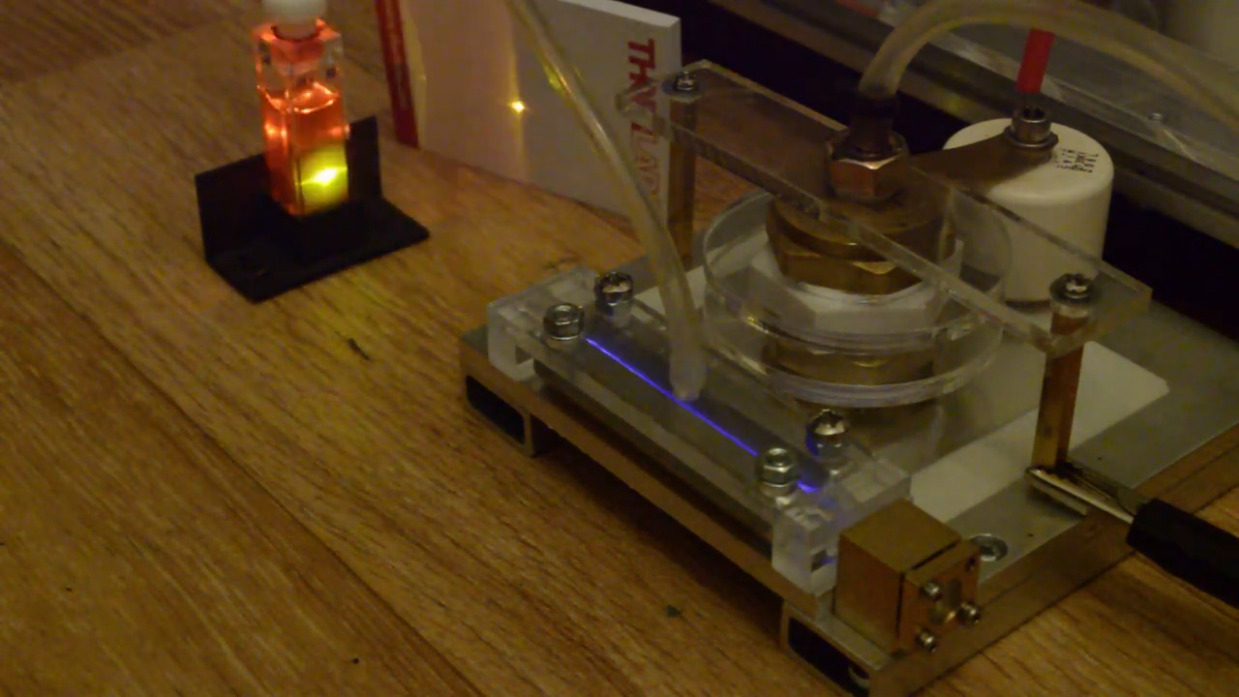
In demonstrations, a nitrogen laser pulse can make certain dyes, papers, plastics, and minerals glow. It can pump dye lasers, trigger fluorescence measurements, and help students understand fast pulsed discharges. The pulse is extremely brief, which makes nitrogen lasers valuable in time-resolved experiments where researchers care about events happening faster than a camera shutter can blink.
The simplicity of the nitrogen molecule is part of the appeal. Nitrogen is everywhere in air, but making it lase requires a fast electrical event that excites the right molecular transition before energy drains away. The upper laser state has a very short useful lifetime at atmospheric pressure, so the system must act quickly. A slow electrical pulse would be like trying to photograph a hummingbird with a sundial.
TEA CO2 Lasers: The Infrared Heavy Lifter
CO2 lasers are among the most important gas lasers ever developed. They emit in the infrared, commonly near 10.6 micrometers, with related lines in the 9–11 micrometer region. A TEA CO2 laser takes that familiar carbon dioxide laser chemistry and adapts it to high-pressure pulsed operation.
In a CO2 laser gas mixture, nitrogen plays a helpful supporting role. Electrical energy excites nitrogen molecules, and those molecules transfer energy to carbon dioxide molecules. The carbon dioxide then participates in the laser transition. Helium is often used to help remove heat and improve energy transfer. It is a molecular relay race, except the baton is energy and the finish line is an infrared pulse.
TEA CO2 lasers have been studied for material processing, spectroscopy, lidar, laser-induced breakdown experiments, and specialized medical or dental research. Their short pulses can deliver energy rapidly to a surface, creating ablation, heating, acoustic waves, or plasma depending on the target and conditions. That makes them useful but also demanding. Controlling pulse shape, beam quality, gas flow, electrode design, and safety systems is not optional; it is the difference between a useful instrument and an expensive spark machine.
Where TEA Lasers Are Used
1. Atmospheric Sensing and Lidar
Lidar, short for light detection and ranging, uses laser pulses to measure distance, motion, aerosols, gases, or atmospheric structure. TEA CO2 lasers have been used in coherent infrared lidar research because their wavelengths can interact with atmospheric molecules and aerosol backscatter. In wind and turbulence studies, a pulsed infrared laser can help researchers analyze Doppler shifts and atmospheric movement.
2. Material Processing
Because TEA CO2 lasers can deliver high peak power, they are useful for studying how surfaces respond to rapid infrared heating. Depending on the pulse energy and material, a TEA pulse can remove material, modify surface texture, generate ultrasound, or create a plasma plume for analysis. This has made TEA lasers relevant in research on polymers, metals, ceramics, and coatings.
3. Spectroscopy and Fluorescence
A TEA nitrogen laser’s ultraviolet pulse can excite fluorescence in dyes and other materials. That makes it useful in spectroscopy, where scientists examine how substances absorb and emit light. In older laboratory setups, nitrogen lasers were often paired with dye lasers because the UV pulse could pump a dye medium and generate tunable visible light.
4. Dental and Biomedical Research
Pulsed CO2 lasers around 9.3 and 9.6 micrometers have been studied for interactions with enamel, dentin, and composite materials. The appeal is that certain dental hard tissues absorb these infrared wavelengths strongly, which can make precise ablation possible under controlled conditions. That does not mean a TEA laser is a magic dentist wand. It means researchers study wavelength, pulse energy, cooling, scanning speed, and thermal effects very carefully.
5. Education and Demonstration
TEA lasers are visually and conceptually dramatic, so they have long fascinated physics educators. They connect electromagnetism, molecular energy levels, gas discharge physics, optics, pulsed power, and safety engineering in one memorable package. Few devices can teach so many lessons while sounding like a beverage.
Why TEA Lasers Are So Interesting
The charm of a TEA laser is that it sits at the intersection of several scientific personalities. It has the elegance of quantum physics, the crackle of electrical engineering, the practicality of industrial optics, and the temperament of a cat near bathwater. Everything has to happen quickly and evenly. The discharge must be uniform. The gas must be right. The optics must be aligned. The electrical pulse must arrive with authority but not chaos.
That balance is why TEA lasers are still discussed in classrooms, labs, and maker-adjacent science writing. They show that a laser is not simply “a bright light.” A laser is a system. Change the pressure, the gas mixture, the electrode geometry, the pulse duration, or the optical cavity, and the result can shift from clean laser action to no output at all. The same device can be a precision instrument or a very fancy noisemaker.
Safety: The Part That Deserves Zero Jokes
TEA lasers deserve respect. The hazards are not limited to the beam. In fact, many laser accidents involve non-beam hazards such as electrical shock, charged capacitors, fire, fumes, compressed gases, and mechanical failures. High-voltage pulsed systems can remain dangerous even after power is switched off because capacitors may retain charge. That is why professional laser safety programs emphasize training, interlocks, controlled areas, warning signs, beam enclosures, protective eyewear matched to wavelength, and written procedures.
There is also the issue of beam visibility. Nitrogen laser output in the UV and CO2 laser output in the IR are outside normal human vision. A person cannot rely on seeing the beam to avoid exposure. Reflections can also be hazardous, especially from shiny surfaces. In a lab, “I didn’t see anything” is not evidence of safety. It may be evidence that the beam is exactly the kind you should worry about.
For readers curious about TEA lasers, the safest path is study, simulation, supervised demonstrations, and reputable laboratory courses. Reading about pulsed gas lasers is delightful. Improvising one without training is not delightful; it is how science becomes a cautionary PowerPoint slide.
How TEA Lasers Compare With Everyday Lasers
Most people encounter lasers as barcode scanners, laser pointers, fiber-optic communication sources, measuring tools, or cosmetic devices. These systems are usually engineered for predictable operation and packaged to reduce exposure risk. A TEA laser is different. It is often a pulsed laboratory or industrial system with a complex relationship between gas discharge, optics, and high-voltage electronics.
A laser pointer may produce a small continuous visible beam. A TEA laser produces short pulses that may be invisible and intense. A diode laser may run from compact electronics. A TEA system may involve charged pulse-forming networks and specialized discharge geometry. A consumer device hides most of its drama. A TEA laser is the drama.
Common Misunderstandings About TEA Lasers
Misunderstanding 1: “Atmospheric” Means It Uses Ordinary Air
Sometimes a TEA nitrogen laser can use nitrogen in air as the active medium, but “atmospheric” mainly describes pressure, not necessarily gas composition. Many TEA lasers use carefully selected gas mixtures. In CO2 systems, the gas mixture is central to performance.
Misunderstanding 2: “Pulsed” Means Low Power
Pulsed lasers can have modest average power but extremely high peak power. Imagine gently dripping water into a cup versus blasting the same amount through a pressure washer for a split second. The total water may be small; the momentary impact is not.
Misunderstanding 3: “Invisible” Means Harmless
This is the most dangerous misunderstanding. Invisible wavelengths can still damage eyes, skin, and materials. UV and IR lasers require engineering controls precisely because the body’s normal blink-and-look-away reflex may not help.
Why the TEA Laser Still Has a Cult Following
TEA lasers have a special place in science culture because they feel almost theatrical. They produce fast pulses, sharp electrical sounds, flashes of discharge, and measurable optical effects. They also reward careful thinking. Every improvement in electrode shape, preionization, gas handling, pulse shaping, and optical alignment can change performance.
For physics students, a TEA laser is a compact lesson in how nature negotiates with engineering. Molecules have energy levels. Electrons have collision probabilities. Gas pressure changes timing. Optics demand alignment. Safety systems demand discipline. The laser works only when all of these characters agree to appear in the same scene.
Practical Experiences and Lessons From the World of TEA Lasers
The first experience many people have with a TEA laser is not actually seeing the beam. That surprises them. They expect a glowing sci-fi ray, perhaps accompanied by a dramatic “pew-pew.” Instead, the most visible part may be the electrical discharge or the fluorescence of a target card or dye. The laser pulse itself may be ultraviolet or infrared, completely outside normal vision. The lesson arrives quickly: optics is not always about what your eyes can see.
In educational settings, TEA lasers are memorable because they make abstract physics feel physical. A student may read about population inversion for weeks and still feel as if the idea belongs in a textbook cave. Then a supervised demonstration shows a gas discharge producing a brief UV pulse that makes fluorescent material glow, and suddenly the concept has a personality. The molecules were excited, the light was amplified, and the room quietly admits that quantum mechanics has excellent stage presence.
Another common lesson is humility. TEA lasers are sensitive systems. A tiny change in alignment, gas quality, electrode condition, humidity, or pulse timing can alter performance. This teaches students and researchers that experimental physics is not just knowing equations. It is listening to equipment, documenting changes, respecting uncertainty, and resisting the urge to blame “bad luck” when the real issue is a slightly dirty optic or unstable discharge.
There is also a powerful safety lesson. TEA lasers remind everyone that impressive science often comes with hazards that are not obvious. A quiet capacitor can be more dangerous than a bright flash. An invisible beam can be more hazardous than a visible one. A reflective tool on the bench can create an unexpected path for radiation. The best laboratories treat safety not as paperwork but as part of the experiment itself. Good safety practice is not the opposite of exciting science; it is what allows exciting science to happen more than once.
For writers, educators, and curious readers, the TEA laser is a perfect example of how a technical topic can be both serious and fun. The name invites a joke, but the technology invites respect. It connects atmospheric pressure, gas molecules, high-voltage pulses, laser cavities, spectroscopy, materials science, and remote sensing. That is a lot of science packed into three letters.
So, how about a nice cuppa TEA laser? As a metaphor, absolutely. As a topic, it is delicious. As a hands-on device, it belongs in a properly equipped lab with trained people, controlled access, correct eyewear, beam management, interlocks, and a healthy fear of charged capacitors. The best way to enjoy this particular cup of TEA is with curiosity, caution, and maybe an actual mug of tea safely outside the lab.
Conclusion
A TEA laser is one of those rare technologies whose name sounds cute while the physics is anything but ordinary. Transversely excited atmospheric lasers use fast electrical discharges to excite dense gas and generate short, energetic pulses. Nitrogen versions produce ultraviolet light around 337 nanometers, while CO2 versions produce infrared pulses useful in research, sensing, and materials work. Their value comes from speed, peak power, and wavelength-specific interactions with matter.
The real takeaway is simple: TEA lasers are not novelty gadgets. They are serious pulsed gas lasers that reveal how much engineering is required to make light behave. They are useful, dramatic, educational, and potentially hazardous. In the right hands and the right lab, they are brilliant tools. In the wrong setting, they are a reminder that not every cup of tea should be brewed at several thousand volts.