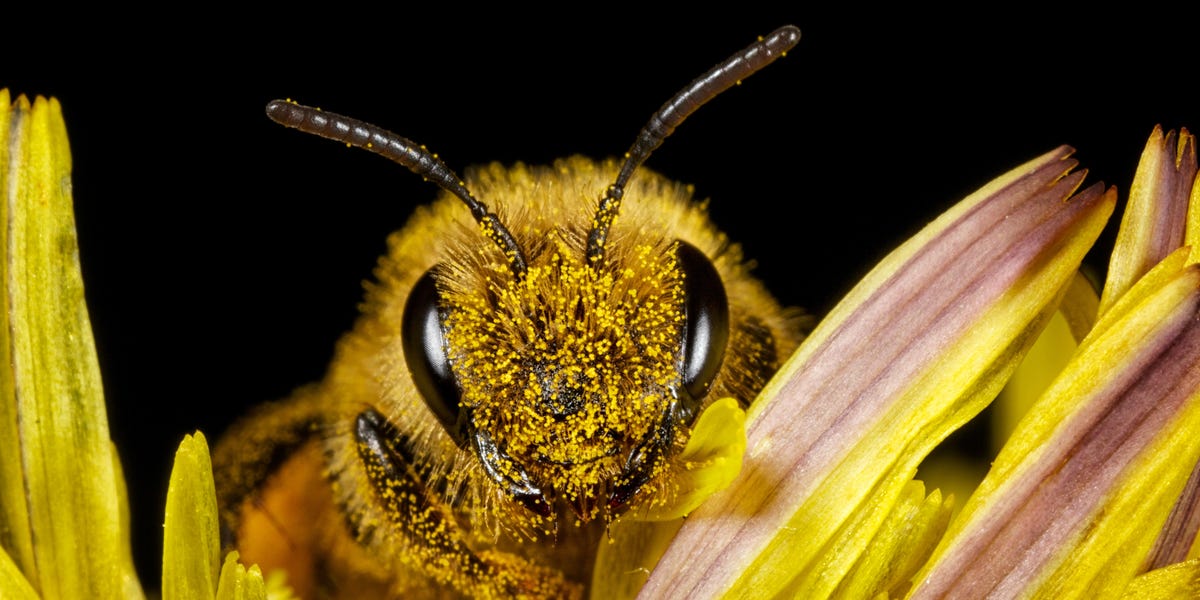
Honeybees already have an impressive résumé. They pollinate crops, navigate across complex landscapes, communicate the location of food, remember rewarding flowers, and manufacture a snack that humans have been stealing for thousands of years. Apparently, that was not enough. Researchers have now shown that honeybees can also learn to separate groups of objects into odd and even quantities.
Yes, bees can tackle a basic mathematical classification that many people first encounter in elementary school. They do not write equations, carry tiny calculators, or complain that math will never be useful after graduation. Instead, trained bees learn that certain quantities belong in one category and other quantities belong in another.
The discovery adds to growing evidence that numerical cognition does not necessarily require a large mammalian brain. A honeybee brain contains fewer than one million neurons, yet it supports learning, memory, navigation, visual categorization, quantity discrimination, and surprisingly flexible problem-solving. The odd-versus-even experiment suggests that a miniature nervous system can learn an abstract rule and apply it to unfamiliar examples.
What Does It Mean to Recognize Odd and Even Numbers?
An even number can be divided into two equal whole-number groups. Two, four, six, eight, and ten are familiar examples. An odd number leaves one item unpaired: one, three, five, seven, and nine.
Humans usually determine paritythe mathematical term for whether a number is odd or evenby recalling a rule. If the last digit is 0, 2, 4, 6, or 8, the number is even. Otherwise, it is odd. That shortcut depends on symbolic numerals and formal education.
Honeybees were not shown Arabic digits. They saw collections of black geometric shapes on white cards. A display might contain three circles, six triangles, or nine squares. The bees therefore had to classify quantities rather than recognize familiar written symbols.
This distinction matters. Memorizing the appearance of the numeral “8” would be a pattern-recognition task. Learning that many different arrangements containing eight objects belong in the same category as displays containing two, four, six, or ten objects is considerably more flexible.
How Scientists Taught Honeybees an Odd-Even Rule
The experiment involved 26 free-flying western honeybees, or Apis mellifera, recruited from more than 25 hives maintained at Paul Sabatier University in Toulouse, France. Each foraging bee was marked with a colored dot so researchers could identify and test individuals.
The insects visited a rotating experimental screen fitted with small landing platforms. Above each platform was a card displaying between one and ten black geometric elements. The shapes included circles, squares, diamonds, and triangles, and their positions and orientations varied.
Sugar for Correct Choices, Bitterness for Mistakes
The bees were divided into two equal groups. Thirteen were trained to select displays containing an even number of elements. The other thirteen were rewarded for choosing displays containing an odd number.
A correct landing provided a drop of concentrated sugar solution. An incorrect choice delivered a drop of quinine solution, which tastes bitter to bees. In other words, the insects received the educational equivalent of dessert for a correct answer and unsweetened disappointment for a wrong one.
This combination of reward and aversive feedback is important. Previous research has found that honeybees often perform more difficult quantity-discrimination tasks when they receive information about both correct and incorrect decisions. A reward alone may not generate enough attention to reveal the full extent of their learning ability.
The position of the correct card changed repeatedly, preventing the bees from simply learning “always turn left.” The equipment was cleaned between choices to remove scent marks, and the geometric patterns were varied so the insects could not succeed by memorizing one picture.
Controlling for Visual Shortcuts
Quantity experiments can be tricky because animals may respond to non-numerical features. A display with ten shapes might contain more black area, more edges, greater density, or a larger overall boundary than a display with three shapes.
The researchers designed the odd-even task so that cues associated with increasing magnitude would not reliably reveal the answer. An even quantity was not always larger than the odd alternative. Sometimes the rewarding choice contained fewer elements, and sometimes it contained more.
The total black surface area was also controlled, while the shapes, configurations, and rotations changed. Researchers analyzed symmetry and spatial-frequency information and found no systematic difference that would neatly separate the odd images from the even ones.
These controls cannot prove that the bees used the same mental procedure humans use. However, they make several simple explanationssuch as choosing the darker card, the denser card, or the side containing more objectsmuch less convincing.
What the Honeybees Learned
Before training, the bees showed no meaningful natural preference for odd or even quantities. Their later choices were therefore the result of learning rather than an unexplained attraction to one category.
Training continued until an individual achieved at least 80 percent correct choices across a block of ten trials. Every bee reached that criterion within 70 choices. Interestingly, bees rewarded for odd quantities learned faster than bees rewarded for even quantities.
Humans often show the opposite pattern, responding more quickly or accurately to even numbers in parity tasks. The reason for the bee asymmetry is unknown. It could reflect the learning procedure, a feature of how insects process groups of objects, or ordinary variation in a relatively small experiment.
The Critical Test: New Numbers and New Patterns
Learning during training was only the first hurdle. A bee could theoretically memorize particular rewarded pictures without understanding a broader category. To examine that possibility, the researchers tested the insects with new arrangements and shapes.
Some tests used quantities between three and eight that had been withheld from an individual bee during training. The bees still chose the category associated with sugar more often than chance would predict.
The most revealing test presented 11 objects against 12 objects. Both quantities were outside the original training range of one through ten. The cards also used novel patterns and shapes, and no sugar or quinine indicated which answer was correct during the test.
Bees trained to select even quantities chose the 12-element display correctly about 73 percent of the time. Bees trained to select odd quantities chose the 11-element display correctly about 69 percent of the time. Those percentages are not perfect, but they are significantly better than the 50 percent expected from random guessing.
Successful transfer to 11 and 12 is especially important because it suggests the bees were not merely memorizing a list of rewarded quantities. They applied something learned from the training examples to quantities they had never encountered in the experiment.
Does This Mean Bees Understand Mathematics Like Humans?
Noor at least the experiment does not establish that conclusion. Saying that honeybees can learn to categorize odd and even quantities is different from saying they understand parity through conscious mathematical reasoning.
The researchers explicitly avoided claiming that the bees counted every element and performed a human-style division-by-two calculation. Several simpler mechanisms could produce the observed behavior.
Possible Strategies Used by the Bees
One possibility is sequential pairing. A bee might visually inspect objects one at a time, mentally switching between two states as each object is encountered. If every element has a partner, the result is even. If one remains unpaired, the result is odd.
Another possibility is alternating category learning. Moving through the sequence from one to ten creates a repeating pattern: odd, even, odd, even. A nervous system might learn that alternation without representing parity in the rich symbolic way humans do.
The bees might also have learned families of visual relationships that researchers have not identified. Animal cognition studies must always consider whether the subject found a shortcut that humans overlooked. Nature is full of excellent test-takers who ignore the intended lesson and discover a cheaper route to the reward.
Still, a shortcut is not the same as no cognition. Finding an efficient solution, storing a rule, and applying it to new stimuli are themselves meaningful abilities. The important question is not whether a bee solves the problem exactly as a person would. It is how such a compact biological system achieves flexible behavior at all.
Honeybees Have a Growing Record of Numerical Skills
The parity study did not appear in isolation. Earlier experiments had already shown that honeybees can discriminate between different quantities, choose a greater or smaller set, and improve their performance when training includes both rewards and penalties.
In one influential study, bees trained to choose the smaller quantity correctly placed an empty set below sets containing one or more elements. This suggested that they could treat “nothing” as a quantity positioned at the lower end of a numerical sequencethe foundation of a basic zero concept.
Other research trained bees to associate colors with arithmetic instructions. Blue indicated that they should select a quantity one greater than the sample, while yellow indicated one less. After extensive training in a Y-shaped maze, the bees applied these addition and subtraction rules to unfamiliar examples at rates above chance.
Honeybees have also learned relationships between abstract symbols and small quantities. Together, these findings show that their numerical abilities are not limited to choosing whichever flower patch appears to contain more blossoms.
A 2026 methodological analysis added further support to the field by reexamining claims that bees might merely respond to low-level visual patterns. When researchers modeled the stimuli according to honeybee sensory and visual constraints rather than human vision, sensitivity to number remained. The result emphasizes a crucial principle: animal intelligence should be tested from the animal’s perceptual point of view.
How Can a Tiny Bee Brain Handle the Task?
A honeybee brain has fewer than one million neurons. A human brain has roughly 86 billion. Comparing those totals might make insect cognition seem impossible, but neuron count alone does not determine what a nervous system can accomplish.
Small brains face strong pressure to operate efficiently. Bees must navigate, recognize landmarks, evaluate flowers, remember locations, regulate flight, communicate, and return to the correct colony. They cannot afford computational extravagance. Their neural circuits have to be compact, specialized, and extremely economical.
To explore how little processing might be needed for parity classification, the odd-even study’s authors built a simple artificial neural network containing only five modeled neurons. The network was not presented as a biological map of the honeybee brain. It was a proof of principle showing that the task does not automatically require a huge computational system.
The network could classify sequences containing up to 40 input events as odd or even. Its design effectively switched internal states as new events arrived, demonstrating how parity could emerge from simple repeated operations rather than advanced symbolic thought.
Other modeling research has shown that a four-neuron artificial circuit can estimate small quantities when objects are inspected sequentially. Movement may therefore be part of the computation. Instead of processing an entire scene at once, a bee can fly close to objects and scan them individually, simplifying what the nervous system must calculate.
Why Honeybee Numerical Cognition Matters
It Challenges Assumptions About Intelligence
Humans have traditionally treated large brains as the admission ticket to sophisticated thought. Honeybee research complicates that story. Some behaviors that look computationally demanding may be produced by small circuits, active sensing, efficient memory, and carefully learned rules.
This does not make human mathematics ordinary. People create symbolic notation, prove theorems, teach algebra, and argue online about whether a viral equation equals one or nine. Bee cognition is different. Yet the building blocks of categorization and quantity processing may be more widespread in nature than previously believed.
It Can Inspire Efficient Artificial Intelligence
Modern artificial intelligence often relies on enormous datasets, energy-hungry hardware, and networks containing millions or billions of adjustable parameters. Honeybees offer a contrasting design philosophy: achieve useful behavior with limited resources.
Bee-inspired systems could contribute to low-power robotics, autonomous navigation, compact sensors, and neuromorphic computing. A small flying robot cannot carry a data center on its back. It needs efficient algorithms that transform movement and sensory input into rapid decisions.
The five-neuron parity model does not provide an instant blueprint for revolutionary AI. It does, however, show why biological cognition deserves attention from engineers. Sometimes the smartest design is not a larger processor but a better-organized problem.
It Improves the Study of Animal Minds
The research also demonstrates how training methods shape scientific conclusions. A bee that fails a poorly designed test may not lack the relevant ability. The task may be visually confusing, insufficiently motivating, or mismatched with the way the animal samples information.
Scientists must control obvious shortcuts while allowing subjects to use their natural senses and movements. Experiments should test what an animal can learn without assuming that every species perceives the world like a human staring at a computer screen.
What the Study Does Not Prove
The experiment included only 26 bees, so replication with larger groups and other laboratories would strengthen confidence in the effect. Researchers also need to test other bee species and non-bee insects to determine how widespread parity learning might be.
The study did not locate a specific “odd-number neuron” inside the honeybee brain. The five-neuron artificial network demonstrated computational simplicity, not biological anatomy.
Nor did the results prove that parity classification has a natural role in honeybee life. Bees may never need to distinguish seven flowers from eight because one quantity is odd and the other is even. The task is scientifically valuable precisely because it tests the flexibility of the brain beyond an obvious ecological routine.
Finally, above-chance performance is not flawless understanding. The bees made many errors. Their success shows learnable categorization, not mastery equivalent to a human who can instantly identify whether 4,672 is even.
Experience Perspective: Watching a Bee Learn a Number Rule
The following is an illustrative, researcher-style account based on the published experimental procedure rather than a claim of personal participation.
Imagine standing near an outdoor testing station on a warm morning. The apparatus does not look like a classroom. There is no chalkboard, no desk, and certainly no miniature teacher asking everyone to turn to chapter four. A circular screen holds several cards decorated with black shapes. A marked honeybee approaches, circles briefly, and lands beneath one display.
At first, its decisions appear unpredictable. It touches a platform beneath six shapes and finds bitter quinine. It backs away almost immediately. On another attempt, it lands beneath three shapes and discovers sugar water. The reward is tiny, but to a foraging bee it is useful fuel and a strong reason to remember the encounter.
The bee drinks, flies home, and returns several minutes later. Meanwhile, the cards have been rearranged and the equipment cleaned. The rewarding category remains the same, but its location, shape, and visual pattern have changed. The insect cannot simply repeat a turn or follow its own scent.
After several trips, its behavior begins to look less random. It hovers in front of the alternatives, shifting position as though inspecting the displays. A choice is made. Sometimes it is correct; sometimes the bee receives another bitter surprise. Gradually, correct decisions become more frequent.
What makes the scene memorable is not the suggestion that a bee is reciting “one, three, five, seven, nine” inside its head. There is no evidence of that. The striking part is the change in behavior. A freely flying insect encounters an artificial problem, uses feedback, and becomes better at solving it.
Then comes the transfer test. The familiar training quantities disappear. One card contains 11 elements and another contains 12. The layouts are new, and the platforms provide only water, so the bee receives no clue after landing.
A bee trained on even quantities chooses 12. It may be applying a parity-like rule, pairing objects, alternating an internal state, or using a strategy humans have not discovered. Whatever the mechanism, the choice fits a category that extends beyond the examples used during training.
This imagined observation changes how an ordinary garden can feel. A bee moving between flowers no longer seems like a simple windup machine guided only by instinct. It is an active decision-maker, comparing visual information with memory while managing energy, distance, competition, weather, and the route home.
The experience also offers a lesson about teaching. Performance depends on clear feedback, repeated opportunities, motivation, and a test suited to the learner’s senses. A creature may appear incapable when the real problem is the lesson design. Give it a meaningful reward, remove misleading distractions, and let it approach the problem in its own way; hidden abilities may become visible.
There is also a humbling engineering lesson. Humans often respond to a difficult computation by adding memory, processors, or data. A bee must solve problems while carrying its entire nervous system through the air on a body weighing roughly a fraction of a gram. Efficiency is not a fashionable feature for the bee. It is the price of staying airborne.
Watching that learning processeven through the careful details of the published experimentencourages a different view of intelligence. Intelligence may not always announce itself through language or conscious calculation. Sometimes it appears as a small animal returning from the hive, examining two unfamiliar cards, and making a better choice than chance can explain.
Conclusion
The discovery that honeybees can learn the difference between even and odd quantities expands our understanding of insect cognition. Trained bees classified displays containing one through ten elements and successfully transferred the rule to unfamiliar displays containing 11 and 12.
The results do not prove that bees perform parity calculations exactly like humans. They may rely on sequential inspection, pairing, alternating internal states, or another efficient strategy. What the experiment demonstrates is flexible rule learning in an animal with an extraordinarily compact brain.
Alongside evidence that honeybees can discriminate quantities, order zero, and learn simple addition and subtraction rules, the parity study makes one conclusion difficult to ignore: brain size is not a reliable excuse for underestimating an animal. The next time a honeybee visits the garden, remember that the tiny pollinator may be carrying fewer neurons than expectedand using them remarkably well.