Most childhood photo albums contain birthday cakes, schooleast one vacation picture in which somebody has closed their eyes. Rob Bierman’s collection is slightly different. His family album includes movie stars, championship athletes, legendary musicians, fashion designers, television personalities, and even an astronaut.
Bierman reportedly began this unusual photography journey at six years old after meeting Muhammad Ali at a sports show in Houston. Rob wanted an autograph, but his father suggested taking a photograph instead, telling him that a picture would preserve far more than a signature. That single encounter developed into a lifelong project involving more than 1,800 celebrity meetings and eventually inspired a visual memoir titled Snap Shots. >A 25-photo selection published in 2022 demonstrates just how broad the collection became. Hollywood comedy sits beside professional basketball, country music shares space with space exploration, and Rob somehow looks comfortable in every frame. He was not merely collecting famous faces. He was building a highly personal timeline of American popular culture. 2>Who Is Rob Bierman?
Rob Bierman is a celebrity-photo collector whose archive documents decades of encounters with well-known people. His childhood pictures gradually became adult pictures, allowing viewers to watch both Rob and popular culture change through the years.
Some photographs appear to have been taken at organized signings or public events. Others have the wonderfully unpredictable backgrounds of genuine chance encounters: hallways, sidewalks, stores, parking areas, backstage spaces, and other locations that were clearly not inspected by a Hollywood production designer.
That lack of polish is part of the appeal. The pictures feel less like publicity portraits and more like proof that an extraordinary meeting briefly interrupted an ordinary day. Rob has described himself online as the person photographed with more celebrities than anyone else in the world. That claim is difficult to verify independently, but an archive exceeding 1,800 encounters certainly makes him a formidable contender.
25 Memorable Photos From Rob Bierman’s Celebrity Collection
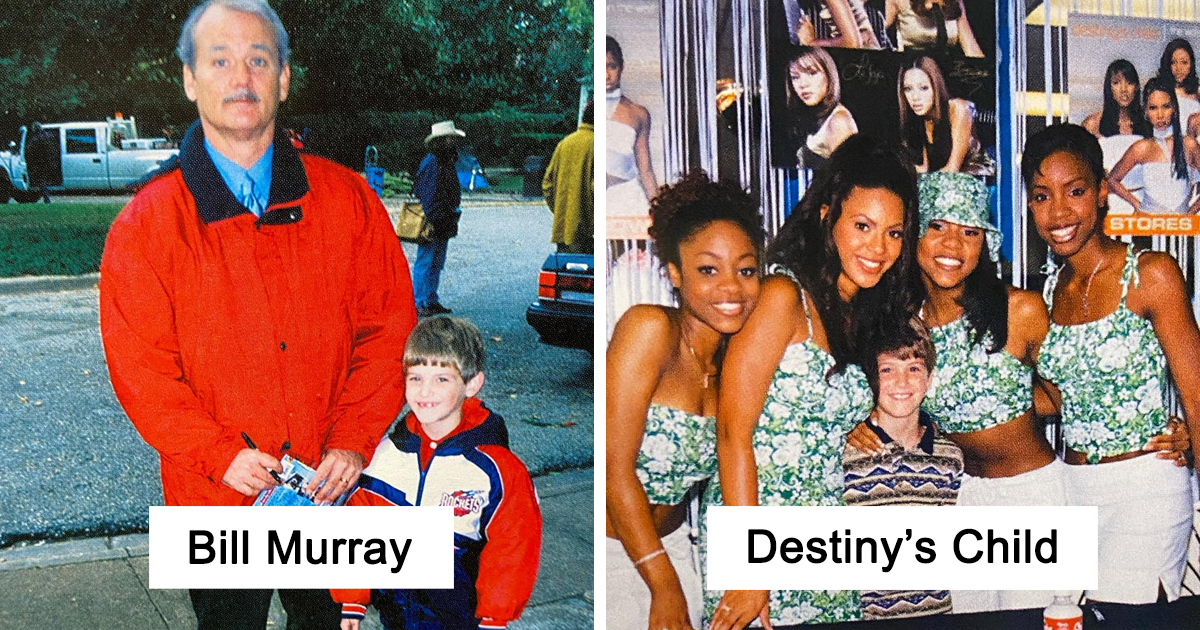
1. Bill Murray
Bill Murray brings his familiar deadpan energy to the collection. Known for moving effortlessly between broad comedy and thoughtful drama, Murray is the kind of celebrity whose expression can make viewers wonder whether he is amused, confused, or quietly planning an elaborate practical joke. Rob, meanwhile, looks delighted simply to have secured the moment.
2. Bruce Willis
The photograph with Bruce Willis captures Rob beside one of Hollywood’s defining action stars. Willis became widely recognized through Moonlighting and the Die Hard movies before appearing in films ranging from Pulp Fiction to The Sixth Sense. The picture offers a softer contrast to the tough characters audiences usually associate with him. 3>3. Dwayne Johnson
Standing beside Dwayne “The Rock” Johnson can make almost anyone look as though the camera’s scale settings need adjustment. The former wrestling superstar became a major movie actor and entertainment personality, but the photograph retains the relaxed atmosphere of a fan meeting rather than a red-carpet event.
4. Destiny’s Child
One celebrity is impressive. An entire hit-making group is considerably more efficient. Rob’s photograph with Destiny’s Child captures a major chapter in late-1990s and early-2000s R&B history. His extra-wide smile suggests that even a veteran celebrity collector occasionally realizes he has achieved a particularly valuable group shot.
5. Eddie Van Halen
Eddie Van Halen transformed rock guitar with his speed, technique, experimentation, and instantly recognizable sound. His presence gives the collection musical significance beyond ordinary fandom. Van Halen was inducted into the Rock & Roll Hall of Fame, placing Rob’s casual-looking picture beside a figure whose influence stretched across generations of guitarists. 3>6. Jon Bon Jovi
Rob also posed with Jon Bon Jovi, frontman of the New Jersey rock band responsible for arena-sized songs and choruses capable of making thousands of strangers sing together. The photograph feels informal, although Bon Jovi’s camera-ready presence suggests that rock stars may possess a built-in portrait mode unavailable to ordinary humans.
7. Michael Jordan
A picture with Michael Jordan would be the crown jewel of many sports collections. Jordan’s basketball career, championships, global popularity, and influence on sneaker culture made him one of the most recognizable athletes in modern history. He entered the Naismith Memorial Basketball Hall of Fame in 2009. 3>8. John Glenn
John Glenn expands the gallery beyond entertainment and professional sports. In 1962, he became the first American to orbit Earth aboard Friendship 7. He later served as a United States senator and returned to space in 1998. Plenty of people have celebrity selfies; considerably fewer have a childhood picture with a member of the Mercury Seven. 3>9. Shaquille O’Neal
The photograph with Shaquille O’Neal offers an unavoidable lesson in perspective. Shaq’s physical presence made him one of basketball’s most dominant centers, while his humor and media career made him recognizable far beyond the court. He joined the Basketball Hall of Fame in 2016, although no hall appears tall enough when he walks into it. 3>10. Bill Russell
Bill Russell represented excellence both on and off the basketball court. The Boston Celtics legend won an extraordinary number of championships and became an important voice on civil rights. Rob’s photograph preserves a meeting with someone whose cultural importance cannot be measured by trophies alone.
11. Willie Nelson
Willie Nelson is instantly identifiable through his braids, guitar, warm personality, and enormous catalog of country standards. Inducted into the Country Music Hall of Fame in 1993, Nelson represents the kind of lasting American icon whose presence gives a personal snapshot genuine historical flavor. 3>12. Goldie Hawn
Goldie Hawn’s cheerful screen persona makes her a natural fit for a collection built around brief, friendly encounters. The Oscar-winning actress rose to prominence through comedy and became known for films including Cactus Flower and Private Benjamin. Her photograph with Rob appears to contain enough smiling energy to power a small suburban neighborhood. 3>13. Terry Bradshaw
Terry Bradshaw became a football legend as the quarterback of the Pittsburgh Steelers dynasty of the 1970s. His strong arm and leadership contributed to four championship seasons before he developed a second public career as a television analyst and entertainer. Rob’s photo catches the personality behind the football résumé. 3>14. Yao Ming
Yao Ming’s warm smile makes this one of the most approachable pictures in the series. The Chinese basketball star became an international ambassador for the sport and entered the Basketball Hall of Fame in 2016. As with Shaq, the photograph also turns Rob into a convenient unit of measurement. 3>15. Naomi and Wynonna Judd
The photograph with Naomi and Wynonna Judd documents one of country music’s most successful family partnerships. The Judds combined close harmonies with songs influenced by traditional folk and acoustic music. Their induction into the Country Music Hall of Fame confirmed the lasting importance of their work. 3>16. Brian Littrell
Brian Littrell represents the era when boy bands ruled radio, television, bedroom walls, and a frightening percentage of teenage conversations. He became a member of the Backstreet Boys after being invited to audition by his cousin Kevin Richardson. Rob’s picture is a compact time capsule of peak pop fandom. 3>17. Tommy Hilfiger
Tommy Hilfiger adds fashion to a collection already crowded with actors, athletes, and musicians. His classic American clothing brand became particularly influential during the 1990s. A photograph with the designer feels appropriate in a gallery that also unintentionally documents several decades of changing shirts, jackets, hairstyles, and extremely confident denim choices.
18. Jenny McCarthy
Rob’s encounter with Jenny McCarthy reflects the world of television appearances, signings, and promotional events that helped his archive grow. The image feels casual and spontaneous, with the sort of background details that remind viewers these meetings were not carefully staged magazine shoots.
19. Nolan Ryan
Nolan Ryan brought intimidating speed and remarkable longevity to professional baseball. The Hall of Fame pitcher became famous for overpowering hitters and recording more career strikeouts than any other major-league pitcher. In Rob’s photograph, however, he looks considerably less intimidating than he did from sixty feet and six inches away.
20. Dirk Nowitzki
Dirk Nowitzki changed perceptions of what a tall international basketball player could do, combining size with elite shooting ability. His long career with Dallas turned him into one of the city’s most beloved sports figures. The picture adds another internationally important basketball star to Rob’s increasingly unbelievable roster.
21. Dusty Baker
Dusty Baker built a long baseball life as both a player and manager. That dual career means different generations recognize him for different reasons. His inclusion demonstrates one of the collection’s strengths: Rob did not limit himself to the most obvious movie stars. He also photographed respected figures whose achievements reward knowledgeable fans.
22. Roger Clemens
Roger Clemens was one of the most dominant pitchers of his era, known for powerful performances and multiple major awards. The older clothing and styling in the photograph also reveal an entertaining side effect of Rob’s project: every celebrity picture eventually becomes a fashion-history exhibit, whether it intended to or not.
23. Bill Fitch
Bill Fitch gives the series another layer of basketball history. The longtime professional coach was known for rebuilding teams and was inducted into the Basketball Hall of Fame as a coach in 2019. His appearance shows that Rob collected encounters with influential leaders behind the action, not only the players receiving the loudest applause. 3>24. Tony La Russa
Tony La Russa became one of baseball’s most prominent managers, guiding teams across several decades. His photograph with Rob belongs to the category of images that seem almost too normal considering the career represented. There is no stadium lighting or championship ceremonyjust two people, one camera, and a moment that survived.
25. Michele Tafoya
Sports broadcaster Michele Tafoya completes the 25-photo selection. Her inclusion recognizes the television professionals who help audiences understand and experience major sporting events. It also closes the list appropriately: after actors, singers, designers, astronauts, coaches, and superstar athletes, Rob had room for the person asking questions from the sideline.
Why These Celebrity Photos Are So Fascinating
The famous names attract attention, but celebrity status alone does not explain why the pictures are so enjoyable. Their real strength comes from the passage of time. Rob grows older from photograph to photograph. Clothing changes. Cameras improve. Careers rise, evolve, and become legacies. Some of the people pictured are no longer alive, which gives otherwise playful snapshots unexpected emotional weight.
The collection also removes celebrities from their usual settings. We are accustomed to seeing major stars under professional lighting, surrounded by assistants, security teams, sponsors, and carefully positioned logos. Rob’s photographs often replace that machinery with an ordinary wall, a store aisle, a sidewalk, or a parking lot. Fame temporarily becomes human-sizedeven when the famous person is Shaquille O’Neal.
Nostalgia contributes another layer. Psychological discussions of nostalgia suggest that revisiting meaningful personal memories can support feelings of continuity and social connection. Rob’s archive combines that private nostalgia with collective memory: viewers remember the movies, songs, teams, and historical moments associated with each face. 2>What the Experience of Building a Collection Like This Really Involves
Turning Chance Into a Long-Term Project
A collection rarely begins with a master plan. It often starts with one object or experience that becomes meaningful enough to repeat. In Rob’s case, a childhood photograph with Muhammad Ali created the pattern. After several dozen celebrity pictures, reaching one hundred became a goal. One hundred eventually led to five hundred, then one thousand, and finally a total so large that counting was no longer the most interesting part.
This progression offers a useful lesson for almost any personal project. Motivation becomes easier when the next milestone is visible. A person does not need to begin by announcing an attempt to create the world’s largest celebrity-photo archive. Starting with the next picture is considerably less intimidatingand requires fewer storage boxes.
Learning How to Approach Famous People Respectfully
Meeting a celebrity is exciting, but the person being approached is still a person. Successful encounters usually depend on timing, courtesy, and the ability to accept no without turning the situation into a three-act tragedy. Public signings, conventions, charity functions, sports events, book tours, and scheduled appearances are generally better opportunities than interrupting someone during a private family moment.
A polite request should be brief. The camera should already be prepared. Nobody wants to watch a stranger perform a six-minute password-reset ceremony while holding a smile. If the celebrity agrees, take the picture efficiently, offer a sincere thank-you, and step aside for the next person.
Accepting Imperfect Backgrounds
Some of Rob’s pictures appear in glamorous environments. Others do not. That variety makes the archive feel authentic. A perfect background may create a prettier image, but an imperfect one often creates a better story.
A store display, hallway, parking space, or unattractive wall identifies the encounter as spontaneous. Years later, those strange details become part of the fun. The goal of a personal collection is not necessarily to produce twenty-five magazine covers. It is to preserve twenty-five moments that would otherwise disappear.
Recording the Story While It Is Still Fresh
A photograph shows who was present, but it may not explain how the meeting happened. Collectors should record the celebrity’s name, the date, the location, the event, and one or two sentences about the encounter. Without this information, future viewers may inherit an extraordinary image labeled only “Dad with tall basketball person, probably sometime in the 1990s.”
Digital metadata, filenames, captions, and organized folders can preserve these details. Printed photographs can be labeled carefully using appropriate materials. The story surrounding the picture may eventually become as valuable as the image itself.
Protecting the Collection for the Future
Physical photographs are vulnerable to moisture, heat, fingerprints, fading, and enthusiastic relatives holding drinks. Preservation experts recommend storing important prints in cool, dry environments and using suitable protective sleeves or enclosures. Hot attics, damp basements, and garages are poor locations for irreplaceable images. >Digitization makes pictures easier to share without repeatedly handling the originals, but scanning is not the end of preservation. Digital files should be organized, copied to more than one storage device, and kept in separate locations. The National Archives and Library of Congress also recommend retaining original photographs after digitization because digital files can be corrupted, misplaced, or accidentally deleted. 3>Recognizing the People Behind the Famous Faces
Perhaps the best experience offered by a collection like Rob’s is perspective. Celebrity culture often creates distance. Stars appear on giant screens, magazine covers, championship stages, and carefully managed social feeds. A simple photograph reduces that distance for a few seconds.
The celebrity may offer a warm smile, make a joke, appear tired, or stand patiently while a nervous child forgets how cameras work. Those tiny interactions do not reveal everything about a famous person, but they create a human memory rather than a distant impression.
Rob’s archive is therefore not simply a scoreboard of notable names. It is a record of curiosity, persistence, family encouragement, changing technology, and thousands of brief social exchanges. His father’s decision to choose a picture instead of an autograph turned out to be excellent advice. Autographs identify a famous person. Photographs show that, for one unusual moment, you were there together.
Conclusion
Rob Bierman’s 25 celebrity photos represent only a small portion of a collection that stretches across much of his life. The featured encounters include Bill Murray, Bruce Willis, Dwayne Johnson, Destiny’s Child, Michael Jordan, John Glenn, Willie Nelson, Yao Ming, Goldie Hawn, and many other influential figures from entertainment, sports, fashion, broadcasting, and science.
Yet the collection’s emotional center is not fame. It is continuity. One childhood photograph became a family tradition, the tradition became a personal challenge, and the challenge became a visual memoir containing more than 1,800 encounters. The result is funny, nostalgic, historically interesting, and almost impossible to view without wondering why your own childhood album contains so many pictures of lawn furniture.
Note: The photographs are not reproduced in this article. The text describes the documented 25-photo series and examines the broader experience of creating, organizing, and preserving a lifelong celebrity photography collection.