There are gadgets that beep. There are gadgets that blink. And then there are gadgets that make a fluorescent tube glow in midair while everyone in the room suddenly remembers that science class could have been much cooler. A handheld Slayer Exciter wand belongs firmly in that third category. It looks like something smuggled out of a wizard academy, but the magic is not supernatural. It is resonance, induction, high-frequency electricity, and a wonderfully theatrical use of a very simple circuit.
The idea behind a handheld Slayer Exciter wand is charmingly direct: take the basic behavior of a small Tesla-coil-style resonant transformer, shrink it into a wand-like form, and use it to create high-voltage, low-current, high-frequency effects. The result can light small fluorescent tubes, excite neon lamps, and create that “wait, how is that happening?” moment that makes electronics feel less like homework and more like a tiny lightning show.
But before we get too starry-eyed, let’s say the serious part out loud: high voltage deserves respect. A Slayer Exciter is often described as a beginner-friendly high-voltage project, but “beginner-friendly” does not mean “lick the sparks and see what happens.” This article explores how the wand works, why it feels magical, what makes it useful for STEM education, and how to think about safety without turning the whole topic into a soggy instruction manual.
What Is a Slayer Exciter Wand?
A Slayer Exciter is a minimalist resonant transformer circuit often compared to a small Tesla coil. Unlike a traditional spark-gap Tesla coil, which may involve bulky transformers, capacitors, spark gaps, careful tuning, and the kind of layout that makes your workbench look like a mad scientist moved in, the Slayer Exciter is famous for simplicity. At its most basic, it uses a switching device, a few supporting components, a primary coil, and a tall secondary coil wound with many turns of fine wire.
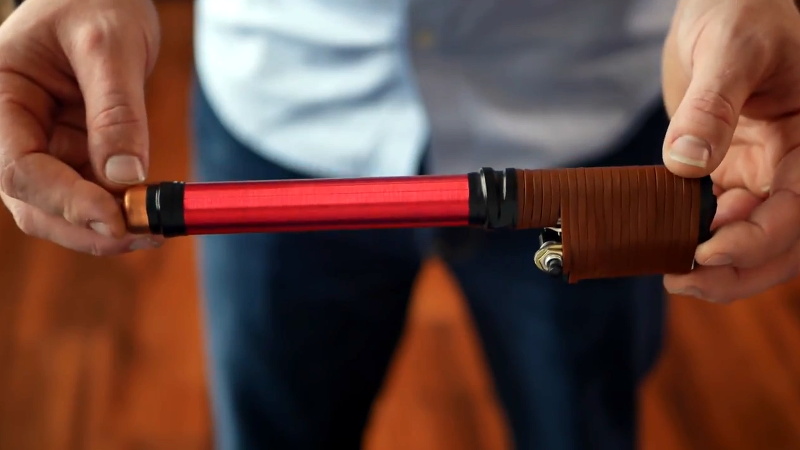
The handheld wand version takes that idea and packages it into a prop-like form. Instead of a benchtop coil sitting on a base, the coil becomes part of a wand. The handle hides the driver electronics and battery, while the coil and top terminal create the electric field. Bring certain gas-filled lamps nearby, and they glow without being plugged in. It is not technically magic, but it is the sort of science that wears a cape.
The title “Handheld Slayer Exciter Wand Makes For Easy High Voltage Magic” captures the appeal perfectly. It is a high-voltage demonstration tool that feels approachable, visual, and a bit mischievous. For makers, educators, and curious hobbyists, that combination is hard to resist.
How the High Voltage “Magic” Works
The wand’s secret is not a hidden battery inside the bulb or a trick switch in the table. The secret is electromagnetic coupling. When the Slayer Exciter oscillates, it drives current through the primary coil. That changing current creates a changing magnetic field, which interacts with the secondary coil. Because the secondary coil has many more turns and resonates with its own stray capacitance, it can develop a much higher voltage at its top end.
In ordinary power transformers, voltage change is closely tied to the turns ratio between the primary and secondary windings. Tesla-coil-style resonant transformers are different. They rely on resonance, where energy sloshes between magnetic and electric fields in an oscillating system. Think of pushing a child on a swing. A tiny push at the right moment can build a big motion. Push at the wrong moment, and you mostly annoy the swing. The Slayer Exciter’s cleverness is that it naturally oscillates near the resonant behavior of the coil instead of needing a complicated external tuning setup.
The electric field around the wand can excite gases inside fluorescent or neon lamps. A fluorescent tube normally needs an electric field to energize gas inside the glass. Close to the wand, that field can be strong enough to make the lamp glow even without metal contacts connected to a power supply. To an audience, the effect looks like wireless power. To an electronics nerd, it looks like electromagnetic induction, capacitive coupling, and resonance doing a little jazz routine.
Why a Wand Design Is So Appealing
Traditional Tesla coil demonstrations are dramatic, but they are not always convenient. Large coils can be loud, intimidating, and fussy. They may require careful spacing, grounding, ventilation, and serious safety planning. A small Slayer Exciter wand offers a gentler way to demonstrate the same family of ideas: high frequency, high voltage, electric fields, gas discharge, and wireless energy transfer over short distances.
The wand format also changes the psychology of the demo. A box on a table says “equipment.” A wand says “performance.” That matters. Good STEM education is not only about delivering facts; it is about creating the hook that makes people ask questions. Why did the tube light? Why does distance matter? Why does orientation change the brightness? Why does a neon lamp behave differently from a fluorescent tube? Why should the phone stay away from the sparkly thing? Each question opens a door into real physics.
The best demonstrations are not the ones that merely impress. They are the ones that make the next question unavoidable. The Slayer Exciter wand does that beautifully.
Slayer Exciter vs. Tesla Coil: Cousins, Not Twins
People often call a Slayer Exciter a “mini Tesla coil,” and the nickname is useful, but it is not perfect. A classic Tesla coil uses resonant circuits, typically with a primary tank circuit and a secondary resonator. Older spark-gap Tesla coils used a spark gap to create rapid bursts of oscillation. Modern solid-state Tesla coils use electronic switching. A Slayer Exciter is much simpler and more self-oscillating, which makes it attractive for compact demonstrations.
That simplicity comes with trade-offs. A Slayer Exciter may be less efficient, less predictable, and less powerful than a carefully designed solid-state Tesla coil. It may depend heavily on the geometry of the coil, the transistor or switching device, the power source, the surrounding objects, and even the way the builder routed wires. In other words, it is simple in the way a bicycle is simple: understandable, elegant, and still fully capable of throwing you into a bush if you pretend physics is optional.
For a handheld wand, though, the trade-off is often worth it. You do not need room-sized arcs or thunderous sound. You need a compact device that can show electric-field effects clearly and safely when handled with care. In that role, the Slayer Exciter shines.
The Science Behind the Glow
Resonance
Resonance is the star of the show. The secondary coil has inductance, and it also has capacitance, even if no obvious capacitor is attached. That capacitance comes from the coil itself, the top terminal, nearby objects, and the environment. Together, the inductance and capacitance form a resonant system. When energy is added at the right rhythm, voltage can build at the top of the coil.
Induction
Induction is the supporting actor with excellent timing. Current in the primary coil creates a changing magnetic field, and that changing magnetic field induces voltage in the secondary coil. Because the secondary has many turns of fine wire, the voltage can become large enough to produce visible effects, even when the power source is modest.
Capacitive Coupling
Capacitive coupling explains why nearby objects can respond even without direct contact. A fluorescent tube near the wand becomes part of the electric environment. The field can influence charges inside the tube, exciting the gas and producing light. This is why the glow changes as the tube moves closer, farther away, or rotates. The invisible field has shape, and the lamp helps reveal it.
Why This Project Is Great for STEM Education
A handheld Slayer Exciter wand can introduce several core concepts in one unforgettable demonstration. Students see that electricity is not just something trapped inside wires. They learn that fields can transfer energy. They observe that frequency matters. They discover that the shape and size of a coil can change electrical behavior. They also learn that safety is part of engineering, not a boring footnote stapled to the end.
The wand also bridges disciplines. Physics explains the field and resonance. Electrical engineering explains the oscillator and switching behavior. Materials science shows up in insulation, wire enamel, plastics, and heat management. Design thinking appears in the handle, balance, durability, and user experience. Even theatrical presentation matters, because a great demo is part instrument and part stagecraft.
That is why projects like this are so effective. They do not just tell learners that science is interesting. They provide evidence.
Safety: The Part That Keeps the Magic Fun
High voltage is never a toy, even when packaged like one. Small resonant coils can produce surprising electric fields, interfere with nearby electronics, generate ozone, create ultraviolet light in spark regions, and produce shocks or small burns under the wrong conditions. People with pacemakers, implanted medical devices, hearing aids, or sensitive electronics should stay well away from Tesla-coil-style demonstrations.
Good practice means treating the wand as a demonstration instrument, not a party trick. Keep it away from phones, laptops, watches, credit cards, and medical devices. Use it only in well-ventilated areas. Do not operate it near flammable vapors or delicate electronics. Do not touch conductive terminals while it is running. Do not let arcs strike objects being held by someone. Do not use it around anyone who cannot understand or follow safety instructions. And yes, “but it looks small” is not a safety plan.
Another issue is radio-frequency interference. Oscillating high-voltage devices can radiate electromagnetic noise. In a home workshop, that may show up as crackles on audio gear, glitches in nearby devices, or mysterious behavior from sensitive electronics. In public or commercial contexts, RF emissions and interference rules matter. The practical takeaway is simple: keep demonstrations short, controlled, and away from equipment that matters.
What Makes a Good Handheld High-Voltage Demonstration?
A good demonstration is clear, repeatable, and controlled. The goal is not to make the biggest spark possible. The goal is to show a phenomenon so cleanly that people understand what they are seeing. A fluorescent tube lighting near the wand is a strong demo because the result is visible and immediate. A neon lamp blinking at different distances can show field strength. A discussion of why metal objects behave differently from glass tubes can lead into conductivity, capacitance, and grounding.
Good demonstrations also avoid the “hold my soda” style of science. That means no shocking volunteers, no waving the wand near someone’s smartwatch, no testing it beside a laptop full of unsaved homework, and no pretending ozone smell is “fresh air.” It is not fresh air. It is chemistry politely asking you to ventilate the room.
Common Misunderstandings About Slayer Exciters
“Low Current Means Completely Safe”
Low current can reduce certain risks, but it does not erase them. Frequency, voltage, contact path, duration, burns, nearby electronics, and medical devices all matter. A small device can still create unsafe conditions if used carelessly.
“Wireless Power Means Free Energy”
Nope. The glowing tube is not evidence that electricity has escaped the monthly utility bill. Energy comes from the battery or power supply driving the wand. The device transfers a small amount of energy through fields, and losses occur along the way.
“More Spark Is Always Better”
More spark is not always better. Longer arcs can mean higher stress, more ozone, more interference, more heat, and more risk. For education, the cleanest demonstration is often better than the loudest one.
Design Lessons from the Wand Concept
The handheld Slayer Exciter wand is a case study in maker design. It takes a known circuit family and turns it into an object people want to pick up, look at, and ask about. The enclosure matters. The balance matters. The visibility of the coil matters. Even the “wand” theme matters because it gives the device a story.
That story is not just decorative. It helps people remember the science. A student may forget the phrase “air-core resonant transformer,” but they will remember the wand that made the light glow without wires. Once memory has a hook, the technical explanation has somewhere to land.
This is a valuable lesson for anyone building educational hardware. Function is essential, but presentation can multiply impact. The best science tools do not hide their personality. They invite curiosity.
Real-World Uses of Similar High-Voltage Ideas
Slayer Exciter wands are mainly educational and experimental, but the principles connect to broader technologies. Resonance is used in radio circuits, wireless charging systems, filters, sensors, and communications. Induction is central to transformers, motors, generators, and induction cooktops. Gas discharge appears in neon signs, fluorescent lighting, plasma globes, and some scientific instruments.
Tesla coils themselves are now best known for education, entertainment, and dramatic stage effects, but the underlying ideas belong to the larger history of high-frequency electrical engineering. Nikola Tesla’s work on alternating current, high voltage, and wireless energy experiments helped shape the imagination of modern electrical technology. The Slayer Exciter wand is a tiny descendant of that larger story: less laboratory thunderstorm, more pocket-sized “whoa.”
Buying, Building, or Demonstrating: What to Consider
Anyone interested in a handheld Slayer Exciter wand should first decide the purpose. Is it for a classroom? A maker fair? A personal electronics experiment? A video demonstration? Each use case changes the priorities. For education, rugged construction, safe spacing, clear labeling, and predictable behavior matter more than maximum output. For a maker project, understanding the circuit and learning from mistakes may be the point. For public demonstrations, safety boundaries and supervision are non-negotiable.
Build quality is especially important in handheld devices. A bench demo can sit behind an acrylic barrier. A wand is meant to be held, so insulation, strain relief, heat management, secure battery placement, and mechanical durability become critical. If something rattles, overheats, smells wrong, or behaves unpredictably, the correct response is not “cool, it has character.” The correct response is to turn it off and inspect it safely.
Experience Notes: What It Feels Like to Use a Slayer Exciter Wand
The first experience with a handheld Slayer Exciter wand is usually a mix of delight and disbelief. You turn down the lights, bring a fluorescent tube close, and the glass begins to glow as though it has remembered a secret. There is no plug, no visible wire, no ordinary lamp socket. The wand hums faintly or buzzes, the tube brightens near the coil, and suddenly the invisible electric field becomes visible. It is one of those moments when theory stops being a diagram and starts acting smug in the real world.
What stands out most is how sensitive the effect can be. Move the tube a little closer, and the glow strengthens. Rotate it, and the brightness may shift. Bring a small neon indicator near the active region, and it can flicker like a tiny orange ghost. The wand teaches through feedback. You do not need a lecture first. You can explore, observe, and then ask why the results changed. That makes the experience unusually intuitive.
Another memorable part is the theatrical pacing. A good demonstration starts quietly. Show the unpowered tube. Let people confirm it is not connected. Then bring the wand near and let the light appear. The room usually reacts before anyone explains anything. That reaction is useful because curiosity is now awake. After that, the science lands better. Terms like resonance, induction, and electric field no longer feel abstract. They are attached to something the audience just saw.
There is also a practical lesson in restraint. The temptation with any high-voltage gadget is to chase bigger effects: brighter glow, longer arcs, louder buzz, more dramatic video. But the best experience often comes from controlled, modest operation. Short demonstrations preserve the surprise, reduce heat and ozone, and keep the focus on learning rather than risk. The wand is most impressive when it feels precise, not chaotic.
For educators, the experience can be turned into a simple question sequence. What happens when the lamp moves farther away? What happens near metal? Why does glass not need a wire connection? Why should electronics be kept away? Why does the lamp glow in some orientations better than others? Each question pulls students deeper into real science without making them feel like they have been ambushed by a textbook.
For hobbyists, the wand is satisfying because it rewards both craftsmanship and understanding. A neatly made coil, a solid handle, careful insulation, and thoughtful layout make the object feel less like a fragile experiment and more like a finished instrument. That sense of completion matters. It turns a circuit into a tool and a tool into a story.
The best way to describe the experience is this: a Slayer Exciter wand makes electricity visible in a way that feels personal. Large Tesla coils are spectacular, but they can feel distant, like watching lightning behind a fence. A handheld wand is smaller, quieter, and more intimate. It lets you guide the demonstration with your own movement. Used responsibly, it turns high-voltage physics into a memorable little performancepart lesson, part maker art, and part “please do not point that at my laptop.”
Conclusion
A handheld Slayer Exciter wand is a brilliant example of how simple electronics can create unforgettable demonstrations. It blends resonance, induction, high-frequency voltage, and electric-field effects into a form that is compact, visual, and surprisingly charming. It can light lamps without wires, reveal invisible fields, and make students lean forward instead of checking the clock.
Still, the real magic is not the glow. The real magic is understanding. Once you know why the lamp lights, why resonance matters, why distance changes the effect, and why safety rules are essential, the wand becomes more than a prop. It becomes a doorway into physics and electrical engineering. That is the best kind of high-voltage magic: the kind that sparks curiosity without frying common sense.