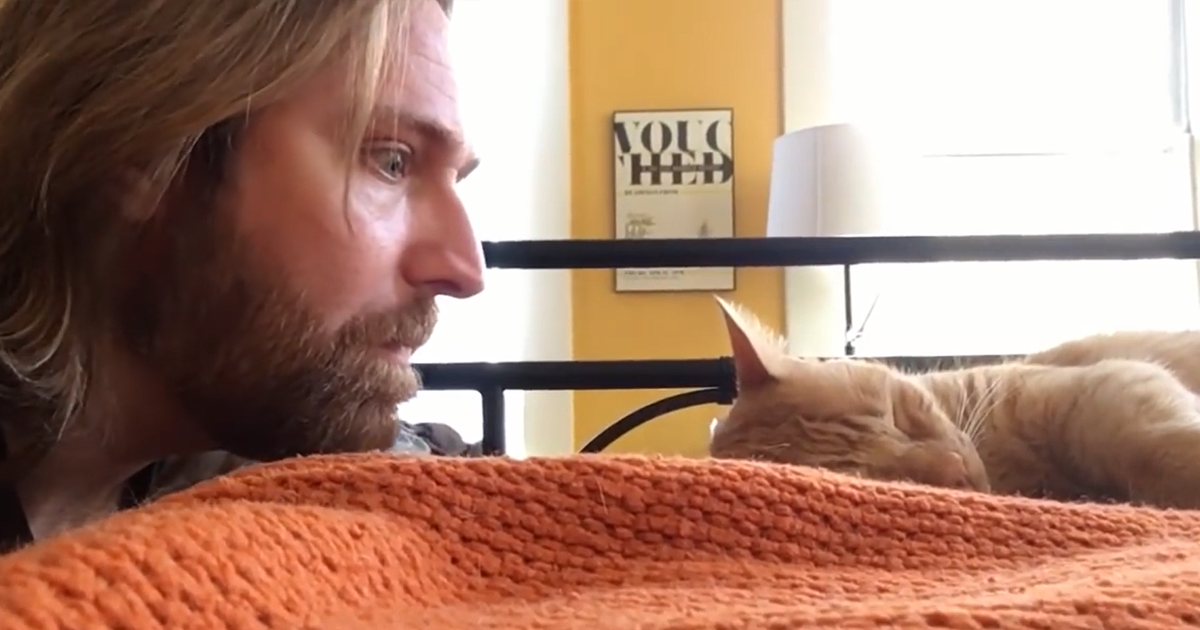
There are alarm clocks, and then there are cats. One comes with a snooze button. The other comes with whiskers, opinions, and the supernatural ability to step directly on your rib cage at 4:00 AM like it is hosting a tiny dawn ceremony. That is the charmingly chaotic setup behind the viral story of a man who got harmless “revenge” on his cat after being woken up before sunrise every morning.
The cat, fittingly named Italics, had a habit many cat owners know too well: launching the household into consciousness at an hour when even coffee is still asleep. His owner, Atlanta-based writer Nicholas Tecosky, reportedly decided to flip the script. If Italics could wake him up at 4 AM, then he could wake Italics up at 4 PM. Petty? Maybe. Funny? Absolutely. Cruel? Nomore like a sleepy human performing one small act of theatrical justice while the cat wondered why the staff had become so bold.
But behind the comedy is a real question: why do cats wake people so early, and what can owners do about it without declaring emotional war on a ten-pound roommate with toe beans? Let’s unpack the story, the science, and the best ways to keep both your sleep schedule and your cat’s dignity intact.
The Viral 4 AM Cat Revenge Story
The original story became popular because it hit a universal nerve. Cat owners everywhere recognized the situation instantly. Italics the cat had apparently been waking his owner at 4 AM every morning. Instead of shouting, chasing, or punishing him, Nicholas chose comedy. He woke the cat at 4 PM, mirroring the same interruption in a way that felt more like a sitcom scene than a disciplinary strategy.
The humor works because cats are famous for treating human sleep as a flexible suggestion. A cat may sit inches from your face, meow like a tiny foghorn, knock something off a nightstand, or perform what can only be described as “parkour with emotional intent.” The human response is usually a mix of love, confusion, and the deeply exhausted thought: “I pay rent here. Why am I the one being managed?”
What made this revenge so shareable was its innocence. The cat was not harmed, scared, or mistreated. The owner simply gave Italics a taste of his own schedule-related medicine. It was the kind of joke that says, “I love you, but also, please stop conducting business meetings on my pillow before sunrise.”
Why Cats Wake People Up at 4 AM
To humans, 4 AM feels like the middle of the night. To many cats, it is more like nature’s happy hour. Cats are often described as crepuscular, meaning they tend to be most active around dawn and dusk. In the wild, those low-light windows are excellent hunting times. Even indoor cats who have never hunted anything more dangerous than a shoelace can still carry that built-in rhythm.
That does not mean your cat is plotting against your REM cycle with a tiny clipboard. It means your cat’s body clock may be shouting, “Rise and hunt!” while your body clock is whispering, “Please, I have responsibilities.” The clash between feline instinct and human work schedules is one of the classic roommate conflicts of modern pet life.
Reason 1: Hunger Has Entered the Chat
One of the most common reasons cats wake their humans early is food. If breakfast arrives every morning after you get out of bed, your cat may start treating your eyelids as the official breakfast button. The pattern is simple: cat meows, human wakes, human feeds cat. Congratulations, you have accidentally trained a furry rooster.
This is especially common when cats receive wet food in the morning or when the feeding schedule is highly predictable. Cats are smart. They notice routines. If your alarm goes off at 6:30 AM and breakfast follows at 6:35 AM, some cats will begin negotiations at 5:50 AM. Then 5:20 AM. Then 4:45 AM. Eventually, your cat is running a pre-market breakfast operation.
Reason 2: Boredom and Built-Up Energy
Indoor cats often spend large parts of the day sleeping, especially when the household is quiet. By the time the early morning hours roll around, they may be rested, energized, and ready to chase imaginary enemies down the hallway. Unfortunately, your sleeping body is the most interesting landmark in the room.
A bored cat may meow, paw, jump, scratch at the door, knock items off furniture, or sprint across the bed with the confidence of an Olympic athlete. This is not always “bad behavior.” Often, it is simply unused energy looking for a place to land. If that place is your stomach, the message is memorable.
Reason 3: Attention Works
Cats learn quickly which behaviors get results. If meowing at 4 AM makes you sit up, talk, pet them, feed them, or even groan dramatically, your cat may interpret that as a successful interaction. To a cat, attention is attention. Even a sleepy “Why are you like this?” can become part of the reward system.
This is where many owners accidentally make the habit stronger. They respond because they are tired. The cat learns because the response is reliable. Before long, the bedroom has become a customer service desk, and your cat is filing daily tickets before dawn.
Was the Owner’s “Revenge” Actually a Good Training Method?
As comedy, waking the cat at 4 PM is golden. As cat training, it is probably not a long-term solution. Cats do not usually connect a one-time afternoon interruption with their own early-morning wake-up routine. Italics may have looked confused, annoyed, or deeply betrayed, but he probably did not think, “Ah, I see. This is a proportional response to my 4 AM vocalizations. I shall modify my conduct.”
That said, the revenge story is useful because it opens the door to a bigger conversation. The best way to stop a cat from waking you early is not revenge, but routine. Cats thrive when their needs are met predictably: food, play, enrichment, comfort, and health. A tired, fed, mentally stimulated cat is much less likely to treat your forehead like a doorbell.
How to Stop a Cat From Waking You Up Too Early
The good news is that early wake-ups are often manageable. The bad news is that cats are extremely committed project managers. If a habit has been rewarded for months, it may take time to reset. Consistency matters more than dramatic gestures, although dramatic gestures do make better internet stories.
1. Move Playtime to the Evening
A strong evening play session can help reset your cat’s rhythm. Use a wand toy, feather teaser, soft ball, or chase-style game to mimic hunting. Let your cat stalk, chase, pounce, and “catch” the toy. The goal is not to exhaust your cat into a puddle, but to give that natural hunting energy a healthy outlet before bedtime.
After play, offer a small meal or snack. This follows a natural pattern: hunt, eat, groom, sleep. Many cats settle more easily when their evening routine feels complete. Think of it as helping your cat clock out from the night shift before it begins.
2. Try an Automatic Feeder
If hunger is the main reason your cat wakes you, an automatic feeder can be a game changer. It removes you from the breakfast equation. Instead of thinking, “Human equals food,” your cat starts thinking, “Mysterious robot bowl equals food.” That is a promotion for you and a career change for the bowl.
Some owners set the feeder to dispense a small early snack before the cat’s usual wake-up campaign begins. Over time, the schedule can be gradually adjusted later. This approach works best when the cat is waking for food rather than attention or anxiety.
3. Do Not Reward the 4 AM Performance
This part is hard because you are sleepy and your cat is persuasive. But if you respond every time your cat meows, paws, or knocks something over, the behavior can become stronger. Ignoring the wake-up attempts may help, but only if you are consistent.
Expect a possible “extinction burst,” which is a fancy way of saying the behavior may get worse before it gets better. Your cat might meow louder or try new tactics because the old method used to work. Stay calm. Avoid yelling, chasing, or feeding in response to the noise. If you give in on day four, your cat may conclude that persistence is the secret password.
4. Create a Nighttime Activity Zone
Many cats wake people because they have nothing better to do. Give them something better. Puzzle feeders, treat balls, climbing trees, window perches, safe toys, and rotating enrichment can make the nighttime environment more interesting. A cat with legal entertainment options is less likely to invent illegal ones, such as knocking your water glass into another dimension.
For food-motivated cats, puzzle feeders can be especially helpful. They make the cat work a little for snacks, which adds mental stimulation and mimics the effort of hunting. This can be a healthier option than simply adding more food to the bowl.
5. Keep the Bedroom Boring
If your cat is allowed in the bedroom, make the room as unrewarding as possible during sleep hours. Do not talk, pet, feed, or play during early wake-up attempts. If your cat is kept outside the bedroom, provide a comfortable alternative sleeping area with water, litter access, cozy bedding, and safe activities.
Closing the door may work for some cats, but not for all. Some will accept the boundary. Others will audition for a percussion role by tapping, scratching, and singing at the door. If you choose this route, combine it with enrichment elsewhere so the cat is not simply bored in a hallway with strong opinions.
When Early Morning Meowing Could Signal a Problem
Most early-morning wake-ups are normal behavior, but sudden changes deserve attention. If an older cat begins yowling at night, seems confused, eats much more or less than usual, loses weight, drinks more water, hides, limps, or appears distressed, a vet visit is wise. Nighttime vocalization can sometimes be linked with pain, anxiety, thyroid issues, cognitive changes, or other health concerns.
The key word is “change.” If your cat has always been a dawn goblin, the cause may be routine or instinct. If your quiet cat suddenly becomes a 3 AM opera singer, do not assume it is just personality. Cats can be subtle when they are uncomfortable, and sleep disruptions may be one of the clues.
Why the Story Resonates With Cat Owners
The reason the Italics story keeps making people laugh is that it captures the emotional contract of living with a cat. Cats are affectionate, funny, elegant, ridiculous, and occasionally terrible at respecting office hours. They can curl up beside you like a tiny angel at 10 PM and then return at 4 AM as a furry debt collector demanding breakfast, entertainment, or a door opened purely so they can stand in it.
Cat owners understand the contradiction. We complain about the meows, the zoomies, the paw taps, and the mysterious thuds from the living room. Then we take 47 photos of the same cat sleeping in a cardboard box. We are not victims exactly. We are willing participants in a very fluffy household government.
That is why the “revenge” was so satisfying. It was not mean. It was not a real solution. It was a symbolic victory for every person who has whispered, “Please, just one more hour,” while a cat stood on their chest like a loaf-shaped sunrise.
The Better Kind of Revenge: A Smarter Routine
The funniest revenge is waking the cat at 4 PM. The best revenge is getting a full night’s sleep. To do that, cat owners need to think less like irritated roommates and more like feline schedule designers. A cat’s early wake-up habit usually has a purpose: food, play, attention, stimulation, comfort, or health. Once you identify the reason, the solution becomes more realistic.
If the cat is hungry, adjust feeding times or use an automatic feeder. If the cat is bored, increase evening play and enrichment. If the cat wants attention, stop rewarding wake-up behavior and give more attention during appropriate hours. If the behavior is new or intense, check for health problems. None of this is as funny as a revenge video, but it is far more likely to protect your sleep.
Real-Life Experiences: What Cat Owners Learn From the 4 AM Wake-Up Club
Anyone who has lived with a cat long enough eventually joins the unofficial 4 AM Wake-Up Club. Membership is free, but the dues are paid in lost sleep and suspicious noises from the hallway. The experience usually begins innocently. Maybe the cat meows once. You wake up, think it is cute, and give a little pat. The next morning, the cat meows twice. By the end of the week, you are negotiating with a creature who has never paid a bill but somehow controls your calendar.
One common experience is the “breakfast creep.” The owner starts feeding the cat at 7 AM. Then, after a few early meows, breakfast happens at 6:45. Then 6:30. Then 6:00. Suddenly the cat has successfully moved breakfast earlier by an hour through sheer persistence. This is not because cats are evil. It is because cats are excellent data analysts. They test a behavior, observe the result, and repeat what works. If humans were this consistent at going to the gym, the fitness industry would collapse.
Another familiar scenario is the “false emergency.” Your cat screams outside the bedroom door as if the world is ending. You leap out of bed, heart pounding, only to discover that the crisis is an empty food bowl, a closed bathroom door, or a toy mouse trapped under a chair. From the cat’s perspective, these are legitimate emergencies. From the human perspective, they are reasons to question every life choice that led to adopting a roommate with whiskers.
Many owners also learn that ignoring the behavior is emotionally difficult. Cats are talented at making silence feel impossible. They can switch from meowing to scratching, from scratching to knocking, from knocking to sitting directly on your face like a warm, purring sleep mask. The key is preparation. Remove tempting objects from nightstands, provide nighttime enrichment, and make sure basic needs are met before bed. It is much easier to ignore a meow when you know the cat has food, water, litter access, toys, and no actual emergency.
Some cat owners find that a late-night play routine changes everything. A 15- to 30-minute play session before bed can turn a tiny chaos machine into a sleepy loaf. The trick is to make the play active and satisfying. Let the cat chase, hide, pounce, and catch. Then offer a small meal. This routine can help signal that the day is winding down. It also gives the cat a job, and cats with jobs are often less interested in inventing crimes.
Automatic feeders are another popular solution because they make breakfast less personal. When the machine provides food, the human is no longer the vending machine with legs. Some cats adapt quickly. Others stare at the feeder like it owes them an explanation. Either way, it can reduce the link between waking the owner and receiving breakfast.
The biggest lesson from the 4 AM cat experience is that humor helps. You can love your cat deeply and still be mildly offended by its scheduling choices. You can laugh at the absurdity while also making practical changes. The viral story of a guy waking his cat at 4 PM works because every pet owner has imagined some harmless way to say, “Now you know how it feels.” But the real win is not revenge. It is building a routine where the cat feels satisfied, the human sleeps, and nobody has to start a household feud before sunrise.
Conclusion
The story of the guy who got revenge on his 4 AM alarm-clock cat is funny because it is familiar. Cats may be small, but their ability to dominate a household schedule is enormous. Italics the cat became a symbol of every feline who believes dawn is the perfect time for conversation, breakfast, parkour, or emotional announcements.
Still, the best takeaway is not that humans should prank their cats into better manners. It is that early-morning wake-ups usually have understandable causes. Cats are naturally active around dawn and dusk, and many also wake owners because they are hungry, bored, reinforced by attention, or dealing with a change in health. A better routinebuilt around evening play, timed feeding, enrichment, and consistent boundariescan turn the 4 AM drama into a calmer morning.
So yes, harmless revenge makes a great viral moment. But the ultimate victory is waking up after a full night of sleep, looking over at your cat, and realizing neither of you had to file a complaint with management.