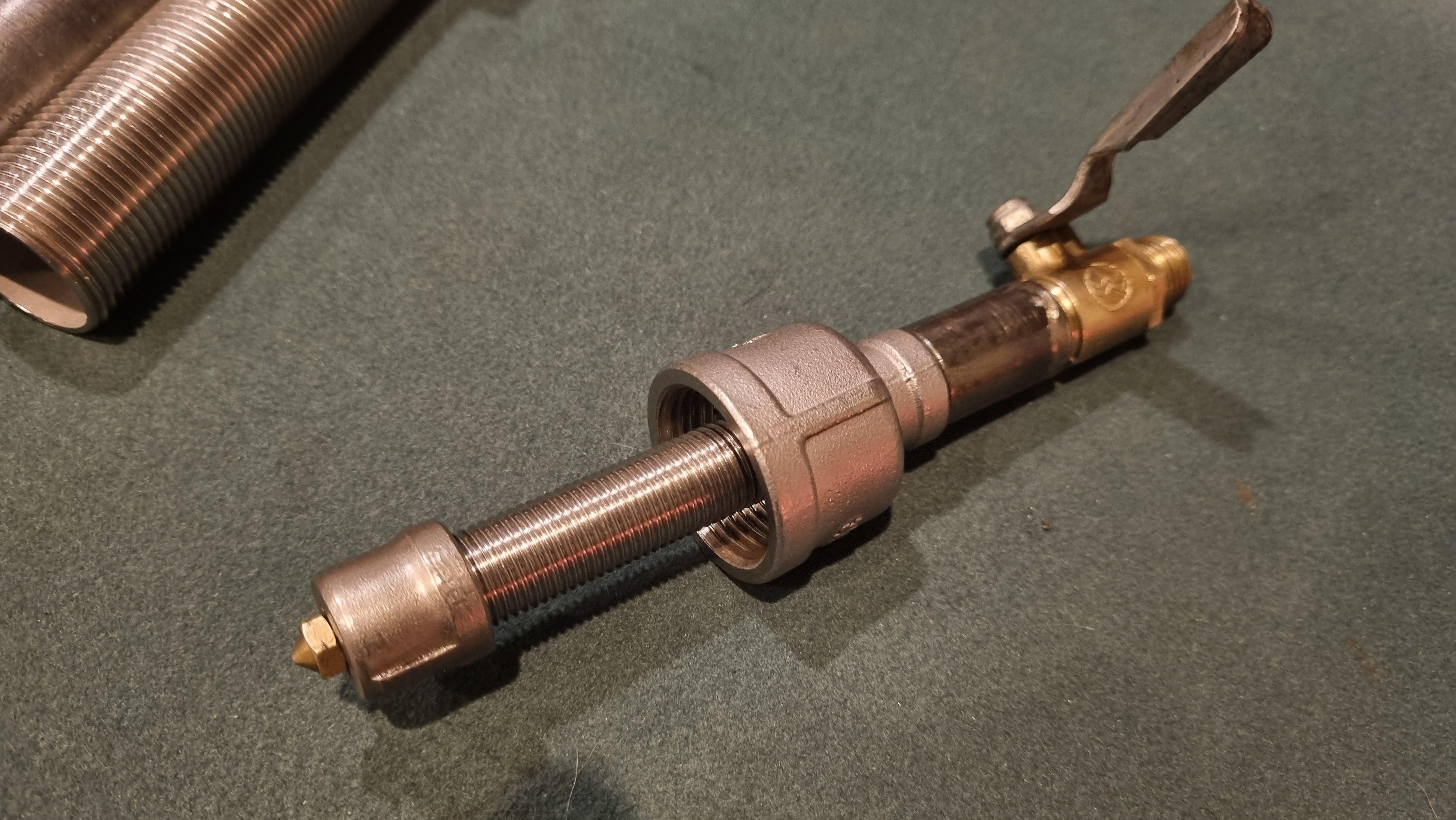
A good workshop hack has a certain flavor. It is part engineering, part thrift, and part “wait, that little thing does what now?” The idea behind a gas burner that reuses a 3D printer nozzle for metalwork lands squarely in that glorious category. Instead of buying a specialized burner jet or drilling a tiny hole with the accuracy of a caffeinated watchmaker, the maker repurposes a ready-made printer nozzle as the gas orifice. Suddenly, a humble brass part from the 3D printing drawer becomes the tiny gatekeeper between fuel, air, flame, and hot metal.
The concept is simple in spirit: a gas burner for a forge or small foundry needs a controlled jet of fuel. That jet shoots into a mixing chamber, pulls in air, and burns at the end of the burner tube. The clever twist is using a 3D printer nozzle as that jet. Printer nozzles are inexpensive, available in predictable sizes, and already machined with tiny openings. In other words, they are practically begging to moonlight outside the printer, assuming the builder treats fuel gas with the respect it deserves.
This article explores why the idea works, what makes it appealing to DIY metalworkers, how nozzle size affects burner behavior, and why safety matters more than bragging rights. A printer nozzle may be small enough to lose under a bench in three seconds, but in the right burner design, it can influence flame shape, heat output, fuel efficiency, and tuning flexibility.
Why a Gas Burner Matters in Home Metalwork
Metalwork is not gentle cooking. You are not warming soup; you are trying to get steel, aluminum, brass, or other metals hot enough to shape, melt, or heat-treat. For many hobbyists, a propane or LPG burner is the most practical way to power a small forge or furnace. It is cleaner than coal, easier to regulate than a pile of glowing coke, and more approachable than industrial equipment that looks as if it needs its own zip code.
A gas burner is the heart of that setup. It determines how fuel and oxygen meet, how stable the flame is, and how quickly the forge chamber gets hot. A poorly tuned burner wastes fuel, produces a lazy yellow flame, struggles to heat evenly, or worse, creates unsafe combustion conditions. A well-tuned burner creates a strong blue flame, mixes air and fuel efficiently, and turns a simple insulated chamber into a serious heat tool.
In small workshops, makers often build burners from black iron pipe, reducers, caps, fittings, hoses, regulators, and valves. The one detail that causes an outsized amount of frustration is the gas orifice. That tiny opening controls how much fuel enters the air stream. Too small, and the burner starves. Too large, and the mixture may run rich, unstable, or wasteful. This is where the 3D printer nozzle becomes unexpectedly useful.
The Clever Hack: A 3D Printer Nozzle as a Gas Jet
A standard FDM 3D printer nozzle is designed to push molten plastic through a precise hole. Common sizes include 0.2 mm, 0.3 mm, 0.4 mm, 0.6 mm, and 0.8 mm, with specialty sizes even smaller or larger. In printing, that hole affects layer width, speed, and detail. In a gas burner, the same hole can act as a calibrated fuel jet.
The attraction is obvious. Instead of drilling a microscopic orifice in a brass plug and hoping the bit does not wander, snap, or vanish into another dimension, a maker can tap the burner intake for the nozzle thread and swap nozzle sizes like tuning jets on a carburetor. Many printer nozzles use M6 threads, which makes them convenient for builders who can drill and tap a matching hole in a cap or fitting.
The specific project that inspired the buzz used a printer nozzle as the fuel entry point into a burner made largely from common hardware-store parts. A smaller nozzle produced serious heat but could become temperamental when the air intake was opened too far. A slightly larger nozzle helped the builder tune the burner for the available LPG. That detail is important: burner tuning depends on the fuel, pressure, chamber design, air opening, and nozzle size. There is no magic number that works for every shop.
How the Burner Works: Venturi Flow Without the Textbook Headache
Many DIY gas forge burners are naturally aspirated, also called Venturi burners. They do not use an electric blower. Instead, a fast jet of gas shoots into the burner tube and drags surrounding air along with it. The moving stream creates a pressure difference that pulls air into the mixture. If the geometry is right, the fuel and air mix before reaching the flame zone.
Imagine squirting water from a hose through the center of a pipe and watching nearby dust, leaves, and your misplaced common sense get pulled along. That is the basic mood of a Venturi burner, except with fuel gas and combustion. The nozzle matters because it shapes the gas jet. A clean, centered, properly sized jet gives the burner a better chance of pulling in air evenly.
This is also why placement matters. The nozzle should be aligned with the burner tube, not aimed at the wall like it has a personal grudge. A jet that is off-center can cause poor mixing, flame instability, hot spots, or backfiring. The builder’s goal is not merely to get fire. Anyone with a match can get fire. The goal is controlled, repeatable heat that behaves the same way each time the forge is lit.
Nozzle Size: Tiny Hole, Big Consequences
When people first look at nozzle sizes, they may think the difference between 0.3 mm and 0.4 mm is trivial. It is not. Area increases rapidly as diameter increases. A 0.4 mm hole has much more flow area than a 0.3 mm hole, which means more fuel can pass through at the same pressure. That change affects flame temperature, mixture ratio, and how much air the jet can entrain.
In practical terms, a smaller nozzle may produce a sharper, faster jet but limit total fuel flow. A larger nozzle may provide more fuel but require more air and careful tuning. If the air intake is opened too far for the amount of fuel available, the burner may blow out or run lean. If the air is too restricted, the flame may turn soft, yellow, smoky, and inefficient. The sweet spot usually looks like a stable blue flame with enough velocity to stay lit and enough heat to bring the forge chamber up to working temperature.
Printer nozzles shine because they make experimentation less painful. A builder can try 0.3 mm, 0.4 mm, 0.5 mm, or 0.6 mm without permanently modifying the burner. That is a real advantage over drilling fixed holes. Once you drill too large, the only easy repair is creative regret.
Why Makers Like This Approach
1. It Uses Cheap, Available Parts
3D printer nozzles are inexpensive and widely available. Many makers already have spares in a drawer beside old PTFE tubing, mystery Allen keys, and a hardened steel nozzle they bought during an “I will definitely print carbon fiber nylon someday” phase. Repurposing one for a gas burner is a neat example of cross-shop recycling.
2. It Makes Tuning Easier
Burner tuning is partly science and partly listening to the angry dragon noise until it sounds right. Interchangeable nozzles make that process more systematic. Instead of changing three variables at once, a maker can adjust one: the gas jet size. That makes troubleshooting easier.
3. It Avoids Precision Micro-Drilling
Drilling tiny holes in metal is possible, but it can be annoying. Micro drill bits break easily, and a rough hole can disturb flow. A manufactured printer nozzle offers a cleaner, repeatable orifice. It is not a certified industrial gas jet, but for experimental hobby use, it is a clever shortcut.
4. It Encourages Modular Design
A burner that accepts threaded nozzles becomes more modular. Need to test LPG versus propane? Try a different nozzle. Need to reduce fuel flow for a smaller furnace? Swap down. Need a little more heat? Swap up carefully. A modular design teaches the builder how the system behaves.
Brass, Steel, and Heat: Choosing the Right Printer Nozzle
Most printer nozzles are brass because brass conducts heat well and machines easily. For 3D printing, that is perfect for common filaments. In a burner, the nozzle is usually located upstream of the hottest flame zone, so it should not be sitting directly in the roaring flame. Even so, the area can get warm, and fuel fittings can experience heat soak if the burner is poorly designed.
Brass nozzles are common and easy to work with, but hardened steel, stainless steel, or plated nozzles may also be available. The best choice depends on the builder’s design, the thread fit, and the expected heat exposure. A nozzle that seals poorly is a bad choice no matter how fancy its material sounds. “Tungsten carbide” may look impressive in an online listing, but leak-free assembly and safe fuel handling are far more important than exotic bragging rights.
One practical point: printer nozzles are not manufactured or certified as gas appliance parts. That does not automatically make them useless, but it does mean the builder must treat the project as experimental. The fitting should be mechanically sound, checked for leaks, and used only in a well-ventilated, appropriate workshop environment. If that sentence feels less exciting than “molten metal,” good. It is supposed to.
Propane, LPG, and the Heat Question
Propane and LPG are popular fuels for small forges because they are portable and capable of producing high heat when mixed with enough air. Under ideal conditions, a propane-air flame can approach temperatures around 1,967 degrees Celsius, which is hot enough for many forging and non-ferrous melting tasks. Real forge temperatures are lower because heat is lost to the chamber walls, exhaust, metal load, air leaks, and every other little gremlin of thermodynamics.
A burner does not work alone. The forge body, insulation, refractory coating, chamber size, exhaust opening, and workpiece mass all determine performance. A brilliant burner attached to a poorly insulated chamber may still struggle. A modest burner in a well-insulated chamber may perform surprisingly well. That is why experienced metalworkers often talk about the entire system rather than one heroic component.
For melting aluminum, a gas-fired furnace can work very effectively because aluminum melts at a much lower temperature than steel. For forging steel, the burner must maintain a hot, stable atmosphere. For forge welding, the requirements become more demanding. The printer nozzle hack is useful, but it is not a cheat code that turns every bucket forge into a dragon-powered industrial foundry.
Safety Is Not Optional: The Serious Part
DIY gas burners deserve respect. Fuel gas leaks, poor ventilation, flashback, overheating, unstable flames, and carbon monoxide are real hazards. A burner should be tested outdoors or in a properly ventilated workspace, away from flammable materials. A carbon monoxide detector, fire extinguisher, leak-checking routine, and proper regulator are not accessories; they are basic survival equipment.
Never guess with gas fittings. Use parts rated for the fuel and pressure involved. Do not use random hose, mystery regulators, or fittings rescued from a box labeled “probably plumbing.” Check joints with an appropriate leak-detection solution before lighting. If bubbles appear, stop. If you smell gas, stop. If the burner pops, burns inside the tube, or behaves unpredictably, stop. The bravest thing in a shop is often turning the valve off.
Also, do not run a propane burner indoors without serious ventilation planning. Carbon monoxide is invisible, odorless, and extremely dangerous. A flame can look cheerful while the air becomes hazardous. Metalwork already offers enough ways to injure yourself; there is no need to invite a silent gas into the party.
Specific Example: Tuning a Small Forge Burner
Consider a small hobby forge used for knife blanks, hooks, punches, or aluminum casting experiments. The builder installs a printer nozzle as the gas jet and starts with a conservative nozzle size. With the regulator set low, the burner lights but produces a soft flame. The builder opens the air intake gradually. The flame sharpens and turns bluer. Then, at a wider air setting, the flame begins to sputter. That suggests the mixture is becoming too lean or the gas velocity is no longer supporting stable combustion.
Instead of drilling a new jet, the builder swaps to a slightly larger printer nozzle. The additional fuel flow supports more air. The flame becomes stronger, and the forge heats faster. The builder records the nozzle size, regulator pressure, air opening position, and warm-up time. That simple log turns a weekend experiment into useful data.
This is the real strength of the printer nozzle method. It makes the burner easier to tune by trial, observation, and documentation. Good makers do not merely build; they measure, adjust, and learn. Also, they label their nozzles, because once five brass nozzles roll across the bench, telling 0.3 mm from 0.4 mm by vibes alone is a losing sport.
Where This Hack Fits in the DIY Metalworking World
The printer nozzle burner is not a replacement for professionally engineered burners in commercial settings. It is better understood as a maker-friendly approach for educational and experimental metalwork. It appeals to people who build tools from accessible parts, understand the risks, and enjoy improving a design over time.
It also reflects a larger trend in modern workshops: parts from one hobby migrating into another. 3D printer parts become burner jets. Welding tips become forge orifices. Microwave transformers become power supplies. Old pressure vessels become forge shells, though that particular path should be approached with extreme caution and proper preparation. The best shop innovations often happen when someone sees a part not for what it was sold as, but for what it can do.
That said, clever does not mean careless. A printer nozzle can solve the orifice problem, but it does not solve gas safety, forge design, insulation, burner geometry, or local code compliance. The project is most successful when treated as a thoughtful engineering exercise rather than a viral shortcut.
Common Mistakes to Avoid
Using Too Much Air Too Soon
Opening the air intake all the way may seem like a path to more heat, but combustion needs balance. Too much air can cool the flame or blow it out. Adjust in small increments and watch the flame response.
Assuming One Nozzle Size Works for Every Fuel
LPG, propane, and natural gas behave differently. Pressure settings, energy content, and air requirements vary. A nozzle that works beautifully for one fuel may perform poorly with another.
Ignoring Forge Insulation
A burner can only do so much if the chamber leaks heat like a screen door on a submarine. Ceramic fiber insulation with a proper rigidizer and refractory coating, castable refractory, or insulated firebrick can drastically affect performance.
Skipping Leak Tests
This is the worst kind of shortcut. Every fuel connection should be checked before operation. A leak near an ignition source is not a learning experience anyone needs.
Experience Notes: What This Kind of Burner Teaches You
Working with a gas burner that reuses a printer nozzle is a surprisingly good lesson in patience. At first, the tiny nozzle feels like the star of the show. You screw it in, connect the fittings, open the valve, and expect the workshop gods to hand you a perfect blue flame. Reality is usually more educational. The first flame may be weak, noisy, too rich, too lean, or determined to go out the moment you touch the air shutter. This is not failure. This is the burner explaining itself.
The biggest experience-based lesson is that small adjustments matter. A tiny change in nozzle diameter can feel dramatic. A small turn on the regulator can shift the burner from lazy to aggressive. Moving the nozzle alignment even slightly can change the sound and stability. The burner becomes a live demonstration of fluid flow, combustion, and heat transfer. It is engineering you can hear.
Another lesson is that the forge chamber matters just as much as the flame. Many beginners blame the burner when the forge heats slowly, but the real culprit may be a heavy refractory lining that absorbs heat for ages, a chamber opening that is too large, or insulation that has not been sealed properly. A good burner in a poor chamber is like putting racing tires on a shopping cart. Technically interesting, but not exactly fast.
Documentation also becomes valuable. Keep a simple shop notebook. Write down the fuel, regulator setting, nozzle size, air opening, warm-up time, flame color, and the job being done. For example, one setup might bring a small steel blank to forging heat reliably with a 0.4 mm nozzle, while another might prefer 0.5 mm because the chamber is larger or the gas pressure is different. Those notes save time later and prevent the classic workshop ritual of muttering, “What did I do last time?” while holding a wrench.
There is also a psychological benefit. Reusing a printer nozzle makes the burner feel less mysterious. Instead of treating burner tuning as black magic guarded by smoky-bearded elders, the maker sees cause and effect. Smaller jet, less fuel. Larger jet, more fuel. More air, leaner flame. Less air, richer flame. Better insulation, faster heat. Suddenly, the burner is not a monster; it is a system.
Finally, the project reinforces a healthy respect for boundaries. The fun part is making heat. The mature part is knowing when to shut down, re-check fittings, improve ventilation, or redesign a questionable assembly. A clever gas burner is satisfying because it works, but it is worth building only if it works safely. In metalwork, confidence is useful. Overconfidence is just a faster way to need new eyebrows.
Conclusion
A gas burner that reuses a printer nozzle for metalwork is a small, smart hack with a lot of workshop logic behind it. The nozzle provides a cheap, consistent, interchangeable gas jet. The burner body can be assembled from common fittings. The result is a tunable system that helps hobbyists understand fuel flow, air mixing, and flame behavior without relying on expensive specialized parts.
The idea is especially appealing because it connects two maker worlds: 3D printing and metalwork. A component designed for molten plastic becomes a tool for heating metal. That is the kind of cross-pollination that keeps workshops interesting. Still, gas burners are not toys. Safe fittings, ventilation, leak checks, carbon monoxide awareness, and cautious testing matter more than saving a few dollars.
For the right builder, this hack is not just about making a forge burner. It is about learning how small design choices affect a real flame. And when a tiny printer nozzle helps turn fuel and air into controlled heat, it earns a new title: the smallest part with the biggest attitude in the shop.
Note: This article is for educational and informational publishing purposes. Any real gas-burner construction or operation should follow applicable fuel-gas codes, manufacturer guidance, local regulations, and professional safety practices.