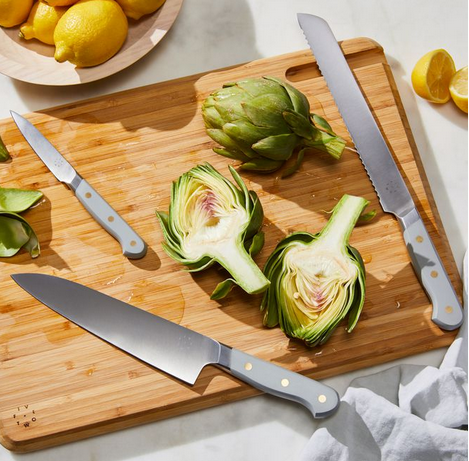
If your kitchen drawers are hiding a chaotic civilization of mismatched, half-dull knives, the Food52 Five Two Essential Knives set makes a convincing argument for a simpler life. Instead of building a blade museum with 14 “specialty” knives you use twice a decade, Food52’s Five Two line focuses on the three knives most home cooks actually reach for: an 8-inch chef’s knife, a 9-inch serrated knife, and a 3.5-inch paring knife. That trio can handle weeknight vegetables, crusty bread, summer tomatoes, citrus, herbs, cakes, apples, strawberries, shrimp, and the occasional heroic sandwich.
Food52 designed these knives with input from thousands of home cooks, which explains why they feel less like intimidating restaurant tools and more like friendly kitchen helpers that happen to be sharp enough to make an onion nervous. The collection combines carbon-infused Japanese steel, full-tang construction, soft-touch handles, brass rivets, a gentle bolster, and colors that look good on the counter instead of hiding in shame behind the toaster.
This in-depth guide breaks down what makes the Food52 Five Two Essential Knives appealing, who they are best for, how each knife performs in everyday cooking, how to care for them, and whether a three-piece knife set is enough for a real home kitchen. Spoiler: for most people, yes. Your avocado toast does not require a sword cabinet.
What Are Food52 Five Two Essential Knives?
The Food52 Five Two Essential Knives are a streamlined kitchen knife collection from Five Two by Food52, the brand’s community-informed line of kitchen and home products. The set typically includes three core blades: a chef’s knife, a serrated knife, and a paring knife. Each one serves a different purpose, but together they cover the majority of slicing, chopping, mincing, trimming, peeling, and sawing tasks that happen in a normal home kitchen.
The knives are fully forged rather than simply stamped, which means the blade is formed for strength and structure. They also feature full-tang construction, so the metal extends through the handle. That matters because a full tang generally improves durability, stability, and balance. In plain English: the knife feels less like a flimsy gadget and more like a tool you can trust when a butternut squash starts acting smug.
The blades are made from carbon-infused Japanese steel, a material choice that aims to deliver sharpness, edge retention, and resistance to everyday wear. The handles are soft-touch and available in signature Food52-style shades such as Nordic Sea, Smoked Salt, Maple, and Rhubarb. Add brass rivets that develop a natural patina over time, and the result is a knife set that cares about performance but still wants to be invited to brunch.
Why a Three-Knife Set Makes Sense
Many home cooks assume a “serious” kitchen needs a giant knife block. You know the one: seventeen knives, eight of which appear to be decorative, one that looks like it belongs on a pirate ship, and a mysterious sharpening rod everyone is afraid to touch. In reality, experienced cooks and kitchen testers often recommend starting with a few high-quality essentials instead of buying a massive set with pieces you rarely use.
The Food52 Five Two Essential Knives follow that practical philosophy. The chef’s knife handles most chopping and slicing. The serrated knife tackles bread, tomatoes, citrus, and delicate baked goods. The paring knife takes care of small, precise work. That is the everyday kitchen triangle: big prep, delicate sawing, and detail work.
The 8-Inch Chef’s Knife: The Daily Driver
The 8-inch chef’s knife is the all-purpose workhorse. It is the blade you grab for onions, carrots, potatoes, herbs, cabbage, chicken, peppers, garlic, and almost anything else that lands on a cutting board. An 8-inch length is popular because it offers enough blade to move efficiently through larger ingredients while still feeling manageable for home cooks.
With the Food52 Five Two chef’s knife, the curved blade shape supports a natural rocking motion for mincing herbs or garlic. The full-tang build gives it reassuring balance, while the gently sloped bolster helps guide the grip and provides a bit of knuckle protection. It is not trying to be flashy in use. It is trying to make prep feel smoother, faster, and less like a vegetable wrestling match.
The 9-Inch Serrated Knife: The Bread-and-Tomato Specialist
The serrated knife is often called a bread knife, but that undersells it. Yes, it glides through crusty sourdough, baguettes, sandwich loaves, and focaccia without smashing them into carb pancakes. But it is also excellent for foods with firm skins and tender interiors, such as ripe tomatoes, oranges, lemons, and even delicate cakes.
A 9-inch serrated blade gives enough length for long, even strokes. That matters because serrated knives work best when you let the teeth do the cutting rather than pressing downward like you are mad at lunch. The Food52 Five Two serrated knife is useful for weekend baking, summer produce, holiday desserts, and any meal where a clean slice makes the plate look intentional instead of “I tried my best.”
The 3.5-Inch Paring Knife: Small but Sneaky Useful
The paring knife is the little blade with big responsibility. It is designed for trimming, peeling, hulling strawberries, coring apples, deveining shrimp, segmenting citrus, and handling small jobs where a chef’s knife feels oversized. Think of it as the kitchen’s detail brush.
The Food52 Five Two paring knife’s compact size makes it easier to control during hand-held tasks. It is especially helpful for prep work that requires precision rather than power. If the chef’s knife is the pickup truck, the paring knife is the tiny scooter that somehow gets into every narrow alley.
Design Details That Stand Out
Food52’s Five Two products usually aim for the sweet spot between everyday usefulness and attractive design, and these knives follow that formula. They are not purely utilitarian in the dull gray “commercial kitchen basement” sense, but they are not style-only props either. The best design details are the ones you notice while cooking.
Carbon-Infused Japanese Steel
Japanese-style kitchen knives are often associated with sharp, precise cutting, and the Food52 Five Two knives lean into that reputation with carbon-infused Japanese steel. Carbon in steel can help with edge performance, while stainless qualities help reduce the risk of rust compared with more maintenance-heavy carbon steel knives. These knives are built for home cooks who want sharpness without signing up for a part-time metallurgy hobby.
Full Tang Construction
A full-tang knife has metal running through the handle, not just stopping at the blade. This gives the knife more integrity and helps distribute weight through the hand. On a chef’s knife, especially, balance can make prep feel calmer and more controlled. A knife that feels wobbly or handle-heavy can turn a simple onion dice into a suspense film.
Soft-Touch Handles
The handles are designed to feel comfortable during longer prep sessions. That matters if you cook in real life, where “quick dinner” can somehow involve chopping three onions, two bell peppers, a mountain of parsley, and one emotional support carrot. A secure, comfortable grip helps reduce fatigue and encourages better control.
Brass Rivets with Patina
The brass rivets are partly functional and partly aesthetic. Over time, brass develops a patina, which means the rivets may darken or change character with use. Some people love that lived-in look; others prefer to polish brass back to a brighter finish. Either way, it gives the knives a warmer, vintage-inspired touch.
Who Should Buy Food52 Five Two Essential Knives?
The Food52 Five Two Essential Knives are a strong fit for home cooks who want an attractive, capable knife set without buying a giant block. They are especially appealing for people setting up a first apartment, upgrading from dull bargain knives, building a wedding registry, or simplifying a cluttered kitchen.
They also make sense for cooks who care about how tools feel and look. Some knives are excellent but visually boring. Others look beautiful but perform like a butter knife having a midlife crisis. The Five Two knives aim for the middle: sharp enough for serious prep, pretty enough to leave out, and approachable enough for cooks who do not speak fluent cutlery.
Best For
- Home cooks who want a practical three-knife setup
- Small kitchens with limited drawer or counter space
- People replacing old, dull, mismatched knives
- Gift buyers looking for useful kitchen essentials
- Cooks who like colorful, design-forward tools
- Beginners who want quality without overcomplication
Maybe Not Best For
- Professional chefs who need specialized blades for heavy daily service
- Knife collectors looking for premium handmade Japanese cutlery
- People who prefer very heavy German-style knives
- Cooks who want a full block with steak knives included
How the Knives Perform in Real Cooking
Performance is where a kitchen knife earns its keep. A knife can be gorgeous, but if it crushes tomatoes, slips on onion skin, or turns herbs into green confetti paste, it belongs in the “decorative mistake” drawer.
Vegetable Prep
The chef’s knife is the star for vegetables. It is well suited for slicing onions, chopping celery, dicing carrots, mincing garlic, and cutting herbs. The sharp blade helps reduce drag, which means cleaner cuts and less bruising on delicate ingredients. For tomatoes, the chef’s knife can work if it is freshly sharp, but the serrated knife is the safer choice when tomatoes are extremely ripe.
Bread and Baked Goods
The serrated knife is the hero here. Crusty bread requires teeth, not brute force. A good serrated blade lets you use long, gentle strokes so the crust breaks cleanly while the interior stays fluffy. It also works well on cakes, quick breads, and soft sandwich loaves. Your banana bread deserves slices, not geological fragments.
Fruit and Small Tasks
The paring knife shines with fruit prep. It can peel apples, hull strawberries, trim citrus, and remove blemishes with more control than a larger knife. It is also useful for small garnishes, trimming garlic cloves, and making tiny cuts where accuracy matters.
Meal Prep and Everyday Use
For batch cooking, the chef’s knife and serrated knife will likely do most of the work. The set is particularly useful for home cooks who prep vegetables, fruit, sandwiches, salads, roasted meats, and baked goods. It is not a butcher’s set or sushi specialist kit, but for everyday American home cooking, it covers the basics extremely well.
Care and Maintenance: Keep Them Sharp, Not Sad
A good knife is only as good as the way it is treated. Even a high-quality blade can become dull, stained, or damaged if it is tossed into a dishwasher every night and stored loose in a drawer with measuring spoons, corkscrews, and the pizza cutter from 2009.
Hand-Wash When Possible
The Food52 Five Two knives may be described as dishwasher-safe, but hand-washing is still the smarter habit. Use mild soap and warm water, wash each knife carefully, and dry it immediately with a soft cloth. Dishwashers can expose knives to harsh detergent, high heat, rattling, and prolonged moisture. That combination is not exactly a spa day for sharp steel.
Do Not Let Knives Sit in the Sink
Leaving knives in a wet sink is bad for the blade and bad for human fingers. A knife hidden under cloudy dishwater is basically a kitchen jump scare. Wash it promptly, dry it fully, and put it away safely.
Use the Right Cutting Board
Wood, bamboo, and quality plastic cutting boards are generally kinder to knife edges than glass, stone, marble, ceramic, or metal surfaces. Hard surfaces can dull blades quickly. If the cutting board makes a loud clack every time the knife lands, your edge is probably writing a complaint letter.
Store Them Safely
Use a knife block, magnetic strip, drawer insert, blade guard, or dedicated knife storage system. Loose drawer storage can chip edges and create safety risks. A sharp knife should be protected like a useful tool, not abandoned in a utensil jungle.
Honing vs. Sharpening
Honing and sharpening are not the same thing. Honing realigns the knife’s edge and helps it feel sharper between sharpenings. Sharpening removes a small amount of metal to create a new edge. For many home cooks, regular honing and occasional sharpening are enough. A whetstone, professional sharpening service, or quality sharpening tool can restore performance when the blade no longer bites cleanly into food.
Food Safety Tips When Using These Knives
Sharp knives are safer than dull knives because they require less force and are less likely to slip. Still, safety depends on habits. Use a stable cutting board, keep fingers curled away from the blade, and cut on a flat surface. If an ingredient rolls around, cut a flat side first so it sits securely.
To prevent cross-contamination, wash knives and cutting boards after cutting raw meat, poultry, or seafood before using them on ready-to-eat foods. Separate boards for raw proteins and produce are a smart idea. The knife may look clean after slicing chicken, but bacteria do not politely wave from the blade.
Food52 Five Two Essential Knives vs. a Traditional Knife Block
A traditional knife block offers variety, but it can also encourage clutter. Many large sets include knives that overlap in function or go unused. A compact three-piece set forces better decisions: one chef’s knife for most prep, one serrated knife for bread and delicate slicing, and one paring knife for precision.
The advantage of the Food52 Five Two Essential Knives is focus. Instead of paying for quantity, you are paying for the knives you are most likely to use. For a small kitchen, that is a major win. For a beginner cook, it also reduces decision fatigue. You do not need to stare at twelve blades wondering which one is for an onion. The chef’s knife is for the onion. The onion knows.
Pros and Cons of Food52 Five Two Essential Knives
Pros
- Includes the three most practical knives for home cooking
- Made with sharp carbon-infused Japanese steel
- Full-tang construction supports balance and strength
- Soft-touch handles are comfortable for longer prep
- Color options add personality to the kitchen
- Brass rivets create a warm, vintage-inspired look
- Good choice for gifting, registries, and first kitchens
Cons
- Not a complete specialty set for advanced butchery or filleting
- Brass rivets may patina, which some users may not prefer
- Hand-washing is strongly recommended for best longevity
- People who prefer very heavy knives may want a different feel
How to Get the Most From Each Knife
Use the chef’s knife for bulk prep. Keep the tip on the board for rocking cuts, use the full blade length for slicing, and let sharpness do the work. Do not force the knife through dense ingredients with twisting motions, because that can stress the edge.
Use the serrated knife with long, smooth strokes. Avoid pushing straight down. The teeth are designed to grip and cut gradually. This is especially important with bread, tomatoes, and cakes, where too much pressure turns beauty into crumbs.
Use the paring knife for controlled, small-scale work. It is not meant for chopping large vegetables on a board. Think trimming, peeling, hulling, scoring, and detail work. When the task feels tiny, the paring knife is probably ready to clock in.
500-Word Experience Section: Living With Food52 Five Two Essential Knives
The best way to understand the appeal of the Food52 Five Two Essential Knives is to imagine a real cooking day. Not a glossy cooking-show day where the counter is spotless and the host somehow has six bowls of pre-measured shallots. A real day. The sink has one mug in it. Dinner needs to happen. Someone is hungry enough to start eating shredded cheese directly from the bag.
You pull out the 8-inch chef’s knife first because dinner begins with an onion. A dull knife makes onions feel rubbery and dramatic, but a sharp chef’s knife moves through them cleanly. The weight feels steady, not clunky. The handle gives enough grip that you are not constantly adjusting your hand. Soon the onion is diced, garlic is minced, peppers are sliced, and the cutting board looks like you have your life together. This may or may not be true, but the knife is helping the illusion.
Next comes a tomato. If it is firm, the chef’s knife can handle it. If it is ripe, juicy, and one stern look away from collapsing, the serrated knife is the better move. The 9-inch blade catches the skin and glides through without pressing the tomato into salsa. This is where the serrated knife earns respect. It is not just for bread. It is for any ingredient with a delicate inside and a stubborn outside, which is also a fair description of many people before coffee.
Then there is bread. The serrated knife makes clean slices from a crusty loaf without showering the counter in crumbs. It also works beautifully on cake, which is important because cake deserves dignity. If you have ever tried slicing a soft cake with a dull straight-edge knife, you know the results can look like a dessert crime scene. A serrated knife keeps layers neater and frosting less chaotic.
The paring knife becomes useful when the little jobs appear. Hulling strawberries, peeling a spot from an apple, trimming citrus pith, cleaning up herbs, or deveining shrimp all feel more natural with a small blade. A chef’s knife can technically do some of these tasks, but it feels like using a lawn mower to trim a houseplant. The paring knife gives you control.
Over time, the biggest benefit of the set is not just sharpness. It is the feeling of not overthinking. You know which knife to grab. You use it, wash it, dry it, and put it away. The colors make the knives cheerful without being silly, and the brass rivets add character as they age. They look like tools that belong in an active kitchen, not props staged for a catalog and then never touched.
There is also something satisfying about owning fewer, better things. A three-knife setup clears mental and physical space. Instead of digging through a block full of mystery blades, you develop muscle memory with the knives you actually use. The Food52 Five Two Essential Knives encourage that kind of cooking: practical, pretty, relaxed, and quietly efficient. They do not promise to make you a professional chef overnight. They do something better. They make everyday prep feel easier, cleaner, and a little more fun.
Final Verdict: Are Food52 Five Two Essential Knives Worth It?
The Food52 Five Two Essential Knives are worth considering if you want a practical, design-forward knife set that covers the daily needs of a home kitchen. The three-piece lineup is smart: chef’s knife, serrated knife, paring knife. The materials and construction offer credible performance, while the handles, colors, and brass details give the set a distinct personality.
These are not ultra-specialized knives for chefs who break down whole fish before breakfast. They are everyday knives for people who cook real food in real kitchens and want prep to feel smoother. They are especially strong for beginners, apartment cooks, registry shoppers, and anyone ready to retire the dull knife that has been mangling tomatoes since the Obama administration.
In the end, the best kitchen tools are the ones you reach for constantly. The Food52 Five Two Essential Knives succeed because they understand that most home cooking does not require a blade arsenal. It requires a sharp chef’s knife, a reliable serrated knife, a nimble paring knife, and maybe the confidence to finally chop herbs without turning them into lawn clippings.
Note: This article was written from a synthesis of current product information, reputable U.S. kitchen publications, knife-care guidance, and food-safety best practices. Source links are intentionally omitted per publishing requirements.