If your doctor just ordered a “FISH test” and you immediately pictured actual fish in tiny lab coats, you’re not alone.
In reality, FISH testing has nothing to do with seafood and everything to do with your DNA.
FISH stands for fluorescence in situ hybridization, a lab technique that lets specialists look for very specific changes in your chromosomes and genes using glowing probes under a microscope.
FISH testing is a powerful tool used in cancer care, prenatal testing, and the diagnosis of many genetic conditions.
It helps doctors understand what’s happening at the molecular level so they can pick the most effective treatment or better estimate risk.
In this guide, we’ll break down how it works, which conditions it’s used for, and what you can expect before, during, and after the testwithout the confusing jargon.
What is FISH testing?
FISH testing is a type of molecular cytogenetic test.
That’s a fancy way of saying it combines genetics and cell biology to look closely at your chromosomes (the structures that hold your DNA).
FISH uses short pieces of DNA or RNA called probes that are labeled with fluorescent dyes.
These probes are designed to match (or “hybridize” with) very specific DNA sequences in your cells.
When the probe finds its matching DNA in your sample and binds to it, it lights up under a special fluorescent microscope.
Pathologistsdoctors trained to interpret lab testslook at the pattern, number, and location of these fluorescent signals to see whether certain genes or chromosome regions are missing, duplicated, rearranged, or present in extra copies.
In short, FISH testing helps answer questions like:
- “Is this cancer driven by a particular gene change?”
- “Is there an extra copy or missing piece of a chromosome?”
- “Does a fetus have a high-risk chromosome abnormality?”
How does FISH testing work?
Even though the lab science is advanced, the basic idea follows a surprisingly simple story:
- Collecting a sample
FISH testing is performed on cells, which can come from:- Blood or bone marrow
- Tissue from a biopsy or surgery
- Body fluids such as amniotic fluid (in prenatal testing)
The type of sample depends on the condition being investigatedfor example, bone marrow for some blood cancers or breast tissue for HER2 testing.
- Preparing the cells
In the lab, technicians prepare thin layers of the cells on slides and treat them to gently “unwind” the DNA in the chromosomes, making it easier for the probes to bind. - Adding fluorescent probes
The lab team adds fluorescently labeled DNA probes designed to match specific regions of interestfor example, the HER2 gene in breast cancer or certain chromosome regions in leukemia or prenatal testing. - Hybridization (the “matchmaking” step)
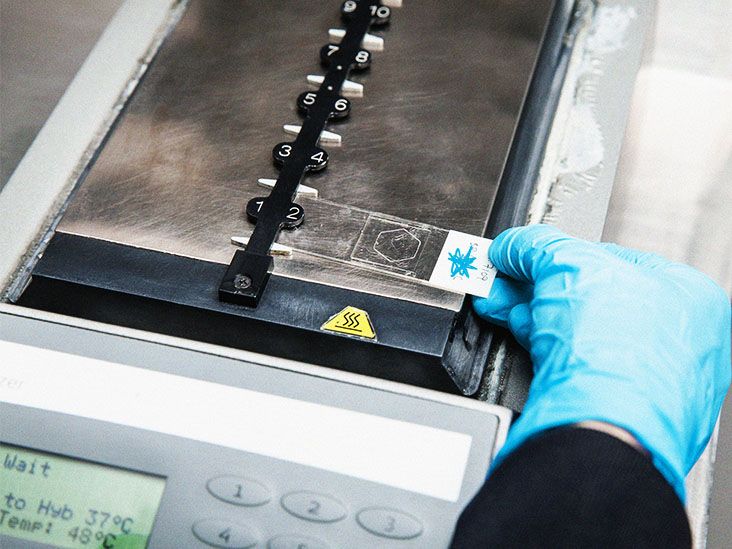
The slide is warmed under controlled conditions.
During this step, probes search for their matching DNA sequences inside the cells.
When a probe finds its match, it sticks (hybridizes) to that DNA segment and stays there. - Washing and visualization
Extra, unbound probes are washed away.
A pathologist then uses a fluorescence microscope to look at the cells.
Each probe glows in a specific color, creating bright dots or patterns that show where the target gene or chromosome region is located and how many copies are present. - Interpreting the results
The pattern of glowing signals tells the pathologist whether there are:- Extra copies of a gene (amplification)
- Missing segments (deletions)
- Chromosomes that have swapped pieces (translocations)
- Abnormal numbers of certain chromosomes
These findings are summarized in a report sent to your healthcare provider, who uses them to guide diagnosis, prognosis, or treatment planning.
What conditions can FISH testing help diagnose?
FISH isn’t a one-trick testit’s more like a flexible toolkit that can be customized for many conditions.
Here are some major areas where it’s commonly used.
Cancer diagnosis and treatment planning
One of the most important applications of FISH testing is in cancer care.
By revealing specific genetic changes in tumor cells, FISH helps doctors:
- Confirm the exact type of cancer
- Estimate how aggressive the cancer may be
- Match patients with targeted therapies that work best for their tumor profile
Examples of cancers where FISH is frequently used include:
- Breast cancer – HER2 FISH testing shows whether the cancer is HER2-positive, which can make it eligible for drugs that specifically target that protein.
- Leukemias and lymphomas – FISH can detect translocations and other chromosome changes in diseases like CML, ALL, AML, CLL, and various lymphomas.
- Multiple myeloma – Bone marrow FISH helps identify high-risk genetic features that influence treatment decisions and prognosis.
- Lung, bladder, and other solid tumors – FISH can look for gene rearrangements such as ALK, ROS1, or other markers that predict response to targeted therapies.
Prenatal and genetic testing
FISH may also be used in prenatal screening and to investigate certain genetic syndromes.
In these situations, the test is often performed on cells obtained through:
- Amniocentesis – sampling amniotic fluid around the fetus
- Chorionic villus sampling (CVS) – sampling placental tissue
FISH can provide relatively rapid information about specific chromosome abnormalities, such as extra copies or missing segments that may be linked to developmental or congenital conditions.
Other applications
Beyond cancer and prenatal testing, FISH can also be used to:
- Investigate unexplained developmental delay or intellectual disability
- Clarify structural chromosome rearrangements seen on other tests
- Study fertility issues and certain inherited conditions
In research settings, FISH is even used to track gene activity in tissues, study microorganisms, and map chromosomes at a very detailed level.
What to expect before, during, and after a FISH test
Before the test: preparation
The good news: for most people, you don’t have to do anything special to prepare for the FISH test itself.
The main “prep” depends on how the sample is collected:
- Blood draw – usually no fasting or special instructions.
- Bone marrow biopsy – your provider may discuss pain control, sedation options, and whether you should arrange a ride home.
- Tissue biopsy or surgery – you’ll follow the prep instructions for that procedure (for example, not eating beforehand if anesthesia is used).
- Prenatal procedures (amniocentesis or CVS) – your obstetrics team will explain what to expect, how to position yourself, and potential risks and aftercare.
Always tell your care team about:
- Medications and supplements you’re taking
- Bleeding or clotting disorders
- Pregnancy or possibility of pregnancy
- Any allergies, especially to anesthetics or contrast agents
During the test: sample collection
You won’t actually see the fluorescent magic in the labthat part happens behind the scenes.
What you’ll experience is the sample collection procedure, which may include:
- Blood draw – A quick needle stick in the arm. Slight pinch, maybe a small bruise later.
- Bone marrow biopsy – A needle is inserted into a bone (often the hip) after numbing. You might feel pressure and brief sharp pain.
- Tissue biopsy – Local numbing or sedation, depending on the site. Discomfort varies with the location and technique.
- Prenatal sampling – For amniocentesis or CVS, an ultrasound guides the needle. Cramping or pressure is common but usually brief.
After the sample is collected, it’s labeled and sent to a specialized lab where the actual FISH process is performed.
After the test: recovery and results
Recovery depends on how the sample was obtained:
- For a simple blood draw, most people can go back to regular activities immediately.
- After a bone marrow biopsy or tissue biopsy, you may have soreness for a few days. Your provider will give you instructions on caring for the biopsy site.
- After prenatal procedures, you may be advised to rest and watch for cramping, fluid leakage, or bleeding, and to contact your provider if anything feels off.
FISH test results usually come back within a few days, which is faster than traditional chromosome analysis that may take one to two weeks.
Your provider will go over the report with you, explain what the findings mean, and discuss how they affect your diagnosis, treatment options, or future plans.
Benefits and limitations of FISH testing
Key benefits
- Targeted – FISH zooms in on specific genes or chromosome regions that are clinically important.
- Sensitive – It can detect certain abnormalities that standard chromosome analysis might miss, especially in non-dividing cells.
- Relatively fast – Results often arrive in days rather than weeks.
- Supports personalized medicine – In cancer, FISH can identify genetic changes that match you to targeted therapies instead of “one-size-fits-all” treatment.
Limitations to know about
- It’s not a full genetic scan – FISH looks only at the genes or regions it’s designed to test. If your doctor doesn’t suspect a specific abnormality, it won’t show up just by accident.
- May need other tests – FISH is often used alongside other tests such as traditional karyotyping, next-generation sequencing, or immunohistochemistry.
- Complex interpretation – Results are not “good vs. bad” in a simple way. A change that looks scary on paper might be common in a particular cancer and simply help guide therapy.
- Cost and availability – Not every lab offers every possible FISH probe. Specialized testing may be sent to reference centers.
Because of these nuances, results should be interpreted by specialists and explained in context.
FISH is a tool, not a verdict.
Understanding your FISH test results
FISH reports can look intimidatinglots of abbreviations, chromosome numbers, and symbols.
Here’s how to think about them in plain language:
- Normal (negative) result
No abnormal copies, deletions, or rearrangements were found in the region tested.
That doesn’t mean everything in your genome is perfectjust that the specific change they looked for wasn’t detected. - Positive result
The test found the abnormality it was designed to detect.
In cancer, this might mean:- A tumor is HER2-positive (extra copies of the HER2 gene)
- A leukemia has a specific translocation associated with a particular subtype
- A lung cancer has a rearrangement like ALK or ROS1, which can make it responsive to targeted drugs
In prenatal or genetic testing, a positive result may indicate an extra chromosome segment, a missing region, or another structural change.
- Variant or uncertain result
Occasionally, results are not clearly normal or abnormal.
Your provider may recommend additional testing or genetic counseling to better understand what the finding means.
Most importantly, don’t try to interpret FISH results on your own.
Always review them with a healthcare professional who can put the information into context for your specific situation.
Real-life experiences: what FISH testing feels like
Every person’s story is different, but hearing what the process tends to feel like in real life can make it less mysterious.
Here are some composite experiences based on common patient and caregiver perspectives.
Experience 1: “The test that changed my treatment plan”
Imagine someone diagnosed with early-stage breast cancer.
After surgery, the pathology report looks borderline: the tumor is not clearly HER2-positive or negative based on the initial stain.
Her oncologist orders a HER2 FISH test for clarity.
From her point of view, there’s no new procedureno extra needle, no new scar.
The FISH test happens entirely in the lab using the tumor tissue already removed during surgery.
A few days later, she gets the call: the FISH result shows true HER2 amplification.
That single piece of information opens the door to targeted therapy known to significantly improve outcomes in HER2-positive breast cancer.
Emotionally, she goes from uncertainty to a strange mix of relief and worry.
Relief, because there’s now a clearer, evidence-based plan.
Worry, because targeted therapy sounds intense.
But understanding that the FISH test pinpointed a treatable target helps her feel that her care is precise, not random.
Experience 2: “Waiting for results during pregnancy”
Consider a couple whose routine prenatal ultrasound picks up a possible concern.
Their maternal-fetal medicine specialist recommends amniocentesis and includes rapid FISH testing for certain chromosome abnormalities.
The amniocentesis itself is the big, stressful event: lying still, feeling pressure as the needle goes in, and then going home to rest and worry.
The FISH part of the process is invisible to thembut knowing that the test can return preliminary answers in days, not weeks, makes the waiting slightly less unbearable.
When the call finally comes, the FISH results are reassuring.
Major chromosome issues tested for by the panel didn’t show up.
The couple still waits on more comprehensive testing, but having those early FISH results gives them a little room to breathe and plan.
Experience 3: “Understanding my cancer better”
For someone with a blood cancer such as leukemia or multiple myeloma, FISH testing can feel like a recurring character in their story.
At diagnosis, a bone marrow biopsy is done and FISH is ordered to look for certain markers that categorize risk.
Later on, FISH may be repeated to see how the disease is responding to treatment or whether new abnormalities have appeared.
Patients often describe the bone marrow biopsy as the toughest part physically, but they also talk about how empowering it feels to know that the results are so specific.
Instead of “You have leukemia, here’s a generic plan,” the conversation becomes, “Your leukemia has this particular genetic profile, which responds well to these exact drugs.”
That personalization comes largely from tests like FISH.
Practical tips from people who’ve been there
- Ask what exactly the FISH test is looking for.
Knowing the specific gene or chromosome region can make the results easier to understand later. - Clarify how the results might change your care.
Will FISH determine whether you receive a targeted drug, need more testing, or can avoid certain treatments? - Plan for the waiting period.
Even though FISH is faster than some tests, a few days can feel very long.
People often find it helpful to schedule distractionswalks, calls with friends, or low-stakes activitiesto avoid spiraling into “what-ifs.” - Bring someone to important appointments.
Having a second set of ears can help you remember what your doctor says about the test and the results. - Don’t be shy about follow-up questions.
It’s completely okay to say, “Can you explain that again in simpler terms?”especially when genetics is involved.
Ultimately, people often describe FISH testing as one of the “quiet heroes” of modern medicine.
You rarely see it happening, but its results can dramatically shape diagnosis, risk assessment, and treatment choices.
While it can be stressful to wait for any genetic test, understanding what FISH doesand what it doesn’t docan help you feel more in control during an uncertain time.
As always, if you have questions about whether FISH testing is right for you, or how your own results should be interpreted, talk with your healthcare team or a genetic counselor.
Online information is great for background, but it’s not a substitute for personalized medical advice.
SEO JSON META