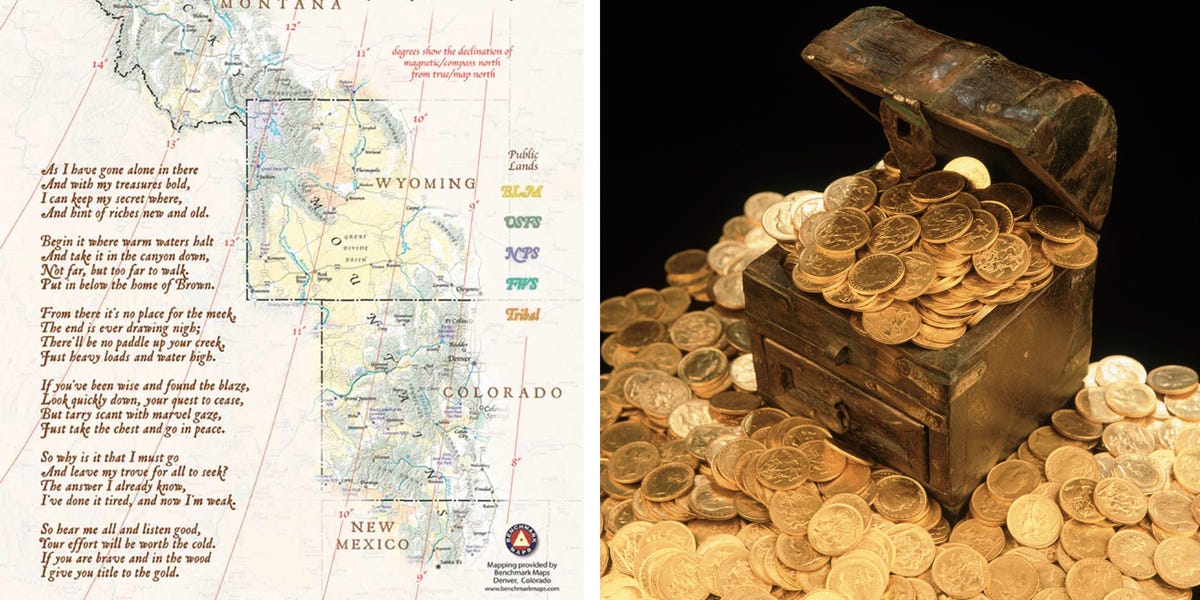
Few modern mysteries have mixed poetry, gold, road trips, obsession, and pure American wilderness quite like the Fenn Treasure. It sounded almost too perfect: an eccentric Santa Fe art dealer says he hid a bronze chest full of riches somewhere in the Rocky Mountains, then leaves behind a cryptic poem and tells the world, in effect, “Good luck, detectives.” That single act launched a decade-long chase that turned ordinary people into amateur codebreakers, armchair geographers, riverbank philosophers, and very determined owners of hiking boots.
The Fenn Treasure became more than a hunt for valuables. It became a cultural phenomenon, a puzzle wrapped in mythology and tied with a ribbon of frontier fantasy. Some people chased it for money. Others chased it for meaning, adventure, or the intoxicating dream of being the one person who could outthink everybody else. And that may be the real reason the story still fascinates people: the chest was valuable, sure, but the idea behind it was worth even more.
What Was the Fenn Treasure?
The Fenn Treasure was a small bronze chest reportedly packed with gold coins, nuggets, jewelry, and rare artifacts. Estimates of its value varied, but most reports placed it somewhere north of a million dollars, with some estimates pushing closer to two million. In treasure-hunt terms, that is not “loose change in the couch cushions.” That is “cancel your weekend plans and start reading maps.”
Forrest Fenn, the man behind the chest, announced the hunt in 2010 through his self-published memoir The Thrill of the Chase. Inside the book was a 24-line poem that searchers believed contained the clues needed to find the treasure. Fenn said the chest was hidden somewhere in the Rocky Mountains north of Santa Fe, within a broad region that sent searchers into New Mexico, Colorado, Wyoming, and Montana.
The genius of the setup was its simplicity. There was no glossy app, no celebrity-hosted game show, no blinking red X on a website. There was just a poem, a man with a colorful reputation, and a promise that the treasure was real. In an age of digital everything, the Fenn Treasure felt refreshingly analog. It was a mystery you solved with books, boots, and stubbornness.
Why Did Forrest Fenn Hide It?
Fenn’s explanation helped turn the hunt into legend. He had faced a serious cancer diagnosis years earlier and said the experience pushed him to think about mortality, legacy, and the outdoors he loved. The treasure hunt, as he framed it, was meant to inspire people to get off the couch, head outside, and feel wonder again. In other words, he created a million-dollar excuse to stare at rivers and argue about metaphors.
That motive mattered. If the whole thing had been pitched as a gimmick, it probably would have faded fast. But Fenn sold the hunt as a challenge, an invitation, and a bit of philosophy disguised as mischief. For many followers, the chest was not just hidden wealth. It was a test of imagination. Could you understand the poem? Could you understand Fenn? Could you think like the man who hid the box?
That human layer is what elevated the story. Treasure maps are fun. Treasure maps tied to a living, eccentric storyteller are irresistible. Fenn became part ringmaster, part puzzle-maker, part myth generator. The hunt was not merely about location. It was about personality.
How the Poem Sparked a National Obsession
The poem was short, but its effect was enormous. Searchers spent years debating every phrase, every capital letter, every possible double meaning. Some believed the solution hinged on geography. Others believed it hinged on biography. Some thought the clues were straightforward. Others were convinced the poem was basically a crossword puzzle wearing hiking boots.
Online forums exploded with theories. Searchers compared topographic maps, river names, historical references, fishing spots, and old interviews. Families turned the hunt into summer vacations. Solo searchers treated it like a second career. Entire communities formed around solving the clues, and many participants were chasing something bigger than cash. They wanted the thrill of being clever. They wanted the story. They wanted to stand in some remote patch of wilderness and say, “I figured it out.”
That kind of obsession is deeply American. The Fenn Treasure combined frontier mythology, puzzle culture, self-reliance, and the fantasy that the right insight can change your life overnight. It offered the oldest promise in the book: somewhere out there, hidden in plain sight, is a life-changing prize for the person brave or odd enough to go find it.
Was the Treasure Real?
For years, skeptics rolled their eyes. That was understandable. Modern life does not exactly overflow with wealthy retirees hiding gold in the mountains for fun. Critics suspected a publicity stunt, a hoax, or a never-ending performance piece designed to sell books and keep the legend alive.
But the treasure was real. In June 2020, Fenn announced that the chest had been found. Later, it was revealed that the finder was Jack Stuef, a former journalist and medical student. Stuef said he had solved the poem and recovered the chest in Wyoming. That confirmation ended the official hunt, though it did not end the debate. If anything, it launched a fresh round of questions.
The biggest question was obvious: where exactly was it? Wyoming narrowed the map, but not enough to satisfy years of obsessive clue-solving. The precise spot was never formally disclosed. That secrecy kept the story alive because mystery hates a clean ending. Since then, many searchers and analysts have argued that later evidence points toward the Yellowstone area, especially around Nine Mile Hole. Still, that remains a widely discussed theory rather than a universally acknowledged official answer.
What Was Inside the Chest?
Reports and later auction records helped paint a clearer picture of the contents. The chest included gold coins, gold dust, nuggets, jewelry, and historical items with the kind of romantic flair that makes ordinary savings accounts look painfully boring. This was not a shoebox of quarters. This was treasure in the cinematic sense: gleaming, old, weirdly specific, and almost too storybook to be believed.
In 2022, items from the treasure were auctioned, proving once again that the chest had existed and had substantial value. That sale gave the story a strange but fitting afterlife. The treasure that once symbolized mystery became a set of documented lots, collectible objects, and post-hunt relics. Adventure eventually met the auction catalog, which feels both poetic and a tiny bit hilarious.
The Dark Side of the Chase
No serious article about the Fenn Treasure should skip the hardest part: the hunt had real consequences. Searchers pushed into dangerous landscapes, and at least five people died while looking for the chest. Others required rescue or ran afoul of the law. Some entered restricted areas. Some damaged protected places. The story inspired wonder, yes, but it also revealed how quickly wonder can slide into risky obsession.
This tension sits at the center of the Fenn Treasure legacy. On one hand, Fenn encouraged adventure, curiosity, and time outdoors. On the other hand, the hunt drew people into remote terrain where confidence often outran preparation. The poem did not create danger on its own, but it absolutely amplified human impulses: hope, greed, certainty, competitiveness, and the powerful belief that this time the answer is just around the next bend.
That tension is part of why the hunt remains such a compelling case study. It was never just about hidden gold. It became a lesson in how stories influence behavior. Give people a map-shaped mystery and enough emotional investment, and many will go much farther than logic suggests.
Why the Fenn Treasure Still Matters
Plenty of treasure stories flare up and fade out. The Fenn Treasure did not. It lasted because it touched several American obsessions at once: wilderness, independence, mystery, self-made adventure, and the idea that ordinary life can still contain legendary possibilities.
It also arrived at the perfect cultural moment. People were already burned out on screens, hungry for real experiences, and increasingly drawn to puzzles, escape rooms, true-crime logic, and internet-fueled communities. The Fenn Treasure offered all of that, but with mountains instead of mood lighting. It turned spectators into participants.
The story has also continued to evolve in public memory. Books, documentaries, interviews, and more recent screen adaptations have brought fresh attention to the hunt, especially for people who missed its wildest years the first time around. That renewed interest proves the story still has magnetic pull. Even after the chest was found, the idea of the Fenn Treasure remained unfinished because mystery, once it enters culture, is very hard to evict.
What the Fenn Treasure Really Reveals
At its core, the Fenn Treasure reveals that people are not just searching for wealth. They are searching for narrative. They want a quest. They want the world to feel layered, symbolic, and still capable of surprise. A hidden chest in the Rockies gave people permission to believe that modern life had not flattened every frontier.
That is why the story resonates long after the chest was pulled from the ground. The real treasure may have been the permission slip Fenn handed out: go look, go wonder, go try. Of course, the story also warns us that wonder needs wisdom. Adventure is best enjoyed with preparation, restraint, and a healthy suspicion of one’s own certainty.
In the end, the Fenn Treasure is both a fairy tale and a cautionary tale. It delivered on its promise of mystery. It proved the chest was real. It changed lives. It started arguments that still refuse to die. And it left behind a legacy that is equal parts gold, folklore, and human nature. Not bad for one bronze box and a poem that sent half the internet into the woods.
Experiences Related to the Fenn Treasure
One reason the Fenn Treasure still feels vivid is that it produced experiences people could not forget, even when they never found so much as a gold flake. Ask former searchers what the hunt meant, and many will not begin with money. They will talk about driving before sunrise with a thermos of coffee and a folded map riding shotgun. They will talk about standing beside cold water, reading a line from the poem for the fiftieth time, suddenly convinced that one ordinary bend in the landscape had to be the answer.
The experience of chasing the Fenn Treasure often sounded like a mix of vacation, obsession, graduate seminar, and campfire mythology. People spent nights in motels highlighting books, mornings tracing rivers with their fingers, and afternoons hiking into places that looked like they had wandered straight out of a Western film. Even unsuccessful trips created stories. A wrong turn became a memory. A missed trail became a joke. A beautiful overlook became proof that not every prize needs to fit in a treasure chest.
Families experienced the hunt differently than solo searchers. For some families, it was an excuse to spend time together outdoors. Parents got to watch kids treat maps like magic objects. Kids got to watch adults become delightfully ridiculous over a poem. The search transformed regular summer travel into something more dramatic. A roadside stop was no longer just a roadside stop. It was a possible clue. A river was not just a river. It was a suspect.
For solo searchers, the experience could be more intense and more personal. Many described the chase as a private mental marathon. The poem stayed with them while cooking dinner, commuting to work, or trying unsuccessfully to sleep. A line would click in the shower. A possible interpretation would arrive in the grocery store aisle. The hunt created a strange parallel life, one where ordinary routines coexisted with a secret, burning conviction that the solution might be just one good insight away.
There was also the social experience of the hunt. Online communities let searchers compare theories, celebrate close calls, argue over clue logic, and occasionally behave like medieval scholars debating sacred texts. Some friendships formed through shared solve ideas. Some rivalries did too. The Fenn Treasure turned strangers into collaborators and competitors at the same time. It was one of those rare modern phenomena where the internet did not just distribute information; it distributed obsession.
The most lasting experience, though, may have been emotional rather than physical. The hunt gave many people a sense of anticipation that daily life often lacks. It made the world feel expandable. A map was no longer finished. A landscape was no longer background scenery. Every canyon, creek, and stand of pine carried the possibility of hidden meaning. That is powerful stuff.
Of course, not every experience was healthy. For some, the hunt became too consuming. That is part of the story, too, and it deserves honesty. But for many others, the Fenn Treasure offered a rare combination of wonder and participation. It gave people a reason to learn geography, read poetry more closely, travel farther, and pay attention to the land in a different way.
That may be the strangest and most enduring experience of all: even after the treasure was found, many people still felt that they had gained something. Not gold. Not jewels. But memories, landscapes, friendships, and the electrifying sensation that for a little while, the modern world had made room for a real adventure. In that sense, the Fenn Treasure did exactly what its creator hoped it would do. It got people out into the world, looking harder, thinking deeper, and believing, however briefly, that mystery was still alive.
Conclusion
The Fenn Treasure endures because it offered more than riches. It gave people a modern legend they could step into with their own boots on the ground. The chest was real, the hunt was real, and the emotions around it were very real. Yet the story remains open-ended enough to keep inviting new interpretations. That balance is rare. Most mysteries disappear when solved. The Fenn Treasure became more interesting because solving it did not erase the myth.
Whether you see the hunt as brilliant, reckless, romantic, or all three at once, it remains one of the most remarkable treasure stories in recent American culture. It promised adventure and actually delivered it. And years later, people are still tracing rivers on maps, rereading the poem in their heads, and wondering how one man with a bronze chest managed to send so many people searching for gold, meaning, and a better story about the world.