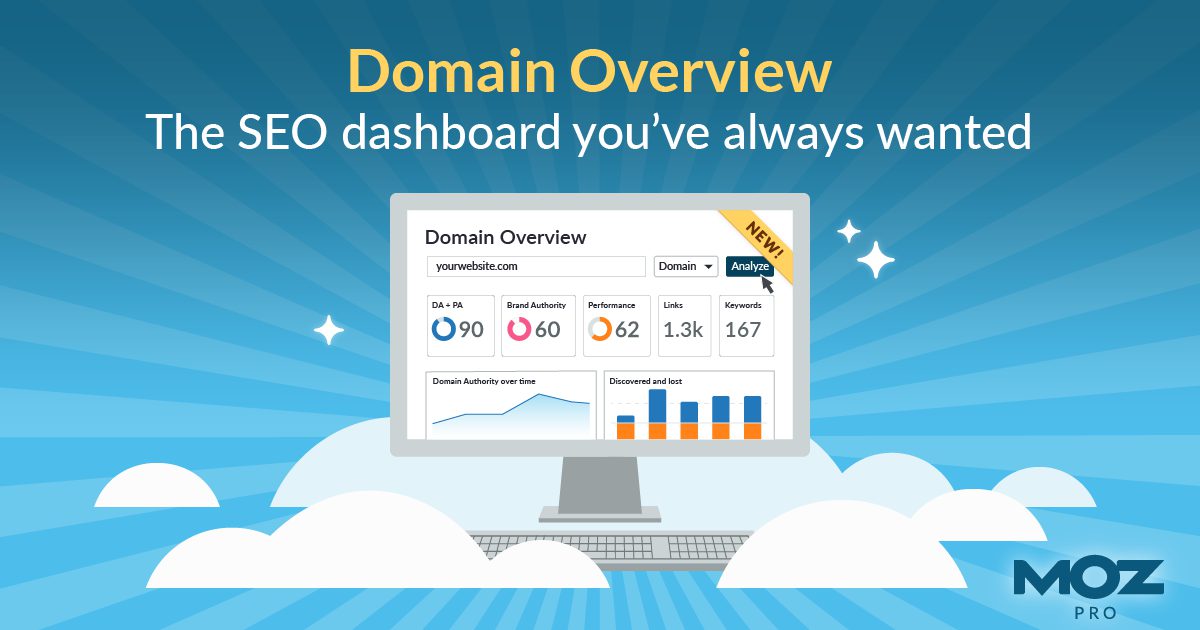
A website can contain thousands of pages, years of content, and enough backlinks to make a spreadsheet beg for mercy. Fortunately, Moz Domain Overview condenses much of that complexity into an instant SEO report that helps marketers understand a domain without spending an afternoon opening 47 browser tabs.
By entering a website address, you can obtain a high-level picture of its authority, backlink profile, ranking keywords, strongest pages, and organic search competitors. The report does not replace a complete technical audit, but it provides an excellent starting point for deciding where deeper investigation should begin.
What Is Moz Domain Overview?
Moz Domain Overview, also known through Moz’s Domain Analysis tools, is a website analysis report that summarizes important SEO metrics for a root domain. It can be used to evaluate your own site, investigate a competitor, qualify a potential link partner, or perform an initial review of a domain before a redesign, migration, partnership, or acquisition.
The original free Domain Analysis tool introduced metrics such as Domain Authority, Spam Score, linking root domains, ranking keywords, top pages, top linking domains, keyword distribution, featured snippets, search competitors, and search questions. The exact interface and limits may change as Moz updates its products, but the central purpose remains the same: turning a mountain of SEO data into a readable snapshot.
Think of the report as an airport departure board for your website. It tells you what appears to be moving, what may be delayed, and where you should pay attention. It does not fly the plane, repair the engine, or explain why someone packed six bottles of shampoo in a carry-on.
Why an Instant Domain Report Is Useful
SEO decisions are often slowed down by scattered information. Keyword rankings may live in one platform, backlinks in another, and technical errors in a third. A domain overview brings several useful indicators together so that you can quickly identify patterns.
It establishes a baseline
Before improving a website, you need to understand its current position. The report gives you benchmark numbers that can be recorded and compared over time. A single score rarely tells the whole story, but changes across several metrics may reveal whether your visibility is strengthening or weakening.
It makes competitor research faster
Your offline competitors are not always your search competitors. A neighborhood retailer may compete in Google with national marketplaces, publishers, directories, and review sites. SEO competitor analysis focuses on domains that rank for the same searches, regardless of whether their business models resemble yours.
It helps prioritize limited resources
Most teams cannot fix everything at once. An instant report can indicate whether the next project should focus on content, digital PR, link reclamation, keyword expansion, or a deeper technical crawl. That is more useful than declaring, “We should do more SEO,” which is the marketing equivalent of telling a restaurant to make more food.
How to Read the Main Moz Domain Metrics
Domain Authority
Domain Authority, commonly abbreviated as DA, is Moz’s comparative score for estimating a domain’s ability to compete in search results. It uses a scale from 1 to 100, with higher values representing stronger predicted ranking potential.
DA is best used comparatively. A score of 35 may be impressive in a specialized local industry but modest in national finance, technology, or health publishing. Compare your website with relevant search competitors instead of chasing an arbitrary number.
Most importantly, Domain Authority is not a Google ranking factor. Google does not import Moz’s score into its ranking systems. DA is a third-party measurement designed to help marketers interpret link-related strength and competitive position.
Linking Root Domains
Linking root domains represent the number of unique websites pointing to the analyzed domain. This measurement often provides more context than the raw backlink total.
Imagine that Website A has 10,000 backlinks from 12 domains, while Website B has 2,000 backlinks from 400 relevant domains. Website A wins the backlink-counting contest, but Website B may have broader editorial support. One enthusiastic sitewide footer link should not be mistaken for thousands of independent recommendations.
Search engines use links to discover pages and understand relationships between online resources. However, quality, relevance, placement, and context matter more than collecting the largest possible number. Bing explicitly recommends earning links organically as people discover useful, distinctive content.
Spam Score
Moz Spam Score helps identify characteristics commonly associated with sites that have experienced search penalties or other quality problems. It is a risk indicator, not a courtroom verdict.
A higher Spam Score does not automatically prove that a domain is malicious or penalized. Likewise, one suspicious backlink does not require an emergency meeting with dramatic background music. Review the actual linking pages, anchor text, topical relevance, traffic patterns, and link acquisition history before making a decision.
Use Spam Score to prioritize investigation. It is especially helpful when evaluating expired domains, partnership opportunities, guest-post prospects, sudden link spikes, or websites being considered for purchase.
Top Pages by Links
The top-pages section shows which URLs attract the most inbound links. These pages are often original research reports, useful tools, definitive guides, newsworthy resources, templates, statistics pages, or evergreen tutorials.
For your own domain, the report reveals which content has successfully earned attention. You can update those assets, improve their conversion paths, add internal links, or create related resources. For a competitor, top linked pages expose the formats and subjects that publishers in your market consider worth referencing.
Top Linking Domains
This section identifies influential websites contributing to a domain’s backlink profile. Review each source for relevance and editorial quality rather than relying only on its authority score.
A link from a respected industry association, university, newspaper, manufacturer, or specialized publication may carry strategic value beyond its numerical metrics. It can generate referral traffic, strengthen brand recognition, and introduce the business to a relevant audience.
Ranking Keywords
The ranking-keywords metric estimates how many search terms produce organic visibility for the domain. A growing keyword footprint may indicate that a site is expanding its topical coverage or gaining search prominence.
However, keyword quantity must be interpreted alongside position and intent. Ranking for 20 valuable commercial queries can be more useful than appearing for 5,000 irrelevant phrases. Look for terms that match the products, services, expertise, and problems your audience genuinely cares about.
Keyword Ranking Distribution
Keyword distribution divides rankings into position ranges, such as the top three results, positions 4 through 10, positions 11 through 20, and lower groups.
The positions 11 through 20 segment is often especially actionable. These pages already have some relevance and authority but sit just outside the first page. Better search-intent alignment, updated information, improved internal links, clearer headings, stronger examples, or a few legitimate backlinks may help them advance.
Keywords by Estimated Clicks
Estimated-click metrics attempt to combine ranking position, search demand, and expected click-through behavior. They provide a more realistic perspective than search volume alone because not every search produces the same number of organic clicks.
Use these figures directionally rather than treating them like analytics data. Third-party estimates are models, while Google Search Console and your analytics platform report activity associated with your verified website.
Featured Snippets and Search Questions
Featured-snippet data can show which concise answers, definitions, lists, or steps are earning prominent search placement. Search-question reports reveal the language people use when investigating the topic.
These insights can guide FAQ sections, comparison pages, tutorials, glossary entries, and supporting articles. The objective is not to stuff every question into one enormous page. Build a sensible information structure in which each page thoroughly answers a distinct search need.
How to Perform a Domain Overview Analysis
Step 1: Analyze your root domain
Enter the canonical version of your domain and record the headline metrics. Save the date, because authority scores and link indexes change as new information is discovered.
Step 2: Select relevant competitors
Choose three to five websites that appear for your priority searches. Include at least one realistic competitor close to your current level. Comparing a new gardening blog exclusively with the largest home-improvement publisher on the internet may be inspirational, but it is not especially diagnostic.
Step 3: Compare the metric gaps
Create a simple comparison covering Domain Authority, referring domains, ranking keywords, strongest linked pages, keyword distribution, and visible search competitors.
Look for relationships. A competitor may have only a slightly higher DA but twice as many keywords in the top 10. Another may receive most of its authority from a few exceptional resources. These patterns are more useful than any isolated score.
Step 4: Inspect pages rather than stopping at the domain
Domain-level data points you toward opportunities, but rankings occur at the page level. Open the pages attracting links and rankings. Study their subject coverage, formatting, originality, freshness, media, citations, and internal links.
Step 5: Verify findings with first-party tools
Compare Moz estimates with Google Search Console, Bing Webmaster Tools, analytics data, server logs, and a technical crawler. Bing’s Site Explorer can surface URL-level crawl information, impressions, clicks, and backlinks, while Google Search Central emphasizes crawlability, indexing, understandable content, and people-first usefulness.
Step 6: Turn observations into assignments
Every useful insight should become an action with an owner and deadline. “Competitor has better links” is an observation. “Publish an updated industry benchmark and pitch it to 25 relevant trade publications by September 30” is a plan.
What Moz Domain Overview Cannot Tell You
An instant SEO report is intentionally broad. It cannot fully diagnose crawl traps, rendering failures, JavaScript problems, incorrect canonical tags, redirect chains, duplicate content, server errors, structured-data issues, or mobile usability problems.
These concerns require a technical audit using Search Console, Bing Webmaster Tools, log files, page-speed testing, and crawling software. Technical crawlers can uncover hundreds of possible issues, but even those findings must be prioritized by business impact rather than fixed merely because a dashboard displayed a warning icon.
The report also cannot measure whether visitors trust your brand, understand your offer, enjoy the website, or convert into customers. A domain can possess impressive authority and still have product pages that read like they were written by a malfunctioning fax machine.
Common Domain Analysis Mistakes
Obsessing over Domain Authority
DA should support decision-making, not become the entire strategy. Publishing weak content or buying questionable links merely to increase a score can waste money and introduce risk.
Comparing unrelated industries
Authority levels vary widely by niche. Compare your domain with websites competing for the same audience and search results.
Treating every backlink equally
Backlink totals hide major differences in relevance and quality. Other platforms use their own proprietary measurements, including Ahrefs Domain Rating, Semrush Authority Score, and Majestic Trust Flow and Citation Flow. Because every provider maintains a different index and model, scores should not be expected to match exactly.
Ignoring conversion value
Organic traffic is valuable only when it contributes to a meaningful objective. Connect keyword and content opportunities with leads, subscriptions, purchases, appointments, donations, or another measurable outcome.
Making decisions from one snapshot
A report captured today may include temporary fluctuations or newly processed data. Monitor trends over several months and document major campaigns, migrations, algorithm updates, and publishing changes.
A Practical 90-Day Action Plan
Days 1-30: Diagnose and prioritize
- Benchmark your domain against three to five search competitors.
- Identify pages ranking between positions 4 and 20.
- Review the strongest and weakest sections of your backlink profile.
- Run a technical crawl and check indexing reports.
- Select five opportunities based on likely business impact.
Days 31-60: Improve existing assets
- Refresh promising pages with current information and clearer answers.
- Add internal links from authoritative pages to priority URLs.
- Repair broken links and reclaim valuable lost backlinks.
- Improve titles, headings, introductions, calls to action, and page structure.
- Consolidate overlapping pages that compete for the same intent.
Days 61-90: Build new authority
- Create one genuinely link-worthy research asset, tool, or guide.
- Contact relevant publishers, associations, partners, and experts.
- Publish supporting content around proven keyword clusters.
- Track new referring domains, ranking movement, qualified traffic, and conversions.
- Run another domain overview and compare the new baseline with the original report.
Field Experience: Lessons From Using an Instant SEO Report
In practical SEO work, the most valuable part of a domain overview is rarely the biggest number on the screen. The real value comes from discovering an unexpected relationship between several metrics.
Consider a hypothetical regional home-services company. Its Domain Authority is 24, while the three websites ranking above it have scores between 31 and 39. The first reaction might be, “We need more backlinks.” That conclusion is not entirely wrong, but it is too broad to be useful.
A closer review shows that the company already has 310 linking root domains. Unfortunately, most links point to the homepage, old sponsorship announcements, or discontinued service pages. Its competitors have fewer total backlinks, but their strongest links point directly to detailed cost guides, maintenance checklists, comparison pages, and regional data studies.
The keyword report adds another clue. The company has dozens of pages ranking between positions 11 and 20 for valuable searches such as seasonal maintenance costs, emergency service questions, and replacement timelines. These pages are not invisible. They are standing outside the first-page party, hearing the music, and wondering why nobody opened the door.
Instead of launching an indiscriminate link-building campaign, the better plan is to update five promising pages. Each article receives clearer expert explanations, original photographs, current pricing ranges, service-area examples, stronger internal links, and a concise FAQ section. The marketing team then promotes the improved resources to local associations, property-management companies, real estate publications, and community news outlets.
This example illustrates an important lesson: the authority gap was real, but the solution was not simply “increase DA.” The domain needed better distribution of authority, stronger page-level assets, and content that gave relevant organizations a legitimate reason to link.
Another frequent discovery involves search competitors. A business owner may name three companies that compete for customers, yet Moz may show that informational publishers dominate the relevant keywords. That changes the content strategy. The company should not merely imitate another service provider’s sales pages. It may need educational resources capable of competing with editorial websites.
Domain reports are also useful during website redesigns. Before removing old pages, the team can identify URLs with valuable links or keyword visibility. Those pages should be preserved, improved, or redirected carefully. Deleting them without review can erase years of accumulated authority faster than someone clicking “Select All” and confidently choosing “Trash.”
The best operating habit is to save a monthly snapshot and attach short notes. Record when major content launches, migrations, digital PR campaigns, technical fixes, or seasonal events occur. After several months, the numbers become a story rather than a collection of disconnected scores.
You may notice that referring domains increased while top-10 rankings remained flat. That could mean the new links were weak, irrelevant, recently discovered, or pointed at pages with limited search potential. You may see DA remain stable while conversions rise sharply because the team improved a handful of commercially valuable pages. In that case, the campaign succeeded even though the headline authority score barely moved.
The most experienced interpretation is therefore balanced: use Moz Domain Overview to ask better questions. Which pages earn links? Which topics create visibility? Where do competitors possess an advantage? Which near-ranking pages deserve attention? What changed since the previous report?
When every metric leads to a sensible question and every question leads to a prioritized action, the instant report becomes more than a dashboard. It becomes a practical map for deciding what the SEO team should do next.
Conclusion
Moz Domain Overview offers a fast, approachable way to evaluate authority, backlinks, keyword visibility, top content, and competitive position. Its greatest strength is speed: within minutes, a marketer can move from knowing almost nothing about a domain to identifying several promising areas for investigation.
The report works best when its metrics are compared with relevant competitors, examined over time, verified through first-party data, and translated into specific projects. Domain Authority, Spam Score, and backlink totals are useful indicators, but they are not substitutes for technically accessible pages, helpful content, genuine editorial recognition, and a website that serves its visitors.
Use the overview as the opening chapter of an SEO analysis, not the final sentence. It will show you where the interesting clues are hiding. The rest of the work involves following those clues without becoming hypnotized by a shiny score from 1 to 100.