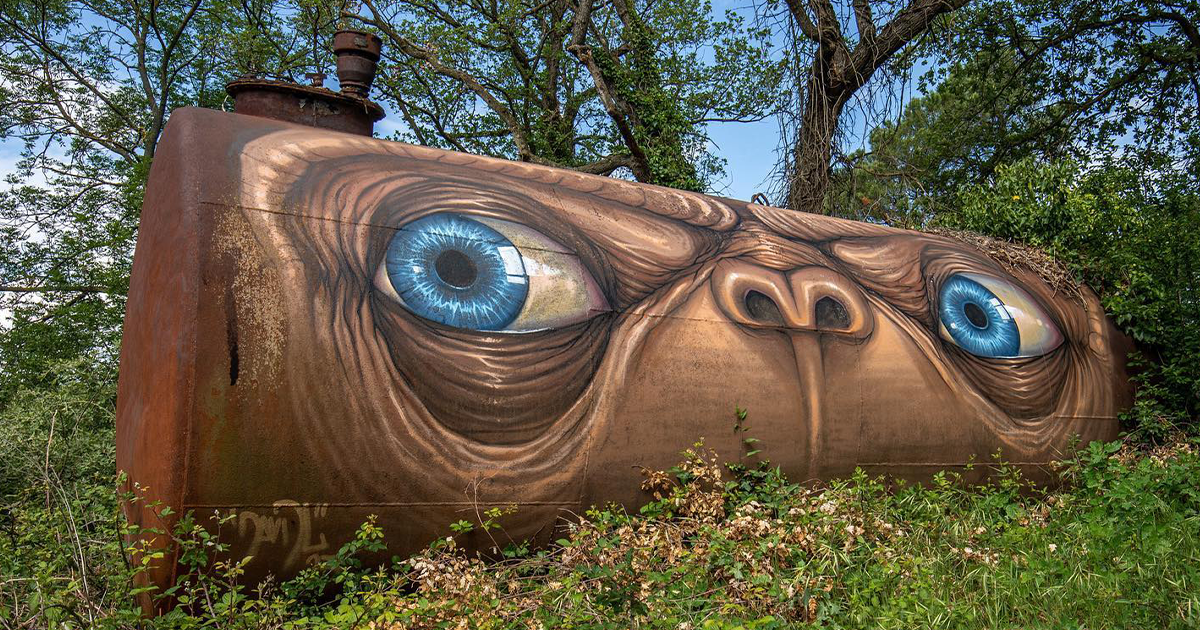
David Lozano, also known as DavidL, has a talent for making abandoned wrong> In this eerie collection of 24 new graffiti artworks, familiar pop-culture characters are stretched, warped, slimed, cracked, and given the sort of expressions that suggest they have seen your browser history.
Set against neglected rooms, peeling paint, broken windows, and weathered concrete, Lozano’s work turns forgotten buildings into strange little theaters. The walls do not simply hold the artwork; they become part of the story. A crumbling doorway becomes a monster’s mouth. A moldy ceiling becomes a storm cloud. A dark hallway suddenly feels like the exact place where a cartoon character would whisper, “You should probably not go in there.”
When Childhood Characters Take a Very Dark Detour
Most people grow up seeing cartoons as cheerful, harmless entertainment. A sponge lives in a pineapple, a yellow family lives in Springfield, and a blue monster is supposed to help children sleep. David Lozano looks at those familiar faces and asks a slightly more unsettling question: what would they look like after spending several decades trapped in an abandoned building with no electricity, no snacks, and questionable ventilation?
The answer is wonderfully creepy. Lozano’s graffiti art takes recognizable characters and reshapes them into creatures that sit somewhere between comedy, horror, fantasy, and the kind of dream you have after eating too much pizza at midnight. His work does not erase the original identity of a character. Instead, it bends that identity until it becomes strange, uncomfortable, and impossible to ignore.
That tension is what makes the artwork effective. Viewers recognize the source material immediately, but the familiar comfort does not last long. A character’s smile may become too wide. Eyes may become hollow, oversized, or disturbingly alert. Tentacles, teeth, dripping textures, sharp shadows, and exaggerated limbs push the image away from childhood nostalgia and toward urban nightmare fuel.
Lozano’s work is especially striking because it uses a visual language that audiences already understand. You do not need an art-history degree or a museum membership to recognize the emotional switch. The character is familiar. The setting is familiar in another way: abandoned rooms, damaged walls, and neglected urban spaces all carry their own stories. Then the artist crashes those two worlds together like a cartoon truck driving through a haunted house.
David Lozano’s Graffiti Art Turns Decay Into a Co-Star
One of the most fascinating elements of DavidL’s street art is the setting. These are not polished gallery walls with soft lighting and someone quietly asking whether you would like sparkling water. Many of the works appear in abandoned or deteriorating buildings around Barcelona, where stains, cracks, rust, broken plaster, and empty rooms become part of the composition.
That matters because the environment changes how each piece feels. A brightly colored monster painted on a clean white wall might look playful. Put the same creature beside a collapsed doorway, under a damaged ceiling, or near a dark stairwell, and suddenly it looks like it has been living there since 1997 and has very strong opinions about visitors.
The decay adds texture that no digital background could fully imitate. Flaking paint can resemble reptile skin. Water damage can look like smoke or slime. A hole in a wall can become an eye socket, a mouth, or a portal to somewhere no sensible person would enter wearing flip-flops. Lozano does not fight these imperfections. He works with them, allowing the building’s scars to shape the final image.
This approach gives his graffiti artwork a temporary quality that suits street art perfectly. Buildings change, walls are repainted, spaces are renovated, and some structures disappear altogether. The artwork may survive online long after the physical location changes, but the original experience belongs to a particular moment. It is art with an expiration date, which somehow makes it feel more alive.
Why Pop Culture Horror Works So Well in Street Art
Pop culture characters are powerful because they arrive with built-in memories. People already know their voices, personalities, catchphrases, habits, and fictional worlds. A viewer sees a familiar silhouette and instantly brings years of associations to the image. Lozano uses that emotional shortcut, then flips it upside down.
In earlier collections of his work, recognizable figures such as Homer Simpson and Cookie Monster were transformed into unsettling caricatures, while newer pieces continue the same playful-but-creepy visual direction. Characters associated with animated comedy, science fiction, and children’s entertainment are reimagined as larger-than-life creatures with a darker edge. That contrast is the secret sauce. If the artwork only featured generic monsters, it could still be impressive, but it would not create the same emotional jolt. The audience laughs because they recognize the character. Then they pause because the character now looks like it escaped from a low-budget horror movie with an extremely generous special-effects budget.
There is also a sly sense of humor in the transformation. Lozano’s work is not simply trying to frighten viewers. It often exaggerates features in a way that feels cartoonish, absurd, and oddly charming. A bulging eye can be disgusting and funny at the same time. A familiar grin can turn sinister without losing its comic energy. That balance keeps the work from becoming gloomy. It is dark, but it is dark with a wink.
Familiar Faces, Unfamiliar Feelings
The best twisted character art creates a tiny identity crisis in the viewer. You know who you are looking at, but you are no longer sure how you are supposed to feel about them. Is that character adorable? Menacing? Ridiculous? All three? Congratulations, the artwork is doing its job.
Lozano’s graffiti style plays with that uncertainty. The images often look theatrical, as if each character is halfway through a bizarre performance. Some seem to crawl out of the wall. Others feel planted in the room like strange residents who have paid absolutely no rent but somehow own the place.
The Artistry Behind the Creepy Cartoon Effect
David Lozano’s work is more than a joke painted with spray cans. The visual impact depends on craft: bold outlines, controlled shading, layered color, exaggerated anatomy, and careful placement within the architecture of the space. The characters often appear three-dimensional because shadows and highlights make them seem to emerge from flat surfaces.
Spray paint is especially useful for this kind of street art because it can move quickly between sharp lines and hazy gradients. A face may have crisp teeth and eye outlines, while surrounding shadows dissolve into the rough texture of the wall. That contrast gives the figures a sense of movement. They do not simply sit on the surface; they seem to breathe through it.
Color is another major part of the effect. Horror does not always need to be gray, black, or blood-red. Lozano frequently uses vivid blues, acidic greens, electric yellows, purples, pinks, and bright oranges. Those colors make the figures pop against decaying architecture, but they also create an unnerving mood. The palette can feel playful at first glance, then increasingly bizarre the longer you look.
There is a visual intelligence in making grotesque images colorful. Bright colors pull viewers closer. Once they are close, the details start doing their strange little dance: the teeth, the wrinkles, the slime, the wild eyes, and the unsettling facial proportions. It is basically the artistic equivalent of a clown offering you a balloon and then asking whether you believe in ghosts.
Street Art Is Not Just Decoration
Graffiti and street art have long existed as forms of public expression, identity, humor, protest, and visual storytelling. Character-driven graffiti can communicate even when no words are used, because the image itself carries emotion and cultural references. Major museums and cultural institutions have increasingly documented graffiti’s history, social commentary, and influence on contemporary art. Lozano’s work fits into that larger conversation while maintaining its own distinct personality. His murals are not trying to imitate traditional fine art, and they are not simply copies of cartoons either. They exist in the middle zone where urban art, horror illustration, pop culture, and environmental storytelling collide.
The abandoned setting also adds a quiet social layer. Empty buildings can feel like visual leftovers from another time: places where people lived, worked, played, or planned something that never happened. By placing exaggerated characters in those spaces, the artist fills the emptiness with imagination. The building becomes less anonymous. It becomes a scene.
That does not mean every abandoned place is fair game for visitors. Art lovers should admire urban artwork responsibly, respect private property, and avoid entering unsafe structures. A brilliant mural is not worth falling through a damaged floor, getting injured, or discovering that the “abandoned” building is actually occupied by three security guards and a very angry goose.
What Makes These 24 New Pictures So Addictive to Scroll Through?
A collection like this works because every image offers a small surprise. The viewer never knows whether the next wall will feature a distorted cartoon face, a bizarre creature, a familiar pop icon, or something that looks like it crawled out of a forgotten arcade machine.
The 24 images also create a rhythm. One piece may be funny, the next may be creepy, and another may be both at once. The mood changes from room to room, but the overall visual world remains consistent. Lozano’s signature is not one single character or color palette. It is the feeling that something familiar has wandered into the wrong universe and decided to decorate.
There is a collectible quality to the work as well. Fans of horror art, graffiti culture, cartoons, surrealism, and abandoned places can all find something to enjoy. Some viewers may focus on the technical spray-paint skills. Others may enjoy spotting the pop-culture references. Others may simply appreciate the joy of seeing a neglected wall become ten times more interesting than it was five minutes earlier.
Street artists who use character imagery have helped show that public-facing art can be immediate, memorable, and emotionally accessible. The combination of recognizable icons and unexpected reinterpretation has also appeared in the work of other contemporary artists who remix cartoons, comics, advertising, and urban visual culture. ion>
Why David Lozano’s Dark Graffiti Art Sticks With You
David Lozano’s twisted graffiti artwork succeeds because it does not rely on one trick. It combines technical skill, bold color, horror imagery, humor, nostalgia, and location-specific storytelling. The characters are attention-grabbing, but the abandoned walls make them memorable.
There is something oddly satisfying about seeing forgotten spaces transformed into imaginative worlds. A damaged room becomes a stage. A wall becomes a character. A broken window becomes part of a visual punchline. Lozano’s work reminds viewers that art does not always need a pristine frame, a velvet rope, or a polite little plaque beside it. Sometimes it needs a cracked wall, a spray can, and a monster with far too many teeth.
These 24 new graffiti pictures are not simply creepy versions of beloved characters. They are playful reminders that popular culture is flexible, street art is alive, and even the most neglected wall can become a canvas for something unforgettable. Just do not be surprised if your next childhood cartoon suddenly feels a little suspicious.
The Experience of Encountering Darkly Twisted Graffiti Art
Experiencing dark graffiti art is very different from looking at a polished painting in a quiet gallery. In a gallery, the artwork is usually protected by clean white walls, bright lighting, careful labels, and the soft sound of someone pretending not to eat crackers in the corner. Street art has a different energy. It is exposed to weather, noise, movement, time, and the unpredictable personality of the city around it.
Imagine walking through an ordinary neighborhood, industrial area, or forgotten side street and spotting a flash of color on a damaged wall. At first, you may only notice the bright paint. Then you see the eyes. Then you recognize the shape. Then your brain begins connecting the dots, and suddenly you realize that a character from your childhood has become a fluorescent nightmare creature with an unsettling grin.
That moment of recognition is part of the experience. The art surprises you because it pulls a familiar image out of memory and places it somewhere you never expected to find it. A cartoon character that once appeared on a television screen is now staring from cracked concrete. The original character may have belonged to a bright, safe, fictional world, but the new version belongs to a space full of dust, shadows, peeling paint, and mystery.
There is also an element of discovery. Street art is not always presented with a map, a ticket, or a guided tour. You may find it by accident. You may hear about it from a friend, see it in a photograph, or notice it while taking a different route home. That sense of accidental discovery can make the artwork feel personal, like the city quietly handed you a strange secret and hoped you would not scream too loudly.
Darkly twisted graffiti also changes the way people see abandoned spaces. A neglected building can seem empty, sad, or forgettable until an artist adds a character to the wall. Suddenly, the space has mood and personality. It feels theatrical. You begin to imagine stories about who lived there, what happened there, or whether the creature painted beside the broken door has been waiting patiently for someone to bring snacks.
For photographers and urban-art fans, these environments create unforgettable visual contrasts. Bright spray paint against gray concrete. Cartoon shapes against broken architecture. Humor against decay. The scene can feel beautiful and uncomfortable at the same time, which is often where the most interesting art lives.
Still, the best way to appreciate this kind of artwork is responsibly. Enjoy murals from safe public areas, respect local rules, and never assume an abandoned-looking place is safe or accessible. Street art should inspire curiosity, not a bad decision involving a flashlight, a loose staircase, and a friend saying, “Come on, it will be fine.”
Ultimately, the experience of seeing David Lozano-style graffiti is about being surprised. It reminds viewers that art can appear in unexpected places, familiar characters can become strange again, and a wall that looked dead yesterday might be telling a completely different story today.