Some dads document family life with a fancy camera. Some write heartfelt journal entries. James Breakwell, better known online as Exploding Unicorn, chose a different survival strategy: he turns the beautiful, noisy, snack-powered chaos of living with his wife and four daughters into intentionally simple, wonderfully funny comics. The result is Unbelievably Bad Webcomic, a series that proves a stick figure can carry more emotional truth than a thousand perfectly filtered family photos.
The title sounds like the setup for a sitcom: a dad living with five girls in one house, surrounded by opinions, imaginary animals, endless questions, mysterious household rules, and probably at least one missing shoe at all times. But Breakwell’s comics are not about complaining. They are about noticing. He catches those tiny family moments that disappear in real life but become comedy gold when placed inside four panels.
These “30 new pics” continue the spirit that made his parenting humor popular online: quick dialogue, absurd logic, deadpan reactions, and the constant reminder that children are not tiny adults. They are tiny philosophers with peanut butter on their sleeves.
Who Is James Breakwell, The Dad Behind The Comics?
James Breakwell is an American comedy writer, author, and father of four daughters. He became widely known through his family humor account, Exploding Unicorn, where he shares sharp, short observations about parenting, marriage, kids, animals, and the everyday weirdness of being responsible for people who think bedtime is a legal negotiation.
His work expanded from social media into books, interviews, columns, and comics. His humor often presents him as an “amateur father,” but that self-deprecating label is part of the charm. Breakwell’s comedy works because it does not pretend parenting is polished. It admits the truth: most parents are improvising, and the kids can tell.
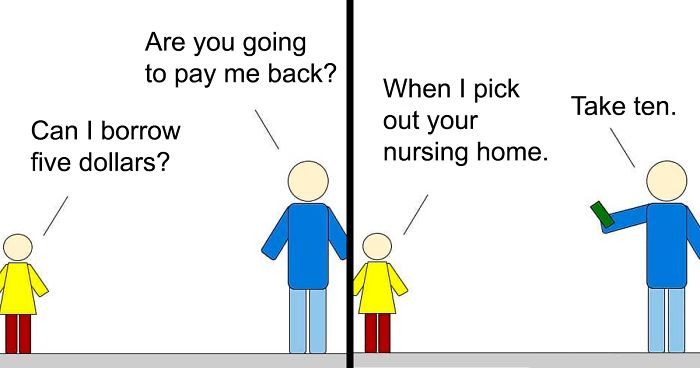
Unbelievably Bad Webcomic is especially memorable because of its deliberately rough art style. The drawings are simple, almost restroom-sign minimal, but that simplicity lets the joke do the heavy lifting. Instead of dazzling readers with visual detail, the comic focuses on timing, character, and the strange logic of family conversation.
Why These Parenting Comics Are So Relatable
The best parenting comics are not funny because they exaggerate family life beyond recognition. They are funny because they exaggerate it just enough to make parents whisper, “Unfortunately, yes.” Breakwell’s comics often begin with an ordinary situation: a kid asking a question, a dad trying to explain a rule, a pet wandering into the conversation, or a child revealing a plan that would terrify both NASA and the local school board.
Then comes the twist. A daughter offers a piece of logic so strange that it somehow defeats adult reasoning. The father reacts with dry resignation. The reader laughs because every parent has been there. You begin a conversation thinking you are the responsible grown-up. Three minutes later, you are debating whether imaginary dolphins need seat belts.
1. The Humor Comes From Real Family Dialogue
One reason Breakwell’s comics feel authentic is that they sound like real conversations. Children do not always deliver polished punchlines. They wander into brilliance by accident. A kid may misunderstand a word, challenge a rule, or ask a question so direct that every adult in the room suddenly needs coffee.
The comics capture that rhythm. Dad sets up normal reality. The kids immediately replace normal reality with something more interesting. The humor is not mean-spirited; it is observational. The daughters are not the butt of the joke. More often, they are the geniuses of the joke, while dad becomes the exhausted straight man trying to keep civilization from collapsing before lunch.
2. The Art Style Makes The Jokes Even Better
There is something oddly perfect about the “bad” art in Unbelievably Bad Webcomic. A highly detailed illustration might make the scene feel too formal. Breakwell’s simple figures remove all distractions. The reader does not stop to admire shading, anatomy, or background perspective. Instead, the eye jumps straight to the facial expressions, speech bubbles, and comic timing.
That roughness becomes part of the brand. It says, “This is not a museum piece. This is something drawn by a dad who may have had three minutes between a child’s meltdown and the dog doing something suspicious.” In other words, the style fits the subject. Parenting is not airbrushed. Parenting is sticky, loud, and occasionally drawn with the confidence of a man who knows the joke matters more than the elbows.
The Never-Ending Adventures Of A Dad In A House Full Of Girls
The phrase “never-ending adventures” is not an exaggeration. In Breakwell’s world, adventure does not require a dragon, a spaceship, or a treasure map. Adventure is a normal Tuesday. It is a child asking what happens if you feed a pig cereal. It is a family member developing a suspiciously detailed plan for avoiding chores. It is the daily miracle of everyone leaving the house with shoes, though not necessarily matching shoes.
Living with five girls in the house gives the comics a lively ensemble feeling. Dad is outnumbered, but not defeated. His wife and daughters create a world of emotional intelligence, weird ideas, sibling negotiations, and unexpected wisdom. The jokes often show that kids are not simply chaotic; they are creative problem-solvers whose solutions happen to be legally, physically, or financially impossible.
Family Life As A Comedy Laboratory
Every family has repeated themes. In Breakwell’s comics, those themes include parenting exhaustion, kid logic, pets, chores, food, school, imagination, and the constant mismatch between adult plans and child execution. Dad might want a quiet evening. The children might want to launch a new household religion based on snacks. Both sides have valid arguments, but only one side has unlimited energy.
That tension powers the series. Parents recognize the comedy because family life is full of tiny defeats. You lose arguments you did not know you were having. You make rules that sound reasonable until a child finds the loophole. You learn that “I cleaned my room” can mean “I moved everything under the bed and declared victory.”
Why Readers Love Parenting Comics Like These
Parenting can feel isolating, especially when social media often highlights perfect birthday parties, spotless kitchens, and children who appear to enjoy kale voluntarily. Comics like Breakwell’s offer a different message: your house is not uniquely chaotic. Everyone is making it up. Everyone has weird conversations. Everyone has at some point said, “Please do not lick that,” and then wondered how this became their life.
That honesty is refreshing. It gives parents permission to laugh at the mess instead of feeling guilty about it. The comics do not present parenting as failure. They present it as a long-running improv show where the cast is adorable, unpredictable, and sticky.
The Appeal Goes Beyond Parents
You do not need children to enjoy these comics. Anyone who grew up with siblings, babysat cousins, taught kids, worked in a school, or once had to explain basic reality to a determined five-year-old can understand the humor. The situations are specific, but the emotional pattern is universal: someone tries to impose order, and life responds by wearing a cape and shouting nonsense from the hallway.
That universality helps explain why family comics spread so well online. They are quick to read, easy to share, and immediately recognizable. A good parenting comic is like a tiny mirror. It reflects your own household back at you, only with better timing.
What Makes These 30 New Pics Stand Out?
The continued appeal of the series is its consistency. Breakwell does not need to reinvent the formula every time. The magic lies in returning to the same family world and discovering that it still has fresh chaos available. Kids grow, but they do not become less funny. They simply upgrade their arguments.
These newer comics show a creator who understands his strengths. The humor is fast. The dialogue is clean. The situations are grounded in family life but often tilt into absurdity. The dad character does not dominate the comic; he reacts, absorbs, and occasionally attempts a comeback before being emotionally defeated by someone half his size.
Example Themes Readers Can Expect
Readers can expect jokes about sibling rivalry, strange questions, pet-related disasters, school misunderstandings, household negotiations, and the kind of kid confidence that makes adults both proud and nervous. A daughter may announce a plan with total seriousness. Dad may point out one small problem, such as physics. The child may ignore that problem because imagination has already won.
The best examples work because they do not require long explanations. One small exchange reveals an entire family dynamic. Dad is tired but loving. The kids are wild but clever. The house is chaotic but warm. The joke lands, and somewhere a parent reading it feels seen.
The Secret Strength: Breakwell Laughs With His Family, Not At Them
There is an important difference between family humor that feels affectionate and family humor that feels cruel. Breakwell’s work succeeds because it stays on the affectionate side. His daughters may say ridiculous things, but the comics usually give them the best lines. Dad is often the one left confused, outmaneuvered, or quietly surrendering to the madness.
That balance matters. The humor respects the children’s point of view. It recognizes that kids are not wrong simply because they think differently. Sometimes their questions reveal how strange adult rules are. Why do we accept some nonsense but reject other nonsense? Why is a toy emergency not as urgent as an email? Why can adults eat snacks after bedtime but kids cannot? Honestly, the prosecution raises several strong points.
Parenting, Creativity, And The Power Of Small Moments
One lesson from these comics is that creativity does not always begin with a grand idea. Sometimes it begins with overhearing a child say something bizarre near the refrigerator. Breakwell’s work shows how everyday life can become art when someone pays attention. A messy breakfast, a bedtime argument, or a random comment from the back seat can become a miniature story.
This is encouraging for anyone who wants to write, draw, blog, or create content. You do not need a dramatic life to make interesting work. You need a point of view. Breakwell’s point of view is clear: family life is weird, exhausting, sweet, and funnier than any fictional sitcom because real kids have no writers’ room and no fear.
Why The Comics Work So Well For SEO And Online Readers
From a content perspective, this topic naturally attracts readers because it combines several search-friendly ideas: funny parenting comics, dad of daughters, family humor, relatable comics, webcomic art, and everyday parenting adventures. People search for light, shareable content that makes them feel connected. This kind of article works because it delivers both entertainment and recognition.
The title also has strong click appeal. “Dad Who Lives With 5 Girls In The House” instantly creates curiosity. “Never-Ending Adventures” promises ongoing chaos. “30 New Pics” signals visual entertainment and easy browsing. Together, those elements make readers want to click, scroll, and share.
However, good SEO content should do more than repeat the title. It should add context, explain why the comics matter, describe the creator’s style, and help readers understand the broader appeal. That is what turns a simple image roundup into a useful, engaging article.
Experiences Related To A Dad Living With 5 Girls In The House
Anyone who has spent time in a busy family home knows that the real adventure is not always dramatic. It is the accumulation of tiny moments. A dad in a house full of girls may wake up thinking the day will be simple. By 8 a.m., he may have mediated an argument about whose imaginary horse is faster, helped find a missing hairbrush that was somehow in the freezer, and been informed that he does not understand fashion because his socks lack “emotional sparkle.”
That is the kind of lived experience these comics celebrate. A household with multiple kids often operates like a miniature government, except the laws change hourly and the citizens are fueled by cereal. One child wants privacy. Another wants attention. A third has invented a game that requires all pillows in the house. A fourth is crying because someone looked at her sandwich “wrong.” Meanwhile, dad is standing in the kitchen holding a coffee he has reheated three times and still has not tasted.
The funny part is that these experiences are exhausting and precious at the same time. Parents often understand the sweetness only after the noise has quieted down. In the moment, a child’s endless questions can feel like a pop quiz written by a philosopher raccoon. Later, those same questions become family legends. “Remember when she asked if clouds were ghosts taking naps?” becomes the kind of memory everyone repeats for years.
A dad surrounded by daughters may also learn that strength looks different than he expected. It is not always about fixing things or having the final answer. Sometimes strength means listening to a long story about playground politics with the seriousness of a Supreme Court hearing. Sometimes it means learning the names of dolls, respecting the emotional hierarchy of stuffed animals, and admitting that yes, the living room performance does require applause even if it has no clear plot.
There is also a special comedy in being outnumbered. Dad may try to introduce a practical rule, only to face a committee of young negotiators who have prepared counterarguments, emotional appeals, and possibly visual aids. He may say, “No snacks before dinner,” and receive a response so elaborate it should come with footnotes. The house becomes a training ground in patience, humility, and selective hearing.
But underneath the jokes is a deeper truth: family adventures are built from attention. The parent who notices the weird comment, the silly debate, the dramatic hallway entrance, or the surprisingly wise observation gets to keep those moments. Breakwell’s comics remind readers that the chaos is not separate from family life. The chaos is the material. The mess is the memory. The joke is the proof that everyone survived the day.
That is why the comics resonate with so many people. They turn domestic confusion into connection. They tell parents, “You are not alone. Your kids are strange, but so are everyone else’s.” And maybe that is the most comforting message a parenting comic can offer. The house may be loud. The adventures may never end. But if you can laugh while searching for the missing shoe, you are doing better than you think.
Conclusion
Dad Who Lives With 5 Girls In The House Continues To Illustrate Their Never-Ending Adventures is more than a funny headline. It describes the heart of James Breakwell’s work: a dad observing the unpredictable comedy of family life and turning it into simple, sharp, relatable comics. His intentionally rough drawings, quick dialogue, and affectionate humor make Unbelievably Bad Webcomic a perfect example of how small domestic moments can become big laughs.
The appeal is easy to understand. Parents see their own homes in these panels. Non-parents recognize the universal comedy of kids being kids. And everyone gets a reminder that life does not need to be perfect to be worth illustrating. Sometimes the best stories happen when the house is noisy, the children are plotting, the pets are suspicious, and dad has no idea what is going on.