Editor’s note: This article takes a balanced approach: it explains the popular spiritual meanings of orb colors while also covering common photographic causes such as dust, moisture, insects, flash reflection, infrared light, and lens flare.
What Are Ghost Orbs?
Ghost orbs are those round, glowing balls of light that show up in photos or videos, usually when someone is taking pictures in a dim hallway, an old house, a cemetery, a basement, or that one guest room nobody likes sleeping in. For many paranormal enthusiasts, orbs are interpreted as spirit energy, angelic signs, messages from loved ones, or visual evidence that something unseen may be nearby. For photographers and skeptics, orbs are more often explained as optical artifacts caused by airborne particles, moisture, insects, flash reflection, or lens flare.
So, which is it? A ghost waving hello? A guardian angel doing a cameo? Or a heroic dust bunny finally getting its big break on camera? The honest answer is: context matters. The color, movement, location, camera settings, lighting, and emotional situation all influence how people interpret orbs. However, orb colors should not be treated as guaranteed proof of spirit activity. They are better understood as symbolic clues, especially within spiritual and paranormal traditions.
In photography, many orb-like circles are explained by backscatter, which happens when light from a flash or strong light source reflects off dust, pollen, mist, rain droplets, or other tiny particles close to the lens. These particles are usually out of focus, so the camera turns them into soft, circular blobs of light. Security cameras can create similar effects when infrared night vision reflects from insects, spider webs, dust, or moisture near the camera.
Why Orb Colors Matter in Paranormal Interpretation
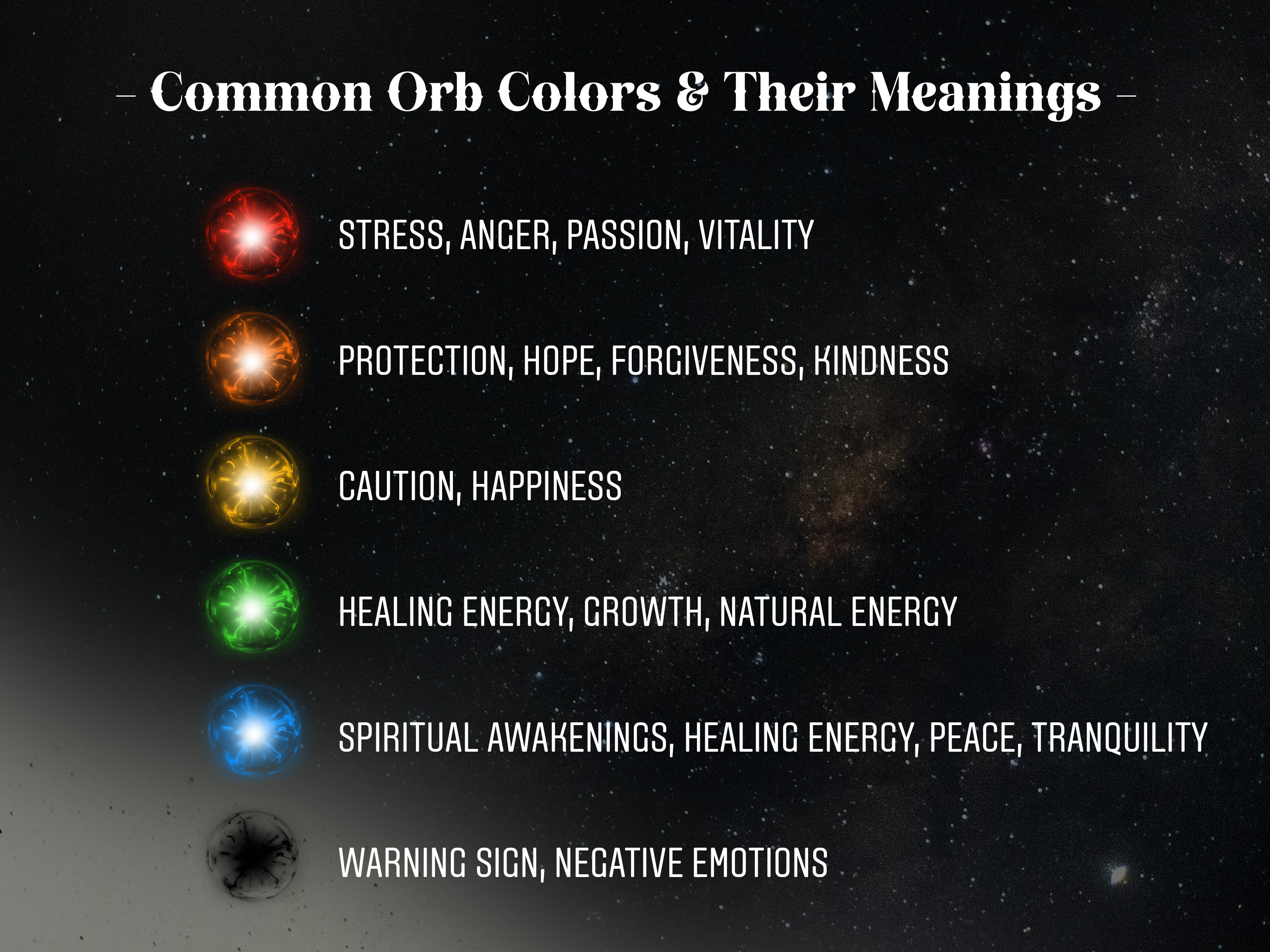
In spiritual circles, color is rarely random. People already associate colors with emotions, moods, energy, chakras, auras, warnings, protection, healing, and memory. That is why the color of orbs meaning has become such a popular search topic. A white orb may feel peaceful. A red orb may feel intense. A green orb may suggest healing. A blue orb may seem protective or calm. Even if the orb itself has a natural explanation, the color can still feel personally meaningful to the person who sees it.
Think of orb color interpretation like dream interpretation. Not every dream predicts the future, but dreams can still reveal fears, hopes, grief, or emotional patterns. In the same way, a colored orb in a photo may not be supernatural evidence, but it may still carry symbolic meaning for the viewer. The trick is to stay open-minded without checking your common sense at the door like a haunted house coat check.
Common Ghost Orb Colors and Their Meanings
White Orbs: Peace, Protection, and Spiritual Presence
White orbs are among the most commonly reported ghost orb colors. In paranormal interpretation, white is usually associated with purity, peace, protection, angelic energy, and the presence of a benevolent spirit. Many people believe a white orb appearing near a person, child, pet, or family gathering may represent a protective guide or a loved one watching over the moment.
From a practical photography angle, white orbs are also the easiest to create naturally. Dust, pollen, moisture, and tiny insects often reflect flash as white or pale gray circles. If a white orb appears in a dusty room, outdoors after rain, near a ceiling fan, or in front of a security camera at night, the ordinary explanation deserves first place in line.
Blue Orbs: Calm Energy, Guidance, and Communication
Blue orbs are often interpreted as signs of calm, truth, guidance, spiritual communication, and protective energy. Some people connect blue with the throat chakra, which is linked to expression and communication. In that sense, a blue orb may be read as a message to speak honestly, listen carefully, or pay attention to subtle signs around you.
Blue can also appear in photos because of digital camera sensors, lens coatings, reflections, LED lights, or chromatic effects. If the orb is near a TV, phone screen, blue holiday lights, neon signs, or a reflective surface, the camera may be producing the color rather than capturing a visitor from the great beyond. Still, symbolically, blue orbs remain popular among people who associate them with peace and reassurance.
Green Orbs: Healing, Growth, Nature, and Renewal
Green orbs are commonly linked to healing, growth, nature, balance, and emotional renewal. In spiritual color symbolism, green often connects with the heart, compassion, recovery, and harmony. If someone sees a green orb during a period of grief, illness, family conflict, or personal change, they may interpret it as a sign of healing energy or encouragement.
Green orbs may also have natural causes. Outdoor photos taken near grass, leaves, moss, trees, or green lights can reflect color into the lens. Night vision systems, camera sensors, and compression artifacts may also tint bright spots green. Before declaring a green orb to be a forest spirit with excellent timing, check the lighting and environment first.
Red Orbs: Strong Emotion, Warning, Passion, or Grounding
Red orbs tend to get people’s attention quickly. In paranormal communities, red may symbolize strong energy, passion, anger, warning, grounding, protection, or a spirit trying very hard to be noticed. Some interpreters see red orbs as intense but not automatically negative. A red orb may represent urgency, emotional heat, or the need to pay attention to your surroundings.
In photography, red orbs can come from brake lights, exit signs, candles, infrared sensors, holiday lights, reflected LEDs, or red-eye-style camera effects. Security cameras and trail cameras may also produce reddish artifacts depending on lighting conditions. Red is dramatic, yesbut cameras are also drama queens when bright colored light enters the frame.
Orange Orbs: Creativity, Energy, and Personal Change
Orange orbs are often associated with creativity, confidence, vitality, warmth, and transition. Spiritually, orange can suggest a burst of motivation, emotional movement, or a message connected to personal expression. Some people interpret orange orbs as signs that life is shifting and that new opportunities are nearby.
Orange orbs can also be caused by warm indoor lighting, candles, fireplaces, streetlights, sunset reflections, sodium-vapor lamps, or camera white-balance settings. If your orb appeared right beside a jack-o’-lantern, it may not be an ancient spirit. It may simply be Halloween lighting doing what Halloween lighting does best: making everything look suspicious.
Yellow or Gold Orbs: Wisdom, Hope, and Higher Guidance
Yellow and gold orbs are commonly interpreted as symbols of wisdom, optimism, divine guidance, confidence, and higher spiritual awareness. Gold especially is often connected with angelic energy, sacred protection, or a loving message from a spirit guide. Many people find gold orbs comforting because the color feels warm, bright, and emotionally uplifting.
On the technical side, yellow or gold orbs may appear when light reflects from lamps, candles, polished wood, brass, jewelry, warm walls, or sunlight. If the photo was taken during golden hour, near a chandelier, or in a room with warm bulbs, the orb color may be environmental. Still, the symbolism of gold remains powerful because people naturally connect it with value, warmth, and hope.
Purple Orbs: Intuition, Mystery, and Spiritual Awareness
Purple or violet orbs are often linked to intuition, psychic sensitivity, spiritual awakening, and mystery. Because purple is commonly associated with the crown chakra and higher consciousness, many paranormal enthusiasts view purple orbs as signs of deeper awareness or spiritual connection.
But purple is also a color cameras love to invent under certain conditions. Purple fringing, chromatic aberration, lens flare, and digital sensor effects can create violet edges or glowing purple spots. A purple orb near a bright window, reflective metal, or strong light source may be more optical than otherworldly. Beautiful? Yes. Definitive proof? Not quite.
Pink Orbs: Love, Comfort, and Emotional Support
Pink orbs are usually interpreted as loving, gentle, comforting, and emotionally supportive. People often associate pink with compassion, affection, softness, and family bonds. If a pink orb appears in a photo taken at a wedding, baby shower, memorial, or family event, it may feel especially meaningful.
Pink can also result from camera filters, phone processing, colored walls, fabric reflection, makeup mirrors, party lighting, or nearby decorations. If the room looked like a Valentine’s Day aisle exploded, a pink orb may not require a supernatural explanation. Even so, the emotional symbolism of pink can make the image feel special.
Black or Dark Orbs: Heavy Energy, Mystery, or Camera Shadow
Black or dark orbs are usually interpreted more cautiously. Some paranormal believers associate them with heavy energy, blocked emotion, sadness, fear, or an unknown presence. Others avoid labeling them as “evil” because that can create unnecessary fear. A dark orb may simply suggest mystery, emotional weight, or an area that feels energetically dense.
Dark spots in photos can also come from shadows, dust on or near the lens, sensor spots, low-light noise, compression issues, or objects passing close to the camera. Before assuming a dark orb is bad news, take more photos in the same location, clean the lens, change the lighting, and see whether the mark repeats. If it repeats in the same place, congratulations: you may have discovered dirt, the least cinematic villain of all time.
How to Tell If an Orb Might Be Natural Instead of Paranormal
The most reliable way to interpret ghost orb colors is to examine the full situation. A single orb in one photo is interesting, but it is not enough to prove anything paranormal. Ask practical questions first: Was the flash on? Was the room dusty? Was it raining, foggy, humid, or windy? Were there insects nearby? Was the photo taken through glass? Were there candles, mirrors, windows, phones, TVs, or shiny surfaces in the scene?
Movement also matters. Dust and insects can drift, streak, or float in ways that look spooky on video. Security cameras often capture bugs flying close to the lens, where they appear larger and brighter than they really are. Spider webs can also create strange glowing orbs or threads, especially when infrared night vision is active.
One helpful test is repetition. Take several photos from the same spot, then take several more after turning off the flash, changing the angle, cleaning the lens, or moving away from reflective objects. If the orb disappears when the lighting changes, it was probably a camera effect. If the same colored orb appears in different cameras, different angles, and different lighting conditions, the case becomes more interestingthough still not automatically paranormal.
Best Practices for Interpreting Orb Photos
Look at the Environment First
Start with the boring explanation. Boring explanations are not as fun, but they are often correct. Dust, mist, pollen, and insects are the usual suspects. Basements, attics, old houses, barns, cemeteries, and abandoned buildings often contain exactly the kind of particles that create orbs. In other words, the same places people investigate for ghosts are also perfect orb factories.
Check the Light Source
Flash is one of the biggest orb-makers. Built-in camera flash sits close to the lens, which makes it easier for nearby particles to bounce light straight back into the camera. Infrared security cameras do something similar at night. Bright lights inside or just outside the frame can also create lens flare, ghost dots, rings, halos, and colored artifacts.
Compare the Orb With the Emotional Context
If the photo was taken during a deeply emotional moment, the orb may feel meaningful even if it has a natural cause. That does not make the feeling “wrong.” Humans attach meaning to symbols, colors, songs, places, and timing. A white orb near a family memorial may comfort someone. A green orb during recovery may feel encouraging. The key is to say, “This feels meaningful to me,” rather than, “This proves a ghost was present.”
Avoid Fear-Based Interpretations
Not every red orb is angry. Not every black orb is dangerous. Not every strange photo means your house needs a dramatic midnight cleansing with thunder in the background. Fear-based interpretations can make people anxious and can turn harmless camera artifacts into unnecessary stress. A calm, curious approach is better than panic with a flashlight.
Do Orb Colors Prove Ghosts Exist?
No, orb colors do not prove ghosts exist. Colored orbs can be fascinating, beautiful, comforting, and symbolically rich, but they are not scientific proof of spirits. Most orb photos can be explained by ordinary optical causes, especially when flash, infrared light, dust, moisture, insects, or lens flare are involved.
That said, paranormal interpretation is not only about proof. For many people, it is about meaning, memory, intuition, and personal experience. A colored orb may remind someone of a loved one, bring comfort during grief, or inspire curiosity about the unseen. It is possible to respect that experience while still being honest about what cameras can do.
Personal Experiences With Orb Colors and Their Meaning
People who report orb experiences often describe them as small moments that felt oddly personal. One common story involves family gatherings. Someone takes a photo during a birthday, holiday dinner, or reunion, and later notices a white or pale blue orb floating near an older relative, a child, or an empty chair. The room may have been dusty, the flash may have fired, and the camera may have captured a natural reflection. Still, the timing can feel emotional, especially if the family recently lost someone who would have loved to be there. In that situation, the orb becomes less of a “case file” and more of a symbol of connection.
Another frequent experience happens in older homes. A person walks through a hallway at night, records a short video, and later sees a green, yellow, or white orb moving across the screen. The practical explanation may be a tiny insect flying close to the camera or dust catching the phone’s light. But if the house already has a reputation for creaky floors, cold spots, or mysterious noises, the orb gets promoted from “dust particle” to “possible resident ghost” very quickly. The human imagination is fast. Give it a glowing dot and a dark hallway, and it starts writing a three-season streaming series.
Security camera orbs create another kind of experience. Many homeowners see bright white or gray orbs floating across porch cameras, garage cameras, or backyard cameras. These often happen at night when infrared light is active. Bugs, mist, rain, snow, pollen, and spider webs can all reflect infrared light and look surprisingly dramatic. A moth near the lens can look like a glowing spirit with urgent business near the trash cans. Still, people may notice patterns: an orb appearing near a memorial garden, a pet’s favorite spot, or the anniversary of a loved one’s passing. Even when the cause is natural, the pattern may feel meaningful.
Some people describe colored orbs during meditation, prayer, or emotional reflection. These experiences are not always captured on camera. A person may close their eyes and sense a blue or purple light, or they may notice a soft golden glow in their peripheral vision. Spiritual interpreters may connect these colors with guidance, healing, intuition, or protection. A scientific explanation might involve eye strain, light sensitivity, afterimages, or the brain’s normal visual processing. Both perspectives can exist in the same conversation. The experience may be internal, but the meaning can still be personal.
Perhaps the most interesting orb experiences are the ones that change how someone feels. A grieving person sees a white orb in a photo and feels comfort. A stressed person notices a green orb and takes it as a reminder to heal. Someone who feels stuck sees an orange or yellow orb and decides to restart a creative project. Whether the orb is a spirit message, a camera artifact, or a coincidence, the result may still be positive. In that sense, orb color meaning works best when it encourages reflection rather than fear.
The healthiest approach is to combine curiosity with grounded thinking. Enjoy the mystery. Notice the color. Ask what the moment means to you. Then check the flash, the dust, the bugs, the glass, and the lighting. If the orb still feels special after that, let it be special. Not every mystery needs to be solved with a spreadsheet, although paranormal investigators with spreadsheets are probably very organized ghosts’ worst nightmare.
Conclusion: The Real Meaning of Ghost Orb Colors
The color of orbs meaning depends on two things: symbolic interpretation and practical investigation. White orbs may symbolize peace and protection. Blue orbs may suggest calm guidance. Green orbs may represent healing and renewal. Red orbs may point to intense emotion or warning. Gold orbs may feel divine or hopeful. Purple orbs may suggest intuition. Pink orbs may represent love and comfort. Dark orbs may feel mysterious or heavy.
At the same time, most orbs in photos and videos have ordinary explanations, including dust, pollen, moisture, insects, infrared reflection, flash backscatter, lens flare, and camera artifacts. The best interpretation is balanced: appreciate the symbolism, but investigate the image before making big claims. A ghost orb can be meaningful without being proven supernatural. Sometimes the mystery is the messageand sometimes the message is, “Please clean the camera lens.”