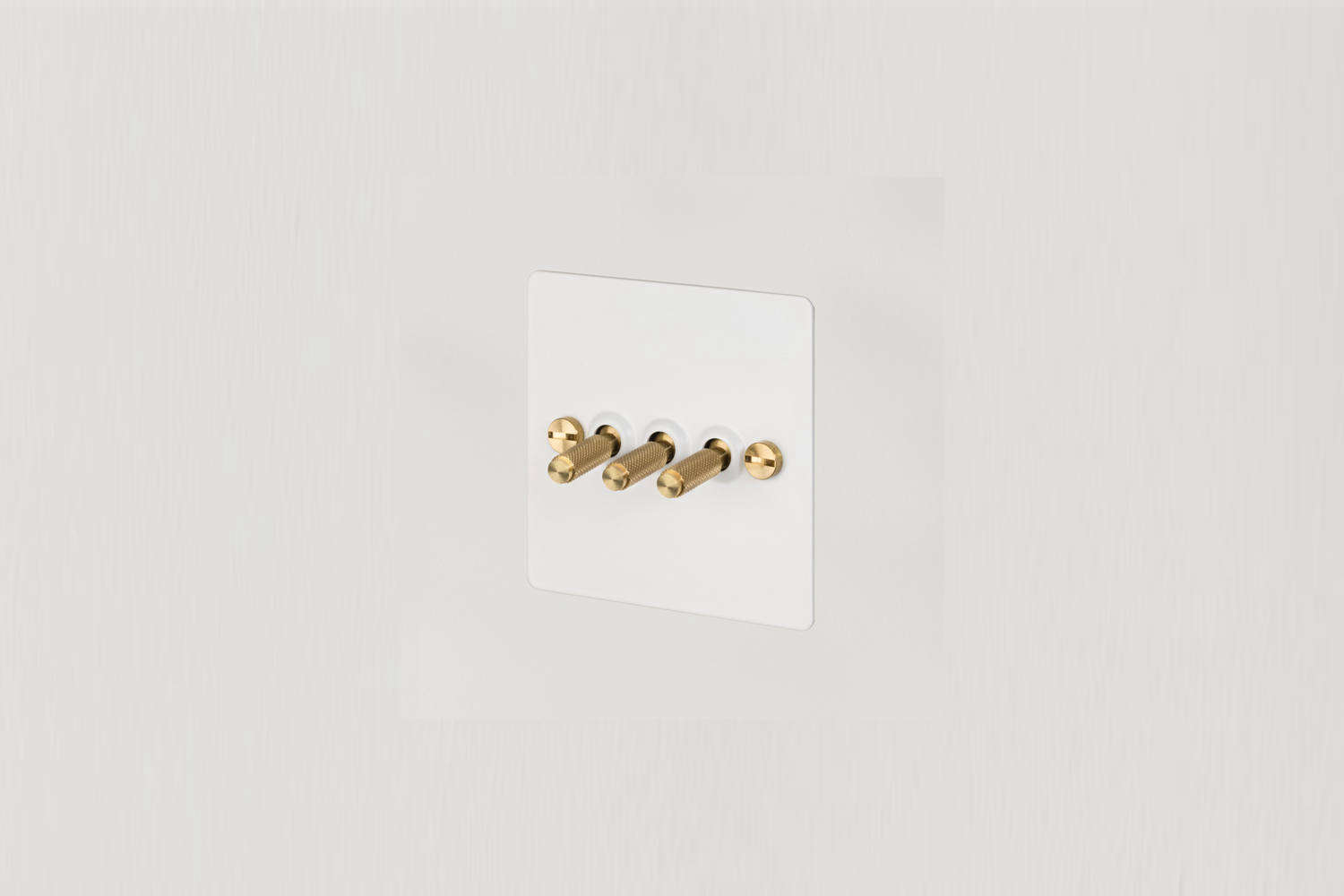
The Buster & Punch 3G Toggle Switch turns a routine wall control into a small piece of industrial theater. Instead of hiding quietly beside the doorway, it brings solid metal, precision-machined texture, exposed decorative screws, and three satisfyingly physical toggle arms into the spotlight. It is the light-switch equivalent of wearing a tailored jacket to take out the trash: arguably unnecessary, undeniably stylish.
Designed for controlling three separate circuits from one three-gang wall box, this premium switch is available in coordinated finishes such as brass, steel, black, smoked bronze, and white. North American versions use electrical modules rated for common residential and commercial applications, while the modular construction lets buyers choose between Cross and Linear knurling, as well as plates with or without the Buster + Punch logo.
That visual drama comes at a price, however. A complete three-gang configuration can cost several hundred dollars, requires careful finish selection, and deserves professional installation. This guide examines its construction, specifications, design options, installation requirements, everyday usability, advantages, limitations, and overall value.
What Is the Buster & Punch 3G Toggle Switch?
In this product name, “3G” means three-gang. It does not refer to mobile internet, and your wall will not suddenly begin loading websites at early-2000s speeds. A three-gang switch assembly occupies a standard three-gang electrical box and provides three individual controls in one coordinated plate.
Each toggle can operate a separate lighting circuit. For example, a kitchen installation might use one switch for pendants, one for recessed ceiling lights, and one for under-cabinet lighting. In an entryway, the three controls might handle a porch light, a hallway fixture, and an adjacent living-room circuit.
The term “three-gang” should also not be confused with three-way switching. Gang count describes how many devices sit together in the wall plate. Three-way describes a circuit that can be controlled from two locations. The standard North American Buster + Punch toggle module supports both single-pole and three-way applications, so a 3G assembly can contain three modules that are individually configured according to the wiring plan.
Design and Construction
Solid-Metal Presence
Most ordinary switch plates are thin plastic parts chosen because they are inexpensive and visually quiet. Buster + Punch takes the opposite approach. Its North American metal electricity range uses stainless-steel plates finished to create distinctly different looks, from bright architectural steel to warmer brass and moody smoked bronze.
The finished plate is approximately 6.37 inches wide and 4.75 inches high in a complete three-gang configuration. Its broad horizontal form has enough visual weight to become part of the room rather than disappearing into it. The decorative coin screws and precisely aligned toggles reinforce the engineered, workshop-inspired aesthetic.
Cross Versus Linear Knurling
Knurling is the textured machining applied to the toggle arm. It adds grip, but its larger purpose here is visual and tactile.
The Cross pattern uses a diamond-cut texture that feels rugged and mechanical. It works especially well in industrial interiors, converted lofts, darker kitchens, and rooms featuring visible steel or heavily textured materials.
The Linear pattern uses fine parallel grooves. It still feels machined, but its appearance is cleaner and slightly more contemporary. Linear knurling can be easier to pair with minimalist cabinetry, modern appliances, streamlined faucets, and refined architectural hardware.
Neither texture changes how the circuit functions. The decision is essentially whether your wall should whisper “precision instrument” or announce “tiny luxury motorcycle part.”
Logo or No Logo
Complete configurations are commonly offered with or without the Buster + Punch script logo. The logo adds brand recognition and a decorative focal point beneath the center switch. A logo-free plate looks quieter and may integrate more naturally into minimalist rooms.
In a highly coordinated Buster + Punch interior, the logo can feel intentional. In a room combining several hardware brands, the unbranded plate is often the more flexible choice.
North American Specifications
The following specifications describe typical current North American three-gang toggle configurations. Buyers should still verify the technical sheet attached to the exact finish and model number being ordered.
| Feature | Typical Specification |
|---|---|
| Configuration | Three-gang plate with three independent toggle modules |
| Switch type | On/off toggle |
| Electrical rating | 15 amps, 120–277 volts AC, 60 hertz |
| Circuit options | Single-pole or three-way switching |
| Approximate overall size | 6.37 inches wide by 4.75 inches high |
| Approximate external depth | 1.3 inches |
| Plate material | Stainless steel with finish-specific treatment |
| Common finishes | Black, brass, smoked bronze, steel, and white |
| Certifications | North American configurations are offered with cETLus or related listed components |
| Typical warranty | Limited two-year warranty through authorized sellers |
A complete package generally includes one three-gang wall plate, three toggle modules, and three matching detail kits. This matters because the decorative toggle arms and detail kits are designed around the brand’s own modules. They should not be assumed to fit generic switches from another manufacturer.
Choosing the Best Finish
Brass
Brass produces the most obvious luxury statement. It pairs naturally with warm wood, cream paint, green cabinetry, marble, and other brass fixtures. Because metal finishes can develop character with regular handling, buyers should expect some visual evolution rather than museum-display perfection forever.
Steel
Steel has a cooler, architectural appearance. It works well with stainless appliances, concrete, gray stone, chrome plumbing fixtures, and modern commercial-style kitchens. Fingerprints may be more noticeable under strong side lighting, so occasional gentle cleaning is part of the relationship.
Smoked Bronze
Smoked bronze is dramatic without being as visually flat as black. Its dark brown undertones complement walnut, leather, bronze lighting, and earthy wall colors. It is a strong choice for rooms that need contrast without introducing a sharply modern black element.
Black
Black provides crisp contrast on white walls and blends neatly into dark cabinetry or charcoal paneling. It is one of the easiest options to coordinate with contemporary window frames, black faucets, and dark door hardware.
White
White is the most restrained finish, although the sculpted toggle arms and decorative screws still distinguish it from a commodity switch. It suits bright interiors where tactile detail is welcome but metallic contrast would be distracting.
Where the 3G Toggle Switch Works Best
A premium three-gang switch earns its keep in locations where people see and touch it frequently. An entry hall is ideal because the switch becomes one of the first details noticed upon arrival. Kitchens are another strong candidate, particularly when three lighting layers need separate controls.
Other suitable locations include living-room entrances, home offices, media rooms, primary bedrooms, and open-plan spaces with several lighting zones. The plate looks especially convincing when its finish repeats elsewhere through cabinet pulls, door levers, faucets, lighting fixtures, or nearby outlets.
It is less compelling in a hidden utility closet or rarely visited storage room. Installing premium machined hardware where nobody sees it is rather like serving a five-course dinner to the vacuum cleaner.
The manufacturer identifies these switches as unsuitable for damp or wet environments. That restriction should be taken seriously in bathrooms, outdoor areas, pool rooms, and other moisture-prone locations. Local electrical codes and required clearances always take priority over aesthetics.
Installation Considerations
Use the Correct Regional Version
Buster + Punch sells different electricity products for different markets. A European or United Kingdom switch may use different dimensions, box requirements, voltage ratings, and certification standards. American buyers should order the North American version rather than selecting an international product simply because its finish is in stock.
Confirm the Wall Box
A three-gang installation needs the correct three-gang box, adequate internal depth, appropriate conductor space, and enough room for the modules and wiring. The finished assembly projects farther from the wall than a basic plastic cover, so reviewing section drawings before installation helps prevent unpleasant surprises.
Planning is particularly important when switches are mounted in stone, tile, wood paneling, or custom cabinetry. The box must be positioned accurately before the finished surface is completed. Even a small alignment error becomes noticeable when six decorative screws are expected to form tidy rows.
Check the Load Type
The standard toggle module is intended for appropriate lighting circuits and is not automatically suitable for every electrical load. Current technical documentation warns against using certain modules with motors, fans, or other inductive loads. A licensed electrician should verify compatibility before the switch is assigned to an exhaust fan, ceiling fan, pump, motorized shade, or similar equipment.
Understand Three-Way Wiring
When a light must be controlled from two locations, the electrician can configure compatible modules as part of a three-way circuit. The phrase “three-way” does not mean that one switch controls three lights. It describes two control locations operating the same circuita naming system apparently designed during a meeting where clarity had taken the afternoon off.
Do Not Treat Electrical Work as Decoration
Installation requires shutting off the correct breaker, verifying that the circuit is de-energized, grounding the metal plate as required, identifying conductors, tightening terminals properly, and confirming that the selected modules comply with local code. Turning the wall switch off is not the same as disconnecting power at the electrical panel.
Because the product is expensive and the visible components can be scratched during assembly, professional installation protects both safety and appearance. The electrician should receive the technical documents before arriving, not while standing in the hallway with the circuit open and everyone quietly reconsidering the renovation budget.
Care and Long-Term Maintenance
Routine cleaning should be gentle. Use a dry, soft, lint-free cloth and avoid abrasive pads, metal polish, harsh household cleaners, or chemical sprays. Never spray cleaner directly onto an electrical switch.
Natural aging is part of the character of decorative metal. Frequently touched areas may change more quickly than protected sections of the plate. This is not necessarily a defect; many owners choose brass or bronze precisely because these materials gain depth through use.
Anyone who expects every surface to remain identical to the day it left the box may prefer black, white, or another more visually uniform finish. Even then, gentle handling is sensible because replacement detail kits are considerably less amusing to buy than they are to admire.
Advantages and Disadvantages
Advantages
- Distinctive solid-metal construction
- Satisfying mechanical toggle action
- Three independent controls in one coordinated assembly
- Single-pole and three-way circuit capability
- Multiple plate finishes and knurling patterns
- Logo and logo-free design choices
- Matching outlets, dimmers, lighting, and hardware are available
- Creates a strong focal point without major structural remodeling
Disadvantages
- Costs dramatically more than a conventional three-gang switch
- Requires compatible proprietary modules and detail kits
- Does not provide built-in smart-home control
- Needs careful planning around boxes and finished surfaces
- Not intended for damp or wet locations
- Standard modules may not suit fans, motors, or inductive loads
- Decorative finishes require thoughtful cleaning
- Scratches or alignment mistakes are more noticeable on premium hardware
Is the Buster & Punch 3G Toggle Switch Worth It?
From a purely functional perspective, an inexpensive switch can turn the same lights on and off. The Buster & Punch 3G Toggle Switch therefore makes sense only when material quality, tactile interaction, and visual consistency are important parts of the project.
It offers strong value in a detail-focused renovation where switches, outlets, cabinet pulls, door hardware, and lighting share a coherent finish. It may also be worthwhile as a single statement piece in a prominent entry or kitchen, even when the entire house is not fitted with premium controls.
It is harder to justify in a budget renovation, a rental property, a smart-home system that requires integrated keypads, or a room where the switch will be hidden. Buyers should budget for both the hardware and professional installation rather than evaluating the plate price in isolation.
Living With the Buster & Punch 3G Toggle Switch: The Real-World Experience
The realistic ownership experience begins before anyone flips a switch. First comes the sample-comparison stage, when steel suddenly appears too cool, brass seems either perfect or suspiciously glamorous, and smoked bronze starts looking better every time the browser refreshes. Because a three-gang plate occupies a noticeable area of the wall, choosing the finish from a small online image can be risky. Seeing a physical sample beside the wall color, door hardware, and nearby lighting is far more useful.
Once installed, the immediate impression is physical weight and precision. The plate looks substantial rather than decorative in the flimsy sense of the word. The toggle arms catch the light, the knurling is visible from several feet away, and the mechanical movement has more ceremony than pressing a broad plastic rocker. It does not make the lights brighter, but it can make turning them on feel oddly more intentional.
Guests often notice the switch because it invites touch. Cross knurling has a particularly tool-like quality, while Linear feels a little smoother and more tailored. In a well-coordinated entryway, the switch becomes a tiny introduction to the rest of the interior. It tells visitors that somebody cared about details most houses treat as visual punctuation.
Daily use also reveals the importance of labeling the circuits mentally. Three identical toggles look wonderfully clean, but they offer no written explanation of which one controls the pendants and which one unexpectedly turns on a light in the next room. A logical left-to-right layout helps. Installers and homeowners should agree on the order before the modules are wired.
The tactile reward remains the product’s strongest quality. A phone app can control a lighting system from the sofa, but it cannot reproduce the immediate mechanical click of a metal toggle. This analog interaction is especially appealing in kitchens and entrances, where people want fast control without unlocking a screen, waiting for a network, or saying a voice command while carrying grocery bags.
The ownership experience is not completely glamorous. Metal shows real life. Steel may reveal fingerprints. Dark finishes can show dust. Brass and bronze can develop variation where hands repeatedly touch the controls. Gentle wiping becomes part of maintenance, and anyone obsessed with flawless uniformity may find the natural aging process less romantic than the product photography suggested.
Installation can also be fussier than replacing a standard plate. The wall box must sit correctly, the modules need room, and the plate needs precise alignment. A slightly crooked commodity switch often disappears into the background; a crooked luxury switch looks like an expensive picture frame hung after somebody declined to use a level.
There is also a psychological adjustment to the price. At first, paying hundreds of dollars for three manual switches may feel extravagant. Over time, the calculation becomes less about electrical function and more about frequency of contact. A hallway switch can be touched thousands of times each year. For owners who appreciate physical materials, that repeated interaction may provide more enjoyment than a decorative object that sits on a shelf and collects dust with great dignity.
The best overall experience comes from treating the 3G toggle switch as part of a system rather than an isolated badge of luxury. Match it with nearby outlets, cabinet hardware, lighting details, or door furniture. Plan the circuits carefully, hire an electrician familiar with premium devices, and accept that real metal may gain character. Under those conditions, the Buster & Punch 3G Toggle Switch succeeds at its central trick: making one of the most ordinary actions in a home feel special without making it complicated.