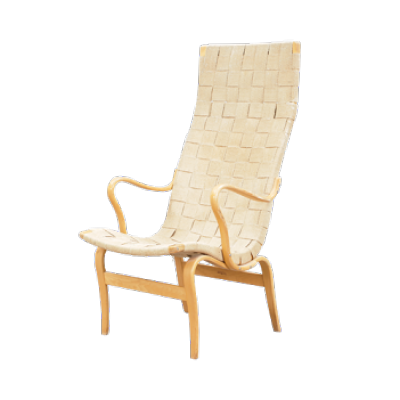
Some chairs enter a room politely. Bruno Mathsson’s Eva Chair enters like a calm Swedish professor who already solved your back pain, redesigned your living room, and brewed coffee before you noticed. Light, sculptural, and surprisingly practical, the Eva Chair is one of the finest examples of Scandinavian modern furniture: beautiful without bragging, comfortable without looking like a marshmallow, and historic without needing a velvet rope around it.
Designed by Swedish architect and furniture designer Bruno Mathsson, the Eva Chair is best known for its bent laminated wood frame, woven webbing seat, gentle curves, and human-centered comfort. It belongs to that rare family of furniture that looks simple at first glance, then becomes more impressive the longer you stare at it. The magic is not loud. It is in the angle of the backrest, the spring of the webbing, the sweep of the arm, and the way the frame seems to float instead of sit heavily on the floor.
For collectors, interior designers, and everyday design lovers, the Bruno Mathsson Eva Chair is more than a vintage lounge chair. It is a lesson in how modern furniture can respect the body, the material, and the room at the same time. In an age of oversized recliners and chairs that require their own zip code, Eva remains refreshingly intelligent.
Who Was Bruno Mathsson?
Bruno Mathsson was born in Värnamo, Sweden, in 1907, into a family of craftsmen. His father was a cabinetmaker, which meant young Mathsson grew up around wood, tools, joinery, and the practical realities of making furniture that did not fall apart after one enthusiastic sit. Unlike designers who approached furniture only as sculpture, Mathsson understood construction from the inside out.
He became one of the major figures in Swedish modernism and Scandinavian furniture design, combining functionalism with warmth and craft. His work was deeply concerned with what he called the mechanics of sitting. That phrase may sound like something a very serious chair scientist would write on a chalkboard, but it captures his genius. Mathsson did not simply ask, “Does this chair look good?” He asked, “What does the human body actually need when it sits, rests, reads, talks, and quietly judges the wallpaper?”
His furniture career took shape in the 1930s, when he began experimenting with bent laminated wood and woven seating surfaces. These materials allowed him to create flexible, lightweight, supportive chairs with graceful organic lines. His better-known designs include the Eva Chair, Pernilla chair, Jetson chair, Karin chair, and the Superellipse table, created with Piet Hein and Arne Jacobsen. But Eva remains one of the purest expressions of his early design philosophy.
The Origin of the Eva Chair
The history of the Eva Chair has a small dating puzzle, which is common in classic furniture design. Museum records often date early Eva or related “work chair” examples to around 1934, while later product literature describes the Eva as a 1941 design developed from an original model from 1933. Rather than seeing this as a contradiction, it is better to understand the Eva Chair as an evolving design family. Mathsson developed the core idea in the early 1930s, refined the sitting curve, adjusted the frame, and eventually gave the chair the recognizable Eva identity.
That evolution matters because Mathsson was not chasing novelty. He was improving a chair the way a musician improves a song: through repetition, listening, adjustment, and a slightly obsessive relationship with details. The Eva Chair grew from his study of posture, comfort, and laminated wood construction. It was not designed to impress from across a showroom for five seconds. It was designed to support a person for years.
Early production was associated with Firma Karl Mathsson in Värnamo, Sweden, the family workshop that helped bring Bruno’s ideas into physical form. Later versions and related Mathsson designs were produced by other manufacturers as his reputation expanded. Today, the Eva Chair appears in museum collections, vintage design galleries, auction catalogs, and carefully edited homes where people know that a chair can be both furniture and an argument for better living.
Why the Eva Chair Looks So Effortless
The Eva Chair’s elegance comes from restraint. There is no unnecessary bulk, no decorative shouting, and no awkward attempt to look futuristic. Instead, the chair uses a bent laminated wood frame to create continuous, flowing lines. The legs, arms, and support structure work together as one visual rhythm. It is the furniture equivalent of a perfectly written sentence: nothing extra, nothing missing.
Bent Laminated Wood
Mathsson’s use of bent laminated wood was central to his design language. By laminating thin layers of wood and bending them into shape, he could create strong components with soft curves and minimal weight. This technique gave the Eva Chair its springy, almost architectural profile. The wood does not look forced. It looks persuaded.
Common materials include beech, birch, and sometimes oak, depending on the version. The pale wood tones associated with many Eva Chairs also support the Scandinavian modern style: bright, natural, calm, and friendly to daylight. In a room, the chair rarely feels like a dark object blocking the space. It feels like air learned carpentry.
Woven Webbing and Human Comfort
The seat and back are often made with woven hemp, linen, canvas, or leather webbing. This webbing is not just decorative. It provides a flexible sitting surface that responds to the body. Instead of using thick upholstery to create comfort, Mathsson relied on tension, curve, and proportion. The result is a chair that looks thin but feels supportive.
This is one reason the Eva Chair still feels modern. Many contemporary chairs try to solve comfort by adding more foam. Mathsson solved it by shaping the structure correctly. It is a quieter approach, but a smarter one. Foam collapses, trends expire, but a well-studied sitting curve keeps doing its job.
The Ergonomic Genius Behind the Eva Chair
One of the most charming stories about Bruno Mathsson is that he studied sitting by observing body impressions, including the famous tale of him sitting in snow to analyze the shape left behind. Whether you imagine this as scientific research or as a Swedish winter hobby that got impressively out of hand, the point is clear: Mathsson cared about the real relationship between the body and the chair.
The Eva Chair supports the back with a gentle recline, encourages a natural seated posture, and distributes weight through its woven surface. It does not trap the sitter in a stiff formal pose. It invites a relaxed but alert position, making it suitable for conversation, reading, and slow Sunday thinking. The chair does not scream “lounge.” It whispers, “Stay a while, but maybe do not spill coffee on the webbing.”
This ergonomic sensitivity separates Mathsson from many decorative modernists. He was not designing abstract shapes and hoping people would adapt to them. He designed from the body outward. That is why his furniture can look delicate while remaining practical.
Eva Chair Variants and Materials
The Bruno Mathsson Eva Chair exists in several versions, and collectors may encounter differences in arms, back height, webbing, upholstery, wood finish, labels, and production period. Some examples have arms, while related models may appear without arms. High-back versions were also developed, offering additional neck and upper-back support.
Classic Eva Chairs often feature a light wood frame and natural woven webbing. Other versions may use leather straps, textile webbing, sheepskin, or full upholstery. While purists often gravitate toward the exposed webbing models because they show the structure most clearly, upholstered versions can be excellent for interiors that need a softer visual presence.
For anyone buying a vintage Eva Chair, condition matters. Webbing can stretch, stain, dry out, or be replaced over time. Wood frames may show wear, repairs, fading, or small cracks. Labels and maker’s marks can help establish authenticity, but buyers should still examine construction details, proportions, and provenance. A beautiful vintage chair should have age, not a secret second career as a trampoline.
Why the Eva Chair Matters in Scandinavian Modern Design
Scandinavian modern design is often described with words like simple, functional, natural, democratic, and timeless. The Eva Chair earns all of them. It uses honest materials. It avoids decorative clutter. It is made for daily life. And it shows that comfort does not have to be visually heavy.
The chair also reflects the broader shift in 20th-century furniture away from rigid historic styles and toward designs shaped by modern living. Instead of carving ornament into wood, Mathsson bent the wood itself into a new language. Instead of hiding structure under upholstery, he made structure beautiful. The Eva Chair belongs to the same modern conversation as the work of Alvar Aalto, Marcel Breuer, and other designers who reimagined what a chair could be in the 20th century.
Yet Mathsson’s work has its own personality. Compared with some steel-tube modernist chairs, Eva feels warmer and more organic. Compared with many upholstered lounge chairs, it feels lighter and more architectural. It is modernism with a pulse.
How to Style Bruno Mathsson’s Eva Chair at Home
The Eva Chair is versatile because it does not bully a room. It can work in a minimalist apartment, a mid-century modern living room, a reading corner, a design studio, or a warm eclectic interior with books, ceramics, and one plant that is trying very hard to survive.
In a Living Room
Use the Eva Chair as an accent chair rather than forcing it to compete with bulky furniture. It pairs beautifully with low sofas, wood coffee tables, wool rugs, and neutral walls. Because the chair has open space in its frame, it helps a room feel larger. This is especially useful in smaller homes where every piece of furniture must earn its rent.
In a Reading Corner
Eva is excellent near a window, floor lamp, and small side table. The reclined posture supports relaxed reading, while the light frame keeps the corner from feeling crowded. Add a throw blanket if you want comfort, but avoid hiding the chair’s silhouette completely. Covering an Eva Chair with too many pillows is like putting sunglasses on a sculpture. Technically possible, but emotionally suspicious.
In a Design-Focused Office
The Eva Chair can bring warmth to a home office or studio. It is not a task chair for typing eight hours a day, but it is perfect for thinking, reviewing materials, taking calls, or pretending to read a serious design book while secretly admiring the chair again.
Collecting and Buying an Eva Chair
Because the Bruno Mathsson Eva Chair is collectible, prices vary widely depending on age, condition, maker, originality, materials, and seller. Museum-worthy early examples, rare versions, and chairs with strong provenance can command higher prices. Later production pieces may be more approachable while still offering the essential Mathsson experience.
Before buying, check the frame carefully. Look for clean bends, stable joints, and signs of repair. Inspect the webbing for sagging, discoloration, or uneven replacement. Re-webbing can be acceptable if done well, but original materials may matter more to collectors. Ask for clear photos of labels, underside details, and any damage. A seller who only provides one dramatic side photo may be selling a chair, or possibly a mystery novel.
It is also wise to compare several examples before purchasing. Study dimensions, maker information, and material descriptions. Vintage design marketplaces often list similar chairs with slightly different terms: Eva easy chair, Eva lounge chair, Mathsson armchair, model 41, or Firma Karl Mathsson Eva. Knowing these variations can help you search more effectively.
Care and Maintenance Tips
To care for an Eva Chair, begin with gentleness. Dust the wood regularly with a soft cloth. Avoid harsh cleaners, excess water, and direct sunlight that can fade wood or dry natural fibers. For woven webbing, vacuum lightly with a brush attachment and avoid aggressive scrubbing. If the webbing is stained or failing, consult a professional familiar with vintage Scandinavian furniture.
Keep the chair away from extreme humidity and heat. Bent laminated wood is strong, but vintage furniture appreciates stable conditions. If the chair creaks, shifts, or feels unstable, do not treat it like a gym challenge. Have it inspected. Good restoration protects both value and comfort.
The best maintenance philosophy is simple: use it respectfully. Mathsson designed furniture for living, not for permanent storage in a shrine. Sit in the chair, enjoy it, and let it participate in daily life. Just maybe keep spaghetti night at a safe distance.
Experience: Living With Bruno Mathsson’s Eva Chair
Spending time with Bruno Mathsson’s Eva Chair changes how you notice furniture. At first, you may admire the outline. The chair has that rare ability to look good from nearly every angle, which is useful because real homes are not museum pedestals. You see furniture from doorways, hallways, sofa corners, and while carrying laundry. Eva passes all those tests gracefully.
The first sitting experience can be surprising. Many people expect a chair this light and open to feel fragile, but the woven surface creates a supportive cradle. You do not sink into it like a deep cushion. Instead, you settle onto it. The difference is important. A heavily cushioned chair can make you feel swallowed. The Eva Chair makes you feel held. It is comfortable in a focused, intelligent way.
In a small apartment, the Eva Chair is especially satisfying because it provides presence without visual weight. A large upholstered lounge chair can dominate a room like an overconfident guest at dinner. Eva behaves better. Its open frame lets light pass through, and its natural materials soften modern interiors. Place it near a light-colored wall and it almost becomes a drawing in space.
There is also a tactile pleasure to the chair. The smooth wood frame invites the hand. The woven webbing adds texture. Over time, you begin to appreciate the tiny decisions: the curve of the arm, the angle of the back, the way the front legs meet the floor, the quiet confidence of the proportions. This is not furniture that relies on novelty. It rewards attention.
Using the chair also teaches patience with vintage design. If you own an older Eva Chair, you may become aware of its history through small marks, softened edges, or replaced webbing. These details do not necessarily reduce its charm. They remind you that the chair has lived. It has supported conversations, books, afternoon naps, perhaps a few dramatic sighs, and at least one person who sat down “just for a minute” and stayed for an hour.
The Eva Chair works best when it is allowed to breathe. Do not crowd it between heavy pieces or bury it under oversized cushions. Give it a lamp, a small table, and enough space for the frame to be visible. It does not need much styling. In fact, the more you fuss around it, the more it seems to politely ask for simplicity.
What makes the experience memorable is not just comfort, but clarity. The chair explains itself through use. You feel Mathsson’s belief that furniture should adapt to people, not the other way around. You see how a design from the 20th century can still feel fresh because it was based on the body rather than fashion. Trends age quickly. Good proportions age slowly.
After living with or even simply spending time in an Eva Chair, many ordinary chairs start to look overcomplicated. You notice when a backrest is too upright, when a seat is too deep, when a frame is bulky for no reason. That may be the chair’s only flaw: it quietly raises your standards. Once you understand what thoughtful seating feels like, it becomes harder to accept furniture that merely looks comfortable in a catalog.
Conclusion: Why the Eva Chair Still Feels Modern
Bruno Mathsson’s Eva Chair remains important because it solves a problem that never goes out of style: how to sit comfortably and beautifully. Its bent laminated wood frame, woven webbing, ergonomic curve, and Scandinavian restraint make it one of the most enduring chairs of modern design.
It is not a loud icon. It does not need chrome drama, giant cushions, or theatrical angles. Instead, it offers a more lasting kind of confidence. The Eva Chair is elegant because it is useful, collectible because it is thoughtful, and timeless because it was designed around the human body rather than a passing trend.
For anyone interested in Scandinavian modern furniture, Swedish design, or classic lounge chairs, the Eva Chair is more than a beautiful object. It is a reminder that the best design often feels obvious after someone brilliant has already done the hard work.
SEO Tags
Note: This publication-ready article omits source links by request while relying on verified museum, manufacturer, design archive, auction, and vintage marketplace information.