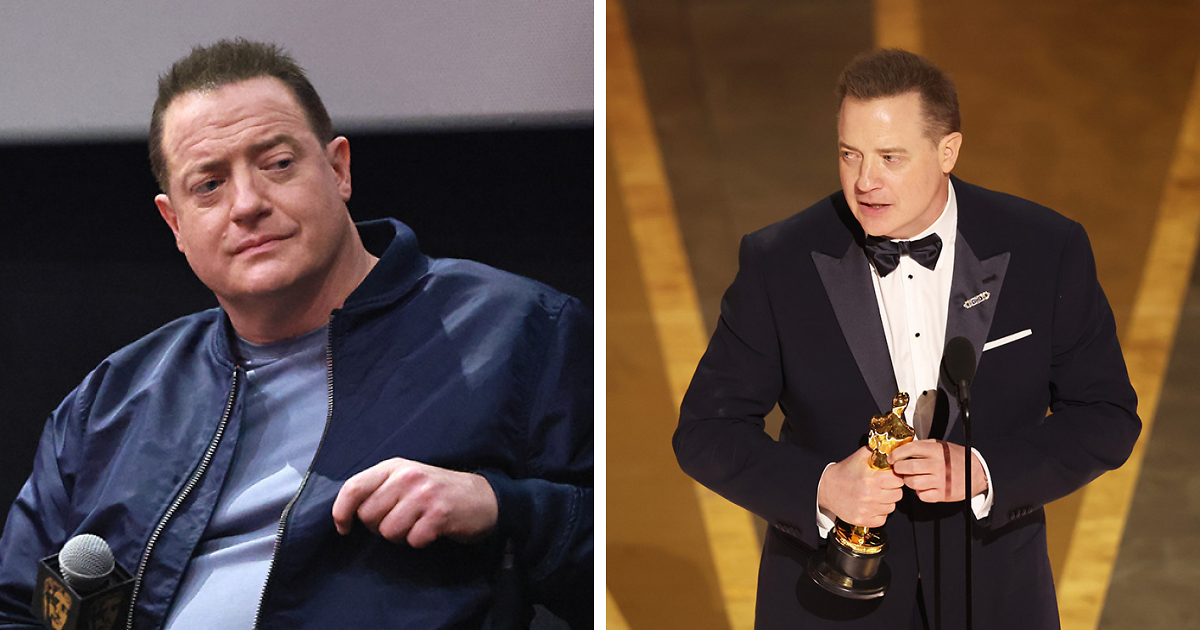
Winning an Oscar is supposed to be the part where the orchestra swells, the clouds part, and the universe hands over a deluxe lifetime supply of confidence. Hollywood loves that version of the story. Brendan Fraser, however, has offered a much more human one. After earning Best Actor for The Whale, Fraser didn’t suddenly turn into a walking motivational poster. Instead, he admitted something unexpectedly raw: he still struggles with confidence, still questions whether he is good enough, and still feels the quiet sting of self-doubt even after standing on the industry’s biggest stage.
That truth is heartbreaking precisely because it feels so honest. Fraser’s Oscar victory was celebrated as the triumphant final chapter in one of Hollywood’s most emotional comeback stories. But real careers are messier than that. They do not end neatly at the awards podium. In Fraser’s case, the post-Oscar reality has been less about basking in a golden glow and more about figuring out what comes next when a dream comes true and the doubts stubbornly refuse to pack their bags.
The Oscar Win That Looked Like a Fairytale
For millions of movie fans, Brendan Fraser’s 2023 Oscar victory felt like justice finally arriving in a tuxedo. Here was the beloved star of The Mummy, George of the Jungle, and Blast from the Past winning Best Actor for playing Charlie in Darren Aronofsky’s The Whale. The moment hit hard because Fraser’s career had never followed the smooth, upward-only line that awards narratives prefer. He had once been one of the most recognizable stars in Hollywood, a performer with leading-man charm, broad comic timing, and enough action-hero stamina to carry giant studio franchises.
Then came the quieter years. Fraser’s profile dimmed. His body paid the price for years of physically demanding roles. He went through serious personal setbacks, including surgeries, family upheaval, and a painful retreat from the center of the spotlight. By the time his performance in The Whale premiered to emotional reactions and standing ovations, audiences were not just responding to the role. They were responding to the feeling that Fraser had somehow fought his way back to himself.
That is why his Oscar speech landed with such force. It was emotional, grateful, and full of the hard-earned humility of someone who knew the road had not been easy. The moment looked like a grand cinematic payoff. But if Fraser’s recent comments make anything clear, it is that victory did not magically erase the emotional bruises collected along the way.
The Heartbreaking Truth: Success Did Not Silence His Self-Doubt
The most striking thing Fraser has said about life after the Oscar is also the saddest: he still struggles with confidence. Not a little. Not in a cute, self-deprecating, celebrity-interview kind of way. He described himself as someone who has long wrestled with the feeling of not being good enough, even after receiving the highest acting honor in the business.
That confession matters because it breaks the myth that external success automatically repairs internal doubt. Fraser’s honesty reveals something many people understand but rarely hear famous actors say out loud: being publicly celebrated does not always fix what has been privately fractured. You can win the trophy and still feel unsure. You can be applauded by an entire industry and still be your own harshest critic. In Fraser’s case, the truth seems to be that the Oscar recognized his talent, but it did not magically rewrite his inner monologue.
There is something almost cruelly ironic about that. If Hollywood were writing the script, the Oscar would be the emotional cure-all. In real life, it was more like validation without anesthesia. Fraser earned a massive career milestone, but the voice in his head did not suddenly become gentle. That makes his story more moving, not less. It reminds us that resilience is not the same thing as being healed.
Why Fraser’s Career Story Resonates So Deeply
He Was Never Just “The Comeback Guy”
Fraser has pushed back on the idea that he simply vanished and then reappeared like a human boomerang. He has said he never felt he went that far away, and that distinction matters. The public loves a neat “fallen star rises again” headline, but Fraser’s career was more complicated than that. He kept working. He took television roles. He stayed connected to acting. What changed was visibility, not worth.
That makes the “comeback” label both flattering and frustrating. On one hand, it acknowledges the renewed attention. On the other, it suggests he had ceased to matter in the years before The Whale. Fraser’s resistance to that framing shows a quiet dignity. He is not interested in pretending his life became meaningful only once awards voters noticed again.
He Paid a Real Price for Earlier Stardom
One reason Fraser’s post-Oscar comments hit so hard is that they come with a long backstory. He has previously spoken about how years of stunt-heavy work left his body battered enough to require multiple surgeries. That image alone says a lot. Audiences saw the swashbuckling hero; Fraser was living with the physical consequences behind the scenes. Add in deeply personal pain, including divorce, grief, and the emotional toll of feeling sidelined, and the glamorous mythology of stardom starts to look more like a very expensive stress dream.
His experience also intersects with something darker in Hollywood culture. Fraser has spoken publicly about the distress he says followed an alleged assault by former Hollywood Foreign Press Association president Philip Berk, an incident Berk denied. Fraser later refused to attend the Golden Globes even while The Whale was making awards noise. That decision reinforced the sense that his story was never just about trophies. It was about dignity, memory, and what it costs to keep going after disillusionment.
After the Oscar, the Real Question Became: Now What?
One of the most revealing aspects of Fraser’s recent comments is that the Oscar did not deliver a simple next step. Instead, it seems to have created a new kind of pressure. He has said that after winning, he had to work harder and become more selective. That sounds backward at first. Shouldn’t an Oscar make everything easier? In some ways, yes. In another way, no. Once you win, every next role gets weighed against the one that got you there. The bar is no longer just high. It is carrying a statuette.
Fraser has described searching for material that feels innovative, meaningful, and different from what he has done before. He also spoke candidly about floating for a while without an agent and looking for the right project rather than grabbing the first thing with a trailer and a poster. That detail is especially revealing. For an Oscar winner, the image of being in a kind of professional in-between is not what fans expect. Yet it fits the larger theme of his honesty. Fraser is not pretending the award turned his career into a frictionless luxury vehicle. If anything, it made him more careful about where he drives next.
That helps explain why projects like Rental Family feel important in his post-Oscar phase. The film, about an American actor in Japan who finds purpose through an unusual job, seems to echo some of Fraser’s own emotional terrain: uncertainty, reinvention, humility, and the search for belonging. It is not hard to see why that would appeal to an actor who has spent the last several years rewriting his relationship with fame, work, and self-worth.
The Performance in The Whale Changed the Conversation
Part of what made Fraser’s awards run so gripping was the performance itself. This was not a nostalgia prize. It was not a ceremonial “welcome back, old friend” medal. Fraser’s work in The Whale demanded emotional precision, physical transformation, and a willingness to inhabit a character with enormous sadness and vulnerability. He spoke about approaching the role with seriousness, emphasizing Charlie’s dignity rather than reducing him to a surface-level transformation.
That commitment changed how many viewers saw Fraser. He had always possessed more range than Hollywood often gave him credit for, but The Whale forced the industry to look again. Suddenly, the actor once remembered mainly for jungle yodeling, mummy punching, and romantic comedy charm was being discussed in terms usually reserved for prestige-drama royalty. That reappraisal did not just revive his career. It expanded it.
Even so, Fraser’s recent admissions show that praise and transformation are not the same thing. The role changed the public conversation around him. It did not necessarily erase the years that shaped his private one.
What Makes Fraser’s Honesty So Powerful
Celebrity interviews often flatten people into brand statements. Fraser’s do the opposite. He comes across as someone deeply aware of luck, pain, timing, and the weirdness of surviving long enough to be reintroduced to the world as your own redemption arc. That self-awareness is part of why audiences root for him so intensely. He does not sound like a man intoxicated by his own mythology. He sounds like someone who knows how fragile momentum can be.
And maybe that is the heartbreaking truth at the center of this story. Fraser won the Oscar, yes. He got the standing ovations, the headlines, the respect, and the emotional full-circle moment. But what he shared afterward is that human beings are not light switches. A life spent absorbing rejection, pain, physical wear, and emotional disappointment does not transform overnight because your name is called on awards night.
That is not tragic in a hopeless way. It is tragic in a real way. It is also oddly reassuring. Fraser’s honesty gives people permission to acknowledge that achievement and insecurity can exist in the same room, probably sitting awkwardly next to each other and pretending not to make eye contact.
The Bigger Meaning Behind Brendan Fraser’s Post-Oscar Story
Fraser’s story matters because it says something broader about work, recognition, and emotional survival. We tend to imagine success as a finish line. In reality, it is often a strange new chapter with different anxieties. The dream job arrives, and then you wonder if you can top it. The long-awaited validation appears, and then you realize it did not solve every old wound. Fraser has described that uncertainty without self-pity, which makes it land even harder.
There is also a lesson in the way he talks about choosing future roles. He seems less interested in proving something to the room and more interested in finding work that still challenges him. That shift feels healthy, even if it was born from struggle. It suggests that the real aftermath of the Oscar may not be confidence in the traditional sense, but clarity. Fraser no longer has to chase every opportunity as if it is his last. Instead, he can look for the ones that mean something.
In that sense, the heartbreaking truth may also contain a kind of grace. Fraser may still doubt himself, but he also seems more grounded in what kind of artist he wants to be. That does not make his story less emotional. It makes it richer. The fairy tale version ends with the trophy. The real version begins there.
Related Experiences: Why Fraser’s Story Feels So Familiar to So Many People
What gives Brendan Fraser’s post-Oscar confession such staying power is that it mirrors an experience countless people know, even if their version does not involve cameras, red carpets, or a gold statue. A student gets into a dream school and still wonders if they belong. An athlete wins a championship and wakes up the next morning feeling oddly empty. A worker lands the promotion, updates the LinkedIn headline, and then quietly panics because the inner critic did not get the memo. Fraser’s story works because it exposes a truth many people live through in silence: achievement often changes your circumstances faster than it changes your feelings.
There is a special kind of emotional whiplash that comes after a major victory. Before the win, life is structured around the chase. You are trying to prove yourself, survive disappointment, and keep moving. Then the big moment happens, and everyone assumes peace has arrived in a chauffeur-driven car. But the mind can be stubborn. It keeps old habits. It remembers humiliation longer than applause. It hangs on to insecurity like it paid rent there. That is why Fraser saying he still struggles with confidence feels less like celebrity oversharing and more like someone finally saying the quiet part out loud.
Another experience tied to Fraser’s story is the challenge of being publicly reintroduced after private pain. Many people know what it is like to be remembered for an older version of themselves: the talented kid, the funny one, the person who used to have it all together, the employee who once never seemed tired. Then life happens. Bodies get hurt. Families change. Confidence takes hits. Circumstances become messier. When success returns, outsiders often want to skip directly to the triumphant montage. But the person living inside the story knows every scene that got cut.
That is partly why Fraser’s refusal to reduce his life to a neat comeback label matters so much. People are rarely gone as completely as the world assumes. Sometimes they are just surviving off-camera. Sometimes they are healing. Sometimes they are working in smaller, quieter ways while the spotlight points elsewhere. His story reminds readers that a dormant public image is not the same thing as a dormant human being.
There is also something profoundly relatable in Fraser’s post-win selectiveness. After a difficult season, many people do not want to rush back into the same patterns that wore them down in the first place. They become pickier about jobs, relationships, opportunities, and the emotional cost of saying yes. That is not arrogance. It is often wisdom arriving late but right on time. Fraser’s talk about choosing material that still challenges him sounds like the grown-up version of ambition: less frantic, more thoughtful, and shaped by what pain has already taught.
So while the headline centers on Brendan Fraser, the emotional engine of the story is much bigger. It is about anyone who has reached a long-awaited milestone and discovered that healing is not as instant as applause. It is about carrying old doubts into new success and learning that this does not make the success fake. It just makes the person human. Fraser’s honesty lands because it turns a celebrity comeback into something far more meaningful: a reminder that even after the biggest win of your life, you may still be a work in progress, and that does not make the victory any less real.
Conclusion
Brendan Fraser’s Oscar victory gave the world one of its most satisfying Hollywood moments in years. But his post-win honesty gave that moment something even more valuable: depth. By admitting that self-doubt still lingers, that confidence remains a struggle, and that the future still requires hard choices, Fraser has turned a comeback narrative into a human one. The heartbreaking truth about his career after the Oscar is not that success failed him. It is that success did what it can do best: recognize the work. The rest, the harder rest, is still personal.
And maybe that is why people continue to connect with him so fiercely. Brendan Fraser is not selling a polished fantasy about what winning fixes. He is offering something better: proof that grace, talent, pain, humor, and uncertainty can all exist in the same person at once. In Hollywood, that kind of honesty is rarer than an awards-season campaign without a think piece. Which is exactly why it matters.