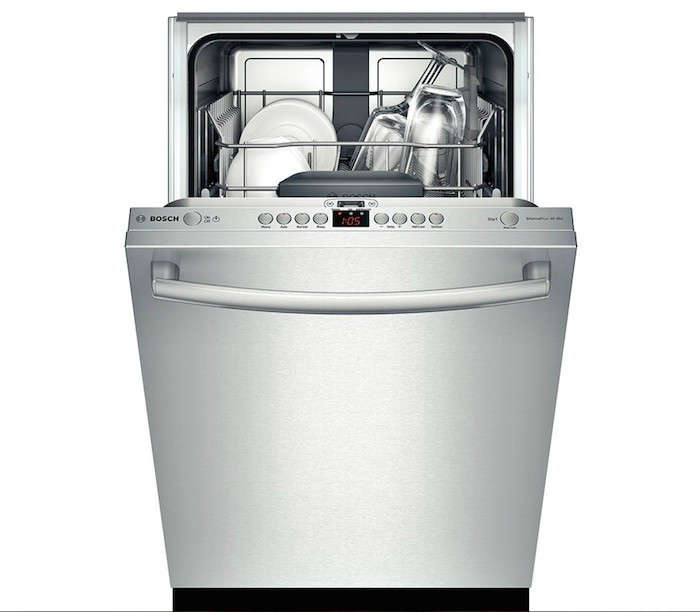
The Bosch SPX5ES55UCX 18-inch fully integrated dishwasher was designed for kitchens where every inch of cabinet space has already submitted a formal request for protection. Narrow enough for apartments, compact homes, wet bars, and secondary kitchens, this stainless steel machine offers many of the practical features associated with larger Bosch dishwashers without demanding a standard 24-inch opening.
One naming detail deserves clarification before we start loading plates. Bosch identifies the official base model as SPX5ES55UC. The extra “X” appears in certain retailer catalogs, resale listings, and design publications. Because Bosch produced several revisions under different E-Nr suffixes, owners and secondhand buyers should confirm the complete identification label before ordering parts.
Although this model is now discontinued, it remains relevant on the used-appliance and replacement market. Its nine-place-setting capacity, quiet operation, adjustable racks, built-in water softener, sanitize option, and leak-protection system make it an interesting choice for anyone trying to fit serious dishwashing into a not-so-serious amount of space.
Bosch SPX5ES55UCX Specifications at a Glance
| Appliance type | 18-inch built-in dishwasher |
|---|---|
| Official Bosch model | SPX5ES55UC |
| Control style | Fully integrated top controls |
| Exterior | Stainless steel with bar handle |
| Capacity | 9 place settings |
| Wash cycles | Heavy, Auto, Normal, and Rinse |
| Cycle options | Half Load, Sanitize, and up to 24-hour Delay Start |
| Noise rating | Originally listed at 46 dBA; some archived revisions show 48 dBA |
| Interior | Stainless steel EuroTub |
| Rack system | Three-position RackMatic upper rack with folding tines |
| Leak protection | 24/7 AquaStop Plus |
| Water softener | Built-in, adjustable system |
| Approximate dimensions | 32 1/16 inches high, 17 5/8 inches wide, and about 22 1/2 inches deep |
| Electrical requirements | 120 volts, 60 Hz, approximately 12 amps |
| Historical energy use | Approximately 259 kWh per year |
| Status | Discontinued |
Compact Dimensions Without Countertop Compromise
The defining feature of the Bosch SPX5ES55UCX is its narrow footprint. At 17 5/8 inches wide, it fits an approximately 18-inch cabinet opening, making it suitable for kitchens that cannot accommodate a full-width dishwasher. This can be especially valuable in older urban apartments, converted galley kitchens, accessory dwelling units, basement suites, and home bars.
Its height also supports many ADA-oriented installations, although buyers should never assume that “ADA compliant” automatically means “fits every accessible kitchen.” Counter height, finished flooring, plumbing placement, leveling range, and door clearance all matter. The original installation literature calls for an opening roughly 17 3/4 inches wide and 24 inches deep, with adjustable feet providing some height flexibility.
Measure the opening at the front, middle, and rear. Cabinets have been known to lean, bow, and generally behave as though geometry were merely a suggestion. Used buyers should also inspect the location of the water connection, electrical supply, drain hose, and adjacent cabinet access before scheduling installation.
What “Fully Integrated” Means on This Dishwasher
On the Bosch SPX5ES55UCX, “fully integrated” refers to the hidden control panel along the top edge of the door. When the door is closed, the buttons and remaining-time display disappear beneath the countertop, leaving a clean stainless steel front and a prominent bar handle.
This terminology does not mean that the dishwasher accepts a custom cabinet panel. The model has its own stainless steel exterior and is not panel ready. That distinction matters when planning a seamless kitchen design, because “integrated” and “panel ready” are frequently treated as synonyms even though appliance manufacturers enjoy keeping shoppers alert.
InfoLight Helps Prevent Mid-Cycle Surprises
Hidden controls look tidy, but they make it difficult to tell whether a quiet dishwasher is actually running. Bosch addresses that problem with InfoLight, which projects a red light onto the floor during operation. When the light disappears, the cycle has ended.
The feature is simple, useful, and arguably more civilized than opening the door during the wash cycle and receiving an unexpected facial treatment from hot steam.
Interior Capacity and Rack Flexibility
Bosch rated the dishwasher for nine place settings. That is less than the capacity of a standard 24-inch machine, but it is respectable for an 18-inch built-in dishwasher. Couples, small households, and people who wash dishes daily may find the capacity sufficient. Larger families or enthusiastic users of mixing bowls may need to run more frequent loads.
Three-Position RackMatic Upper Rack
The RackMatic system allows the upper rack to be positioned at three heights. Raising it creates additional room for dinner plates and cookware below, while lowering it provides more clearance for tall glasses, mugs, and small bowls above.
Folding tines in both rack areas add flexibility when loading irregular pieces. That is important in a narrow dishwasher, where one badly positioned saucepan can consume approximately the same emotional and physical space as a studio apartment.
No Third Rack
Unlike many current Bosch dishwashers, the SPX5ES55UCX does not include a third rack. Utensils go into a conventional flexible silverware basket. The basket occupies some lower-rack space, but it can be repositioned to suit the load.
Shoppers comparing this discontinued model with a newer 18-inch Bosch should consider whether a third rack would materially improve capacity. For frequent users of flatware, measuring spoons, espresso cups, or cooking tools, the newer configuration can be helpful. For simpler loads, the traditional basket remains perfectly workable.
Four Wash Cycles Cover the Essentials
The cycle selection is not enormous, but each program has a clear purpose. There are no mystery buttons labeled with names that sound like spa packages for plates.
Heavy
The Heavy cycle is intended for cookware, baked-on food, grease, and dishes that would otherwise require soaking. It is the logical choice for casserole dishes, saucepans, and the skillet you promised yourself you would clean immediately after dinner.
Auto
Auto is the everyday workhorse. It evaluates conditions during the cycle and adjusts washing behavior for a mixed load with varying soil levels. Plates, bowls, glasses, and moderately dirty cookware can usually share this program without requiring a family meeting.
Normal
Normal is designed for a full load of ordinarily soiled dishes. It was also the cycle associated with historical energy-label testing, so actual consumption can differ when users select additional heat, sanitation, or heavier programs.
Rinse
The Rinse program is useful when the dishwasher is only partly full. It removes loose food residue and allows dishes to wait for a later full wash, reducing the temptation to rinse every plate under the faucet.
Half Load, Sanitize, and Delay Start Options
Half Load
The Half Load option can be paired with Heavy, Auto, or Normal when the machine is only partly filled with lightly soiled items. Because the dishwasher itself is compact, this feature works well for one- or two-person households that do not want breakfast bowls forming a small archaeological site while they wait for dinner.
Sanitize
The Sanitize option increases thermal performance on compatible cycles. When sanitation requirements are achieved, an indicator confirms completion. The extra heat can also support better drying, although it may increase cycle length and energy use.
Only the designated sanitizing configuration should be treated as a sanitizing cycle. The presence of a Sanitize button does not turn every program into a laboratory-grade decontamination chamber.
Twenty-Four-Hour Delay Start
Delay Start can postpone operation in one-hour increments for up to 24 hours. This is useful for running the dishwasher overnight, scheduling it around household routines, or taking advantage of time-of-use electricity rates where available.
Quiet Performance for Open or Compact Kitchens
The original specification sheet and control fascia identify the Bosch SPX5ES55UC at 46 dBA. Some current Bosch archive pages display 48 dBA for later or alternate production records, so the full model revision should be checked when exact noise data matters.
Either rating falls into the quiet range for a dishwasher of its generation. The sound is generally more like a subdued wash-and-drain murmur than an appliance attempting to communicate with passing aircraft. This matters in small apartments, where the kitchen, dining room, living room, and home office may all occupy roughly the same twelve feet.
InfoLight becomes particularly valuable because users may not hear enough noise to know the machine is operating.
Water Softener and Cleaning Performance
A built-in water-softening system is one of this model’s more distinctive features. It can be adjusted according to local water hardness and uses dishwasher salt when activated. In hard-water areas, proper setup may reduce mineral film, cloudy glassware, and white deposits inside the tub.
The salt reservoir must be filled with dishwasher-specific salt rather than table salt or detergent. Accidentally filling the softener with detergent can damage the system, turning a simple maintenance task into an expensive anecdote.
ActiveTab Tray and Filtration
The detergent dispenser releases a tablet into a dedicated tray where spray action helps it dissolve. A multi-stage filtration system captures food particles rather than grinding them with a hard-food disposer. The result is quieter operation, but the filter needs periodic inspection and cleaning.
Owners should scrape away bones, toothpicks, large food pieces, and heavy grease before loading. Full pre-rinsing is generally unnecessary. Using an appropriate amount of detergent, maintaining rinse aid, and avoiding crowded spray paths are more important than presenting the dishwasher with plates that are already suspiciously clean.
Drying Performance: Set Realistic Expectations
The stainless steel tub, concealed heating system, hot final rinse, and rinse aid work together to support drying. The Sanitize option can further improve results by increasing heat. However, lightweight plastics may retain droplets, particularly when they collect water in recessed lids and cup bottoms.
Rinse aid is not merely decorative blue liquid. Bosch specifically recommends using it for proper drying, even when the detergent claims to contain a drying additive. Correct loading also matters: angle cups so water can drain, avoid nesting bowls, and make sure plastic containers cannot flip over during the wash.
Energy and Water Use
Historical product literature lists approximately 259 kWh of annual electricity consumption and about 645 gallons of annual water consumption under the testing standards used when the model was introduced. It was ENERGY STAR qualified at that time.
Those figures should not be compared directly with current certification limits without considering changes in federal testing methods and efficiency standards. A discontinued dishwasher may also consume more than its original rating if components are worn, the water supply is unusually cold, filters are clogged, or users rely heavily on hot sanitizing cycles.
For efficient daily use, scrape rather than pre-rinse, select the program that matches the load, keep the filter clean, and run reasonably full loads. The Half Load option is available when waiting for a full nine-place-setting load would require buying additional dishes solely to fill the dishwasher.
Potential Drawbacks
- It is discontinued: New inventory is scarce, and remaining listings may represent old stock, floor models, refurbished appliances, or inaccurate catalog pages.
- Capacity is limited: Nine place settings work for smaller households but may require frequent cycles after entertaining.
- There is no third rack: The silverware basket uses space in the lower rack.
- No modern connectivity: There is no Home Connect app, remote monitoring, or downloadable cycle library.
- No dedicated quick-wash cycle: The four-cycle selection focuses on core washing needs.
- Drying plastics can be inconsistent: Rinse aid and careful loading improve results but cannot repeal the laws of puddles.
- Replacement parts require precise identification: Buyers should use the full E-Nr and production suffix, not just the shortened catalog name.
Who Should Consider the Bosch SPX5ES55UCX?
This dishwasher makes the most sense for a small household with an existing 18-inch opening. It is also suitable for a guest suite, butler’s pantry, home bar, compact rental, or secondary kitchen where quiet operation and a stainless steel interior matter more than app control.
A used example may be worth considering when it is clean, complete, correctly identified, professionally removed, and priced low enough to account for age and limited warranty coverage. Buyers paying close to the price of a current dishwasher should compare newer Bosch models with a third rack, updated drying systems, current efficiency certification, and readily available service support.
Extended Ownership Experience: What Daily Use Is Like
The following ownership-style experience is based on the documented controls, loading system, maintenance requirements, and recurring themes found in owner feedback. It is not presented as a personal laboratory test.
The first noticeable benefit is how naturally the machine fits into a small kitchen. A standard dishwasher can dominate a narrow cabinet run, while this Bosch leaves nine precious inches available for drawers, pantry storage, or the collection of reusable bags that somehow reproduces after dark. The bar handle feels substantial and provides a convenient place for a dish towel, assuming household members can resist hanging six towels, an apron, and a grocery tote from it.
Loading requires a short adjustment period. The nine-place-setting interior is more capable than its width suggests, but it rewards planning. Dinner plates fit comfortably when the lower rack is arranged correctly. Bowls need to be angled rather than nested, while large pans may require folding tines or raising the upper rack. Loading randomly works until one saucepan blocks half the spray pattern and every cereal bowl develops a close personal relationship with its neighbor.
Once the rack arrangement becomes familiar, everyday use is straightforward. Auto handles mixed dishes well, while Heavy is the better choice after roasting, baking, or creating a sauce that has permanently reconsidered its relationship with the pan. Rinse is genuinely useful in a two-person home because a partial load can sit without becoming fragrant. Half Load offers another practical route when there are enough dishes to justify washing but not enough to fill every tine.
The quiet operation changes how the dishwasher fits into the evening routine. Conversation, television, and remote work can continue without the familiar soundtrack of a pump wrestling a bucket of bolts. The trade-off is uncertainty: without InfoLight, someone would inevitably open the door midway through a cycle. The red floor beam quietly says, “Please stop checking on me. I am working.”
The built-in water softener can make a visible difference in a hard-water household, but only when it is configured correctly and supplied with dishwasher salt. Owners who ignore the hardness setting may still see spots and assume the machine is failing. Owners who pour detergent into the salt reservoir may discover that reading the manual is cheaper than improvisation.
Drying is the area where expectations need the most calibration. Ceramic plates, stainless utensils, and glassware generally benefit from the hot final rinse and stainless tub. Plastic lids are more rebellious. A recessed lid can emerge holding enough water to irrigate a windowsill herb garden. Keeping rinse aid filled, selecting Sanitize when appropriate, and allowing the load to sit briefly after the cycle can improve results.
Maintenance is manageable but cannot be skipped forever. The filter should be removed, rinsed, and checked for labels, seeds, broken glass, and unidentified kitchen archaeology. Spray arms should rotate freely, the door seal should be wiped, and the stainless interior should occasionally receive a hot maintenance cycle with a dishwasher-approved cleaner. These tasks take minutes and help prevent odors, drainage problems, and disappointing wash performance.
For the right household, the overall experience is one of compact competence. It does not offer Wi-Fi notifications, a third rack, automatic door opening, or the newest drying technology. What it does offer is a quiet, flexible, nine-place-setting dishwasher that can occupy a difficult 18-inch opening and clean daily dishes without turning the kitchen into a mechanical concert. Its limitations become noticeable during large gatherings, but for one or two people, it can feel less like a compromise and more like the correct size.
Final Verdict
The Bosch SPX5ES55UCX remains a thoughtfully designed compact dishwasher, even though its technology reflects an earlier Bosch generation. Its strongest features are the narrow ADA-oriented dimensions, quiet operation, stainless steel tub, adjustable RackMatic system, water softener, InfoLight, Half Load option, Sanitize function, and AquaStop Plus leak protection.
Its weaknesses are equally clear: limited capacity, no third rack, no smart connectivity, modest plastic drying, and discontinued status. A well-maintained used unit can still be a sensible replacement for an existing 18-inch opening, but it should be inspected carefully and priced with its age in mind. For a new kitchen project, comparing it with current compact Bosch dishwashers is the safer long-term decision.