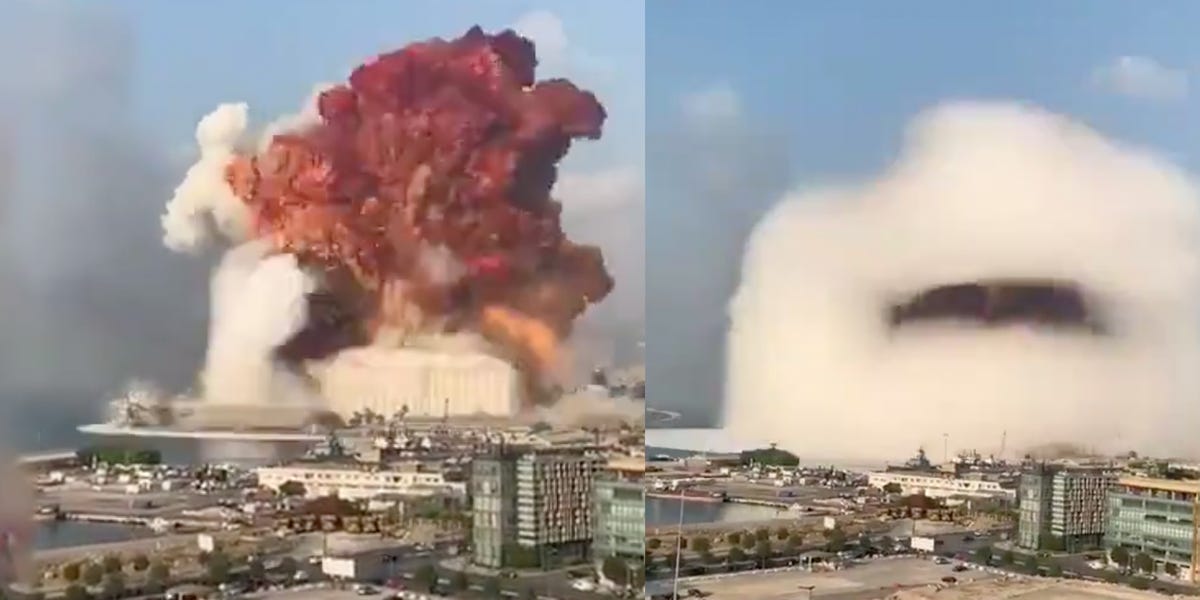
Note: This article is written for educational and journalistic purposes. It explains the Beirut explosion, the widely shared video footage, and the physics of mushroom clouds in a safe, non-instructional way.
Introduction: When a City Saw Physics in Its Most Terrifying Form
On August 4, 2020, Beirut experienced one of the most powerful non-nuclear explosions ever recorded. In seconds, a fire at the Port of Beirut turned into a massive blast that shook buildings, shattered glass across the city, and produced video footage that traveled around the world almost instantly. Many viewers saw the expanding white dome, the towering reddish-brown plume, and the mushroom-like cloud and asked the same questions: What caused the Beirut explosion? Was it a nuclear blast? Why did the cloud look like that?
The answer is both tragic and scientific. The Beirut explosion was linked to a large quantity of ammonium nitrate that had been stored for years at the port under unsafe conditions. The event was not nuclear. It was a chemical explosion, but it was powerful enough to generate seismic waves, a dramatic pressure wave, a short-lived condensation cloud, and a rising plume that resembled the classic “mushroom cloud” people usually associate with nuclear tests.
That visual confusion is understandable. The human brain sees a giant cloud, a bright flash, and a circular shock front and immediately reaches for the Hollywood folder labeled “atomic boom.” But nature is a little more complicatedand much more interesting. Mushroom clouds are not exclusive to nuclear explosions. They can form whenever a large, hot, buoyant mass of gas rises quickly through cooler surrounding air. In other words, the cloud is not a signature of one weapon or one material. It is a signature of fluid dynamics having a very bad day.
What Caused the Beirut Explosion?
The core cause of the Beirut explosion was the detonation of ammonium nitrate stored at the Port of Beirut. Ammonium nitrate is widely used in agriculture as a fertilizer, but it is also a dangerous oxidizing material when stored improperly, exposed to intense heat, contaminated, or involved in a major fire. In Beirut, reports and investigations pointed to approximately 2,750 metric tons of ammonium nitrate that had been offloaded from the cargo ship Rhosus years earlier and stored in Hangar 12.
The disaster was not simply a chemical accident in the narrow sense. It was also a failure of governance, logistics, risk management, and public safety. A dangerous stockpile remained close to a dense urban area for years. Warnings were reportedly raised, yet the material was not removed in time. The story is less “one bad spark” and more “a long chain of ignored red flags.” If disaster prevention had a dashboard, this one was blinking like a Christmas tree in a thunderstorm.
On the day of the explosion, a fire broke out in the port area. Video footage shows smoke, smaller flashes, and then a sudden, enormous blast. The exact sequence of ignition has been heavily investigated and debated, but the broad conclusion remains clear: a large quantity of ammonium nitrate detonated, releasing an immense amount of energy in a fraction of a second.
Why the Beirut Explosion Video Looked So Dramatic
The Beirut explosion video footage became a global reference point because it captured several physical phenomena at once. Unlike many disasters that are reconstructed from scattered evidence, this one was recorded from apartments, balconies, cars, streets, offices, and waterfront locations. Those videos helped researchers and journalists estimate the speed of the blast wave, the scale of the explosion, and the sequence of visible effects.
The White Expanding Dome
One of the most striking features in many videos is the white, rapidly expanding dome that appears immediately after the blast. Many people called it a shock wave, but it is more accurately described as a condensation cloud associated with the pressure disturbance. When a powerful blast wave moves through humid air, pressure and temperature changes can cause water vapor to condense briefly into tiny droplets. The result is a pale, ghostly shell racing outward.
This is sometimes compared to a Wilson cloud, a condensation effect seen around powerful explosions and high-speed pressure changes. It is not smoke. It is not radioactive material. It is not proof of a nuclear event. It is water vapor briefly becoming visible because the air was squeezed, expanded, and disturbed extremely fast.
The Reddish-Brown Mushroom-Like Cloud
After the white cloud faded, a red-brown plume rose above the port. That color is consistent with nitrogen dioxide and other combustion byproducts associated with ammonium nitrate decomposition. The plume rose because hot gases are less dense than the surrounding cooler air. Like steam rising from a pot, but on a catastrophic urban scale, the hot mass climbed upward and pulled surrounding air and debris with it.
As the hot gases rose, the edges rolled and curled, forming a cap-like structure. This is where the “mushroom cloud” appearance comes from. The same general shape can appear above volcanic eruptions, large industrial explosions, and nuclear detonations. The physics is about buoyancy, turbulence, and vorticesnot just the source of the blast.
The Physics of Mushroom Clouds Explained
A mushroom cloud forms when a large amount of energy rapidly heats air and surrounding material. The heated gas expands, becomes buoyant, and rises. As it moves upward, cooler air rushes in from below, creating a strong updraft. The top of the cloud spreads outward because it meets resistance from the surrounding atmosphere, while the rising column below becomes the “stem.”
Think of it like dropping a blob of dark ink into a glass of water and then turning the glass upside down in your imagination. The blob curls, folds, rolls, and pulls nearby fluid into motion. The atmosphere behaves like a fluid too, even though we usually walk through it without giving it much credit. When an explosion injects heat and momentum into the air, the atmosphere responds with dramatic shapes.
Step 1: Rapid Energy Release
The explosion releases energy quickly, heating gases and pushing air outward. The immediate blast creates a pressure wave that travels away from the source. This is the part that breaks windows, damages structures, and arrives before the sound is fully understood by anyone nearby.
Step 2: Buoyant Rise
Hot gases rise because they are less dense than surrounding air. The greater the temperature difference and the more energetic the event, the faster the plume climbs. In Beirut, the blast produced a large, hot cloud loaded with gases, dust, and debris, giving the plume its visible body.
Step 3: Vortex Ring Formation
As the rising gas column pushes upward, air circulates around the edges. This creates a rolling motion known as a vortex ring. The cap of the mushroom cloud forms as the rising material curls outward and downward at the edges, like a smoke ring that decided to become a skyscraper.
Step 4: Stem and Cap Separation
The “stem” forms as air, dust, and debris are pulled upward from below. The “cap” spreads at the top as the plume slows and expands. This shape is familiar because the physics is repeatable. The source can be nuclear, chemical, volcanic, or industrial, but the atmosphere follows the same broad rules.
Was the Beirut Explosion a Nuclear Blast?
No. The Beirut explosion was not nuclear. The mushroom-like cloud, the white condensation shell, and the scale of the damage led to online speculation, but the known evidence points to a chemical explosion involving ammonium nitrate. A nuclear explosion would involve different radiation signatures, different fireball characteristics, and a different investigative footprint.
The confusion happened because people often associate mushroom clouds only with nuclear weapons. That association comes from history and media imagery, not from physics alone. A mushroom cloud is a shape created by hot rising gas and atmospheric motion. Nuclear blasts can produce mushroom clouds, but so can large conventional explosions.
In the Beirut videos, the visible cloud behavior aligns with a huge chemical detonation. The short-lived white dome was a condensation effect. The red-brown plume was associated with chemical byproducts. The rising mushroom shape came from hot gases and turbulent air.
Pressure Wave vs. Shock Wave: What Viewers Saw in the Videos
Many people use the terms “shock wave” and “pressure wave” interchangeably, but they are not always identical. A shock wave involves an extremely abrupt jump in pressure, while a pressure wave can be a broader disturbance moving through air. In real-world explosions, the details depend on the energy release, distance, atmosphere, terrain, and surrounding buildings.
In the Beirut footage, the expanding visual shell was not the blast wave itself in the simple cartoon sense. It was a visible condensation effect connected to the pressure changes caused by the explosion. The damaging pressure arrived as air compressed and moved outward at high speed. That is why windows shattered across a wide area and why the event was recorded by seismic instruments.
The U.S. Geological Survey registered the event as a magnitude 3.3 explosion, not because it was an earthquake, but because the blast transferred energy into the ground strongly enough for seismic networks to detect it. That detail gives readers a sense of scale: the explosion was not just loud; it physically shook the Earth.
Why Ammonium Nitrate Can Be So Dangerous
Ammonium nitrate is not automatically explosive in everyday agricultural use. It has legitimate uses and is handled safely in many regulated settings. The danger rises when large quantities are stored improperly, exposed to fire, confined, contaminated, or left without adequate safety oversight. The Beirut case showed what can happen when a hazardous material is treated like ordinary cargo instead of a serious industrial risk.
One of the most important lessons is that risk is not only chemical; it is organizational. A dangerous material plus poor storage is risky. A dangerous material plus years of inaction is worse. A dangerous material plus a busy port beside a capital city is a public safety nightmare wearing a warehouse badge.
Safety agencies have long warned that ammonium nitrate requires careful storage and emergency planning. The Beirut explosion became a painful reminder that regulations are not paperwork decorations. They are barriers between normal life and catastrophe.
How the Beirut Blast Changed Public Understanding of Disaster Videos
The Beirut explosion was one of the first major urban disasters where social media video became a central tool for public analysis. People did not only watch the footage; scientists, journalists, engineers, and open-source investigators studied it. By comparing timestamps, camera locations, sound delays, and the movement of the visible cloud, analysts could estimate distances, timing, and blast behavior.
This changed how many people think about viral disaster footage. A video is not just a dramatic clip. It can be data. The angle of a shadow, the delay between flash and sound, the speed of a cloud front, and the shaking of a building can all become clues. Of course, internet detectives should still keep their lab coats metaphorical. Real analysis requires expertise, caution, and respect for victimsnot just a pause button and a confident tweet.
Human Impact: Beyond the Science
Physics explains how the explosion moved through air. It does not explain the full human cost. The blast devastated neighborhoods, damaged homes and businesses, disrupted hospitals, and left hundreds of thousands of people affected. For many residents, the explosion was not an abstract event about pressure waves and buoyancy. It was a life-changing moment that turned familiar streets into a disaster zone.
That is why writing about the Beirut explosion requires balance. The science matters because it helps people understand what they saw and why it happened. But the science should not turn tragedy into spectacle. The videos are powerful, but behind every frame were real people, families, workers, patients, shop owners, and emergency responders.
What the Beirut Explosion Teaches About Urban Safety
The Beirut disaster offers several lessons for cities around the world. First, hazardous materials must be tracked, labeled, inspected, and moved away from dense populations when risk becomes unacceptable. Second, warnings must lead to action. A memo that says “danger” is not a safety system if nobody acts on it. Third, ports are not just shipping zones. They are critical urban infrastructure, often located near homes, hospitals, highways, and food supply chains.
The event also reminds us that old problems do not become safer simply because they become familiar. A hazardous stockpile sitting quietly for years may look boringuntil it is not. Risk management is the art of taking boring things seriously before they become breaking news.
Experiences and Reflections Related to the Beirut Explosion and Mushroom Cloud Physics
For many people who watched the Beirut explosion video online, the first experience was confusion. The clip begins like a fire scenesmoke, flashes, distant concernand then suddenly becomes something much larger. Viewers often describe a strange delay in understanding. The eyes see the white dome racing outward before the mind catches up. It is one of those moments when the internet, usually full of memes and lunch photos, turns into a classroom with no warning bell.
One meaningful experience from studying the event is realizing how misleading first impressions can be. A mushroom cloud does not automatically mean a nuclear explosion. A white cloud does not automatically mean smoke. A loud blast does not tell the whole story of its cause. The Beirut footage teaches viewers to slow down, ask better questions, and separate visual drama from scientific evidence. In an age where videos travel faster than explanations, that habit is valuable.
Another reflection is how physics can make the invisible visible. Air is usually ignored because it behaves politely. It stays clear, moves gently, and lets us get on with our day. But during a massive explosion, air becomes an active participant. It compresses, condenses, races, curls, and rises. The white shell in the Beirut videos made pressure changes visible. The red-brown plume made chemistry visible. The mushroom cloud made buoyancy and turbulence visible. It was a terrible event, but it also revealed forces that normally hide in plain sight.
The Beirut explosion also changes the way people think about safety signs, storage rules, and bureaucratic warnings. Before a disaster, regulations can seem dull. Labels, inspections, paperwork, and hazard plans are not exactly blockbuster material. Nobody buys popcorn to watch a compliance checklist. Yet after Beirut, those boring systems look different. They are the quiet architecture of prevention. When they fail, the consequences are not theoretical.
Teachers, science writers, engineers, and journalists can use the Beirut case carefully as an educational example. It connects chemistry, physics, urban planning, emergency management, and media literacy. A classroom discussion might explore why hot gases rise, why pressure waves damage buildings, why ammonium nitrate requires strict control, and why viral videos should be analyzed responsibly. The key is to keep the focus on understanding and prevention, not sensationalism.
For everyday readers, the strongest takeaway may be this: disasters often look sudden, but many are built slowly. The visible explosion lasted seconds. The conditions that made it possible developed over years. That gap between slow cause and sudden consequence is one of the hardest lessons in public safety. The Beirut explosion was not only a moment of physics; it was a warning about attention, accountability, and the cost of ignoring risk.
In the end, the mushroom cloud over Beirut was not just a shape in the sky. It was a message written in heat, pressure, chemistry, and grief. Understanding the physics helps decode the image. Remembering the people affected gives that understanding a purpose.
Conclusion: The Science Behind the Cloud, the Lesson Behind the Disaster
The Beirut explosion remains a defining example of how chemistry, physics, infrastructure, and governance can collide. Its cause was tied to a large stockpile of ammonium nitrate stored unsafely for years. Its videos revealed a dramatic sequence of pressure effects, condensation, chemical plume formation, and mushroom-cloud dynamics. Its impact showed the world that industrial hazards do not stay politely inside warehouse walls when prevention fails.
The physics of mushroom clouds is fascinating, but the lesson is practical: powerful disasters are rarely just about energy release. They are also about decisions, delays, systems, and responsibility. The Beirut blast should be remembered not only for the shocking images that filled screens around the world, but also for the urgent reminder that safety rules exist because physics does not negotiate.