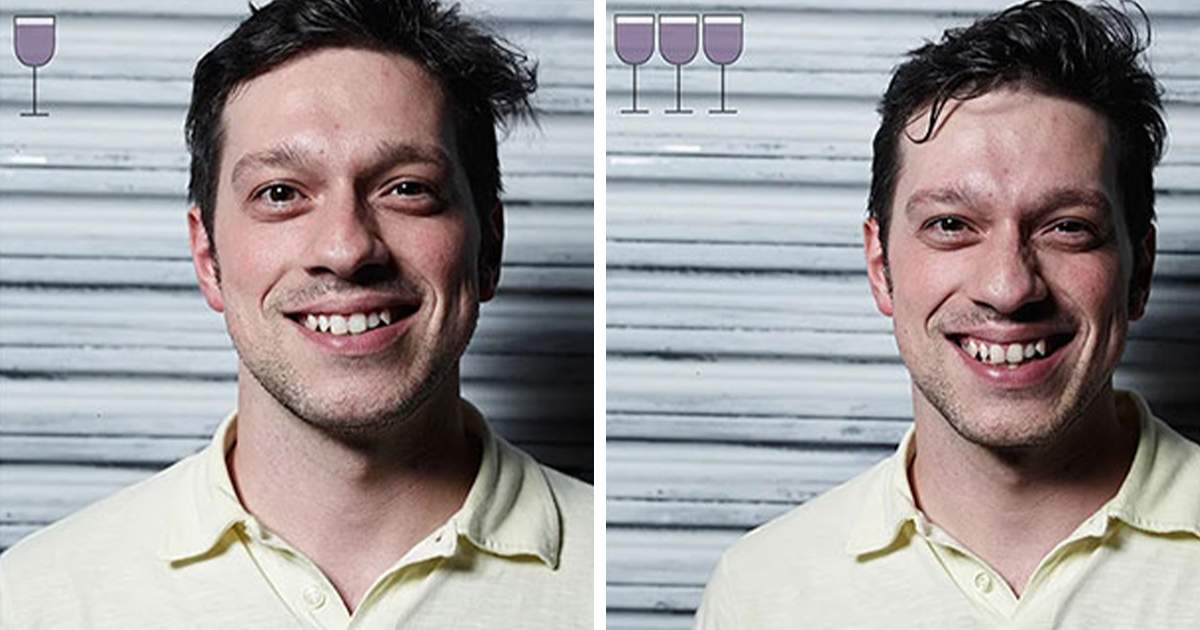
Most portrait sessions begin with careful lighting, flattering angles, and at least one person asking what to do with their hands. Brazilian photographer Marcos Alberti chose a livelier formula: photograph friends when they arrived at his studio, serve them wine, and take another portrait after each glass.
The result was the Wine Project, also widely known as 3 Glasses Later. Its four-frame sequences move from sober arrival to one, two, and three glasses of wine. In the opening images, many subjects look as though they have just survived work, traffic, unanswered emails, and a meeting that should have been an email. By the final frame, smiles are wider, shoulders are looser, and the camera appears to have become an old friend.
Nearly a decade after the project first went viral in 2016, 20 additional portraits from the original sessions were presented to a new audience. They are amusing, expressive, and surprisingly revealingbut not necessarily for the reasons a casual viewer might assume.
How Marcos Alberti’s Wine Project Began
Alberti did not begin with a laboratory hypothesis or a grand plan to explain human behavior. He combined several things he enjoyed: photography, friends, conversation, and wine. The experiment started as an after-hours joke and gradually became a serious portrait series with a deliberately playful spirit.
The photographer was inspired by an old saying that roughly divides a wine-filled evening into three stages: the first glass accompanies food, the second encourages affection, and the third invites mayhem. Rather than debating the saying over dinner, Alberti decided to test its visual potential.
His subjects were friends from varied creative and professional backgrounds, including music, architecture, advertising, fashion, dance, and the arts. Some drank wine regularly; others rarely touched it. That mixture helped prevent the gallery from feeling like a parade of identical reactions.
The portraits were created during several weeknight gatherings in Alberti’s São Paulo studio. Participants generally arrived after work, often carrying the tension of a long day and a frustrating commute. Alberti photographed them immediately, before the social part of the evening had time to soften their expressions.
The Simple Setup Behind the Before-and-After Photos
The format could hardly have been simpler. Each person stood against the same plain, horizontally textured background. Alberti used consistent framing and lighting, minimizing visual distractions so that posture, eye contact, smiles, and gestures became the main event.
Frame One: The Unfiltered Arrival
The first photograph was taken as soon as each guest reached the studio. This detail matters. The “before” expression was not a scientifically neutral baseline. It was the face of someone arriving from work, traffic, responsibilities, and ordinary weekday fatigue.
Some people appear reserved. Others offer a polite camera smilethe expression used for office identification badges, formal introductions, and encounters with distant relatives who insist they remember you as a baby.
Frames Two Through Four: One Portrait Per Glass
After the initial photograph, Alberti served Cabernet Sauvignon. He took another portrait when the subject finished the first glass, followed by one after the second and another after the third.
There was no rigid countdown between shots. Participants drank at their own pace while talking and spending time together. That relaxed timing made the sessions feel natural, although it also means the project should be viewed as art rather than controlled research.
What the 20 Photos Reveal
The newly shared portraits were not produced in a fresh experiment. They came from the original 2016 sessions but were not included in the widely circulated first gallery. Their reappearance offers another opportunity to study the small changes that made the Wine Project so irresistible.
After One Glass: The First Cracks in the Formal Pose
The transition after one glass is often subtle. A tight mouth becomes a genuine smile. Eyebrows lift. Eye contact grows warmer. A subject who initially looked directly into the lens with passport-photo seriousness begins to lean slightly, tilt the head, or acknowledge the photographer as a person rather than a piece of equipment.
This stage may be the most interesting because the changes are small enough to invite close observation. The viewer starts comparing cheek tension, shoulder position, and the corners of the eyes. Suddenly, everyone becomes an amateur body-language detective.
After Two Glasses: Personality Steps Forward
In many sequences, the second-glass portrait marks the largest visible shift. Smiles become less symmetrical and therefore more believable. Some subjects move closer to the camera, while others turn their bodies, laugh openly, or experiment with playful expressions.
Alberti reportedly noticed that even friends accustomed to drinking changed in the way they interacted with his lens. One regular wine drinker did not dramatically alter his facial expression, but he became increasingly comfortable and moved closer to the camera in successive frames.
That example illustrates the project’s real strength. Transformation is not limited to rosy cheeks or bigger smiles. It can appear as confidence, proximity, posture, or willingness to abandon the approved “portrait face.”
After Three Glasses: The Polite Portrait Officially Clocks Out
By the final frame, many subjects seem less interested in producing a conventionally flattering photograph. That is when the gallery becomes especially entertaining. There are closed eyes, exaggerated grins, tilted heads, raised hands, tossed hair, and expressions that appear to contain the beginning of a very long story.
The third-glass images are not universally chaotic. Some people remain composed, while others become theatrical. The variation is part of the charm. Alcohol does not press a universal “silly face” button, and personality still shapes what reaches the camera.
One session apparently became so animated that a participant wanted to pose inside a refrigerator. The refrigerator declined to cooperate on dimensional grounds. Another gathering stretched from evening until early morning, proving that a portrait project can quietly become a party when nobody is watching the clock.
Why the Wine Project Went Viral in 2016
The project reached a huge audience because its concept could be understood in seconds. No lengthy artist statement was required. Four pictures, three wineglass icons, one face, and a visible progression told the entire story.
That clarity made the photographs ideal for social media. Viewers could scan a sequence, recognize a familiar emotional journey, and immediately share it with the friend who always becomes philosophical after the second drink.
The series also arrived during an era when highly polished online identities were becoming increasingly common. Alberti offered the opposite: a repeated, consistent format in which composure gradually gave way to spontaneity. The pictures felt less like advertisements and more like outtakes from real conversations.
Most importantly, the portraits invite comparison without humiliating their subjects. The humor feels affectionate rather than cruel. Nobody is shown stumbling through a nightclub or waking up beside a traffic cone. The setting remains friendly, controlled, and visually elegant.
The Real Subject May Be Connection, Not Wine
At first glance, the project appears to document what alcohol does to faces. Look longer, however, and another interpretation emerges. Each portrait also records the passage of time inside a welcoming social environment.
Between the first and final frames, the participants did more than consume wine. They talked with friends, became accustomed to the studio, developed rapport with the photographer, and stopped worrying about how they looked. Any of those factors could influence expression.
The initial portrait was intentionally captured at a stressful moment: immediately after work and commuting. The later images followed conversation and hospitality. The series therefore contrasts two environments as much as two levels of alcohol consumption. One environment says, “You are late and your inbox contains 47 messages.” The other says, “Sit down; your friends are here.”
This does not make the project misleading. It makes it more human. Alberti was creating portraits, not submitting a clinical trial for peer review. The images explore how people relax in company, and wine is one part of that social ritual.
Why the Photos Are Not a Scientific Alcohol Experiment
The four-frame sequences should not be treated as proof that three glasses of wine produce happiness. There was no alcohol-free comparison group, no standardized drinking interval, no blind assessment, and no measurement of blood alcohol concentration.
The subjects also knew they were participating in a photography project. Expectations matter. When people anticipate becoming more relaxed or playful, they may unconsciously behave in ways that match that expectation.
Selection matters too. A photographer chooses which frame to publish from several possible shots. A joyful expression may communicate the project’s theme more effectively than a blink, a distracted glance, or a sudden concern about tomorrow morning.
The takeaway is not that the portraits are false. Every photograph is a selection. Alberti’s artistic decisions turned ordinary changes in facial expression into a clear visual narrative, which is precisely what strong portrait photography does.
What Alcohol Can Actually Change
Alcohol is a central nervous system depressant. It can affect mood, behavior, judgment, self-control, coordination, memory, and reaction time. Lowered inhibition may help explain why some subjects appear more expressive or less concerned about posing perfectly.
However, “three glasses” is not a precise dose. In the United States, one standard drink of wine is generally defined as five fluid ounces at approximately 12% alcohol by volume. A generously poured restaurant glass or a stronger wine may contain more than one standard drink.
Alcohol affects individuals differently. Drinking speed, food intake, age, medications, biological differences, body composition, and tolerance can all influence impairment. Two people can finish apparently similar glasses and have very different experiences.
That is another reason the project works better as a celebration of individual expression than as a chart of predictable intoxication. Each face follows its own route from frame one to frame four.
A Necessary Responsible-Drinking Note
The project’s cheerful atmosphere should not be interpreted as medical evidence that drinking improves health or emotional well-being. Alcohol consumption carries short- and long-term risks, and even moderate use may increase certain health risks compared with not drinking.
People who are pregnant, younger than the legal drinking age, taking medications that interact with alcohol, managing certain medical conditions, driving, or unable to control their intake should not drink. No photograph is charming enough to make impaired driving acceptable.
What Portrait Photographers Can Learn From the Series
The Wine Project offers useful lessons even for photographers who would prefer to serve coffee, tea, or aggressively sparkling water.
Consistency Makes Small Changes Visible
By keeping the background, camera position, crop, and lighting similar, Alberti made tiny behavioral changes easy to notice. A shifting shoulder or deepening smile becomes meaningful because the visual environment stays stable.
Rapport Often Matters More Than Equipment
The later portraits feel natural partly because the subjects had time to settle in. A photographer does not need wine to create that comfort. Conversation, music, humor, patience, and clear direction can produce the same essential ingredient: trust.
The First Expression Is Rarely the Whole Person
People often arrive at a portrait session carrying tension unrelated to the camera. A rushed commute or difficult day may appear in their face. Giving a subject time to breathe can be more valuable than changing lenses for the seventh time.
Experiencing the 20-Photo Gallery: What Viewers Notice Over Time
Viewing one sequence is funny. Viewing 20 creates a more layered experience. At first, the eye races toward the fourth frame because that is where the biggest grin or strangest pose is likely to appear. The gallery behaves like a collection of miniature punch lines: serious face, warmer face, happy face, surprisesomeone is now communicating exclusively through eyebrows.
After several sequences, however, the sober portraits begin to demand more attention. The viewer notices how much effort people put into managing their public expressions. Chins are centered. Lips are carefully arranged. Shoulders are squared. The subjects seem to be answering an unspoken question: “How would you like strangers to see you?”
The later portraits answer a different question: “What happens when you stop managing the answer?”
This contrast can feel familiar even to viewers who never drink. Most people have experienced the difference between entering a room full of uncertainty and leaving it after a good conversation. The face changes when a deadline is completed, a difficult phone call ends, or an old friend appears unexpectedly. Wine is present in Alberti’s studio, but relief is the emotion many viewers recognize.
The gallery also encourages people to choose a favorite transformation. Some will prefer the dramatic sequences in which a reserved subject becomes a human exclamation point. Others may be drawn to subtler changes: an almost invisible smile, softer eyes, or a head that leans a few degrees toward the lens.
Those quieter sequences can be the most convincing. A giant laugh is easy to identify, but a small increase in comfort feels intimate. It resembles the moment during a conversation when somebody stops performing politeness and begins speaking honestly.
Another common viewing experience is self-comparison. People naturally wonder what their own four-frame sequence would look like. Would they grin? Become sleepy? Start explaining a business idea that absolutely must be launched by Monday? The project functions like a personality quiz without scores, categories, or a demand for an email address.
There is also an ethical dimension to the viewing experience. Because the subjects are friends photographed in a controlled studio, the images generally preserve dignity. Their expressions become more playful, but they are not presented as spectacles of dangerous intoxication. This boundary helps the humor remain warm.
At the same time, modern viewers may approach alcohol imagery more cautiously than audiences did in 2016. Public understanding of alcohol-related health risks has expanded, and cheerful lifestyle imagery can easily blur the distinction between documenting drinking and advertising it. The best way to appreciate the Wine Project is to hold two ideas at once: the portraits can celebrate friendship and visual storytelling while alcohol itself still carries genuine risks.
The final experience is surprisingly tender. Across 20 sets of photographs, the most consistent change is not wild behavior. It is openness. Faces become less guarded. People occupy more space. The camera records what happens when a formal appointment turns into an evening among friends.
That emotional arc explains why the project continues to circulate. Technology changes, social platforms rise and fall, and yesterday’s viral post becomes today’s forgotten browser tab. Yet the desire to see a person move from tension to ease remains universal.
Conclusion
Marcos Alberti’s before-and-after wine portraits succeeded because they transformed a simple gathering into an instantly readable story. The 20 additional photos from the viral 2016 project extend that story without changing its essential appeal: one face, one camera, three glasses, and a steady retreat from self-consciousness.
The images are funny, but their lasting value lies in the detailsthe softened posture, the warmer eye contact, and the moment a carefully prepared portrait gives way to something unpredictable. The Wine Project may have been built around Cabernet, yet its most interesting subject is the human need to relax, connect, and occasionally make a face that should never appear on a company profile.