Note: This article is a fully rewritten synthesis of reputable archaeological reporting and museum-based background research. It is prepared for web publication in standard American English and does not include raw source links or citation artifacts inside the article body.
Every so often, archaeology gives the modern world a headline that sounds as if it escaped from a movie poster: Archaeologists Find the Book of the Dead in an Egyptian Cemetery. Cue the dramatic music, the desert wind, and at least one person whispering, “Do not open the scroll.” Fortunately, this is not a horror movie. It is something better: a real discovery from ancient Egypt that helps scholars understand how people more than 3,000 years ago imagined death, memory, judgment, and eternal life.
The find was reported from the Tuna al-Gebel necropolis in Egypt’s Minya Governorate, in the Al-Ghuraifa area of Middle Egypt. Archaeologists working there uncovered a New Kingdom cemetery containing mummies, coffins, amulets, canopic jars, statues, and a remarkably preserved papyrus associated with the ancient Egyptian Book of the Dead. The cemetery dates broadly to the New Kingdom, roughly 1550 to 1070 B.C., a period famous for powerful pharaohs, expanding temples, refined burial customs, and some of the most vivid religious art ever painted on papyrus.
For anyone new to the subject, the Book of the Dead was not a single “book” in the modern sense. There was no official ancient Egyptian hardcover edition, no ISBN, and no grumpy bookstore clerk shelving it under “Self-Help: Afterlife.” Instead, it was a flexible collection of funerary spells, hymns, instructions, and illustrations used to guide the dead through the dangerous landscape of the underworld and into a blessed afterlife.
What Exactly Did Archaeologists Discover?
The most attention-grabbing object from the cemetery is a long papyrus scroll containing passages from the Book of the Dead. Most reports describe the papyrus as measuring about 13 to 15 meters long, or roughly 43 to 49 feet. Some early reporting mentioned a preliminary estimate of 16 to 18 meters, which is why readers may see slightly different figures. Either way, we are talking about a document long enough to make your average grocery receipt feel emotionally inadequate.
The scroll is especially significant because it was found in a burial context rather than floating around the antiquities market without a clear history. Context is archaeology’s favorite word for a reason. A papyrus found near the people, coffins, tombs, and objects it originally accompanied can tell scholars far more than a beautiful object with no known origin. It helps answer questions such as who may have owned it, how it was used, what kind of burial it belonged to, and how religious texts were selected for specific individuals.
The cemetery also yielded richly decorated wooden and stone coffins, human remains, amulets, canopic jars, and thousands of small funerary figurines known as shabtis or ushabtis. These figures were believed to serve the deceased in the afterlife, which is either a touching religious idea or the earliest known form of outsourcing, depending on your sense of humor.
Why Tuna al-Gebel Matters
Tuna al-Gebel is not a random patch of desert. It is one of Middle Egypt’s most important archaeological zones, associated with the ancient city of Hermopolis, a major center for the worship of Thoth. Thoth was the god of writing, wisdom, measurement, and sacred knowledge. In other words, if any Egyptian god would appreciate a carefully written funerary manuscript, it would be Thoth.
The newly reported cemetery appears to have served high-ranking officials and priests. Some inscriptions from the burial group identify individuals connected with temple service, including titles linked to Amun and other religious roles. This matters because the Book of the Dead was not merely decorative. It was part of a religious technology, a written toolkit designed to help the deceased speak correctly, pass divine tests, avoid supernatural hazards, and join the company of the blessed dead.
The discovery also expands what researchers know about New Kingdom activity in the Al-Ghuraifa area. Archaeological missions had worked in the region for years before announcing the cemetery. Finds like this rarely appear because someone simply trips over a golden coffin on a Tuesday. They are usually the result of long-term excavation, patient recording, conservation work, and enough dust to make every archaeologist’s laundry machine file a complaint.
What Was the Book of the Dead?
The title Book of the Dead is modern. Ancient Egyptians called the collection something often translated as the Book of Coming Forth by Day. That name is more poetic and more accurate. The goal was not to celebrate death as an ending, but to help the deceased emerge into renewed existence. The dead person hoped to move freely, breathe, eat, speak, remember their name, and join the cosmic cycle of rebirth.
The text developed from earlier Egyptian funerary traditions, including the Pyramid Texts and Coffin Texts. Pyramid Texts were carved inside royal pyramids during the Old Kingdom. Coffin Texts later appeared on coffins and were used by a wider elite audience. By the New Kingdom, the Book of the Dead became a major form of funerary literature, commonly written on papyrus and placed in tombs.
There were nearly 200 known spells, though individual manuscripts usually included only selected chapters. A wealthy patron might commission a personalized scroll with their name inserted into the text. Some versions were beautifully illustrated with scenes of gods, monsters, gates, boats, offerings, and judgment. Others were shorter or less elaborate. Ancient Egypt, like modern life, had budget tiers.
The Famous Judgment Scene
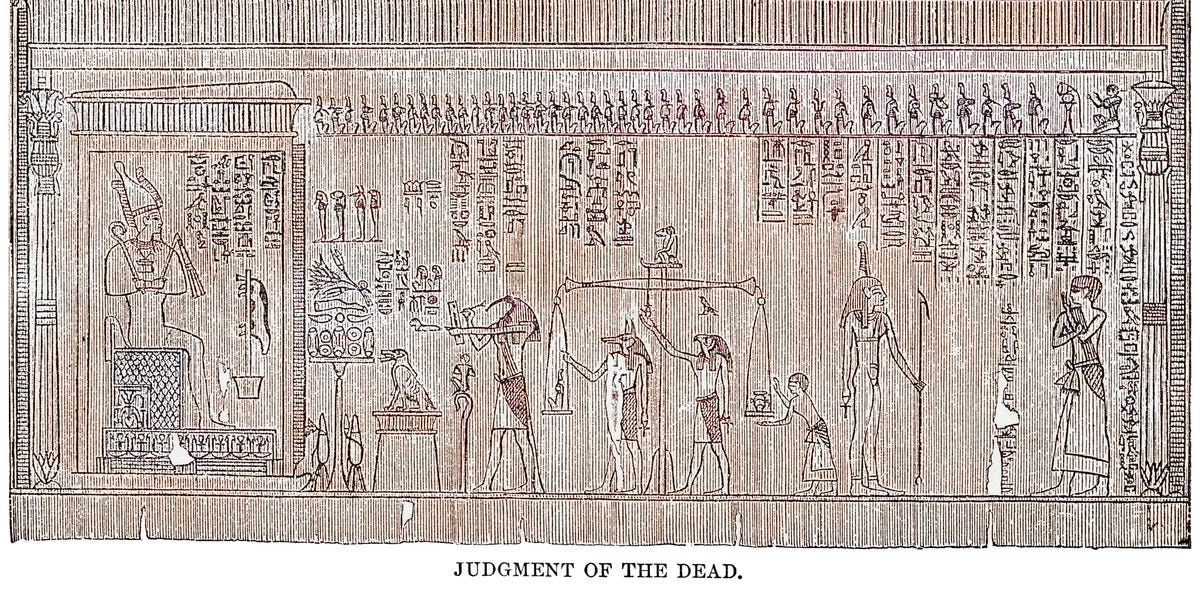
One of the best-known ideas associated with the Book of the Dead is the weighing of the heart. In this scene, the heart of the deceased is weighed against the feather of Ma’at, the principle of truth, balance, justice, and cosmic order. If the heart balanced properly, the person could move toward eternal life. If not, the monstrous Ammitpart crocodile, part lion, part hippopotamus, and fully terrifyingwaited nearby to devour it.
This image captures one reason the Book of the Dead still fascinates modern readers. It combines law, morality, religion, psychology, and spectacular creature design. The ancient Egyptians imagined the afterlife not as a vague cloud lounge but as a structured journey full of passwords, tests, divine beings, and moral accountability. It was less “float toward the light” and more “please have your paperwork ready.”
Why Finding a Papyrus in Place Is So Rare
Papyrus is fragile. It can decay, burn, crumble, absorb moisture, or be damaged by insects, tomb robbers, and time itself. Egypt’s dry climate helped preserve many ancient materials, but survival is never guaranteed. A long papyrus that remains in good condition after more than three millennia is an archaeological jackpot.
Another reason this discovery is important is that many ancient manuscripts in museums were acquired long ago without modern excavation records. They may be beautiful and informative, but they often lack precise archaeological context. A Book of the Dead papyrus found during a documented excavation can connect the words on the scroll to a real cemetery, a specific burial environment, and possibly named individuals.
That connection allows researchers to ask sharper questions. Was the papyrus made for a priest, an official, or a family member of temple elites? Which spells were selected? Were the illustrations typical or unusual? Was the text written in hieroglyphs, hieratic, or a combination? Did the scroll reflect local religious preferences in Middle Egypt? These are the kinds of questions that turn an exciting discovery into long-term scholarship.
What Else Was Found in the Cemetery?
The cemetery contained a wide range of funerary objects. Decorated coffins are especially valuable because their inscriptions can preserve names, titles, family relationships, and religious formulas. In some reports, one coffin is associated with the daughter of a high priest connected to Djehuti, another name for Thoth. Other finds include amulets intended to protect the body and spirit, canopic jars connected with mummification, and shabti figurines meant to perform labor for the deceased in the next world.
These objects were not random decorations. They formed a carefully arranged burial system. The coffin protected and identified the body. The amulets guarded vulnerable points. The canopic jars related to the preservation of internal organs. The shabtis provided symbolic labor. The papyrus supplied sacred knowledge. Together, they created a spiritual survival kit for eternity. Today we pack phone chargers before a trip; ancient Egyptians packed spells, servants, and divine insurance.
What the Discovery Reveals About Ancient Egyptian Beliefs
The discovery reinforces a central truth about ancient Egyptian religion: death required preparation. The afterlife was not automatic. It depended on ritual care, moral standing, correct speech, divine favor, and the preservation of identity. Names mattered. Images mattered. Written words mattered. A spell was not just literature; it was action in sacred form.
The Book of the Dead also shows how deeply the Egyptians connected writing with power. To know the name of a gatekeeper, to recite the right formula, or to identify oneself with a god was to gain control over danger. This is one reason the text often feels surprisingly practical. It reads like a travel guide for a place where the rivers are cosmic, the judges are divine, and one wrong answer could ruin your entire eternity.
How Scholars May Study the Papyrus
Before scholars can fully interpret a fragile papyrus, conservators must stabilize it. Conservation may involve cleaning, humidification, flattening, repairing tears, mounting, and careful imaging. Specialists may use high-resolution photography, infrared imaging, or other noninvasive methods to read faded ink and identify corrections or hidden details.
Egyptologists will then study the script, spell sequence, illustrations, names, titles, and grammar. They may compare the papyrus with other known Books of the Dead from the New Kingdom and later periods. Even small variations can be meaningful. A missing spell, unusual drawing, local title, or scribal error can reveal how funerary texts were copied, customized, and understood.
In other words, the public sees a spectacular scroll; scholars see a thousand tiny clues. Both reactions are correct.
Why the Discovery Captured Public Attention
The phrase “Book of the Dead” has irresistible drama. It sounds mysterious, forbidden, and slightly likely to glow in the dark. But the real story is more human than spooky. The scroll represents grief, hope, wealth, belief, craftsmanship, and the desire to continue beyond death. It belonged to a culture that treated the afterlife as a destination requiring planning, language, art, and community.
Modern readers may not share the same religious worldview, but the emotional logic is easy to understand. People wanted their loved ones to be safe. They wanted death to make sense. They wanted the universe to be moral. They wanted memory to survive. Across 3,500 years, that does not feel ancient at all.
The Bigger Picture: Egypt’s Ongoing Archaeological Story
Egypt continues to reveal major archaeological finds because its ancient landscape is layered with temples, settlements, tombs, workshops, cemeteries, roads, and sacred sites. Yet each discovery must be handled carefully. Archaeology is not treasure hunting. It is the scientific study of human lives through material evidence. The value of the Tuna al-Gebel cemetery lies not only in its beautiful objects but in the information those objects preserve.
The Book of the Dead papyrus may eventually be displayed after restoration, allowing the public to appreciate both its religious meaning and its physical survival. Museum display, however, is only one chapter. The deeper work will happen through conservation reports, translation, comparison, and publication. That process can take years, because ancient papyri do not appreciate being rushed. Honestly, neither do most writers before coffee.
Experiences and Reflections Related to the Discovery
Reading about archaeologists finding a Book of the Dead in an Egyptian cemetery feels like standing at the edge of two worlds. On one side is the modern world of cameras, press releases, conservation labs, and excited headlines. On the other is a world of priests, scribes, mourners, incense, painted coffins, and desert silence. The scroll becomes a bridge between them.
One of the most powerful experiences connected with this topic is the realization that archaeology is not only about objects. It is about attention. A papyrus scroll survives because someone made it, someone paid for it, someone placed it with the dead, and someone thousands of years later noticed it carefully enough not to destroy it. Every step depends on human care.
Imagine entering a tomb chamber where the air feels still and the walls seem to hold their breath. The first reaction might be wonder, but the second should be humility. The people buried there were not “ancient mysteries.” They were individuals with names, families, jobs, fears, and ambitions. A priest buried with sacred texts was not merely a museum label waiting to happen. He or she was part of a living community that believed words could help the soul survive.
There is also something surprisingly relatable about the Book of the Dead. Modern people keep documents for important transitions: passports, wills, medical records, insurance forms, wedding certificates, diplomas, and passwords scribbled somewhere we swear is “totally secure.” Ancient Egyptians prepared for the greatest transition of all with sacred texts. The method differs, but the impulse is familiar. Humans like instructions when the stakes are high.
For students, travelers, history fans, and casual readers, this discovery offers a reminder that ancient Egypt should not be reduced to pyramids and gold masks. Those are spectacular, yes, but daily religious life, scribal work, burial customs, and regional cemeteries are just as important. A single papyrus can teach us about language, art, class, trade, priesthoods, funerary workshops, and ideas of justice.
The discovery also changes how we experience museum objects. The next time a visitor sees a Book of the Dead papyrus behind glass, it may be tempting to admire only the neat columns and charming figures. But behind that surface is a chain of labor: papyrus makers cutting and pressing plant fibers, scribes mixing ink, artists painting divine scenes, priests choosing spells, mourners arranging the burial, excavators documenting the find, and conservators preserving it for future eyes.
That is the quiet magic of archaeology. It turns objects back into actions. It reminds us that history was not inevitable; it was made by people doing specific things with specific hopes. The Tuna al-Gebel papyrus matters because it is not simply old. It is meaningful. It shows that the dead were not abandoned. They were equipped, protected, named, and guided.
And perhaps that is why the headline works so well. “Archaeologists Find the Book of the Dead in an Egyptian Cemetery” sounds thrilling because it is thrilling. But the thrill is not about curses or secret doors. It is about hearing a human voice across an impossible distance. The papyrus says, in effect: remember me, guide me, let me come forth by day. After 3,500 years, we are still listening.
Conclusion
The discovery of a Book of the Dead papyrus in a New Kingdom cemetery at Tuna al-Gebel is more than an archaeological headline. It is a rare glimpse into how ancient Egyptians prepared for eternity through writing, ritual, art, and belief. The scroll’s length, condition, and burial context make it especially valuable, while the surrounding coffins, mummies, amulets, jars, and shabtis help reconstruct the spiritual world of the people buried there.
In the end, the Book of the Dead is not really about death alone. It is about transformation. It reflects a civilization that believed words could open gates, names could preserve identity, and moral balance could shape the soul’s future. That is why this discovery matters. It gives scholars new evidence, gives museums new responsibility, and gives the rest of us a reason to look at ancient Egypt with fresh curiosityand maybe a little less confidence that our own paperwork is impressive.