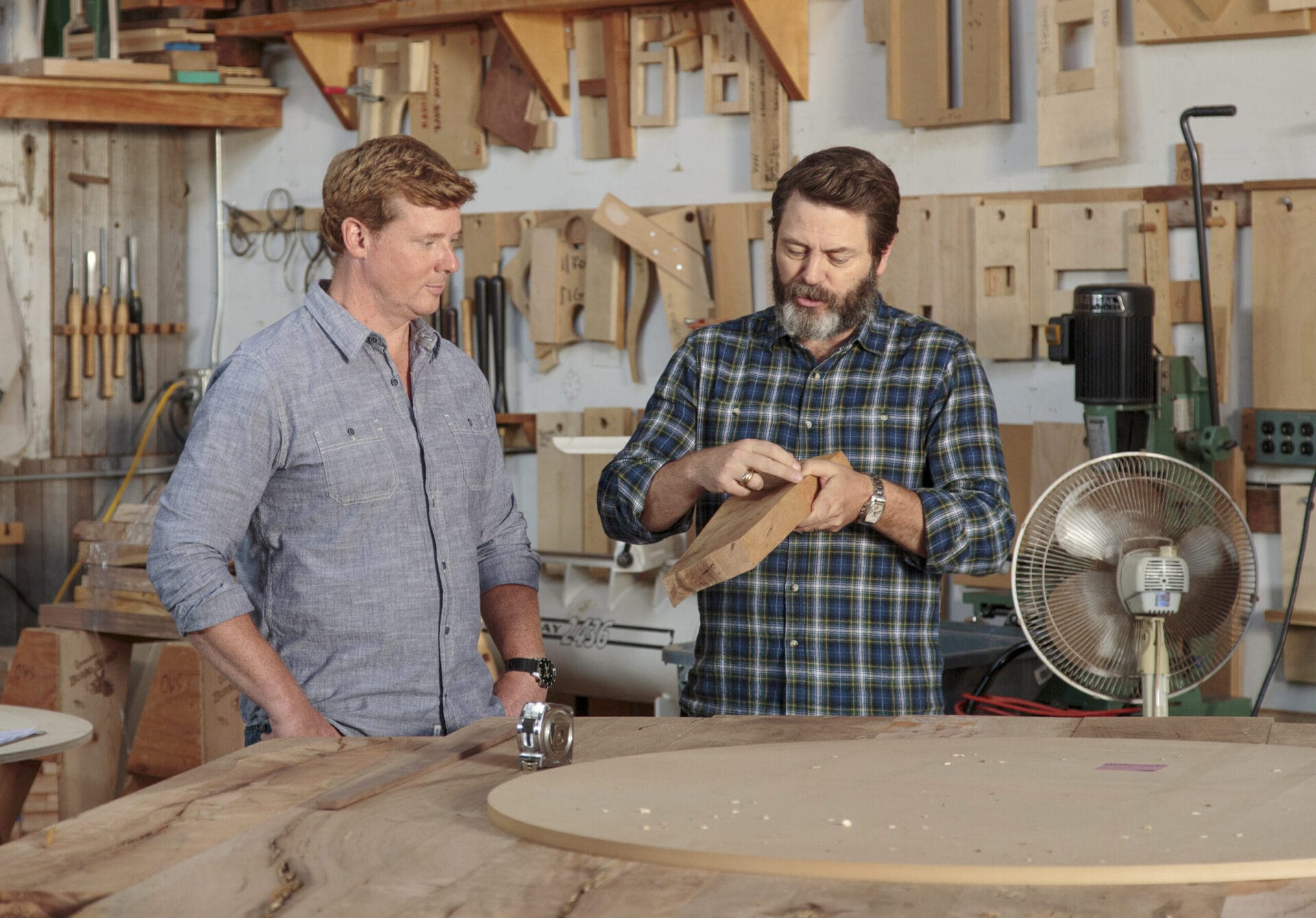
Nick Offerman’s California woodshop is not a television set dressed with decorative hand planes and one suspiciously clean workbench. It is a working East Los Angeles shop where lumber is milled, joints are fitted, furniture is commissioned, mistakes are corrected, and sawdust settles on nearly everything with democratic enthusiasm.
Offerman may be widely recognized as the actor behind Ron Swanson, the famously woodworking-loving character from Parks and Recreation, but his life as a craftsman began long before that role. Offerman Woodshop is the real thing: a collaborative workspace rooted in traditional joinery, useful design, sustainable lumber, and the belief that making an object by hand can be both serious work and very good fun.
From an Illinois Tool Belt to an East Los Angeles Workshop
Offerman’s woodworking story starts far from Hollywood. He grew up in a farm family in Illinois, where fathers, grandfathers, and uncles taught him how to use tools. On a farm, practical repairs do not wait for a lifestyle influencer to arrive with sponsored hardware. Fences sag, sheds need attention, and a doghouse occasionally requires construction before the dog files a formal complaint.
Those early skills became unexpectedly valuable when Offerman studied theater at the University of Illinois. He worked in the university’s scene shop and later built scenery and props for professional theaters in Chicago. His ability to construct a set helped support his acting career, especially during the years when stage roles offered more artistic satisfaction than financial stability.
After moving to Los Angeles, he took on construction work, including decks and cabins, while continuing to act. He and fellow craftsman Martin McClendon became increasingly interested in fine furniture and old-world joinery. Offerman established his Los Angeles shop in 2001, gradually turning a practical workspace into a professional woodworking collective.
What Nick Offerman’s California Woodshop Looks Like
The shop occupies a converted industrial space in East Los Angeles. It has the visual character that many home woodworkers spend years trying to manufacture: high ceilings, open work areas, heavy machinery, racks of clamps, timber stacked in practical corners, templates on the walls, and at least one handmade canoe suspended overhead.
Nothing about the space feels designed merely for photographs. Tools are arranged according to workflow rather than interior-design fashion. Large machines handle milling and dimensioning. Workbenches provide room for joinery, layout, assembly, and finishing. Shelves and cabinets carry the small tools, hardware, finishes, jigs, and mysterious objects that accumulate in every serious shop.
A Mix of Machines and Hand Tools
Photographed tours of the workshop have shown industrial equipment such as a Powermatic planer, table saws, band saws, drill presses, dust-collection lines, and substantial work surfaces. These machines make it possible to flatten slabs, dimension rough stock, prepare components, and produce repeatable cuts safely and efficiently.
Yet the shop is not devoted to machinery for machinery’s sake. Hand planes, chisels, rasps, carving tools, spokeshaves, and layout instruments remain essential. Traditional furniture making depends on being able to read grain, refine a surface, adjust a joint, and recognize when a board is about to behave like a dignified materialor like a caffeinated mule.
The Canoe Above the Shop Floor
The canoe hanging in the workshop is more than decoration. Small boats have long been part of Offerman’s woodworking interests. A canoe demands accuracy, patience, careful shaping, and an appreciation for graceful curves. It must also float, which is a notably unforgiving customer review.
Boatbuilding reflects the broader personality of the shop. The goal is not simply to create something attractive. The object must perform its job, survive use, and reward close inspection. That combination of beauty and utility appears throughout Offerman Woodshop’s furniture, household goods, instruments, and occasional pieces of carefully engineered silliness.
Offerman Woodshop Is a Collective, Not a Celebrity Hobby Room
One of the most important facts about Offerman Woodshop is that Nick Offerman is not the only person making things there. The operation is a small collective of professional woodworkers and makers. Members bring different backgrounds, specialties, and design interests while sharing tools, space, knowledge, and the practical demands of running a working shop.
This collaborative structure became especially important as Offerman’s acting, writing, touring, and television commitments increased. Rather than allowing the workshop to become an unused monument to a busy celebrity, he developed a model in which skilled craftspeople could continue producing commissions and original work.
The result feels closer to a cooperative studio than a star-branded factory. Individual makers can take responsibility for projects, contribute ideas, and learn from one another. A complicated table may require input on milling, joinery, shaping, finishing, and installation. Sharing a shop allows those skills to overlap naturally.
It also creates a culture of accountability. When several experienced woodworkers can see your glue-up from across the room, there is a powerful incentive to count the clamps before spreading adhesive.
Salvaged Lumber Gives the Furniture a California Story
Offerman Woodshop specializes in live-edge and slab furniture made from salvaged or responsibly sourced lumber. Much of the wood comes from fallen or removed trees in Los Angeles, Southern California, and other parts of California and Oregon.
Urban trees are often cut down because of storm damage, disease, construction, or public-safety concerns. Without a local salvage network, trunks large enough to become extraordinary tables can be chipped, burned, or sent to landfills. Recovering that material preserves its value and reduces demand for newly harvested lumber.
What “Slab Rescue” Means
Slab rescue begins with a log that might otherwise be treated as waste. The tree is transported, milled into thick boards, and carefully dried. Drying can take considerable time because massive slabs hold moisture unevenly. Rush the process and the wood may crack, cup, twist, or express its displeasure through all four behaviors at once.
After drying, a slab is evaluated for furniture. Natural edges may be retained, but “live edge” does not mean “leave everything exactly as found and attach four metal legs before lunch.” The slab must still be flattened, stabilized, shaped, sanded, joined to a base, and finished with care.
Designing Around the Tree
Conventional manufacturing often forces lumber into standardized dimensions. Slab furniture reverses the relationship. The wood’s width, grain, color, curves, knots, and old injuries influence the design.
A California walnut slab may suggest a dining table with a restrained base. Redwood might become an expansive table or sculptural surface. Smaller offcuts can be transformed into cutting boards, boxes, coasters, spoons, or other useful objects. In a thoughtful shop, the irregular piece is not automatically scrap. It may simply be waiting for a smaller assignment.
Traditional Joinery in a Modern Professional Shop
The collective emphasizes traditional joinery, meaning that components are connected through carefully shaped relationships between pieces of wood rather than depending entirely on screws, brackets, or synthetic materials.
Depending on the project, that can include mortise-and-tenon joints, dovetails, housed joints, splines, dowels, or other proven methods. Good joinery manages the movement of solid wood as humidity changes. It also creates strength without hiding every structural decision behind a panel.
This does not mean the shop rejects modern tools. A professional workflow may combine machines for rough preparation with hand tools for fitting and refinement. The table saw can establish a clean shoulder; a chisel can perfect it. A planer can bring stock close to thickness; a hand plane can remove machine marks and improve the final surface.
The guiding principle is not “old tool good, new tool bad.” It is choosing the tool that produces a safe, accurate, durable, and satisfying result. Any tool that does all four without launching the workpiece into neighboring airspace has earned its keep.
What Comes Out of Offerman Woodshop?
The shop’s portfolio ranges from major custom furniture to approachable household objects. Its makers have produced slab dining tables, desks, shelving, seating, cabinets, beds, end tables, boats, paddles, ukuleles, cutting boards, boxes, combs, stools, and playful gifts.
Custom Furniture Built for Long Use
Custom commissions are designed around the client, the room, and the available lumber. A large slab table may begin with the dimensions of a particular board rather than a fixed catalog template. The base must support the weight, allow for seasonal wood movement, and visually complement the top without turning the entire piece into an argument between tree and geometry.
The shop explicitly favors solid wood over disposable sheet-goods construction. That choice affects price, weight, repairability, and longevity. A well-made solid-wood table can be refinished, repaired, and passed along. It can collect scratches without becoming useless. Eventually, those scratches become “patina,” which is furniture’s way of hiring a better publicist.
Small Objects With the Same Philosophy
Smaller goods make the shop’s work accessible to people who are not currently commissioning an eight-foot walnut dining table. Cutting boards, coasters, boxes, garden markers, and other products use many of the same principles: durable materials, careful finishing, local production, and visible respect for the grain.
These objects also help use offcuts responsibly. A piece too small for a chair rail may be perfect for a utensil, toy, or keepsake. Turning leftovers into useful goods requires imagination and additional labor, but it keeps valuable hardwood out of the waste stream.
The Shop’s Community Connections
Offerman Woodshop participates in a wider Los Angeles network of craftspeople, teachers, lumber specialists, and social enterprises. Its members have relationships with Allied Woodshop, where craftspeople teach classes, and Angel City Lumber, which supplies locally salvaged urban wood for products and commissions.
The collective has also worked with Would Works, a nonprofit social enterprise that offers woodworking instruction and employment opportunities to people experiencing homelessness or poverty. These partnerships show how a woodshop can function as more than a private production space. It can preserve local material, teach practical skills, create paid work, and connect people through shared effort.
That community emphasis fits Offerman’s larger philosophy. Woodworking is often portrayed as a solitary activity performed by one solemn person in an apron. In reality, professional craft depends on loggers, arborists, mill operators, designers, finishers, teachers, clients, and fellow makers who are willing to help carry the heavy end.
Why the Woodshop Matters to Nick Offerman
For Offerman, making things is not merely an extension of his public persona. Woodworking predates Ron Swanson and helped make his theater and acting career possible. It gave him employment, a community, and a sense of competence during periods when entertainment work was unpredictable.
He has repeatedly connected craftsmanship with self-reliance, attention, and a healthier relationship with technology. The appeal is not nostalgia for an imaginary age when everyone cheerfully churned butter before breakfast. It is the directness of working with physical material. You make a mark, perform an action, and observe the consequence.
His books Good Clean Fun and Little Woodchucks expand that philosophy beyond the walls of the California woodshop. They encourage adults, children, and families to use tools, attempt manageable projects, accept mistakes, and discover the pleasure of producing something tangible.
The humor matters. Craft instruction can become intimidating when every expert behaves as though a slightly imperfect dovetail has disgraced eight generations of cabinetmakers. Offerman’s approach makes room for high standards without pretending that learning is elegant. Sometimes learning looks like measuring twice, cutting once, and then wondering which of the two measurements was apparently fictional.
Lessons Home Woodworkers Can Borrow From the Shop
- Start with useful projects. A box, stool, cutting board, or shelf can teach layout, cutting, assembly, and finishing without requiring a commercial hangar.
- Respect the material. Study grain direction, moisture, defects, and movement before deciding what a board should become.
- Build for repair. Durable joints and renewable finishes can extend an object’s life for decades.
- Use scrap creatively. Offcuts can become small gifts, jigs, wedges, handles, test pieces, or components for future projects.
- Find a community. Classes, shared shops, clubs, and experienced friends can improve both safety and skill.
- Expect mistakes. Error is part of craft. The goal is to make increasingly interesting mistakes at progressively higher levels of competence.
A Maker’s-Eye Experience of a Shop Like Offerman’s
Because this article is based on documented tours and public reporting rather than a private visit, the most honest way to describe the experience is through the features that makers consistently recognize in a busy professional shop.
Imagine entering through an open industrial door and noticing the smell first. Freshly milled wood has a distinctive presence: walnut can seem rich and earthy, cedar announces itself from several counties away, and sawdust adds a dry sweetness to the air. Beneath that is the less poetic aroma of machine oil, glue, coffee, and a shop rag that should have retired during the previous presidential administration.
Your eyes would likely move upward to the canoe hanging overhead, then across clamp racks, slabs, templates, hand tools, and machinery. A functioning workshop rarely reveals itself all at once. It is read in layers. A stack of lumber indicates future work. A jig on the wall suggests a problem solved years ago and likely to return. Pencil marks on a bench record decisions too temporary for a notebook but too important to trust to memory.
The sound changes constantly. One moment, several people may be quietly measuring or fitting joints. Then a dust collector starts, followed by a planer with the subtle vocal qualities of an irritated jet engine. Ear protection goes on. Conversation pauses. When the machine stops, the room settles back into scraping, sanding, tapping, and the short exchanges of people who already understand the project.
A newcomer might expect Offerman’s shop to revolve around celebrity memorabilia. The more interesting experience would be seeing how quickly fame becomes irrelevant when a joint does not fit. Wood is magnificently unimpressed by awards, applause, or television ratings. It responds to moisture, geometry, sharp edges, pressure, and time. This indifference is part of the craft’s appeal.
Working beside other makers would also change the experience. In a home garage, a problem can feel uniquely personal. In a collective shop, someone nearby has probably encountered a similar issue. Advice may arrive as a recommended tool, a revised sequence, or a quiet question: “Are you certain you want to cut that side?” Such a question has saved many projects and several colorful vocabularies.
The material itself would command attention. A salvaged urban slab carries evidence of its previous lifebranch transitions, dark mineral streaks, old wounds, checks, knots, and perhaps traces of city hardware. The maker’s task is not to erase all of that history. It is to determine which features are structurally sound, which need stabilization, and which can become the visual center of the finished object.
Finishing the day in such a shop would produce a satisfaction unlike checking another digital notification. Progress may appear modest: boards milled flat, joinery marked, a surface planed, or an assembly dry-fitted. Yet those changes are physical and cumulative. Tomorrow’s work begins where today’s hands stopped.
That may be the clearest experience associated with Nick Offerman’s California woodshop. The space celebrates competence without demanding perfection, tradition without rejecting modern equipment, and humor without treating craft casually. It reminds makers that a useful object can begin as a fallen city tree, a rough sketch, and an unreasonable number of clamps.
Conclusion: More Than Sawdust and Celebrity
An inside look at Nick Offerman’s California woodshop reveals something more compelling than the novelty of a famous actor using a table saw. The East Los Angeles workshop is a living craft community built around salvaged lumber, traditional joinery, durable design, teaching, and collaborative work.
Offerman’s public profile may attract the first glance, but the wood deserves the longer look. Fallen California trees become tables, scraps become useful objects, and practical skills pass from one generation of makers to another. The shop’s lasting lesson is pleasantly straightforward: choose good material, sharpen the tool, help your neighbor, and do not begin the glue-up until you know where every clamp is hiding.
Note: This independently written article synthesizes publicly available shop profiles, interviews, woodworking tours, and official Offerman Woodshop information. The experiential section is a maker-focused interpretation and does not claim a private visit to the workshop.