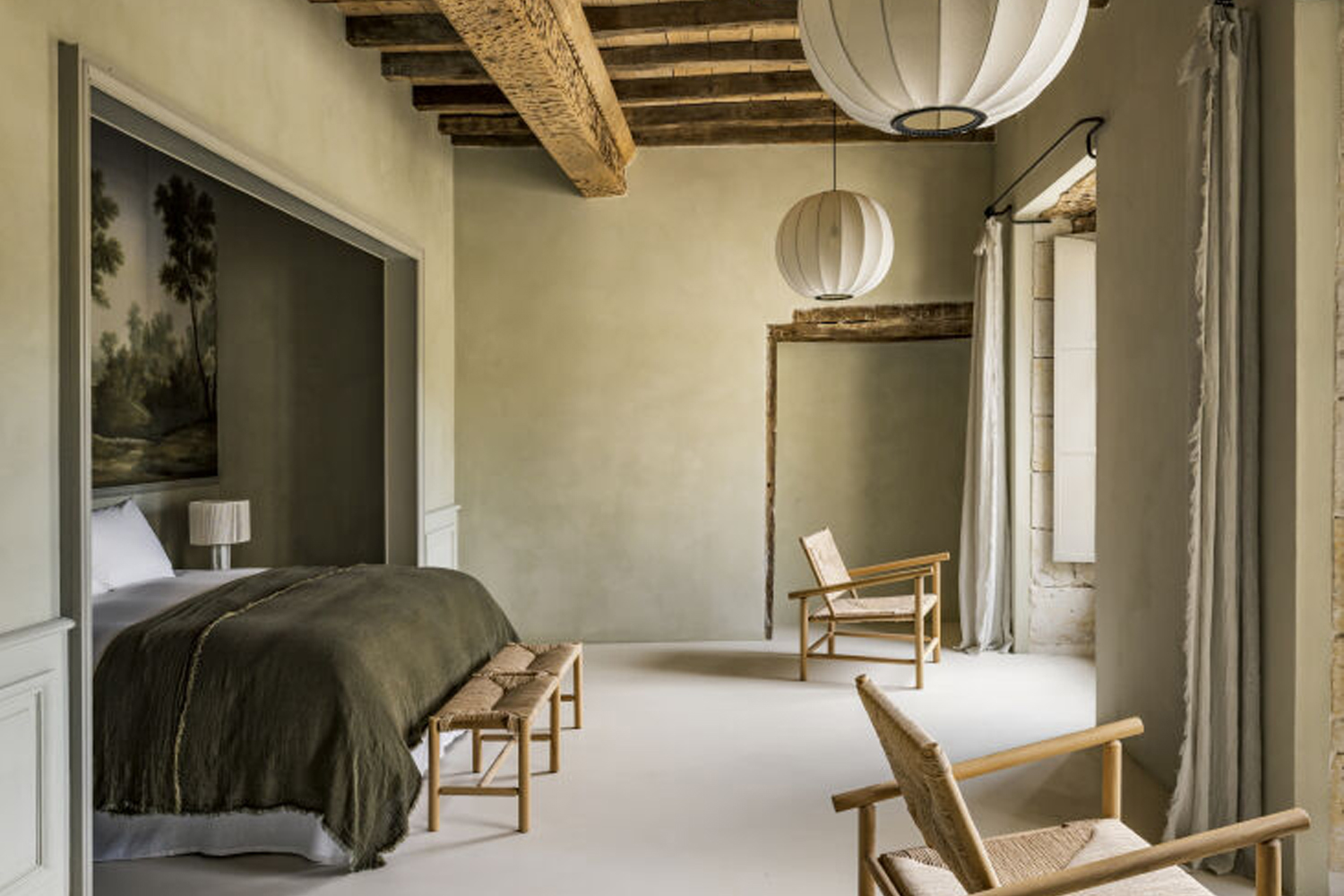
Some hotel bedrooms shout with glossy marble and enough brass to make a trumpet section nervous. The “Jardin” suite at Manufacture Royale de Lectoure in southwestern France takes the opposite route: hemp-colored limewash, a shadowy bed alcove, linen curtains, woven lighting, weathered wood, straw seating, and a landscape mural that seems to extend the garden indoors.
The room feels historic without becoming a museum and luxurious without looking freshly unwrapped. Its ideas translate easily to an American primary or guest bedroom. Here is how to recreate the look with thoughtful color, tactile materials, practical substitutions, and a little Southern France hotel magic.
Why This Southern France Garden Suite Works
Manufacture Royale de Lectoure occupies an 18th-century royal tannery in the historic town of Lectoure. Owners Christèle Ageorges and Hubert Derlance restored the long-abandoned property with architect François Muracciole and local craftspeople, then opened it to guests in 2022. The ground-floor Jardin suite connects directly to the garden and includes an entrance, a compact work area, a bedroom, a bathroom, and a dressing room.
Its appeal is not based on a single expensive object. Mineral walls echo local stone, linen and yarn soften the architecture, and straw and distressed wood introduce rural texture. A darker bed recess creates intimacy while the restrained palette lets the garden remain the star. The first lesson to steal: do not decorate by collecting random brown things. Build one atmosphere through color, light, texture, and proportion.
Build a Sun-Washed Earth-Tone Color Palette
A successful earth-tone bedroom should resemble a landscape faded by sun, not a bowl of mushroom soup. Begin with warm limestone, putty, oat, mushroom, or soft hemp. Add one botanical midtoneolive, sage, or lichenand one warmer accent such as clay, tobacco, rust, or muted bronze.
Use a Simple 60-30-10 Balance
Keep about 60 percent of the room in the lightest neutral, use 30 percent for wood, woven pieces, and midtone fabrics, and reserve 10 percent for bronze, rust, dark ceramic, or mural details.
Match Undertones in Real Light
Warm limestone can look uneasy beside a cold gray rug. Test samples in morning, afternoon, and lamplight. North-facing rooms often need warmer pigments; bright south-facing rooms can handle slightly grayer shades.
Choose Limewash or a Convincing Textured Alternative
The Jardin suite uses nuanced limewash colors developed to reflect the greens, pinks, terracottas, and stone shades of the surrounding landscape. Limewash creates subtle movement because its mineral pigments absorb and reflect light unevenly. The finish can make a new wall feel softened by time, which is extremely useful when your house was built during the age of builder-grade eggshell.
True limewash performs best on compatible porous surfaces or over an approved mineral primer. Follow the product directions, apply broad overlapping strokes, and accept variation; the goal is a cloudy, hand-worked finish. Renters can approximate it with a matte color wash, plaster-look coating, or removable textured wallpaper. Glossy beige will not become Provençal merely because a ceramic jug is nearby.
Create a Darker Bed Alcove Without Remodeling
One of the suite’s strongest moves is its darker sleeping recess, which separates rest from the brighter sitting and garden areas. You can reproduce the effect without an architectural niche.
Paint behind the bed one or two values deeper than the surrounding walls and wrap the color 18 to 36 inches onto the ceiling. You can also frame the bed with shallow wardrobes, curtains, or simple wood trim. In a small room, carry one muted olive or clay tone across the entire headboard wall and ceiling for a convincing cocoon.
Add a Landscape Mural as the Main Artwork
The original alcove uses panoramic country landscape wallpaper. Look for sepia trees, hazy hills, pastoral sketches, or low-contrast botanical scenes. Avoid hyper-saturated tropical leaves unless your Southern France fantasy includes a surprise layover in Miami.
For a lower-cost approach, paper only the bed width and finish the edges with narrow molding. An enlarged public-domain landscape or oversized tapestry can work too. Keep the remaining wall décor minimal.
Select Furniture with Provençal Ease
The suite’s Provençal chairs and bench combine natural straw with warm wood. To capture that mood, search for rush-seat chairs, woven benches, cane side chairs, turned-wood stools, and vintage pieces with honest patina.
Avoid a matching bedroom set. Let the bed, nightstands, bench, and chair share a material language without arriving from the same carton. Pair pale oak with a darker antique table or a crisp metal side table; one modern interruption keeps “French country” from drifting into costume territory.
Use an End-of-Bed Bench Wisely
A bench adds seating and finishes the bed’s silhouette. Choose one slightly narrower than the mattress and low enough not to hide the bedding. In a tight guest room, an open luggage bench is more useful than a pillow-collecting ottoman.
Layer Natural Lighting Instead of Using One Bright Fixture
The Jardin suite combines woven pendant lights with a handmade ceramic table lamp. This mixture produces ambient glow, task lighting, and sculptural interest. At home, aim for at least three sources: a ceiling fixture or pendant, bedside reading lights, and a small lamp near a chair or dresser.
Choose shades made from yarn, linen, paper, rattan, or finely woven cane. Their texture remains visible when the lights are off and softens the beam when they are on. Use warm-white bulbs, preferably dimmable. A bedroom should glow like late afternoon, not resemble the dairy aisle at midnight.
Bedside pendants free small nightstands and make an ordinary room feel custom. Center each over the usable table surface and hang it high enough for reading without creating a hazard during sheet changing.
Dress the Bed in Relaxed Linen Layers
The bed should look inviting, tactile, and slightly undone. Start with breathable cotton or linen sheets in ivory, flax, or warm white. Add a duvet in oatmeal, pale stone, dusty olive, or soft clay. Finish with a fringed blanket or lightweight wool throw in bronze, tobacco, or rust.
Texture matters more than a parade of pillows. Two sleeping pillows, two shams, and one lumbar cushion are usually enough. Mix slubby linen, washed cotton, waffle weave, and wool. Keep patterns quiet unless the room lacks a mural.
For hotel polish, use a generously sized duvet, steam the pillowcases, and drape the top blanket across the lower third of the bed. “Casually” still requires intention; a throw launched from the doorway rarely lands with editorial grace.
Frame the Garden with Linen Curtains
Fringed linen curtains contribute movement, softness, and filtered daylight in the original suite. For a similar effect, hang curtain rods close to the ceiling and extend them beyond the window frame. This makes the opening appear taller and wider while allowing the panels to clear more of the glass.
Choose natural flax, warm white, greige, or muted olive. Unlined linen provides a breezy daytime effect, but bedrooms often need privacy and darkness. Pair decorative linen panels with discreet blackout shades, or select lined linen-blend curtains. The layered solution preserves the relaxed look without asking you to wake at sunrise every summer morning like an extremely stylish farmer.
Bring the Garden Inside Without Creating a Greenhouse
The room’s garden connection is architectural, visual, and material. You can strengthen that relationship by repeating outdoor colors indoors, keeping the window area uncluttered, and placing one or two plants where they receive appropriate light. An olive tree, rosemary pot, trailing pothos, or sculptural branch can be enough.
Add handmade ceramics, a stone tray, botanical books, or a bowl for garden clippings. Irregular glazes suggest human hands without requiring twelve tiny accessories arranged with military precision. Keep a clear route from bed to window or patio door, and position a chair toward the view rather than the television.
Recreate the Look at Three Budget Levels
Quick Refresh: Under $500
Paint the headboard wall muted olive or warm putty, add warm dimmable bulbs and linen-look curtains, then layer a clay throw over neutral bedding. Find a rush-seat chair or wood bench secondhand.
Full Update: $1,500 to $4,000
Use limewash, add a mural, upgrade the bedding and rug, separate the nightstands, and install woven pendants. Spend on tactile pieces used daily; save on accessories.
Renovation-Level Interpretation
Build a shallow bed niche, integrate wardrobes, improve garden access, and use real plaster, oak, stone, and custom curtains. Preserve original floors, beams, and masonryauthentic age is expensive to imitate.
Common Mistakes That Flatten the Look
- Using one shade everywhere: Earth-toned does not mean monochrome brown. Mix pale stone, botanical green, wood, and a warm accent.
- Ignoring texture: Without linen, woven fibers, ceramics, and visible grain, neutral rooms can feel unfinished rather than serene.
- Overdecorating: Give statement elements space. A mural, woven pendant, and sculptural chair do not need fifteen supporting actors.
- Choosing harsh lighting: Cool bulbs erase warmth and exaggerate gray undertones.
- Buying faux-rustic everything: Combine old and new. Too many distressed finishes can make a bedroom resemble a themed restaurant.
- Forgetting function: Provide reading light, concealed charging, useful surfaces, window privacy, and somewhere to place luggage.
A Practical Steal-This-Look Checklist
Prioritize a mineral wall finish, a darker sleeping zone, one landscape focal point, layered linen bedding, woven seating, warm wood, a bedside bench, soft pendant lighting, full-length curtains, imperfect ceramics, and an open sightline to the best window.
The Experience: Living in an Earth-Toned Garden Suite Bedroom
The real achievement of this look is not that it photographs well, although it certainly knows what to do when a camera enters the room. Its success is experiential. Imagine waking in a darker bed alcove while the rest of the room gradually brightens. The mural is still shadowy, the linen is rumpled, and the first daylight catches the uneven limewash instead of bouncing sharply from a flat white wall. The bedroom does not demand immediate activity. It gives the morning somewhere to arrive.
You open the curtains and the palette outside makes sense of the palette inside. Garden greens answer the olive and lichen notes on the walls. Terracotta pots repeat the warmer blanket. Pale stone or concrete reflects the soft neutrals. Because the room is not competing with the landscape, even a small yard appears more generous. A suburban maple, balcony herb box, or patch of ornamental grass can provide the same visual conversation; the view does not need to include the Pyrenees to earn its moment.
During the day, the room feels cooler and airier than its brown-and-beige description might suggest. Linen curtains move with a breeze, woven shades create delicate shadows, and pale wood prevents the deeper colors from becoming heavy. A chair near the window becomes a genuine place to sit because it faces something worth noticing. You may drink coffee there, read ten pages, or simply watch light travel across the floor. This is how hotel design changes behavior: it makes an ordinary pause feel officially scheduled.
By evening, the atmosphere shifts. The mural recedes, the handwoven pendant glows, and the ceramic lamp creates a smaller pool of light near the bed. Natural textures become more noticeable when color becomes less dominant. Linen looks softer, wood grain grows richer, and the fringed throw earns its keep. With overhead brightness reduced, the room feels enclosed without being cramped. The darker sleeping zone signals that the public portion of the day is over.
Guests tend to experience this kind of room as both special and easy. Nothing is too precious to touch, and the luxury comes from comfort, proportion, and sensory detail rather than sparkle. A useful bench receives a suitcase. A small table holds water and a book. Curtains provide privacy. Reading lights point where they should. The room appears relaxed because its practical problems were solved before the decorative layer was added.
At home, that may be the most valuable lesson from a Southern France garden suite. A beautiful bedroom is not a stage set. It should improve the first and last minutes of the day. Earth tones slow the visual tempo; natural materials reward touch; layered lighting supports changing routines; and a strong garden connection reminds you that the world continues beyond the glowing rectangle in your hand. Steal the colors, certainly. Steal the mural, the linen, and the woven chair too. But above all, steal the room’s permission to be quiet.
Conclusion
An earth-toned garden suite bedroom works when its elements feel related rather than matched. Begin with a mineral base, deepen the bed area, add a landscape focal point, and layer linen, straw, wood, ceramic, and warm light. Keep furniture useful, decoration selective, and the best view open.
You do not need an 18th-century tannery or a passport to France. You need a coherent palette, tactile materials, thoughtful lighting, and enough restraint to let each detail matter. Add one woven chair, make the bed, dim the lights, and practice saying “garden suite” with confidence.