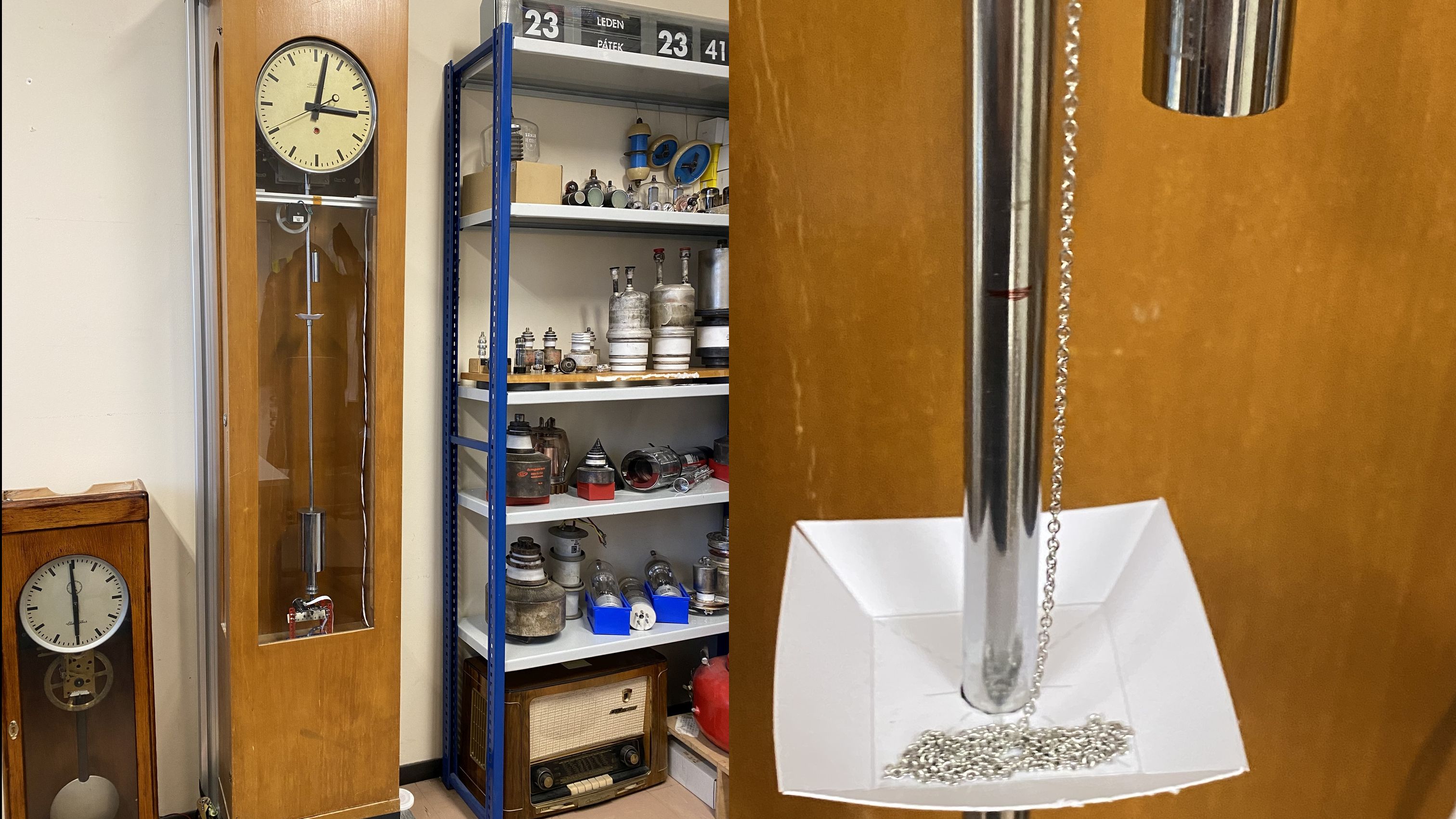
Most pendulum clocks are charming in the same way an old dog is charming: loyal, dignified, and occasionally wrong about the exact time. But at CERN, where timing errors can matter at the scale of particle beams, radiofrequency systems, antimatter spectroscopy, and scientific measurements that make ordinary stopwatches look like potato technology, one restored pendulum clock became something far more unusual.
This is the story of an atomic pendulum clock accurate enough for CERN: a mid-century Elektročas HH3 master clock restored, measured, and disciplined against a laboratory-grade frequency reference. It is part mechanical romance, part precision engineering, and part “because it would be funny if it worked.” Spoiler: it worked well enough to make clock nerds grin and engineers nod with dangerous approval.
The phrase “atomic pendulum clock” sounds like something from a steampunk physics lab, but the idea is real. The clock is not atomic because atoms swing from the pendulum like tiny gymnasts. It is atomic because its pendulum is controlled using a reference ultimately tied to atomic time. A beautiful old mechanical oscillator is guided by the kind of timing infrastructure used in serious laboratories. In other words, it is a grandfather clock that went to graduate school.
What Makes This Clock So Special?
The star of the project is an Elektročas HH3, a Czechoslovakian master clock produced in the 1950s. These clocks were not decorative living-room furniture. They were built to serve institutions that needed coordinated time: laboratories, observatories, radio and television facilities, power plants, and other places where “close enough” was not always close enough.
The HH3 uses an invar pendulum. Invar is a nickel-iron alloy famous for its low thermal expansion. That matters because the period of a pendulum depends heavily on its effective length. When a pendulum rod expands in warm weather, the clock slows down; when it contracts in cold weather, the clock speeds up. This is why old mechanical clocks sometimes behave like they have seasonal opinions.
By using invar, the HH3 reduces temperature-related changes in pendulum length. Even so, the original clock was not ready to compete with an atomic fountain clock. Its expected free-running accuracy was roughly in the range of tenths of a second per day. That is excellent for a mechanical clock, but CERN does not operate on “excellent for something with gears” standards.
At CERN, timing is not just about knowing when lunch starts. The Large Hadron Collider is a 27-kilometer ring where particle beams travel at nearly the speed of light. Accelerator components, detectors, radiofrequency systems, trigger networks, and experiments need coordination at extreme precision. CERN’s White Rabbit timing technology, for example, provides sub-nanosecond accuracy and picosecond-level precision for large distributed systems. Compared with that, your kitchen clock is basically a sundial with batteries.
The Atomic Side: Caesium, Hydrogen Masers, and the SI Second
To understand the “atomic” part, we need to visit the world of caesium fountain clocks. The official SI second is defined by the frequency of a transition in caesium-133 atoms: exactly 9,192,631,770 oscillations. Atomic clocks measure these transitions, using atoms as incredibly stable references. Unlike a pendulum, an atom does not care if the office is chilly, if someone slammed a door, or if the clock cabinet once suffered the indignity of having a flowerpot placed on it.
Modern caesium fountain clocks cool caesium atoms with lasers, toss them upward through a microwave cavity, and measure them as they rise and fall. The longer observation time improves frequency accuracy. It is a strange and elegant setup: atoms launched like a microscopic fountain, gravity doing its job, lasers doing their laser thing, and scientists pretending this is all perfectly normal.
At CERN’s ALPHA experiment, a caesium fountain clock helps support ultra-precise measurements of antihydrogen, the antimatter counterpart of hydrogen. ALPHA studies whether hydrogen and antihydrogen behave identically, an important test related to matter-antimatter symmetry. To compare their spectral properties at very high precision, researchers need an extremely reliable frequency reference.
In practical laboratory timing systems, caesium fountain clocks are often used to discipline or calibrate other highly stable oscillators, such as hydrogen masers. Hydrogen masers are prized for excellent short-term stability, while caesium fountains provide an accurate realization of the second over longer timescales. In the HH3 project, the pendulum clock was measured against a 10 MHz reference associated with this kind of high-end timing chain.
How Do You Discipline a Pendulum?
A pendulum clock is an oscillator. It swings, repeats, and gives the rest of the clock something to count. To improve its timekeeping, you can either adjust the displayed time periodically or adjust the rate at which the oscillator runs. The CERN HH3 project chose the more elegant route: control the pendulum’s frequency using a feedback loop.
The basic pendulum period depends on length and local gravity. Changing gravity is possible in theory, but moving the whole clock up and down several floors to tune it is not exactly convenient. It would also make office visits awkward. “Where is the clock?” “Currently between floors three and four, optimizing its gravitational environment.” Charming, but not ideal.
Changing temperature was also unattractive because the pendulum was made from invar specifically to resist thermal expansion. Heating and cooling the clock aggressively would be inefficient, possibly damaging, and emotionally confusing for a vintage timepiece.
So the project adjusted the pendulum’s effective length by shifting its center of gravity. The solution was delightfully mechanical: a fine chain could be moved into or out of a small container attached near the pendulum rod. Adding or removing chain changes the mass distribution, which changes the pendulum’s effective length, which changes the swing period. It is a little like tuning a violin, except the violin weighs a lot more and may judge you in Czech.
The Chain Controlled Oscillator: A Brilliantly Weird Idea
Electronic control systems often use a voltage controlled oscillator, or VCO. In this project, the pendulum had no convenient voltage input. You cannot simply plug a BNC cable into a 1950s master clock and ask it politely to phase lock.
Instead, the project created what was jokingly called a Chain Controlled Oscillator, or CCO. A stepper motor controlled the chain position. A sensor measured the pendulum period. A counter compared the pendulum swings against the 10 MHz reference. A microcontroller processed the measurement and adjusted the chain. The result was a mechanical phase locked loop, a PLL, wrapped around a vintage pendulum clock.
This is the kind of engineering that makes perfect sense once explained and sounds completely unhinged before that. The system measures whether the pendulum is running fast or slow, then nudges the chain position to bring the period back toward the reference. The pendulum remains the visible, physical oscillator, but its frequency is disciplined by atomic-grade timing.
The tuning range was on the order of seconds per day, enough to correct the clock’s natural drift. In free-running mode, even a very good pendulum will respond to tiny changes in temperature, pressure, support stability, amplitude, and environment. Locked to the reference, the system can correct those slow deviations. The clock becomes less like a lone musician and more like an orchestra member wearing headphones and following the conductor.
Is It Really Accurate to One Second in 158 Million Years?
The famous claim around the project is that the clock could be good to one second in 158 million years. That number is best understood carefully. The HH3 itself is not magically transformed into an independent atomic clock. If unplugged from its reference and left alone for geological time, it would not patiently outlast dinosaurs, mountain ranges, and probably several unfortunate software updates.
The impressive claim comes from disciplining the pendulum against a reference tied to a caesium fountain and hydrogen maser system. The pendulum’s frequency can be locked to an extremely accurate timebase. In that sense, the clock becomes a mechanical display and oscillator controlled by atomic time.
This distinction is important for readers, makers, and anyone tempted to list “atomic pendulum clock” on an online auction with twelve exclamation marks. The clock is extraordinary because it merges historical mechanical engineering with modern frequency metrology. It is not extraordinary because pendulums suddenly beat atoms at being atoms.
Why CERN Is the Perfect Place for This Kind of Madness
CERN is a place where timing is part of the machinery of discovery. Particle accelerators depend on synchronization. Detector systems depend on timestamps. Antimatter spectroscopy depends on stable frequency references. Distributed controls depend on timing networks. When experiments operate across large distances and tiny time windows, a nanosecond is not small; it is a unit with consequences.
That is why CERN developed and uses advanced timing systems such as White Rabbit. White Rabbit combines networking and precision timing, allowing large systems to transmit data while synchronizing devices with sub-nanosecond accuracy. In accelerator environments, where components may need coordination down to tens of picoseconds, that capability matters.
The atomic pendulum clock sits in a different category. It is not controlling the LHC. It is not replacing CERN’s timing infrastructure. It is a demonstration, a personal engineering project, and a joyful proof that old mechanical systems can still participate in modern precision culture when paired with the right reference and feedback system.
That makes it powerful as a story. It translates abstract timing science into something people can see: a pendulum swinging in a cabinet, corrected by invisible atomic regularity. Instead of explaining frequency metrology through equations alone, the clock lets the concept tick in public.
The Physics Behind the Charm
Pendulum Length
A pendulum’s period is closely related to the square root of its length. Make the pendulum effectively longer and it swings more slowly. Make it shorter and it swings faster. Precision clockmakers have used this fact for centuries, adjusting pendulum bobs with screws or small weights.
Temperature
Temperature changes can alter the pendulum length. Invar reduces this problem, which is why it became important in precision clocks and scientific instruments. But “reduced” does not mean “removed from the universe.” Even tiny changes matter when chasing fractions of a second per day.
Air Pressure
Air pressure affects pendulum clocks through buoyancy and drag. The pendulum bob moves through air, and changes in air density can subtly change its behavior. In ultra-precise mechanical timekeeping, even the atmosphere gets a vote. It is annoying, but at least the atmosphere is consistent in its desire to be included.
Support Stability
A pendulum clock also depends on a stable frame. If the support shifts, vibrates, tilts, or resonates, the pendulum responds. The HH3 project used robust mechanical support because a precision clock sitting on a wobbly base is like a concert pianist performing on a trampoline.
Why This Project Matters Beyond Clock Collecting
The atomic pendulum clock is more than a clever office conversation piece. It shows how feedback can upgrade an old oscillator without destroying its character. The original mechanism remains visually and mechanically alive, while modern electronics quietly supervise its behavior.
This is a useful idea across engineering. Many systems do not need to be replaced; they need to be measured, modeled, and controlled. A vintage clock can be disciplined by atomic time. A noisy sensor can be improved with calibration. A mechanical system can be stabilized with feedback. Precision often comes not from brute force but from listening carefully to what a system is already doing.
It also reminds us that technology is not a straight line where new things erase old things. Sometimes the best project is a handshake across eras: invar, gears, optical sensors, counters, microcontrollers, hydrogen masers, and caesium atoms all cooperating so a pendulum can swing with absurd dignity.
Practical Lessons for Makers and Engineers
First, measure before modifying. The HH3 project did not begin by attacking the clock with random motors. The free-running stability was studied. Environmental effects were considered. The tuning range was characterized. Good engineering starts with observation, not enthusiasm armed with a drill.
Second, respect the original machine. The goal was not to gut the vintage clock and hide a digital clock inside. That would be like replacing a grand piano with a Bluetooth speaker and calling it restoration. The project preserved the mechanical soul while adding reversible, external control.
Third, choose a control method that matches the system. A pendulum is slow. Its errors develop over many swings. The correction system does not need to panic. It needs patience, stability, and a good reference. The chain actuator is simple, analog-like, and mechanically compatible with the clock’s nature.
Finally, humor helps. Precision work can be serious without being joyless. The project’s charm comes partly from its playful engineering language: Chain Controlled Oscillator, pub-born ideas, and the image of moving a clock between floors to adjust gravity. That humor makes advanced metrology easier to understand.
Experience Notes: Living With an Atomic Pendulum Clock Mindset
Working around a project like an atomic pendulum clock changes the way you think about time. Most people treat time as a number on a screen. It arrives from a phone, a laptop, a microwave, or the dashboard of a car that is somehow always seven minutes wrong. But when you watch a pendulum being measured against an atomic reference, time stops feeling like a simple display and starts feeling like a negotiated agreement between physics, engineering, and patience.
One practical experience is that precision quickly teaches humility. At ordinary scale, a clock that gains one second per day seems excellent. At laboratory scale, that same second is a loud confession. You begin to notice how many invisible forces are constantly leaning on the result: temperature, air pressure, vibration, aging components, sensor noise, mounting stiffness, and even the building itself. Precision is not about finding one big villain. It is about discovering a committee of tiny troublemakers.
Another experience is the satisfaction of using feedback correctly. A feedback loop feels almost alive when it works. The system senses a deviation, responds gently, overshoots less with tuning, and settles into stability. In the HH3-style approach, the pendulum is not bullied into obedience. It is guided. The chain moves by small amounts, the period shifts, and the clock slowly returns toward the reference. It is engineering with a light touch.
There is also a surprisingly emotional side to preserving old technology. A restored master clock carries the design values of its era: durable materials, readable mechanisms, serviceable parts, and a belief that important machines should look important. Adding modern control without erasing that heritage feels deeply satisfying. You get the best of both worlds: the visible poetry of mechanical timekeeping and the invisible authority of atomic frequency standards.
For makers, this project offers a useful lesson: do not underestimate old hardware. A pendulum clock may look obsolete beside a GPS-disciplined oscillator or a chip-scale atomic clock, but it remains a superb physical oscillator when treated carefully. Its limitations are not failures; they are invitations to measure, understand, and improve.
For writers and educators, the atomic pendulum clock is a gift. It explains abstract ideas through something familiar. People may not immediately understand fractional frequency stability, Allan deviation, maser discipline, or caesium hyperfine transitions. But they understand a pendulum. They understand fast and slow. They understand a chain adding weight. From there, the article can guide them toward the deeper science without making them feel like they accidentally walked into a graduate seminar wearing flip-flops.
The biggest experience-based takeaway is this: accuracy is not magic. It is a relationship between a reference, a measurement, a correction method, and a system stable enough to be corrected. That idea applies far beyond clocks. It applies to laboratories, software, manufacturing, navigation, finance, and even personal habits. If you can measure honestly, compare against a good standard, and make small corrections over time, you can improve almost anything. Even a 1950s pendulum clock at CERN.
Conclusion
An atomic pendulum clock accurate enough for CERN is not just a quirky headline. It is a beautiful example of what happens when mechanical history meets modern metrology. The Elektročas HH3 began life as a serious master clock, already impressive for its era. By restoring it, measuring it, and disciplining its pendulum through a clever chain-based feedback system tied to atomic-grade timing, the project turned a vintage machine into a living demonstration of precision control.
The real wonder is not that a pendulum became an atomic clock in the strictest sense. It did not. The wonder is that a pendulum could be guided by atomic time so elegantly that it became a bridge between centuries of clockmaking and the timing demands of modern physics. It is part science, part craft, part joke, and part engineering lesson. And like the best machines, it makes you want to look closer, listen to the tick, and ask one dangerous question: what else could we make better with a little measurement and a lot of imagination?