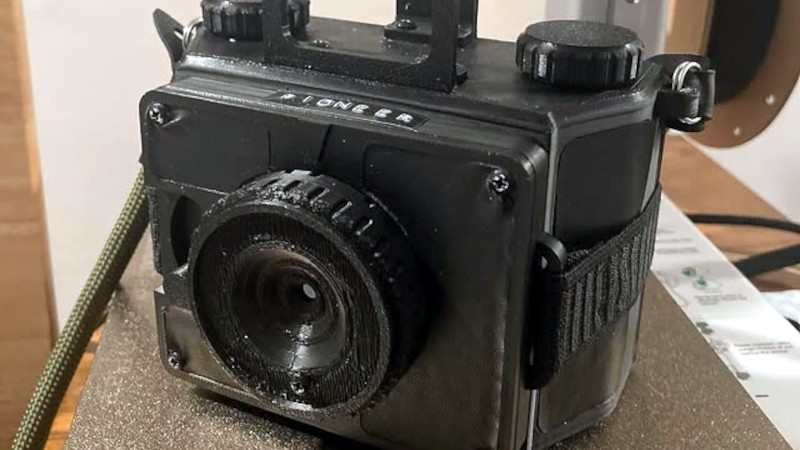
For years, the phrase 3D printed camera sounded a little like a dare from the internet: “Sure, you can print the body… but can it actually work?” Plenty of makers proved you could print a shell, a pinhole box, or an accessory. But a camera with real mechanical guts, the kind that handles film, controls light, and includes a printed shutter instead of borrowing one from some retired donor camera? That was the juicy part of the dream.
Now that dream has wandered out of the prototype cave and into the download folder. A fully printable film camera, shutter included, is no longer just a heroic one-off project sitting on a workbench beside a mug of cold coffee and a small mountain of failed test parts. It is something people can actually download, print, assemble, and use. And that makes this moment far bigger than one cool gadget. It turns a camera from a sealed product into a shared design language.
That is why this story matters. It is not just about a quirky DIY camera. It is about what happens when photography, open design, analog craft, and desktop manufacturing all collide in the same beautiful, slightly unreasonable object.
Why This Downloadable 3D Printed Camera Is Such a Big Deal
The headline-grabbing detail is obvious: this camera is printable, functional, and remarkably complete. Not “complete” in the marketing sense where a company says “some assembly required” and then hands you enough screws to start a small hardware store. Complete in the genuinely impressive sense that the camera’s shutter is part of the design story, not an outsourced miracle tucked inside the lens or stolen from another machine.
That last bit changes everything. A shutter is where camera romance crashes into camera engineering. It has to move consistently, control exposure, and behave like a disciplined little gatekeeper for light. In camera history, shutters have always been one of the fiddliest, most timing-sensitive parts. Printing one that can actually function is the kind of achievement that makes makers grin and photographers squint suspiciously, which is honestly the healthiest possible reaction.
The camera at the center of this moment is exciting because it treats 3D printing as a way to build a camera system, not just a camera-shaped object. It embraces the idea that the body, film path, shutter mechanism, and user experience all belong in the same conversation. That is what separates serious maker photography from novelty printing. Anyone can print a decorative camera. Printing one that can expose film on purpose is another level of ambition entirely.
From Prototype Flex to Real-World Download
One of the most interesting parts of this story is that the camera did not appear fully formed like some sort of plastic photography deity. It evolved. Earlier coverage of the project focused on the achievement of designing and printing a working film camera from scratch. Later coverage shifted the story from “look what this person built” to “look what the community can now build too.” That move from personal invention to public download is the real milestone.
In practical terms, downloadable hardware changes the audience. A one-off custom camera is inspiring. A camera other people can print is influential. It invites experimentation, remixing, troubleshooting, upgrades, and all the glorious chaos that follows when creative people get access to files and start asking dangerous questions like, “What if I change the lens mount?” or “What if I make a panoramic version?”
That is how niche design becomes a living ecosystem. The camera stops being a static object and becomes a platform. The shutter is no longer just a clever trick. It becomes a proof of concept for what home fabrication can do when it grows up a little and starts wearing safety glasses.
The Lineage: This Camera Didn’t Come Out of Nowhere
As thrilling as this release is, it did not emerge from a vacuum. The world of printable photography has been quietly building toward this for years. Earlier open projects like the OpenReflex showed that makers could create a fully operational analog SLR with a mechanical shutter and mirror viewfinder. Other builds pushed hard on modularity, designing camera bodies so parts could be swapped, improved, or reprinted without rebuilding everything from scratch. Printable pinhole cameras made the entry point even friendlier, proving that film, light, and additive manufacturing could get along better than many people expected.
That history matters because innovation in camera design is rarely one giant leap. It is more like a relay race with tiny pieces of ABS and PLA. One project proves a printable body can work. Another proves a mirror box can behave. Another makes film transport less annoying. Another makes printing faster by avoiding support-heavy geometries. Another explores movie-camera mechanics. Over time, all those lessons pile up into something that feels sudden from the outside but is really the result of years of maker persistence.
So yes, this downloadable camera feels fresh. But it also feels earned. It stands on a decade-plus trail of experiments, hacks, printable pinhole designs, modular film bodies, and open-source camera nerdiness. In other words, this thing has ancestors, and they are gloriously weird.
What Makes a 3D Printed Film Camera Harder Than It Looks
A camera is a cruelly honest machine. If your geometry is off, the image tells on you. If your film plane is slightly wrong, the frame tells on you. If your body leaks light, the film absolutely tells on you, usually in streaky, dramatic, emotionally devastating ways. That is why building a workable 3D printed camera involves more than printing parts and channeling confidence.
Light Control Is Ruthless
The first challenge is keeping stray light out while letting the correct light in. That sounds basic, but it is the entire sport. Printed parts can have seams, texture, and tolerance issues that are harmless in a desk organizer and catastrophic in a camera. Even a tiny leak can turn a lovely photo into a ghostly mess.
Mechanical Timing Is Unforgiving
The shutter has to behave consistently enough to make exposures predictable. That is difficult in any medium. It becomes even more impressive when the mechanism is being created through a process that naturally involves layer lines, material quirks, and fitment adjustments.
Film Handling Is Its Own Drama
Film must advance properly, stay flat enough at the image plane, and remain aligned with the lens. Miss any of those details and you get blur, overlap, spacing problems, or frames that look like they were photographed during a mild earthquake.
Printing Is Manufacturing, Not Magic
This is the part many beginners discover around hour six, right after a print fails at 93 percent. Desktop 3D printing is powerful, but it still demands tuning, iteration, patience, and occasional muttering. That is part of the charm. It is also part of the warning label.
Why Analog Photography Makes This Story Even Better
If this were just a downloadable digital camera shell, it would still be neat. But film changes the emotional temperature of the whole project. Analog photography adds friction, ritual, and consequence. You load the roll. You commit to limited frames. You wait. You hope. You find out later whether your genius idea was genius or merely ambitious nonsense.
That slower process is exactly why so many people are circling back to film right now. In a world of computational photography, AI enhancement, and instant previews, film feels stubbornly human. It records not just the scene, but the imperfections of the device and the choices of the person using it. A 3D printed film camera doubles down on that idea. It is imperfect by nature, handcrafted by process, and proudly mechanical in an age that increasingly hides the machinery.
There is also something wonderfully poetic about using cutting-edge fabrication to make an old-school camera. The result is not anti-technology. It is post-convenience. It says maybe progress is not just about making everything frictionless. Maybe progress can also mean giving people new tools to engage more deeply with old crafts.
Who This Camera Is Really For
Not everyone needs a downloadable 3D printed camera. Some people want a camera that works right now, with no sanding, no fiddling, and no mysterious leftover screws. Those people are valid, rested, and probably much less stressed.
But this camera is perfect for a specific crowd:
Makers Who Love Functional Objects
If you get emotional about tolerances, modular parts, and clever mechanisms, this is catnip.
Photographers Who Miss Mechanical Personality
If modern cameras feel a little too polished and a little too perfect, a printable film camera offers a more hands-on relationship with the act of picture-making.
Students and Educators
This kind of project is a classroom disguised as a gadget. It teaches optics, mechanics, fabrication, iteration, troubleshooting, and visual storytelling in one handsome little package.
Tinkerers Who Enjoy Improving Things
The beauty of downloadable camera files is that the first successful version does not have to be the last. A printable camera invites community intelligence. One person tweaks the shutter feel. Another improves the film advance. Another redesigns a lens mount. Progress becomes collaborative.
What This Means for the Future of Camera Design
The bigger story is not that everyone will suddenly start printing their own cameras at home between dinner and bedtime. The bigger story is that camera design is becoming more accessible as a creative practice. The same way open-source software changed who could build digital tools, downloadable hardware lowers the barrier to building physical photographic tools.
That does not mean factory-made cameras are doomed. Not even close. Precision manufacturing still matters, especially when tolerances become microscopic and reliability has to be boringly excellent. But projects like this expand the ecosystem. They create room for custom cameras, educational builds, niche formats, experimental shutters, specialty film paths, and one-off designs that would never survive a boardroom meeting.
In a healthy photography culture, both things can be true: mass-produced cameras can remain wonderful, and weird downloadable cameras can flourish on the side like ambitious little rebels. Honestly, that sounds ideal.
Why the Moment Feels So Timely
This camera arrives at exactly the right cultural moment. 3D printing is mature enough to be useful but still scrappy enough to be fun. Film photography has regained its cool without losing its nerd credentials. Makers are more comfortable moving between digital tools and analog outcomes. And the appetite for owning something unusual, tactile, and personal is stronger than ever.
A downloadable 3D printed camera, shutter and all, feels like the perfect symbol of that overlap. It is retro without being nostalgic mush. It is modern without being sterile. It is technical, creative, impractical in the best way, and absolutely irresistible to anyone who has ever looked at a camera and thought, “I wonder if I could build one myself.”
The answer, increasingly, is yes. You probably can. You may also ruin a print, curse a tolerance, discover a light leak, and spend an evening explaining to a confused friend why a magnetic shutter is exciting. But that is part of the deal. The point is not just the finished camera. The point is that the design is now shareable, printable, and alive.
That is a big leap for DIY photography. And for once, “downloadable camera” is not science fiction. It is just delightfully real.
Experiences Related to “A 3D Printed Camera You Can Now Download, Shutter And All”
The most memorable part of a project like this is not the first finished photo. It is the long, funny chain of tiny victories and tiny disasters that comes before it. Downloading the files feels almost suspiciously easy. You click once, maybe twice, and suddenly you are staring at a folder full of parts that represent a working camera. At that point the brain does a dangerous thing: it assumes the hard part is over. That is adorable.
Then the printer starts. For a while, the experience is all optimism and little robot noises. Layers stack. Shapes emerge. A body panel appears. A knob appears. A mechanism that looked abstract on a screen now exists on your desk in actual physical form. This is the phase where makers become philosophers. “Wow,” they say, holding a freshly printed part. “We really can just manufacture our own nonsense now.”
Assembly is where the project gets personal. This is when you stop being a spectator and become a collaborator with the design. Printed cameras do not merely ask you to follow instructions. They ask you to notice things. Does this part slide smoothly or bind slightly? Is that seam harmless, or is it an invitation for light to sneak in and ruin your weekend? Does the shutter feel crisp, mushy, or like it is considering a union vote? Every answer teaches you something.
One of the best experiences is discovering how mechanical a camera really is. Commercial cameras often hide their complexity behind refined shells and factory precision. A printable camera puts the machine right in your hands. You feel the film path. You understand why alignment matters. You start appreciating why lens position, body rigidity, and shutter travel are not abstract engineering ideas but the difference between a usable negative and a very artistic accident.
Loading film into a camera you printed yourself is a special kind of thrill. It feels slightly rebellious, like you are getting away with something. There is a moment when you close the camera back and think, “This should not work.” And then you advance the film, hear or feel the mechanism respond, and realize that maybe, just maybe, it will.
Shooting with it is different from shooting with modern digital gear. You are slower. More attentive. Slightly more suspicious. Every frame feels expensive, not necessarily in money, but in effort. You printed the machine. You assembled the shutter. You fussed over the tolerances. Naturally, each exposure carries a tiny emotional surcharge.
And when the images come back, the experience becomes strangely intimate. You are not just evaluating composition or focus. You are reading the personality of the camera you helped bring into the world. Maybe there is a little softness at the edge. Maybe the exposure drifts in a charming way. Maybe there is a light leak you will absolutely call “character” until you fix it. Whatever shows up on the film, it feels earned.
That is the real magic of a downloadable 3D printed camera. It turns photography from button-pressing into authorship. You are not just the photographer. You are also part builder, part tester, part mechanic, and part accidental industrial designer. The result is not merely a picture. It is proof that an idea traveled all the way from file to print to mechanism to light to film. And honestly, that is cooler than most gadgets ever get.