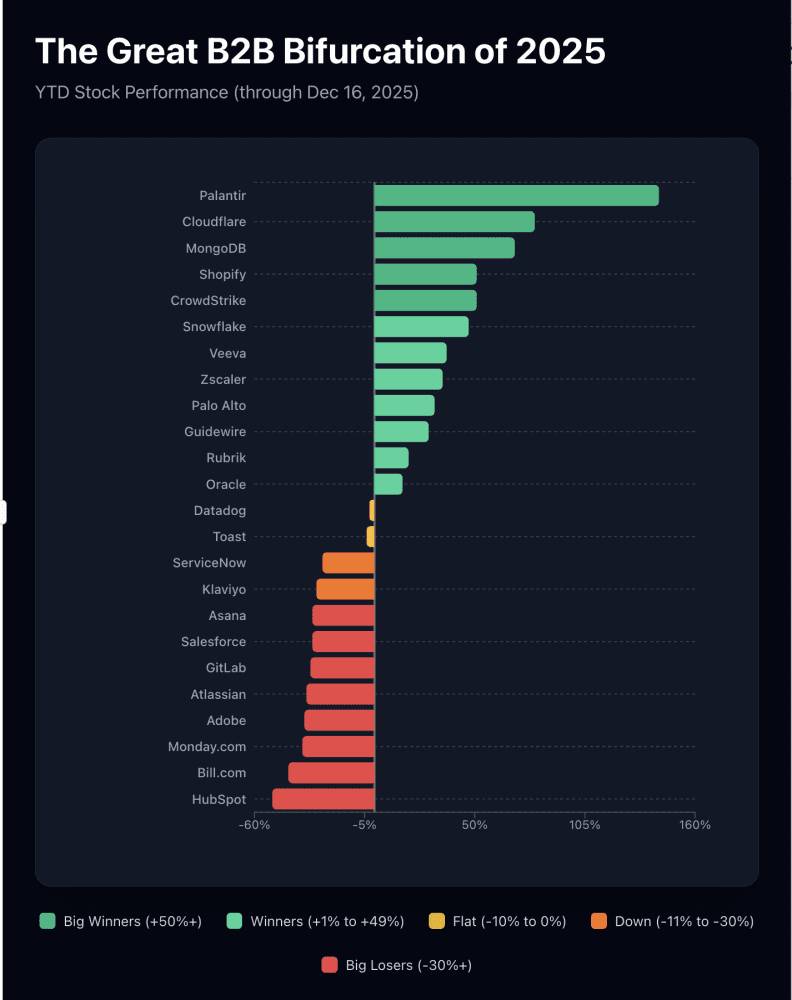
In 2025, the B2B software market stopped behaving like one big happy cloud-computing family. Instead, it divided into two dramatically different neighborhoods. In one, investors threw a block party for AI infrastructure, cybersecurity, data platforms, and specialized industry software. In the other, established SaaS companies watched their valuations slide despite reporting perfectly respectable revenue growth.
Through mid-December 2025, Palantir shares had risen approximately 142%, Cloudflare was up about 80%, and MongoDB had gained roughly 70%. Meanwhile, HubSpot had fallen about 51%, Bill.com was down 43%, monday.com had lost 36%, and companies including Adobe, Atlassian, Salesforce, and ServiceNow were also sitting deep in negative territory. This was not a mild difference of opinion. It was the financial-market equivalent of one elevator going to the penthouse while the other headed toward the parking garage.
The split became known as the Great B2B Bifurcation of 2025. More importantly, it revealed a new standard for evaluating SaaS stocks. Revenue growth alone was no longer enough. Investors wanted evidence that artificial intelligence created new demand, protected pricing power, improved customer outcomes, and strengthened a company’s competitive moat.
What Was the Great B2B Bifurcation of 2025?
For much of the previous decade, public SaaS companies were judged using a familiar recipe: recurring revenue, customer retention, expanding seat counts, and a credible path toward profitability. Faster growth generally earned a higher revenue multiple. The formula was not flawless, but it was wonderfully easy to explain on a slide.
AI disrupted that comfortable arrangement. By 2025, investors were asking a more unsettling question: Does AI make this software more valuable, or does it make the software easier to replace?
| 2025 leaders | Approximate stock performance through mid-December | Market narrative |
|---|---|---|
| Palantir | +142% | Operational AI for mission-critical government and enterprise work |
| Cloudflare | +80% | Security, edge computing, and infrastructure for AI applications |
| MongoDB | +70% | Modern data platform positioned for AI workloads |
| CrowdStrike | +51% | Cybersecurity platform benefiting from non-discretionary spending |
| Snowflake | Approximately +47% | Consumption-based data infrastructure supporting enterprise AI |
| 2025 laggards | Approximate stock performance through mid-December | Primary investor concern |
|---|---|---|
| HubSpot | -51% | SMB exposure, AI competition, and seat-based economics |
| Bill.com | -43% | Automation threatening specialized back-office workflows |
| monday.com | -36% | Work-management tools facing commoditization concerns |
| Adobe | -35% | Generative AI lowering barriers to creative production |
| Salesforce | -31% | Slower core growth and uncertainty about AI monetization |
| ServiceNow | -26% | A high valuation demanding near-perfect execution |
The precise percentages depend on the starting and ending dates used, but the broader pattern is unmistakable: the market rewarded companies viewed as essential infrastructure for the AI economy while discounting software that appeared vulnerable to automation, cheaper substitutes, or declining seat requirements.
Why the Winning SaaS Stocks Won
They Sold AI Outcomes, Not Decorative AI Features
Almost every software vendor added a chatbot, assistant, copilot, agent, sparkle button, or other AI-powered object to its product in 2025. Unfortunately, putting an AI button beside the export button did not automatically create a new business model.
The biggest winners could connect AI directly to measurable operational value. Palantir’s Artificial Intelligence Platform was designed to deploy AI inside real organizational workflows, including manufacturing, logistics, defense, fraud detection, and supply-chain management. In the third quarter of 2025, Palantir reported revenue of approximately $1.18 billion, up 63% year over year, while U.S. commercial revenue grew 121%. Those numbers suggested that enterprise AI had moved beyond experimental demonstrations and into production budgets.
That distinction mattered. Investors did not merely want to hear that customers were “engaging with AI.” They wanted evidence that AI shortened sales cycles, increased usage, expanded contracts, or opened an entirely new spending category.
They Occupied Mission-Critical Budgets
Cybersecurity companies enjoyed another advantage: chief information officers could postpone a new collaboration widget, but they could not casually switch off breach prevention. AI expanded the attack surface by increasing the number of applications, automated agents, identities, data connections, and machine-generated actions that organizations needed to secure.
CrowdStrike ended its third fiscal quarter of 2026 with $4.92 billion in annual recurring revenue, up 23% year over year. Quarterly revenue increased 22% to $1.23 billion, and the company added approximately $265 million in net new ARR. Its results reinforced the idea that security platforms could benefit from both AI adoption and software consolidation.
Cloudflare benefited from a similar combination of security and infrastructure. Its network provides content delivery, distributed computing, DDoS protection, Zero Trust services, and developer tools on one global platform. That positioning allowed investors to see Cloudflare as part of the plumbing for AI applications rather than another app competing for employee attention.
Data Infrastructure Became AI Infrastructure
AI systems have an enormous appetite for organized, accessible, governed data. That made database and data-cloud vendors look less like victims of disruption and more like suppliers selling pickaxes during a digital gold rush.
MongoDB’s fiscal third-quarter 2026 revenue reached $628.3 million, up 19% year over year. Atlas revenue grew 30% and represented 75% of total revenue, while the company finished the quarter with more than 62,500 customers. Its support for search, vector search, flexible document structures, and cloud deployment helped strengthen the narrative that modern applicationsand especially AI applicationswould create more database consumption, not less.
Snowflake enjoyed a related advantage. Its consumption-oriented model tied revenue more closely to data activity than to the number of employees assigned a login. When AI workloads generate additional queries, models, pipelines, and storage requirements, increased automation can expand consumption rather than shrink the bill. That is a much more cheerful conversation to have with investors than, “Our product is so efficient that customers may need half as many licenses.”
Vertical SaaS Preserved Its Moat
Industry-specific software also held up better than many horizontal applications. Vertical SaaS platforms tend to contain specialized workflows, regulatory requirements, proprietary datasets, and years of customer configuration. Replacing them is rarely a weekend project powered by coffee and optimism.
Veeva, which focuses on life sciences, reported third-quarter fiscal 2026 revenue of $811.2 million, up 16%, while subscription-services revenue increased 17%. Its software is embedded in complex clinical, regulatory, quality, and commercial processes where domain knowledge matters as much as a clever model.
Guidewire benefited from a similar position in property and casualty insurance. As of July 31, 2025, its annual recurring revenue stood at approximately $1.04 billion. Insurance carriers cannot casually replace policy administration, billing, underwriting, and claims infrastructure with a generic AI assistant that learned insurance terminology last Tuesday.
Why Strong SaaS Businesses Still Became Losing Stocks
The most surprising part of the B2B software bifurcation was that many declining stocks belonged to companies that continued to grow. Their businesses had not fallen into a crater. Their valuation stories had.
HubSpot’s third-quarter 2025 revenue grew 21% on a reported basis, and the company added approximately 10,900 customers, bringing its total to 279,000. Non-GAAP operating margin reached 20%. Those are not the financial statistics of a company being chased out of town by villagers carrying torches. Yet the stock was down approximately 51% through mid-December.
monday.com reported third-quarter revenue growth of 26%, reaching $316.9 million, while improving its non-GAAP operating margin to 15%. ServiceNow delivered third-quarter subscription-revenue growth of 21.5% and raised its annual guidance. Nevertheless, their shares remained sharply negative for the year at the measurement point used in the bifurcation comparison.
Adobe offered an even more dramatic example. It reported record fiscal 2025 revenue of $23.77 billion, an increase of 11%, and said AI-influenced ARR represented more than one-third of its business. Still, the stock had fallen by more than one-third during the year as investors worried that generative AI would make basic image creation, design, video production, and marketing content dramatically easier for new competitors.
The Seat-Based Pricing Paradox
Traditional SaaS economics assumed that a successful customer would hire more employees, add more users, and purchase more seats. AI introduces the opposite possibility. A customer may accomplish more work with fewer people.
Imagine a sales organization that once needed 50 representatives, 10 business-development employees, and five operations specialists. If AI tools allow it to produce the same output with a smaller team, software vendors charging per employee could experience declining seat expansion even while their products deliver greater value.
This creates an awkward pricing paradox: the better the automation becomes, the more it may pressure the vendor’s old revenue model. Companies that move toward consumption-based, workflow-based, agent-based, or outcome-based pricing may be better positioned to capture the economic value their AI creates.
Horizontal Software Faced a “Good Enough” Problem
Horizontal categories such as project management, basic CRM, content creation, collaboration, and administrative automation contain many tasks that language models can understand reasonably well. AI-native startups can therefore target individual workflows without rebuilding every feature of a mature software suite.
A new competitor does not need to recreate an entire project-management platform. It may only need to automate status updates, assign tasks, summarize meetings, identify delays, and produce management reports. For many customers, that could be good enoughtwo words that have caused more sleepless nights in software boardrooms than any horror movie.
High Valuations Left Little Room for Merely Good Results
Several lagging companies entered 2025 with premium valuations based on assumptions of durable growth and strong competitive positioning. When investors became uncertain about long-term AI economics, a normal earnings beat was not enough. The market wanted acceleration, measurable AI revenue, expanding margins, and confident guidancepreferably delivered all at once and accompanied by fireworks.
Salesforce demonstrated the challenge. Its fiscal third-quarter 2026 revenue reached $10.3 billion, and Agentforce ARR surpassed $500 million, growing 330% year over year. Combined Agentforce and Data 360 ARR approached $1.4 billion. Those were meaningful achievements, but the core company remained a slower-growing enterprise platform, leaving investors to debate whether AI would expand total spending or eventually reduce the number of human seats.
The New B2B SaaS Valuation Checklist
The Great B2B Bifurcation of 2025 produced a more demanding checklist for founders, operators, and investors.
1. Is AI Generating Revenue or Generating Press Releases?
Useful indicators include AI-specific ARR, paid-agent adoption, consumption growth, expansion revenue, conversion from free AI tools, and the number of AI products running in production. Product announcements are interesting; customer invoices are more persuasive.
2. Does Automation Expand or Contract the Revenue Base?
A company should understand what happens when customers automate 20%, 40%, or 60% of a workflow. Does revenue rise because usage increases? Does it remain flat because customers pay for outcomes? Or does it decline because fewer employees require licenses?
3. Is the Product Mission-Critical?
Security, databases, compliance, payments, core operational systems, and regulated industry platforms often occupy more durable budgets than optional productivity tools. The closer a product sits to revenue, risk, or essential infrastructure, the harder it is to remove.
4. Does the Company Own Proprietary Context?
AI models are widely available. Valuable context is not. Companies with trusted customer data, embedded workflows, permission systems, regulatory knowledge, and long-standing integrations can create stronger barriers than vendors offering a thin interface over a third-party model.
5. Can Growth and Profitability Improve Together?
The market is no longer eager to reward growth purchased through unlimited sales spending. Strong net retention, healthy gross margins, efficient customer acquisition, rising free cash flow, and disciplined stock-based compensation have become central parts of the SaaS valuation discussion.
Experience-Based Lessons from the 2025 SaaS Divide
The most useful way to understand the bifurcation is to imagine how it played out inside a typical B2B software company. Consider a mature SaaS vendor entering its annual planning cycle. Revenue is growing in the high teens, customer retention is stable, and management has launched several AI features. Under the old playbook, this would support an upbeat board presentation. In 2025, the board’s first question was more likely to be, “How much of the growth came from AI, and what prevents a cheaper AI-native competitor from doing this?”
That change affected product planning immediately. Teams learned that attaching a conversational interface to an existing dashboard rarely changed customer behavior. The more successful projects started with a costly workflow: reviewing thousands of security alerts, reconciling invoices, analyzing clinical documents, building data pipelines, or resolving service requests. The product team then measured whether AI reduced completion time, improved accuracy, or generated additional business. Customers cared less about whether a feature used the newest model and more about whether it saved Tuesday afternoon.
Sales teams experienced a similar adjustment. A generic demonstration promising “greater productivity” often produced polite nods and no purchase order. Demonstrations using a prospect’s own data were more effective because the buyer could see the product perform real work. Palantir’s emphasis on hands-on boot camps illustrated this broader lesson: reducing the distance between an AI demonstration and a working operational result can dramatically improve credibility.
Pricing meetings became more uncomfortable. A company might discover that its AI agent completed work previously performed by five licensed users. Charging for only one remaining employee would surrender much of the value created. Charging separately for every automated action could feel unpredictable to customers. Successful pricing experiments therefore combined platform fees with credits, usage thresholds, completed workflows, or premium agent capabilities. There was no universal answer, but pretending seat-based pricing would remain untouched was no longer a strategy.
Customer-success teams also had to change their language. Adoption could no longer be measured only by logins and active users. An automated product may create tremendous value while attracting fewer human sessions. Better measurements included tasks completed, cases resolved, time saved, data processed, threats blocked, revenue influenced, and business outcomes achieved.
Finally, investors learned to separate a damaged stock from a damaged business. HubSpot, monday.com, ServiceNow, Salesforce, and Adobe continued to report substantial revenue, large customer bases, and meaningful AI development. Their falling share prices reflected uncertainty about future economics rather than proof of immediate operational collapse. That distinction can create opportunity, but it also demands patience. A low valuation becomes attractive only when the company can show that AI strengthens its platform instead of slowly converting it into a beautifully maintained museum.
The practical experience of 2025 can be summarized simply: AI strategy became business-model strategy. Product design, pricing, sales, customer success, and investor communication could no longer be handled as separate conversations. They had to explain the same economic story.
What the Bifurcation Means for the Future of SaaS
The lesson of 2025 is not that traditional SaaS is dead. Businesses will continue paying for reliable software, integrated workflows, governance, security, and specialized functionality. The lesson is that the market now distinguishes sharply between software that merely contains AI and businesses whose economics improve because of AI.
The likely winners will combine proprietary data, trusted workflows, strong distribution, mission-critical use cases, and pricing models aligned with customer outcomes. Some will be AI-native newcomers. Others will be established SaaS companies that successfully rebuild their products and commercial models without setting fire to their existing revenue streams.
The laggards are not automatically doomed. HubSpot, Adobe, Salesforce, ServiceNow, monday.com, and Atlassian possess brands, customers, ecosystems, and enormous amounts of workflow context. However, investors are demanding proof that those assets can be converted into durable AI revenue.
That is the real meaning of the Great B2B Bifurcation of 2025. The market did not simply choose AI companies over non-AI companies. It rewarded businesses that could demonstrate where AI fit in the value chain, why customers would continue paying, and how automation would increase rather than erode long-term revenue.