Note: This article treats visible skin texture as normal human skin, not as a flaw. The real story is less about one celebrity’s face and more about filter culture, media literacy, and why the internet reacts so loudly when famous people look like, well, people.
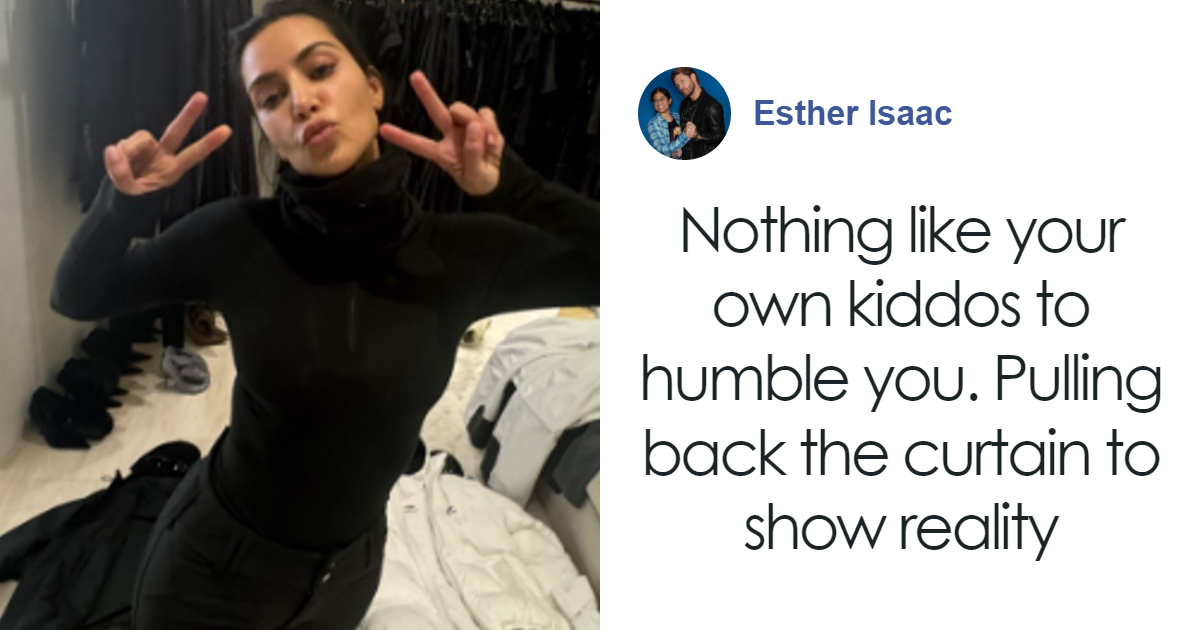
When North West posted a casual TikTok photodump featuring Kim Kardashian in a more candid, less polished light, the internet did what the internet does best: it zoomed in, formed a committee, issued opinions, and somehow turned a family snapshot into a cultural weather report. The phrase “she looks more real” quickly became the center of the conversation, because viewers were not just reacting to Kim’s skin texture. They were reacting to the gap between celebrity perfection and everyday reality. Public reports described the photos as more candid than Kardashian’s usual high-glam public image, while also noting the obvious but important point that even images showing skin texture can still be edited in subtle ways.
That small detail matters. This was not a medical mystery, a scandal, or proof of anything dramatic. It was a reminder that pores, lines, shadows, lighting, expressions, and camera angles exist. They exist on regular people. They exist on celebrities. They exist on billion-dollar brand founders with glam teams, contour kits, and probably a drawer somewhere that contains more lip liners than most of us have socks.
What Happened In North West’s Photodump?
The conversation began after North West, Kim Kardashian’s eldest daughter, shared TikTok content that included candid images of her mother. Entertainment outlets framed the moment as unusual because Kardashian’s public image is famously controlled, polished, and visually consistent. Reports described a FaceTime screenshot and other family-style images that appeared less airbrushed than the professional photos fans usually see. Bored Panda reported that one of the photo dumps had gained millions of views, and BuzzFeed highlighted how the pictures appeared less blurred than Kim’s typical public-facing imagery.
North’s role made the moment even more interesting. She is not a tabloid photographer hiding behind a shrub. She is Kim’s daughter, and her posts often feel playful, chaotic, and family-centered in the way kids’ posts tend to feel. That is what made the images land differently. They were not presented as an exposé. They felt like a child sharing life from inside a celebrity household, where the lighting is not always studio-perfect and the camera does not always ask permission before being brutally honest.
North has become more visible online over time, including through the joint TikTok account she shares with Kardashian. Elle reported that North later launched a personal Instagram account whose bio says it is managed by parents, and that she already had a digital presence through the shared TikTok account with her mother.
Why Did “Real Skin” Become Breaking News?
The short answer: because celebrity beauty has trained audiences to expect impossible consistency. Kim Kardashian is not just a reality television personality; she is a visual brand. Her face, makeup, fashion, and photoshoots are part of a larger business ecosystem. Reuters reported that Skims, the brand founded by Kardashian and Jens Grede, raised funding at a $5 billion valuation in 2025, underscoring how powerful the Kardashian image remains in fashion, retail, and social media-driven commerce.
That kind of brand power depends on recognition. People know the Kim Kardashian aesthetic: sculpted glam, glossy lighting, camera-aware posing, neutral tones, polished hair, and a level of production that makes even a casual mirror selfie look like it came with a lighting crew and a meeting agenda. So when a candid image shows normal texture, the internet reacts as though someone pulled back the velvet curtain and found a regular lamp behind it.
But the more honest interpretation is simpler. Cameras flatten reality, filters reshape it, and professional photography edits it into a final product. The celebrity image we consume is often a collaboration between makeup artists, lighting, lenses, angles, retouching, brand strategy, and platform algorithms. A candid image does not “destroy” that image. It simply reminds viewers that the polished version is not the whole person.
Skin Texture Is Not A Plot Twist
Here is the great dermatological spoiler: skin has texture. The American Academy of Dermatology notes that pores can look more noticeable for reasons such as irritation or changes in skin firmness, and it advises being gentle with the skin rather than scrubbing or picking at it. Cleveland Clinic explains that wrinkles and lines are a natural part of the body’s aging process. In other words, visible texture is not a celebrity malfunction. It is skin doing skin things.
This is why the “she looks more real” response is so revealing. Many viewers were not mocking Kim; they were relieved. The reaction suggests that people are tired of seeing faces presented as permanently poreless, permanently smooth, and permanently lit like a luxury candle commercial. When a celebrity appears in a more ordinary way, it can feel oddly refreshing, like seeing the teacher outside school or discovering that a fashion editor also owns sweatpants.
The North West Factor: A Kid’s Camera Inside A Curated Empire
North West’s photodump hit a nerve because it came from inside the Kardashian universe. The Kardashian-Jenner family built an entertainment dynasty by transforming private life into public content. Yet even within that world, there are layers of curation. Red carpets are curated. Reality shows are edited. Instagram posts are selected. Brand campaigns are polished until they practically glow in the dark.
North’s posts feel different because they often carry the unpredictable energy of a child who is not thinking like a brand manager. That does not mean every post is unfiltered truth, and it does not remove the need for parental oversight. But it does create a different tone. The photos feel less like “Kim Kardashian, global celebrity” and more like “Mom on FaceTime making a face.” That shift from icon to parent is part of why the internet paused.
There is also a privacy conversation here, especially because North is still young. Public interest in celebrity families can become intense, and audiences should be careful not to turn a child’s post into a reason to criticize either the child or the parent harshly. The healthier angle is not “North exposed Kim.” It is “a casual family post reminded everyone that polished images are not the same as everyday life.”
Why The Internet Loves Unfiltered Celebrity Photos
Unfiltered celebrity photos perform a strange function online. They reassure audiences that beauty is not as effortless as it looks. They also let people compare the “official” image with the “casual” image, which can become unhealthy if the conversation turns into nitpicking. The best version of this conversation is not “Gotcha, Kim has texture.” The best version is “Of course she has texture, and maybe we should stop expecting otherwise.”
Common Sense Media has noted that social media can affect body image through judgment and comparison, while also acknowledging that more realistic images, including “no makeup” and “no filter” posts, can help challenge unrealistic appearance ideals. Dove’s Self-Esteem Project has reported that many girls encounter beauty advice online that makes them feel less confident, and Pew Research Center found that social media remains deeply tied to how teens and parents discuss mental health.
That is why a Kim Kardashian photodump can become bigger than Kim Kardashian. It becomes a mirror held up to the audience. People are not only asking, “What does Kim really look like?” They are also asking, “Why did I think skin was supposed to look like glass in the first place?”
The Filter Culture Problem
Filters are not automatically bad. Sometimes they are playful. Sometimes they are artistic. Sometimes they make a rainy Tuesday selfie look less like evidence from a haunted office building. The problem begins when filtered beauty becomes the default standard and unfiltered faces start to look surprising.
In the Kardashian era of celebrity, visual control is a form of power. The right image can launch a product, shape a trend, sell a routine, and dominate a news cycle. But the more controlled celebrity imagery becomes, the more valuable authenticity feels. This is why candid photos can travel so quickly. They seem to offer something audiences rarely get: a break from perfection.
Still, we should be careful. “Authentic” is now a marketing style too. A grainy photo can be strategic. A makeup-free post can still be planned. A visible pore can become part of a brand story. The modern internet is complicated like that. Even realism can arrive wearing a press badge.
Kim Kardashian’s Image Has Always Been About Control
Kim Kardashian understands image better than almost anyone in modern pop culture. From early reality television fame to beauty, shapewear, fashion, and social media, her career has been built around visibility. She did not just become famous in front of cameras; she learned how to use cameras as business tools.
That is why the North West photodump felt symbolically powerful. It was a rare moment where the image looked less controlled, even if the broader family ecosystem remains highly public and media-savvy. The candid images did not erase Kim’s brand. If anything, they made her seem more human, which may be why so many people responded positively.
There is a lesson here for public figures and everyday users alike: perfection can impress people, but relatability can connect with them. The internet may admire a flawless campaign photo, but it often loves a candid moment more because it feels accessible. The glossy photo says, “Look at this fantasy.” The candid photo says, “Yes, I also exist under overhead lighting, and overhead lighting has never been anyone’s loyal friend.”
What “She Looks More Real” Really Means
When people said Kim “looks more real,” many were not saying she looked less beautiful. They were saying she looked less digitally distant. That distinction matters. Realness is not the opposite of beauty. Realness is the opposite of artificial pressure.
For years, audiences have watched celebrities appear with smooth skin, sculpted makeup, and carefully edited photos. Then everyday people open their front-facing cameras and wonder why they look like they just lost an argument with fluorescent lighting. The answer is simple: the comparison was never fair. One side has production. The other side has a bathroom mirror and a phone that chooses violence at 7:12 a.m.
Kim’s candid images became popular because they interrupted that unfair comparison. They gave viewers permission to remember that even famous faces have normal skin variation. That does not mean people should stop enjoying makeup, skincare, or photography. It means those things should be understood as tools, not requirements for being acceptable.
How To Read Celebrity Images More Wisely
The healthiest way to process moments like this is to treat them as media literacy lessons. Ask what lighting was used. Ask whether the image was posed or candid. Ask whether makeup, filters, retouching, or compression might affect what you see. Ask why one image feels “real” and another feels “perfect.” These questions do not ruin celebrity content; they make you a smarter viewer.
It also helps to stop using celebrity images as personal measuring sticks. A celebrity photo is often the end result of a long chain of decisions. Your face in natural light is not competing with a campaign image. Your skin at school, work, the grocery store, or on a video call is not failing because it does not resemble a beauty ad. It is simply existing in real conditions.
That is the real value of the North West photodump conversation. It gives people a chance to reset expectations. Skin texture should not be shocking. It should be normal. A candid image should not feel like a revelation. It should feel like a reminder that people are not products, even when they run product empires.
Experience: Why This Moment Feels Familiar To So Many People
Almost everyone has had a “photodump moment” in real life. Maybe a friend posted a group picture before anyone approved it. Maybe a parent uploaded a family photo where the lighting made everyone look tired after a long day. Maybe someone paused a video at the exact worst frame, where one eye was mid-blink and the mouth was doing something legally difficult to explain. It happens. The camera catches a fraction of a second and suddenly that fraction becomes evidence, comedy, memory, or all three.
That is why the Kim Kardashian and North West story connected with so many people. It was celebrity-scale, but the experience was familiar. A child posts something casual. A parent appears in a way they might not have chosen. The internet reacts. The only difference is that most family photodumps do not become international entertainment news. For most people, the audience is Aunt Linda, three cousins, and one person from high school who still likes every post within 11 seconds.
There is also something emotionally comforting about seeing a famous person in a more ordinary frame. It reminds viewers that the polished images filling their feeds are not the full story. Think about how different people look across settings: morning light, car light, bathroom light, restaurant light, direct sun, cloudy weather, front camera, back camera, flash, no flash. Nobody has one permanent face. We all move through changing conditions, and the camera records those conditions as much as it records us.
This is especially important in the age of filters. Many people have become used to seeing themselves through softened lenses before they see themselves plainly. Then a candid photo appears, and it can feel jarring. But the jarring part is not the real face. The jarring part is the distance between the real face and the edited expectation. Moments like North’s photodump can help close that gap by reminding people that texture is not strange. It is ordinary.
There is a practical lesson here for anyone who posts or reacts online: be kinder than the zoom button. Before commenting on someone’s face, ask whether the comment adds anything useful. Before criticizing a candid photo, remember that everyone has angles, expressions, and lighting situations they would not personally select for a billboard. And before comparing yourself to a celebrity image, remember that public images often pass through many invisible hands before they land on your screen.
The best experience to take from this topic is not gossip; it is relief. You do not need to look airbrushed to look human. You do not need to look poreless to be photographed. You do not need to panic because a candid image looks different from a polished one. The internet may turn one family photodump into a debate, but the takeaway can still be simple and healthy: real skin belongs in real life, and real life is allowed to show up online.
Conclusion: The Real Story Is Not Kim’s Skin, It’s Our Expectations
North West’s photodump sparked headlines because Kim Kardashian is one of the most visually managed celebrities in the world. But the lasting conversation should not be about inspecting Kim’s face. It should be about questioning why normal skin texture still surprises people.
Kim Kardashian did not become less glamorous because a candid photo showed a more natural view. If anything, the reaction proved that audiences are hungry for images that feel less polished and more human. The internet may love perfection, but it also gets tired of it. Sometimes the most powerful image is not the one with the best lighting, but the one that quietly says, “This is real life too.”