Note: This article discusses public criticism of celebrity costumes with care. “Problematic” refers to the backlash and concerns reported at the time, not a claim that every person involved had the same intent.
Halloween is supposed to be the one night of the year when adults can wear a lobster hat, call it fashion, and receive polite applause. Yet celebrity Halloween costumes have a way of turning one Instagram post into a weeklong public-relations séance. A costume can be clever, theatrical, nostalgic, or gloriously absurd. It can also cross a line by treating race, religion, cultural traditions, trauma, or real people’s pain like party décor.
The most controversial celebrity Halloween looks are memorable not because the tailoring was impeccable or the prosthetics deserved an Oscar, but because they sparked a larger conversation. Some involved blackface or skin-darkening makeup. Others used sacred cultural clothing as a shortcut to a costume idea. A few took recent tragedies or painful public events and converted them into a punchline before the cultural dust had settled.
Here are 20 problematic celebrity Halloween looks that still come up whenever spooky season rolls around. Think of this less as a fashion roast and more as a reminder that creativity is much more impressive when it does not require someone else’s identity, history, or grief to do the heavy lifting.
Why Celebrity Halloween Costume Controversies Keep Happening
Celebrity costumes attract more attention than the average backyard party outfit because stars have giant audiences, stylists, publicists, cameras, and social media feeds working overtime. That visibility turns a questionable idea into a cultural conversation almost instantly. What may have been intended as tribute, satire, or “just a costume” can land very differently for people whose communities have been caricatured, excluded, or stereotyped for generations.
The recurring lesson is surprisingly simple: dress as a character, fictional creature, profession, or pop-culture reference without changing your skin tone, mimicking racial features, borrowing sacred objects, or reducing an entire culture to a costume aisle cliché. There are many ways to become a vampire accountant, a glamorous alien, or a haunted bowl of pasta. Humanity has options.
20 Celebrity Halloween Looks That Sparked Backlash
1. Julianne Hough as Crazy Eyes
Julianne Hough’s 2013 costume inspired by Suzanne “Crazy Eyes” Warren from Orange Is the New Black became one of the most frequently cited celebrity Halloween controversies. The jumpsuit and hairstyle were not the main issue; the use of skin-darkening makeup was. Hough later apologized, acknowledging that the costume hurt and offended people. The episode became a widely referenced example of why admiration for a performer does not justify racial mimicry.
2. Luann de Lesseps as Diana Ross
Luann de Lesseps drew criticism after appearing as Diana Ross in 2017 with noticeably darker makeup. The controversy was not about dressing as a music legend; countless fans pay tribute to artists through clothing, hair, and signature stage outfits. The backlash centered on altering skin tone, which many viewers connected to the long and harmful history of blackface. It was a reminder that a tribute should celebrate a person’s artistry, not imitate their race.
3. Colton Haynes as Kanye West
Actor Colton Haynes faced criticism for a Halloween costume portraying Kanye West that included darkened makeup. The costume became part of a larger public discussion about blackface and why “I was dressing as a specific celebrity” is not a reliable defense. A costume can reference an artist’s fashion era, album cover, sunglasses, or stage persona without treating skin color as an accessory.
4. Colton Haynes as Mahatma Gandhi
Haynes also faced backlash for a separate costume in which he appeared to use brown makeup while portraying Mahatma Gandhi. The controversy showed that the problem is not limited to blackface. Brownface similarly turns racial identity into a visual prop and flattens a real person or community into a costume concept. Halloween does not require an actor-level transformation when the transformation includes someone else’s racial identity.
5. Hilary Duff and Jason Walsh as a Pilgrim and Native American Stereotype
Hilary Duff and then-boyfriend Jason Walsh attended a 2016 Halloween party dressed as a pilgrim and a Native American-inspired character. The pairing received backlash because it echoed a simplified “pilgrims and Indians” story that ignores the violence, displacement, and ongoing realities faced by Indigenous communities. Both apologized afterward. Their costumes became a textbook example of how a familiar school-pageant image can carry far more weight than a partygoer may realize.
6. Chris Brown and the Terrorist Costume
Chris Brown and members of his group were criticized in 2012 for costumes widely described as terrorist or Taliban-inspired, complete with weapons-themed props, facial hair, and traditional clothing used as shorthand for a violent stereotype. The issue was not simply that the costumes were edgy. They leaned on a reductive association between Muslim or Middle Eastern identity and terrorism. “Shock value” may get attention, but it rarely ages well.
7. Kim Kardashian as Aaliyah
Kim Kardashian’s 2017 Aaliyah costume prompted debate about cultural appropriation. Kardashian said she intended it as an homage to a musician she admired, and some people agreed that recreating an iconic outfit is different from changing one’s race. Others argued that the costume still felt uncomfortable because it involved a white celebrity embodying a deceased Black artist whose image and cultural significance remain deeply meaningful to fans. The discussion showed that intent and impact can exist in the same room without agreeing on the playlist.
8. Kourtney Kardashian as Fook Mi
Kourtney Kardashian faced criticism after dressing as Fook Mi, a character from the Austin Powers films. Critics pointed out that the character itself relied on Asian stereotypes and a sexualized joke name. Recreating a dated comedy character does not automatically make the original stereotype disappear; sometimes it simply gives it a new ring light and better contour.
9. Scott Disick as an Arab Sheikh
Scott Disick’s 2014 costume as an Arab sheikh, along with captions that referenced “Arab money,” drew backlash for stereotyping Arab identity and wealth. The look relied on a familiar costume-party shortcut: take a broad region, add a robe and a few clichés, and call it a character. But cultures are not interchangeable props, and real communities are not a theme party.
10. Pamela Anderson and the Native American Headdress
Pamela Anderson drew criticism in 2019 after sharing photos of herself wearing a large Native American-style headdress. For many Indigenous people, feathered headdresses are not generic fashion accessories; they can carry specific ceremonial, cultural, and community significance. The controversy highlighted why sacred or traditional regalia should not be reduced to a dramatic finishing touch for a Halloween photo.
11. Kenya Moore as a “Warrior Princess”
Kenya Moore’s Native American-inspired “warrior princess” costume on The Real Housewives of Atlanta prompted criticism from viewers, cast members, and Indigenous advocates. The conversation focused on the way mainstream costume culture often turns Native identity into a fantasy character instead of recognizing the diversity and modern reality of Indigenous communities. A feathered headpiece is not a shortcut to imagination; it is usually a shortcut to backlash.
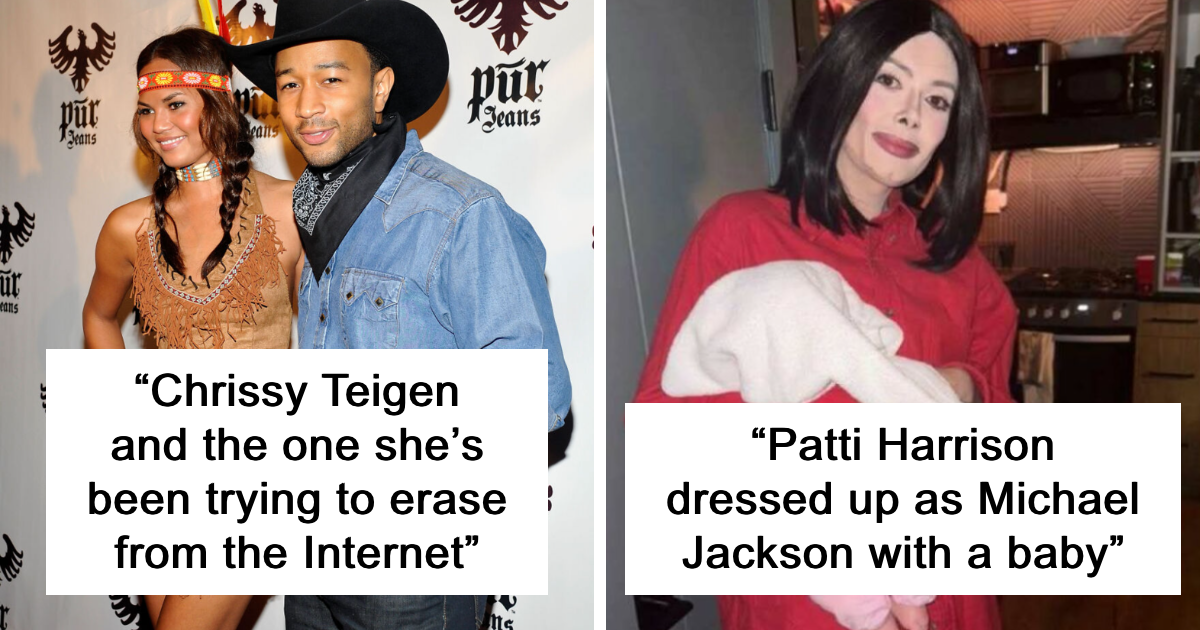
12. Chrissy Teigen in a “Cowboys and Indians” Costume
Chrissy Teigen was criticized for a 2008 costume that placed her in a Native American-inspired outfit while John Legend dressed as a cowboy. The “cowboys and Indians” concept is common in old movies and party stores, but it reduces hundreds of distinct Indigenous nations to a historical stereotype. The fact that a costume is familiar does not make it harmless; some ideas have simply been recycled for too long without enough thought.
13. Tia Mowry as a Geisha
Tia Mowry’s 2013 geisha costume received criticism for using Japanese cultural imagery as a costume. A geisha is not a generic “Asian costume” category; it is part of a specific Japanese tradition with real history and cultural context. The problem is compounded when makeup or styling is used to imitate racial traits rather than simply referencing a fictional character or a fashion era.
14. Ashley Tisdale and a Sexualized Día de los Muertos Look
Ashley Tisdale’s Día de los Muertos-inspired Halloween styling drew criticism from people who felt it sexualized a Mexican holiday centered on honoring deceased loved ones. Día de los Muertos is often confused with Halloween in U.S. pop culture, but it has its own traditions, symbolism, and emotional meaning. Decorative skull imagery may look festive online, yet context matters more than a flattering filter.
15. Heidi Klum as the Hindu Goddess Kali
Heidi Klum’s 2008 costume as Kali, a Hindu goddess, drew criticism from Hindu leaders and others who felt a sacred religious figure had been turned into spectacle. Klum is famous for elaborate Halloween transformations, and the craftsmanship was undeniably ambitious. Still, a costume can be technically impressive and culturally insensitive at the same time. More arms do not automatically equal more awareness.
16. Ashley Benson and the Cecil the Lion Costume
Ashley Benson faced backlash in 2015 after sharing a lion costume idea labeled as a reference to Cecil the Lion, whose killing had recently prompted international outrage. Benson later apologized and said the post was in poor taste. The controversy was less about dressing as an animal and more about using a recently mourned, highly publicized death as a cheeky Halloween reference. Timing is part of taste, and timing occasionally screams louder than the costume itself.
17. Harry Hamlin as Sid Vicious
Harry Hamlin’s 2015 Sid Vicious costume included a shirt bearing a swastika, a symbol associated with Nazi atrocities. Hamlin and Lisa Rinna later apologized, explaining that they were trying to portray Sid Vicious and Nancy Spungen authentically. The backlash made clear that historical context does not neutralize the symbol’s meaning. A costume reference may explain why something was worn, but it does not erase how it lands in public.
18. Julia Fox as Jackie Kennedy in the Pink Suit
Julia Fox’s 2025 costume inspired by Jackie Kennedy’s pink suit following President John F. Kennedy’s assassination sparked immediate criticism. Fox defended the look as a statement about grief, trauma, beauty, and history. Critics viewed it as insensitive because it referenced a real, devastating event connected to a real family. The debate showed how quickly Halloween “art” can become contentious when it uses public tragedy as a visual concept.
19. Jaclyn Hill and the Afro Wig
Beauty creator Jaclyn Hill was criticized in 2017 after wearing an Afro wig as part of a Halloween costume. Some observers saw it as cultural appropriation, while others argued it was simply part of a clown-like look. The divided response did not erase the larger issue: hairstyles associated with Black identity have often been mocked, policed, or treated as costumes by people outside the culture.
20. Paris Hilton as a “Sexy Indian”
Paris Hilton’s 2010 Native American-inspired costume was criticized for turning Indigenous identity into a sexualized fantasy. The phrase “sexy Indian” is itself a warning sign, because it treats a broad and diverse group of people as a costume category rather than living communities with distinct histories and traditions. Halloween does not need a cultural stereotype to be glamorous. It has sequins, fake spiders, and enough fog machines already.
What These Celebrity Costume Controversies Have in Common
Not every controversial costume belongs in the same category. Some involved blackface or brownface, which carry a specific racist history. Others involved religious figures, Indigenous regalia, national traditions, or cultural imagery treated as decorative shorthand. A different group used real deaths, public trauma, or sensitive events for shock value.
But the common thread is that each costume asked someone else’s identity, pain, or history to provide the joke. That is why “I did not mean to offend anyone” may explain intention but does not resolve impact. A thoughtful costume does not require changing skin tone, exaggerating features, borrowing sacred items, or playing dress-up with a community’s stereotypes.
How to Choose a Better Halloween Costume Without Becoming the Group Chat Lesson
Before committing to a costume, ask a few practical questions. Am I dressing as a specific fictional character, or am I turning an entire culture into a costume? Does this idea require changing my skin tone or mimicking a racial feature? Is the clothing, symbol, hairstyle, or accessory sacred or culturally specific? Would the joke still work if the costume did not rely on stereotypes?
When the answer feels murky, choose another idea. A haunted librarian, a retro video-game character, a glamorous ghost, a movie monster, a pun costume, or a bizarre food item can all deliver personality without causing an apology tour. The best Halloween costume gets a laugh because it is inventive, not because it made someone else the punchline.
The After-Party: What These Costume Controversies Feel Like in Real Life
Celebrity Halloween controversies can seem distant because they unfold through red-carpet photos, Instagram captions, talk-show debates, and public apologies written by teams of people who probably own more laptops than houseplants. But the experience behind them is familiar to ordinary partygoers. Someone sees a costume, pauses, and has to decide whether to say something. Someone else realizes too late that an outfit they thought was funny has made the room uncomfortable. Then comes the awkward silence, followed by frantic explanations that somehow make the mood even stranger.
At a typical Halloween party, most people are not trying to be cruel. They want to be funny, recognizable, stylish, or dramatic enough to win an imaginary award for “Most Likely to Be Photographed Near a Bowl of Candy.” That is why these mistakes happen so often. People sometimes confuse familiarity with harmlessness. They remember a costume idea from an old movie, a childhood school event, a party store display, or a meme. They do not always stop to ask who has been stereotyped, mocked, or excluded by that image over time.
The uncomfortable experience is often not just about the person wearing the costume. It can also affect everyone else in the room. A guest from the culture being referenced may feel pressured to laugh it off so they do not become “the serious one.” Friends may worry that speaking up will ruin the party. The host may suddenly wish the playlist were loud enough to erase social tension. Meanwhile, the costume wearer may feel embarrassed, defensive, or genuinely confused about why the look landed badly.
The best way to avoid that entire experience is to do a small amount of research before Halloween night. Search the meaning of an item before buying it. Ask whether a costume reduces people to a stereotype. Skip racial makeup entirely. Avoid sacred religious imagery, cultural regalia, and costumes based on recent tragedies. These are not restrictive rules designed to drain fun from Halloween. They are creative guardrails that make room for better ideas.
There is also a useful difference between dressing as a person and dressing as their identity. You can honor a musician through a recognizable outfit, hairstyle, microphone, album-era styling, or signature accessory. You can portray a fictional character without copying racial features. You can love a culture without treating it as a costume category. The goal is not to become terrified of getting dressed. The goal is to make the joke, reference, or tribute about your creativity rather than someone else’s humanity.
When a costume goes wrong, the most constructive response is usually to listen, acknowledge the impact, and change course. Defensiveness tends to turn one poor decision into an entire sequel. A sincere apology does not require a 14-slide notes-app statement, a sad piano track, or the phrase “I’m sorry you were offended.” It requires recognizing why the costume hurt people and doing better next time. Halloween comes back every year, which means everyone gets another chance to choose a costume that is clever, memorable, and free of unnecessary cultural baggage.
Conclusion
The most problematic celebrity Halloween looks endure because they reveal how quickly a costume can become a cultural statement. The line between tribute and offense is not always identical in every situation, but a few boundaries are clear: do not use blackface or brownface, do not wear sacred cultural items as props, and do not turn real trauma into party entertainment. The good news is that Halloween remains packed with better options. A costume can be bold, weird, glamorous, scary, and unforgettable without making anyone else’s culture, identity, or pain carry the punchline.