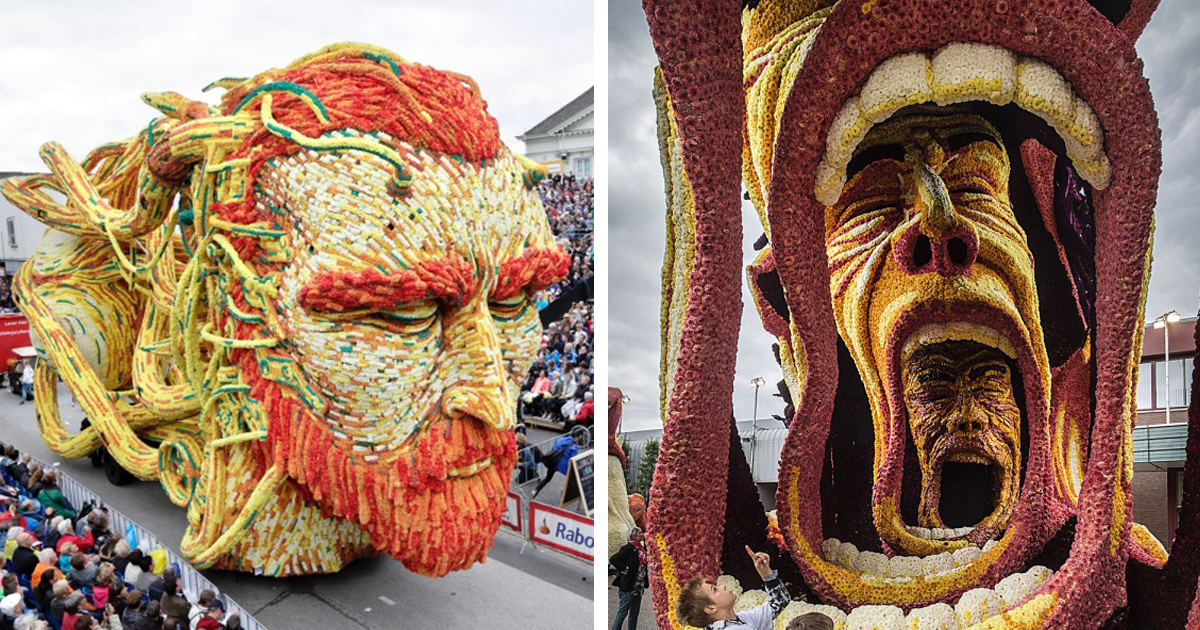
Imagine Vincent van Gogh looking down at his quiet Dutch hometown and seeing his face rolling through the streets as a nine-meter-tall sculpture made of dahlias. He might have blinked twice, asked for a stronger cup of coffee, and then reached for his brushes. That, essentially, was the magic of Corso Zundert 2015: a spectacular flower parade in the Netherlands where 19 giant flower sculptures honored Van Gogh with color, movement, drama, and enough dahlias to make a florist faint gracefully into a bucket.
Known widely as the world’s largest flower parade, Corso Zundert is not a polite little procession of bouquets. It is a full-scale community art battle. Massive floats, built by local hamlets and pushed by human power, roll through the narrow streets of Zundert, the town where Vincent van Gogh was born in 1853. In 2015, the parade paid tribute to its most famous son on the 125th anniversary of his death. The result was not just a parade. It was a moving museum, a floral theater, and a love letter written in petals.
What Is Corso Zundert?
Corso Zundert, also called Bloemencorso Zundert, is an annual flower parade held in Zundert, a town in North Brabant in the Netherlands. The event traditionally takes place on the first Sunday of September and has grown from modest flower-covered carts and bicycles into an internationally admired display of design, engineering, teamwork, and botanical excess.
The parade began in 1936 and is organized around local communities known as hamlets. Each hamlet creates its own float, and the friendly rivalry is serious business. Think neighborhood barbecue competition, except instead of arguing over brisket smoke rings, everyone is welding steel, shaping papier-mâché, growing dahlias, and building enormous sculptures that must survive a parade route without collapsing into a very artistic compost heap.
The floats are usually made with steel frames, cardboard, papier-mâché, and thousands upon thousands of dahlias. Unlike many floral festivals that use mixed flowers, Zundert is famous for its dahlia tradition. The flowers are grown locally and attached shortly before the parade, which means the final week is a heroic sprint of pinning, placing, adjusting, and probably saying, “Who moved the orange ones?” more than once.
Why Van Gogh Was the Perfect Theme
Vincent van Gogh was born in Zundert on March 30, 1853. Although he spent his most famous artistic years elsewhere, including France, his roots in North Brabant shaped his early life and his connection to rural landscapes, working people, nature, and emotional intensity. The 2015 Corso Zundert theme honored Van Gogh because that year marked 125 years since his death in 1890.
It was a natural match. Van Gogh’s paintings already feel alive with movement: skies swirl, fields breathe, sunflowers almost lean out of the canvas to introduce themselves. Translating his work into giant flower sculptures made perfect sense. Dahlias became brushstrokes. Floats became canvases. Streets became galleries. And the people of Zundert became both builders and storytellers.
The 19 floats did not simply copy famous paintings. They interpreted Van Gogh’s world. Some floats drew from his self-portraits. Others leaned into his love of sunflowers, wheat fields, peasants, color, emotional struggle, and the expressive brushwork that made him one of the most recognizable artists in history. The parade transformed familiar Van Gogh imagery into three-dimensional, moving sculptures that could tower over spectators and still feel strangely intimate.
19 Giant Flower Sculptures, One Floral Masterpiece
The 2015 edition featured 19 competing floats, each inspired by Van Gogh’s life or art. These giant flower sculptures were not small decorative vehicles with a few cheerful blossoms taped to the bumper. Many were enormous works of temporary public art, some reaching more than 60 feet long and around 30 feet high. Their scale alone was impressive, but the emotional range was what made the tribute unforgettable.
One float might evoke Van Gogh’s famous self-portraits, using fields of yellow, orange, purple, and deep blue dahlias to suggest the painter’s face, beard, and restless eyes. Another might reinterpret the energy of his landscapes, turning flowers into textured skies and rolling fields. Others explored darker themes, including Van Gogh’s mental suffering and final days, but did so through beauty rather than spectacle for spectacle’s sake.
The Winning Float: “Adieu Vincent”
The top prize went to Wernhout’s float, “Adieu Vincent, een afscheid in bloemen,” which translates roughly to “Goodbye Vincent, a farewell in flowers.” It depicted Van Gogh in a powerful, emotional scene connected to his final days. Rather than treating his death as a grim headline, the float offered him dignity: surrounded by nature, color, and the fields that had always mattered to him.
That is the special strength of Corso Zundert. The floats may be gigantic, but they are not empty showpieces. The best ones carry feeling. “Adieu Vincent” worked because it combined scale with stillness. A massive flower-covered sculpture somehow managed to feel quiet, tender, and personal. That is not easy. Anyone can make something big. Making something big that whispers is the hard part.
How the Floats Are Built
Behind every finished float is a long process of design and community labor. The hamlets begin with concepts and scale models, then move into construction inside temporary building tents. Volunteers handle everything from engineering and welding to shaping surfaces and preparing the flowers. Older residents often help with growing and harvesting dahlias, while younger volunteers take part in building, decorating, and pushing the floats.
The flower work happens close to parade day because dahlias are fresh, living materials. They cannot be attached months ahead of time like plastic ornaments on a holiday wreath. The final days are a high-pressure marathon. Volunteers place flowers one by one, matching colors and textures to the design. If Van Gogh used paint with urgent brushstrokes, Zundert uses dahlias with equally urgent hands.
There is also an engineering challenge. The floats must move through real streets, turn corners, remain structurally stable, and be pushed by people. They need artistic ambition and practical balance. A float can look magnificent in a tent, but if it cannot move, it becomes a very expensive stationary shrub with confidence issues.
Why Dahlias Matter So Much
Dahlias are the signature flowers of Corso Zundert. They come in a wide range of colors, shapes, and sizes, making them ideal for creating texture and shading across huge surfaces. For Van Gogh-inspired floats, this was especially important. His art depends heavily on color contrast and expressive rhythm. Dahlias allowed builders to mimic painterly effects: golden yellows for sunflowers, deep blues for shadow, purples for drama, whites and pinks for highlights, and oranges for that unmistakable Van Gogh warmth.
The use of dahlias also ties the parade to local agriculture and community identity. Zundert is known for flower cultivation, and the parade reflects that heritage. These are not anonymous flowers shipped in to decorate a commercial event. They are part of the town’s seasonal rhythm. People grow them, pick them, carry them, pin them, parade them, and then watch as the temporary sculptures disappear. There is something beautifully Van Gogh-like about that: intense beauty, brief life, lasting memory.
A Parade Powered by Volunteers
One of the most impressive facts about Corso Zundert is that it is powered by volunteers. The event is not simply a professional production placed in front of a passive audience. It is a town-wide ritual. Families, friends, neighbors, designers, growers, builders, students, retirees, and local enthusiasts all contribute. Children grow up around the parade, learning that art is not something locked away behind museum glass. Art can be built in a tent, covered in flowers, pushed down the street, and cheered by thousands.
This community aspect explains why the floats feel alive. They are not just objects. They are months of conversation, problem-solving, teasing, panic, pride, and teamwork. Every petal carries a little civic stubbornness. Every float says, “Our hamlet can do this.” And in 2015, every hamlet also said, “Vincent belongs to us, and we are going to honor him properly.”
Van Gogh’s Art Reimagined in Flowers
The 2015 Van Gogh parade was especially compelling because his art translates so well into floral sculpture. His paintings are famous for thick, energetic brushwork and bold color. In floral form, those qualities become physical. The raised surfaces of dahlias create texture. Curved float structures echo swirling skies. Layered petals mimic the rhythm of brushstrokes. A painted sunflower becomes a real flower pretending to be a painted flower. Somewhere in that loop, art history smiles and slightly loses track of itself.
Self-portraits were a natural source of inspiration. Van Gogh painted himself many times, often with intense eyes and dramatic color contrasts. Floral versions of his face can feel both playful and profound. On one hand, it is a giant dahlia beard. On the other, it is a community reconstructing the image of a man who was largely uncelebrated during his lifetime but became one of the most beloved artists in the world.
The parade also highlighted Van Gogh’s relationship with nature. Wheat fields, sunflowers, trees, gardens, and rural workers appear again and again in his work. Corso Zundert returned those themes to the landscape of his birth, using living flowers to honor an artist who found meaning in fields, seasons, and ordinary people.
Why This Flower Parade Still Captures Global Attention
The story of 19 giant flower sculptures honoring Van Gogh continues to fascinate people because it combines several irresistible ingredients: world-famous art, small-town pride, massive handmade objects, fresh flowers, competition, and a little bit of controlled chaos. It is photogenic, but it is more than a photo opportunity. It shows what happens when cultural memory is not treated as dusty history but as something people can build together.
In an age when so many experiences are digital, Corso Zundert feels refreshingly physical. The flowers are real. The labor is real. The floats are heavy. The deadline is unforgiving. The audience can smell the dahlias and hear the crowd. Nothing can be paused, filtered, or saved forever in its original form. The parade exists, dazzles, and then disappears. That temporary quality makes it even more powerful.
Travel Tips for Experiencing Corso Zundert
If you plan to see Corso Zundert, expect crowds, color, and a town fully committed to the occasion. The parade usually takes place on the first Sunday of September, with floats often displayed afterward. Because Zundert is smaller than major Dutch tourist cities, planning ahead matters. Visitors commonly travel through nearby Breda and continue toward Zundert by bus, car, or organized tour.
Arrive early if you want a good viewing spot. Bring comfortable shoes, because flower worship is surprisingly hard on the feet. A camera is useful, but do not spend the entire parade hiding behind it. These floats are built at a scale that rewards slow looking. Notice the color transitions, the structural details, the movement, the sound, and the reactions of the volunteers walking beside the floats. The best photos are wonderful, but the best memories come from putting the camera down and letting a giant dahlia-covered Van Gogh roll past your actual human face.
Experience: What It Feels Like to Watch Van Gogh Bloom in Zundert
Experiencing a Van Gogh-themed flower parade in Zundert is a little like stepping into an art museum after the paintings have escaped their frames and decided to join a street festival. The first sensation is scale. You may think you understand the phrase “giant flower sculpture,” but then a float appears, taller than a house, covered in thousands of dahlias, and your brain quietly updates its definition of “giant.”
The second sensation is texture. From a distance, the floats look like painted sculptures. Up close, the surface resolves into individual flowers. Every color field is made of petals. Every shadow has been planned. Every highlight is a cluster of carefully placed blooms. It is almost impossible not to lean forward and inspect the details, the way people lean toward Van Gogh’s paintings in museums to see the brushwork. In Zundert, the brushwork smells faintly floral and may attract bees, which is not usually a problem at the Van Gogh Museum.
The third sensation is community pride. You can feel it in the volunteers walking beside the floats and in the crowd’s reactions when a favorite hamlet passes. The parade is competitive, but not coldly competitive. It has the warm intensity of people who have invested months of labor and are now watching their creation meet the world. When a float succeeds, the applause is not just for the object. It is for every late night, every design argument, every flower picked, every pin placed, and every person who showed up when showing up was needed.
A Van Gogh-themed edition adds emotional depth. His life story is often told through struggle, poverty, illness, and posthumous fame. Seeing his image recreated in flowers in his birthplace changes the tone. It feels less like a biography lesson and more like a homecoming. Zundert is not simply saying, “A famous artist was born here.” It is saying, “We remember him in our own language.” That language happens to involve steel, papier-mâché, dahlias, marching bands, and the kind of teamwork that makes spreadsheets look spiritually underdressed.
For travelers, the experience is also a reminder that the Netherlands is not only Amsterdam canals and tulip postcards. Dutch flower culture is broad, inventive, and deeply tied to local identity. Corso Zundert is not a generic attraction created for tourists. It is a living tradition that visitors are lucky enough to witness. That distinction matters. The parade feels authentic because it belongs first to the people who build it.
The most memorable moment may come after the biggest float has passed, when petals on the surface catch the light and the sculpture seems to shift from flower arrangement to painting to theater and back again. You realize that the float will not last. The flowers will fade. The structure will come down. The streets will return to normal. But the image stays with you: Van Gogh, honored not in bronze or marble, but in dahlias, the most cheerful possible material for serious art.
Conclusion
The 19 giant flower sculptures that honored Van Gogh at Corso Zundert showed why the world’s largest flower parade is more than a colorful curiosity. It is a rare blend of art history, local pride, floral craftsmanship, engineering, and collective imagination. By turning Van Gogh’s paintings and life story into monumental dahlia-covered floats, Zundert created a tribute that was bold, tender, and unforgettable.
Van Gogh once transformed ordinary fields, flowers, chairs, rooms, and faces into emotional masterpieces. In 2015, his hometown returned the favor by transforming flowers into Van Gogh. That is the kind of full-circle moment art lovers dream about: beautiful, temporary, slightly outrageous, and absolutely alive.