Some places whisper. Ikeshima Island does not whisper. It creaks, sighs, rusts, and occasionally lets a loose sheet of metal clap in the wind like a sarcastic round of applause. Located off the coast of Nagasaki Prefecture, this small Japanese island once moved with the daily rhythm of coal miners, schoolchildren, shopkeepers, nurses, cooks, cats, ferry passengers, and families hanging laundry between concrete apartment blocks. Today, fewer than 130 people remain, while rows of decayed buildings stand like stage sets after the actors have quietly gone home.
I came to photograph Ikeshima because abandoned places have a strange way of telling the truth. A shiny new building tells you what someone wants the future to look like. A decaying building tells you what the future actually did. On Ikeshima, the future arrived wearing moss, salt, cracked paint, and a very dramatic amount of vines.
This photo journey through 36 scenes is not just about ruins. It is about a former coal mining island in Japan that rose quickly, worked brutally hard, and emptied almost overnight when the mine closed in 2001. It is about the beauty of abandoned Japanese architecture, the sadness of industrial decline, and the odd little jokes that survive in silence: a chair facing nothing, a stairway leading to a door that no longer cares, a vending machine that looks as if it retired without filling out the paperwork.
Ikeshima Island: Japan’s Forgotten Coal Mining Town At Sea
Ikeshima, also written as Ikejima, sits in Nagasaki Prefecture and is often called the “second Gunkanjima.” That comparison makes sense, but it is also a little unfair. Gunkanjima, or Battleship Island, is the famous one: dramatic skyline, UNESCO attention, James Bond villain-lair energy. Ikeshima is quieter, larger, more accessible in parts, and still inhabited. It is not a completely dead island. It is more like a town that fell asleep with the lights off and forgot to set an alarm.
The island’s modern story is tied to coal. Mining began in the late 1950s, and for decades Ikeshima was a busy offshore industrial community. Tall apartment blocks were built for workers and their families. The island had the everyday infrastructure of a real town: housing, shops, medical facilities, recreation spaces, and streets designed for people who expected tomorrow to look a lot like yesterday. At its peak, thousands of residents lived on this small patch of land. Depending on the source and period measured, estimates often place the peak population around 8,000 people.
Then the economics changed. Imported coal became cheaper. Japan’s domestic coal industry struggled. Accidents, aging infrastructure, and market pressure pushed the mine toward closure. In November 2001, the Ikeshima coal mine shut down. Around 2,500 workers lost their jobs, and most families left. What remained was not a movie set, although your camera will absolutely behave like it has found one. What remained was a real community reduced to a small number of mostly older residents, surrounded by the concrete shell of a much louder past.
Why Photograph A Place Full Of Decayed Buildings?
People sometimes ask why anyone would photograph abandoned buildings. The polite answer is “historical interest.” The honest answer is that decay is visually irresistible. Rust has better texture than most modern office lobbies. Peeling paint has more personality than a motivational poster. A hallway with broken windows and plants growing through the floor says more about time than a thousand inspirational desk calendars.
But Ikeshima is not interesting because it is “creepy.” That word is too small. The island is moving because it still feels domestic. You do not only see industrial ruins; you see traces of daily life. Apartment balconies. School-like corridors. Clinic rooms. Stairwells. Kitchens. Laundry rails. Places built for ordinary mornings. That is what makes Ikeshima’s abandoned buildings so powerful. The island does not just show collapse. It shows interruption.
In the 36 pictures, the strongest images are not always the most dramatic. Yes, the huge concrete apartment blocks are spectacular in a post-apocalyptic way. Yes, the old coal mining facilities look like they were designed by someone who thought “industrial dystopia” was a cozy interior style. But the smaller details hit harder: a curtain still hanging, a tiled room overtaken by dust, a sign fading into near-nonsense, a chair positioned as if someone stepped out for lunch and accidentally skipped two decades.
The First View: Concrete, Sea Air, And Silence
Arriving by ferry, Ikeshima does not reveal itself all at once. First comes the water, then the outline of land, then the shapes of buildings that seem too big for the island. The apartment blocks rise above the greenery like tired giants. They are not polished ruins. They are not curated with dramatic lighting and a gift shop exit. They are raw, weathered, and very much at the mercy of the sea.
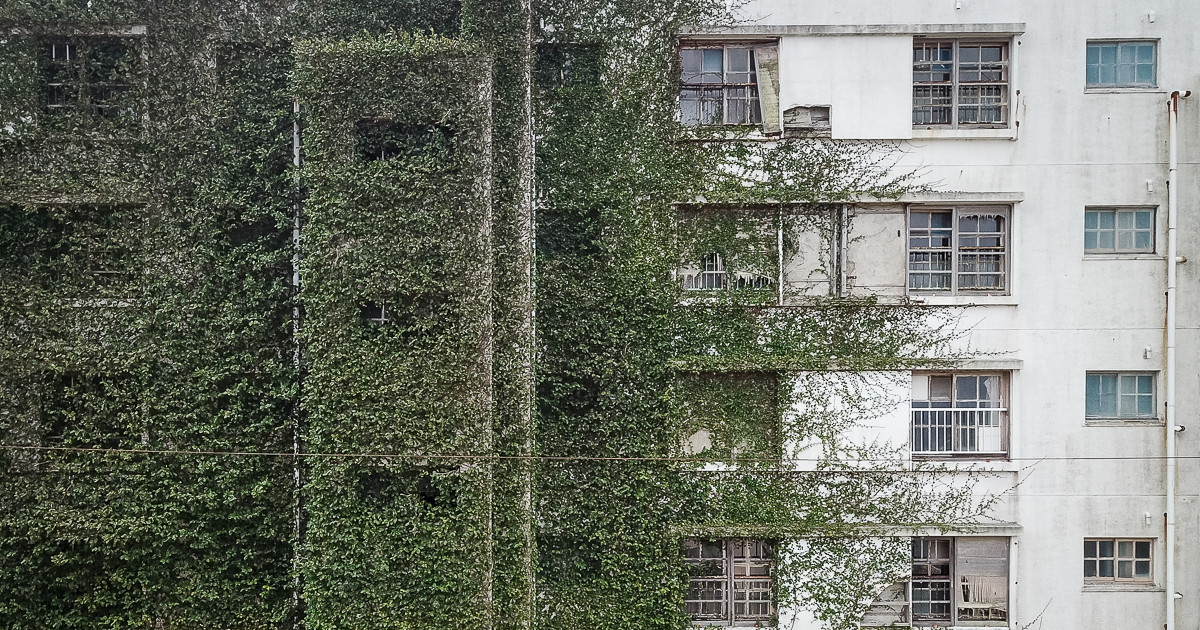
Sea air is not gentle. It gets into everything. It salts metal, lifts paint, weakens concrete, fogs glass, and turns hinges into small sculptures of defeat. On Ikeshima, the ocean is not just scenery; it is an active editor. Every building has been revised by weather. Some walls are stained with rain. Some windows are missing. Some balconies have become planters for whatever seeds the wind felt like delivering.
The silence is not total. There are birds, insects, the ferry, distant voices, and sometimes the famous island cats moving around with the confidence of tiny landlords. Still, compared with the thousands of people who once lived here, the quiet feels enormous. It fills the streets. It stands in doorways. It waits in stairwells like it has nowhere else to be.
Abandoned Apartment Blocks: The Vertical Memory Of Ikeshima
The apartment buildings are the visual heart of Ikeshima. Built to house coal workers and their families, they once represented progress, employment, and stability. Today, they represent the speed with which an economy can leave architecture behind.
Photographing them is a lesson in scale. From far away, the buildings look like a single wall of gray concrete. Up close, they become a grid of individual lives. Each balcony once belonged to someone. Each window framed a private view. Each stairwell carried footsteps: children heading to school, miners returning from shifts, neighbors exchanging gossip, someone carrying groceries and wondering why they bought the heavy cabbage.
Now vegetation grows along edges and cracks. The repeated geometry of the buildings makes the decay feel even more surreal. One broken window is damage. A hundred broken windows become a pattern. A balcony with weeds is neglect. A whole facade with greenery spilling from it becomes an accidental hanging garden, although admittedly one with a very poor maintenance committee.
The Coal Mine That Built The Island’s Boom
Ikeshima’s abandoned beauty cannot be separated from coal. The island’s dense housing, industrial facilities, and sudden depopulation all come from the same source: the mine. Coal turned Ikeshima into a bustling town. Coal paid wages, supported families, justified ferry routes, filled schools, and shaped the island’s identity.
Coal also demanded hard labor. Mining communities are never just romantic stories of industry; they are stories of risk, exhaustion, and bodies working underground so cities above ground can keep moving. The remaining facilities on Ikeshima remind visitors that industrial heritage is not only about machines. It is about people who lived by the schedule of those machines.
Today, parts of Ikeshima’s coal mining history can be experienced through guided tours. Visitors may ride a mine trolley, see equipment, and learn about the working conditions underground. That matters because abandoned places can easily become empty aesthetics. A guided experience helps put the ruins back into context. Without context, a rusting machine is just a cool photo. With context, it becomes evidence.
Hospitals, Corridors, And Rooms That Feel Recently Abandoned
Among the most unsettling scenes are the medical spaces. Hospitals and clinics already carry emotional weight, even when they are clean, staffed, and brightly lit. Add rust, silence, and the sense that time left in a hurry, and suddenly every corridor becomes a little too cinematic for comfort.
Photographs of abandoned medical rooms on Ikeshima reveal how quickly practical spaces become uncanny. A dental chair without a dentist looks like a prop from a horror film with excellent production design. Empty shelves, old equipment, and tiled rooms suggest a community that once had enough people to need regular care. The island was not merely a work camp or industrial site. It was a place where people got sick, recovered, worried, waited, gave birth, aged, and complained about appointments like everyone else on Earth.
That is the emotional trick of Ikeshima. The buildings are decayed, but they still perform their old identities. Apartments still look like apartments. Clinics still look like clinics. Shops still look like shops. The island has changed function, but the architecture keeps insisting, “No really, people lived here.”
Nature Is Not Reclaiming Ikeshima Quietly
There is a cliché in abandoned-place photography: “nature is reclaiming it.” On Ikeshima, nature is not reclaiming anything politely. Nature has arrived with elbows out. Plants climb walls, spill over railings, squeeze through cracks, and occupy rooms like they signed a long-term lease.
This creates some of the most beautiful images on the island. Green leaves against gray concrete. Tree roots pressing into human-made surfaces. Moss softening stairs. Sunlight falling through broken openings and making dust look almost glamorous. Decay is not simply destruction here. It is collaboration. The buildings provide structure; nature provides the special effects department.
For photographers, this contrast is irresistible. Ikeshima offers a rare combination of industrial texture and subtropical softness. The concrete is stern. The plants are chaotic. Together, they create scenes that feel both harsh and strangely gentle, like a robot learning to garden.
Less Than 130 People: What It Means To Live Among Ruins
The phrase “less than 130 people” is powerful because it turns Ikeshima from an abandoned island into a living question. What does it mean to stay when almost everyone else has left? What does home mean when the buildings around you are becoming ruins? How does a community continue when its original economic purpose has vanished?
For the remaining residents, Ikeshima is not merely content for photographers. It is home. That is why responsible travel matters here. The island may look abandoned, but it is not a free-for-all playground. Some areas are restricted. Some buildings are unsafe. Some spaces still belong to people, legally or emotionally. A camera does not grant permission, no matter how expensive the lens is or how mysterious the hallway looks.
The best way to approach Ikeshima is with humility. Photograph the island, yes. Admire the textures, the shadows, the dramatic decay. But remember that every ruin was once useful. Every empty apartment was once someone’s ordinary. The remaining residents are not background characters in an urban exploration fantasy. They are the last human thread connecting Ikeshima’s past to its present.
Ikeshima Vs. Gunkanjima: The Famous Ghost Island And The Living One
Many visitors first hear about abandoned Japanese islands through Gunkanjima, the famous Battleship Island near Nagasaki. Gunkanjima is visually stunning, historically important, and heavily controlled because of safety concerns. It is also uninhabited. Ikeshima, by contrast, is still a living island with ferry access, guided mine experiences, and a quieter reputation.
That difference changes the atmosphere. Gunkanjima feels like a sealed monument. Ikeshima feels like a half-open diary. You can sense the overlap between past and present: abandoned apartments near active homes, empty streets near working ferry schedules, ruins near people who remember when the island was crowded.
For photographers, Ikeshima may be more intimate. It does not hit you with one iconic skyline and then step back. It invites slow looking. You notice layers. You follow roads. You see how the community was arranged. You begin to understand that industrial decline is not one dramatic event but a long afterlife of maintenance, memory, weather, and waiting.
What The 36 Pictures Reveal
A good photo series does not simply document objects. It builds a mood. These 36 pictures of Ikeshima create a visual journey through abandonment, but also through endurance. The island is not presented as a cheap scare. It is presented as a place where history has become visible on surfaces.
1. The Wide Shots
The wide photographs show the island’s scale: apartment blocks, harbor areas, industrial remains, and the surrounding sea. These images help readers understand how compact the community was. Ikeshima was not a scattered rural village. It was a dense coal town built vertically and efficiently, surrounded by water.
2. The Interiors
The interior shots carry the strongest emotional charge. Empty rooms ask viewers to imagine the people who once used them. A hallway becomes a timeline. A broken chair becomes a character. Peeling walls become a calendar of neglect.
3. The Details
Small details make the photo essay memorable: rusted fixtures, old signs, cracked tiles, forgotten tools, tangled wires, and plants entering through places plants were definitely not invited. These details prevent the island from becoming generic. They make Ikeshima specific.
4. The Human Absence
The most important subject in many images is what is missing. People. Noise. Laundry. Footsteps. Lights in windows. The absence becomes almost physical. That is why abandoned building photography can feel so compelling: it photographs the shape people leave behind.
How To Read These Photos Without Turning Them Into “Ruin Porn”
There is a fine line between appreciating abandoned places and consuming decay as entertainment. Ikeshima deserves better than lazy “creepy island” treatment. Its ruins are beautiful, but they are also connected to labor, economics, aging, rural depopulation, and Japan’s postwar industrial history.
When looking at the photos, ask better questions. Who lived here? What did the mine make possible? What happened when the jobs disappeared? What does a community lose when young families leave? What responsibility do visitors have when photographing places that still contain private memories?
These questions make the images richer. They turn the photo series from “Wow, spooky buildings!” into something more meaningful: a portrait of a place caught between heritage and disappearance.
Travel Notes For Visiting Ikeshima Responsibly
If you plan to visit Ikeshima, prepare carefully. Services are limited, ferry schedules matter, and many structures are unsafe or restricted. Bring water, wear comfortable shoes, respect signs, and do not enter buildings just because a doorway looks dramatic. The floor does not care about your Instagram engagement rate.
Guided tours are the best way to understand the coal mining side of the island. They also help support local efforts to keep Ikeshima’s story alive. Industrial heritage tourism can be valuable when it is done respectfully. It gives remaining residents, guides, and local organizations a reason to preserve memories that might otherwise disappear under vines and weather.
Most importantly, remember that Ikeshima is still inhabited. Keep noise low, avoid photographing residents without permission, and treat the island as a community first and a photography location second.
Personal Experience: What It Felt Like To Photograph Ikeshima
The first thing I noticed was how ordinary the island felt before it became extraordinary. The ferry ride was calm. The harbor was quiet. There was no thunderclap, no horror-movie violin, no crow landing on a sign to announce, “Welcome, foolish photographer.” Just water, concrete, and a soft wind carrying the smell of the sea.
Then I turned a corner and saw the apartment blocks.
They did not look abandoned in the dramatic way I expected. They looked paused. That was worse, and better. A completely collapsed building feels like history. A building with balconies, windows, and recognizable rooms feels like someone might still be late coming home. I lifted my camera and immediately felt that familiar conflict: excitement at the image, sadness at the story, and the mild panic of realizing I had packed one less memory card than a sensible adult would have brought.
Walking through Ikeshima changed my rhythm. In a normal city, you move around obstacles because you have somewhere to be. On Ikeshima, the obstacles are the point. A rusted railing, a cracked stair, a vine crossing a doorway, a sign faded into near abstractioneach one asks you to slow down. Photography became less about hunting for the “best” shot and more about listening with my eyes.
The quiet had texture. In some places it felt peaceful. In others, it felt heavy. The abandoned medical spaces were the most difficult to photograph. Not because they were frightening, though they certainly had the atmosphere of a place where even ghosts would whisper. They were difficult because they made the island’s former population feel real. People needed care here. Someone waited in those rooms. Someone cleaned those floors. Someone complained about the lighting, probably correctly.
The apartment blocks were different. They were grand, repetitive, and almost architectural in their sadness. I kept photographing windows. Window after window after window. From a distance, they formed patterns. Up close, each one felt like a separate absence. I found myself imagining evening light in the old days: families cooking, televisions murmuring, children shouting, miners resting after long shifts. Now the same windows reflected sky, vines, and the occasional photographer trying not to trip over his own awe.
There were funny moments too, because abandoned places are rarely serious all the time. A cat appeared near a decayed building with the entitled expression of a hotel manager inspecting a late checkout. A plant had grown through a space so perfectly that it looked staged by an interior designer specializing in “post-industrial jungle chic.” One old object sat in the middle of a room with such confidence that I laughed out loud. Ikeshima may be melancholy, but it is not humorless. Time has a weird sense of composition.
By the end of the walk, I realized the island’s power was not in its decay alone. It was in the tension between abandonment and continuation. Fewer than 130 people still live here. Ferries still come. Tours still happen. Cats still patrol. Plants still climb. The island is not finished. It is changing chapters, even if some pages are stuck together from humidity.
Photographing Ikeshima taught me that ruins are not empty. They are crowded with evidence. Every crack, stain, stairwell, and silent balcony holds a trace of decisions made by companies, governments, families, workers, and time itself. I arrived looking for abandoned buildings in Japan. I left thinking about labor, memory, aging communities, and how quickly a place built for thousands can become a home for only a few.
And yes, I also left with too many photos of peeling paint. I regret nothing.
Conclusion: Ikeshima Is More Than A Ghost Island
Ikeshima Island is often described as abandoned, decayed, or forgotten, but none of those words fully captures it. It is a former coal mining island in Japan where industrial ambition created a dense community, global economics helped empty it, and time has turned its buildings into haunting visual records. Its decayed apartment blocks, old medical rooms, mining facilities, and overgrown streets are undeniably photogenic. But the deeper story is human.
These 36 pictures matter because they show what happens after the boom ends. They reveal how architecture outlives industry, how nature edits human plans, and how a small group of residents can keep a place from becoming only a ruin. Ikeshima is not just a destination for urban explorers. It is a reminder that every abandoned building once had a reason to be built, and every silent window once belonged to a life with errands, meals, arguments, jokes, and ordinary Tuesday problems.
In the end, photographing Ikeshima felt less like documenting decay and more like meeting a place that still had something to say. You just have to stand still long enough to hear it.