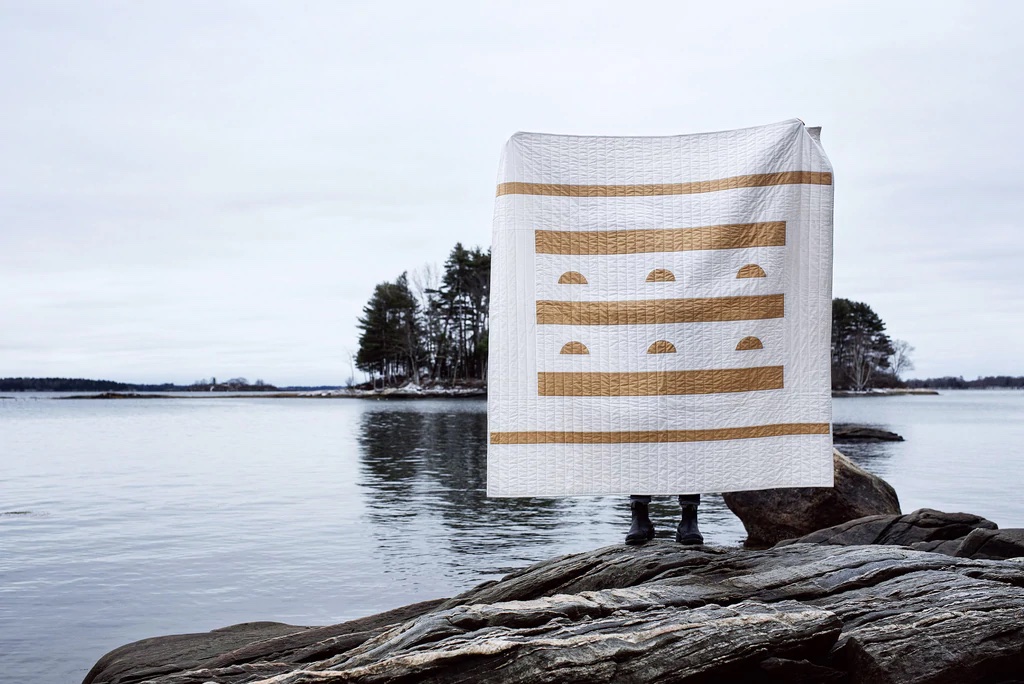
Some home objects whisper. Others announce themselves with brass hardware, marble veining, or a price tag that requires emotional hydration. Then there are quilts from Smith’s General in Yarmouth, Maine: quiet, practical, coastal, deeply considered, and somehow capable of making a room feel like it has exhaled. They do not beg for attention. They simply land on a bed, sofa, bench, or wall and say, “Yes, this is a home. Please remove your shoes and stop pretending you do not want a nap.”
Smith’s General, the quilt and pattern studio of designer and maker Dash Masland, has become a beloved name among people who like their interiors warm but not fussy, modern but not cold, handmade but not precious in the “nobody sit there” way. The studio’s work is rooted in the coast of Maine, where fog, rock, tide pools, working landscapes, and brisk evenings have a way of turning practical textiles into small acts of survival and beauty.
Today, Smith’s General notes that its studio is on hiatus for handmade goods, while quilt patterns remain available. That detail matters because it makes the quilts feel even more like objects of desire: admired, collected, searched for, remembered, and studied for their blend of craft and restraint. Whether you are lucky enough to own one, hunting for a pattern, or simply gathering design inspiration, these quilts offer a master class in modern heirloom style.
What Makes Smith’s General Quilts So Desirable?
The appeal begins with contrast. A Smith’s General quilt is contemporary, but it is not trendy. It uses clean geometry, coastal color, and negative space, yet it never feels sterile. The designs often take inspiration from Maine landscapes: a slate beach at sunset, the structure of a pier, the rhythm of tide pools, or the quiet drama of island paths. The result is not a literal postcard. It is more like a memory translated into fabric.
That is the trick. Many coastal home goods lean hard on anchors, shells, navy stripes, and the occasional lobster who looks like he is late for a yacht-club brunch. Smith’s General takes another route. The quilts draw from the coast without becoming costume. They suggest sea foam, stone, ochre, timber, snow, charcoal, and oat. These are colors that feel at home in Maine but also work beautifully in a Brooklyn apartment, a California bungalow, or a guest room that desperately needs a personality beyond “spare towels live here.”
Smith’s General’s best-known quilts, including the Madeleine Quilt, Winslow Quilt, and Mackworth Quilt, show how a handmade bed covering can function as both utility and art. Their patterns are minimal, but not empty. Their palette is soft, but not sleepy. Their craftsmanship is practical, but the emotional register is high. They are quilts with manners, backbone, and a very good sense of place.
A Maine Studio with a General Store Soul
Smith’s General began in Dash Masland’s home studio in 2017. In 2018, Masland opened a brick-and-mortar shop and renamed the brand Smith’s General, a nod to the building where the shop was located and to Smith’s Store, which operated there for much of the 1900s as a local staple. That backstory gives the brand its flavor. It is not just a quilt label; it carries the feeling of a community store, a maker’s workshop, and a New England habit of making beautiful things that still have a job to do.
The shop later moved to a small brick building in town before the 2020 pandemic forced the physical retail chapter to close. Smith’s General returned to an independent studio model, designing and making quilts by hand. In that evolution, the brand became even more focused: less storefront bustle, more studio discipline; less browsing with coffee in hand, more pattern, fabric, quilting, finishing, and coastal inspiration distilled into textile form.
That history matters for SEO readers and design lovers alike because it explains why these quilts do not feel mass-produced. They sit at the intersection of Maine craft, modern quilting, local memory, and small-studio design. In a marketplace crowded with bedding that looks nice in a thumbnail and mysteriously flattens in real life, Smith’s General quilts have depth. They come with a point of view.
The Design Language: Modern Quilting with Coastal Memory
Modern quilting often uses bold color, graphic contrast, minimalism, expansive negative space, alternate grids, and updated interpretations of traditional blocks. Smith’s General fits comfortably inside that conversation, but the studio’s work has a softer, more place-based quality than many high-contrast modern quilts. Instead of shouting with neon angles, it builds atmosphere with proportion, restraint, and coastal references.
The Madeleine Quilt
The Madeleine Quilt is inspired by a slate beach at the end of a Maine island, where sunset colors gather over the mainland and flat stones invite skipping. Its design references a stone crib supporting a pier, and its materials include a linen-cotton blend background, cotton fabrics, cotton batting, and cotton thread. The palette, with oat, charcoal stripe, ice blue, sea foam, light ochre, and deep mauve, feels like twilight edited by someone with excellent taste.
Madeleine works because it balances softness and structure. The name feels romantic, but the geometry keeps it grounded. It could sit on a bed in a shingled cottage, hang as textile art in a minimalist room, or soften a reading nook where the books are stacked in a way that says “curated” rather than “avalanche hazard.”
The Winslow Quilt
The Winslow Quilt takes inspiration from a peninsula landscape of forest paths, beaches, fields, ocean views, tide pools, and an old wooden crib pier. Its warm golden yellow accent evokes fresh wood, salty air, and summer by the sea. Made with cotton fabrics, cotton batting, and cotton thread, Winslow is one of those designs that proves a restrained palette can still carry a lot of feeling.
In a bedroom, Winslow adds warmth without tipping into rustic cliché. It pairs well with white sheets, natural wood, painted floors, woven baskets, linen curtains, and the kind of bedside lamp that makes you believe you might finally become a person who reads before bed instead of scrolling into oblivion.
The Mackworth Quilt
The Mackworth Quilt is bold in a quiet way. Inspired by Maine’s Mackworth Island and the form of a stone pier, it uses a minimalist design and a snow, black, and oat colorway. The materials include a linen-cotton blend and cotton fabrics, along with cotton batting and cotton thread. It is the most architectural of the group, making it especially appealing for interiors that lean modern, Scandinavian, Shaker-inspired, or gallery-like.
Mackworth is a reminder that quilts do not have to be busy to be interesting. Sometimes one strong shape, well placed, is enough. That is true in design and, frankly, in dinner plating. Nobody needs a parsley confetti cannon.
Why These Quilts Feel Like Heirlooms, Not Just Bedding
A quilt is more than a blanket. Traditionally, it is a layered textile made from a top, batting, and backing, stitched together for warmth, durability, and design. That structure gives quilts their tactile intelligence. They are soft but engineered, decorative but functional, intimate but visible. They live with the body and the room at the same time.
Smith’s General modernizes that heritage by using cleaner forms and contemporary palettes while preserving the emotional value of handwork. The quilts are meant to be used. Product care notes for several Smith’s General quilts include machine washing cold on delicate and tumble drying low for a crinkly texture, or laying flat to dry for a smoother finish. That is an important distinction. These are not museum pieces trapped behind glass, staring sadly at a climate-control system. They are designed for daily life.
At the same time, Smith’s General quilts can be ordered with hanging sleeves, allowing them to become wall displays. This dual role is central to their desirability. They can be bed coverings, throws, wall hangings, heirlooms, art objects, or the thing your guest secretly photographs before asking, “Where did you get this?”
How to Style Quilts from Smith’s General
The easiest way to style a Smith’s General quilt is to avoid overworking it. These quilts already bring pattern, texture, and story. Give them space. A white, cream, oat, or pale gray sheet set lets the geometry breathe. Natural woods, simple ceramics, woven lampshades, and a few coastal materials such as stoneware or linen can echo the Maine mood without turning the room into a themed rental called “The Salty Gull.”
On the Bed
For a serene bedroom, fold a Smith’s General quilt across the lower third of the bed over crisp cotton or linen sheets. This keeps the quilt visible while allowing the rest of the bed to feel airy. For a more relaxed look, pull it all the way up and let the natural crinkle show. Quilts are better when they look used. A perfectly flat quilt can feel like a spreadsheet with batting.
On the Sofa
A throw-size quilt can soften a modern sofa, especially one with clean lines or neutral upholstery. Drape it casually over the back or fold it lengthwise over one arm. The goal is not chaos; it is controlled invitation. You want the room to say, “Sit down,” not “A textile emergency occurred here.”
On the Wall
Because many Smith’s General designs have strong graphic compositions, they work beautifully as wall art. A hanging sleeve makes display easier, and the texture adds warmth that framed prints cannot always provide. This is especially effective in dining rooms, bedrooms, stairwells, nurseries, and home offices where acoustic softness is a bonus.
What Smith’s General Teaches About Modern Coastal Design
The biggest lesson is restraint. Coastal design does not need to be literal. A room can feel connected to the sea through palette, material, texture, and atmosphere rather than decorative props. Smith’s General quilts show how coastal inspiration can be abstracted into shape and color: black and oat for stone, light ochre for wood, sea foam for water, mauve for evening sky, snow for salt air and winter light.
The second lesson is usefulness. Good design should make life better, not more complicated. A quilt warms the bed, travels to the sofa, comforts a child, dresses a guest room, and occasionally saves a movie night from thermostat politics. Handmade quality does not mean fragile. In the best case, it means repairable, lovable, and worth keeping.
The third lesson is locality. Smith’s General quilts carry Maine not as a logo, but as a way of seeing. The designs are shaped by islands, piers, beaches, tide pools, and the practical culture of textiles in a climate where summer nights can still turn cool. That rootedness gives the work staying power.
Buying, Collecting, or Recreating the Look
Because Smith’s General’s handmade goods are currently on hiatus, shoppers may not always find finished quilts available directly. However, the studio continues to offer quilt patterns, including modern designs such as Flight Effect, a paper-pieced pattern inspired by ocean surroundings and birds in migration. For makers, this opens a different kind of desire: not just owning the object, but participating in the process.
If you are shopping secondhand or watching for future studio updates, pay attention to size, materials, condition, and whether the quilt includes a hanging sleeve. Smith’s General quilts have been produced in multiple sizes, including little, throw, twin, queen, and king for several designs. That range makes them versatile, but it also means scale matters. A little quilt may be perfect for a nursery wall or reading chair; a queen or king can define an entire room.
If you are trying to recreate the feeling rather than purchase the exact piece, focus on natural fibers, spare geometry, and landscape-inspired color. Look for cotton, linen-cotton blends, visible quilting texture, and patterns that use space confidently. Avoid overly glossy fabrics or generic coastal motifs. The Smith’s General mood is thoughtful, not souvenir-shop frantic.
The Experience: Living with a Quilt Inspired by Smith’s General
To understand the desire around these quilts, imagine a late afternoon in a Maine house. The air has shifted. Morning was bright and easy, but now the temperature is doing that coastal trick where it drops just enough to make everyone reconsider their confidence. The windows are cracked. Somewhere outside, a gull is screaming as if it has discovered taxes. You walk into a bedroom and see a quilt folded across the bed: simple, graphic, soft, and quietly alive with texture.
This is where the magic of a Smith’s General-style quilt becomes clear. It does not behave like ordinary bedding. It changes the room’s pace. The bed feels less like furniture and more like a landing place. The quilt’s geometry gives the eye somewhere to rest, while the fabric gives the hand something to understand. You notice the stitching. You notice the color shifts. You notice how a small accent can change the mood of an entire white room.
Using a quilt like this also changes how you think about home. Many decorative objects are passive. They sit there and look pretty, which is fine; we all have days when sitting there and looking pretty is the full agenda. But a quilt participates. It warms your knees during coffee. It becomes the extra layer when a guest stays over. It is dragged to the porch, folded back onto the bed, shaken out after a nap, admired from the doorway, and eventually associated with specific seasons and people.
There is also a pleasing honesty to quilts. They reveal use rather than hiding it. A little crinkle after washing is not a flaw; it is character. Cotton softens. Edges relax. The surface develops a lived-in topography. Unlike decor that seems to lose value the moment real life touches it, a good quilt becomes better when it joins the household routine. It is one of the rare design objects that can handle a sleepy dog, a chilly teenager, a visiting aunt, and a bowl of popcorn nearby, though let us not test the popcorn too aggressively.
For anyone drawn to Smith’s General, the experience is also about longing for place. You do not have to live in Maine to understand the appeal of coastal restraint. The quilts carry that feeling of weathered wood, open water, stone paths, salt air, and quiet rooms where the best objects are useful first and beautiful because of it. They make a home feel collected rather than decorated. They suggest that taste is not about owning more things; it is about choosing things with enough meaning to stay.
That is why these quilts work so well in different interiors. In a farmhouse, they feel native. In a city apartment, they bring air and texture. In a modern home, they soften hard lines. In a cottage, they avoid kitsch. In a child’s room, they offer warmth without cartoon overload. In a guest room, they perform the design equivalent of a handwritten note: thoughtful, personal, and much nicer than a mysterious decorative pillow that nobody knows where to put at bedtime.
There is a small ritual pleasure in folding a quilt at the end of the day. The weight of it, the sound of fabric moving, the way the stitched layers hold shapeall of it makes the room feel tended. That is the real object of desire. Not just the quilt as a product, but the life it implies: slower, warmer, more attentive, with fewer disposable things and more objects worth repairing, washing, folding, and passing on.
Conclusion: A Quiet Luxury Worth Wanting
Quilts from Smith’s General in Yarmouth, Maine, occupy a rare design category: practical art with emotional weather. They are modern enough for clean-lined interiors, traditional enough to feel rooted, and personal enough to outlast trends. Their references to Maine’s coast give them depth, while their restrained geometry makes them easy to live with.
In an era of fast decor and algorithm-approved sameness, Smith’s General reminds us that desire can be quiet. It can look like cotton, linen, batting, thread, and a shape borrowed from a pier. It can be handmade, washable, useful, and beautiful without shouting. And when the fog rolls in, whether you are actually in Maine or just spiritually parked beside a tide pool, a quilt like this feels less like an accessory and more like the point.