For more than two decades, the International Space Station has been the world’s most expensive roommate arrangement: the United States, Russia, Europe, Japan, and Canada all sharing one orbiting laboratory while trying not to bump elbows in microgravity. But Russia has repeatedly floated a bold idea: when the ISS era ends, why not take parts of the Russian segment, separate them from the rest of the station, and use them as the seed of a new national outpost?
That idea sounds simple in a headline. In reality, it is more like trying to detach one apartment from a skyscraper while the whole building is traveling around Earth at roughly 17,500 miles per hour. Still, the concept has returned again and again under names such as the Russian Orbital Station, ROS, and the Russian Orbital Service Station, ROSS. Russia’s plan to spin off a new space station from the ISS is not just a space engineering story. It is also a story about geopolitics, aging hardware, national prestige, orbital economics, and the awkward question of what comes after humanity’s most famous laboratory in low Earth orbit.
What Is Russia’s “Spin-Off” Space Station Plan?
The basic idea is to preserve Russia’s human presence in orbit after the ISS retires. Instead of starting completely from zero, Russia has considered using relatively newer Russian modules attached to the ISS as the foundation for a future station. Older versions of the plan focused on modules that were still waiting to launch, including the Nauka laboratory, the Prichal node, and the Science and Power Module, often called NEM. More recent discussions have explored whether existing Russian ISS hardware could be reused when the international partnership winds down.
In plain English, the “spin-off” plan means this: separate selected Russian modules from the ISS, add new modules, provide independent power and propulsion, and operate the result as a Russian-controlled orbital station. It is not a cosmic version of unplugging a phone charger. The ISS is an integrated machine, with shared systems, shared responsibilities, and a long history of hardware being modified, repaired, patched, upgraded, and persuaded to keep working like a very expensive flying minivan.
A Short History of the Idea
The OPSEK Concept
Russia’s post-ISS thinking goes back years. One early concept was called OPSEK, short for Orbital Piloted Assembly and Experiment Complex. The concept imagined using Russian modules from the ISS as the core of a separate station that could support experiments, spacecraft assembly, and future deep-space missions. In theory, OPSEK would let Russia keep valuable orbital hardware instead of sending everything into a controlled reentry with the rest of the ISS.
That plan did not become reality, but it left behind an important idea: the Russian segment was designed with modularity in mind. Russian spacecraft architecture has a long tradition of docking ports, propulsion modules, service modules, and orbital add-ons. If space stations were made of building blocks, Russian engineers have always liked having extra blocks in the drawer.
The 2015–2016 Spin-Off Proposal
By the mid-2010s, Russian space officials and industry sources were discussing a more specific plan. The idea was to keep supporting the ISS for a while, then detach newer Russian modules after the station’s international mission ended. Nauka, Prichal, and the proposed NEM module were central to that vision. NEM was especially important because it was expected to provide substantial power generation and make the Russian outpost more independent.
That was the theory. The schedule, however, did what space schedules often do: it slipped, stretched, changed clothes, and pretended it had always meant to be late. Nauka, originally expected much earlier, finally docked with the ISS in July 2021. Prichal followed in November 2021. NEM has been redesigned and redirected over time, and the overall Russian station plan has gone through several major revisions.
The Current Situation: ISS Retirement and Russia’s Timeline
The ISS is not expected to operate forever. NASA and most of its international partners have committed to station operations through 2030, while Russia has formally committed through at least 2028. NASA has also selected a U.S. Deorbit Vehicle to help guide the ISS safely into a controlled reentry when the time comes. Translation: nobody wants a 400-ton space laboratory making surprise travel plans over someone’s backyard.
Russia, meanwhile, has announced plans for a new orbital station with a core targeted around 2030 and additional modules planned into the early 2030s. Public schedules have included a scientific and energy module, a universal node module, a gateway or airlock module, and other specialized modules. Some versions of the plan suggest periodic crewed visits rather than permanent occupation, which could reduce cost and radiation exposure while still preserving a national human spaceflight capability.
The most important point is that the plan is not frozen in titanium. Russia’s proposed station has shifted between several architectures: a fresh-built high-inclination station, a station assembled from new modules, and a renewed concept that could reuse Russian ISS components. That flexibility may be strategic, but it also reflects pressure from budgets, sanctions, aging hardware, industrial capacity, and the brutal reality that space stations are expensive even before you add the snacks.
Which ISS Modules Matter Most?
Nauka: The Late-Arriving Laboratory
Nauka, also known as the Multipurpose Laboratory Module, is one of the most important pieces in this story. It provides research space, a docking port, life-support-related systems, and an airlock function for the Russian segment. Its 2021 arrival was a major moment because Russia finally added a large modern laboratory module to the ISS after years of delays.
If Russia were to reuse ISS hardware, Nauka would be a logical candidate because it is younger than many other Russian modules. However, “younger” in space station terms does not mean “fresh out of the factory.” Launch delays, integration work, and years of orbital operation all matter. Any spin-off plan would require careful inspection, system upgrades, propulsion support, and a realistic assessment of how long the module can safely operate.
Prichal: The Docking Hub
Prichal is a node module attached to Nauka. It provides multiple docking ports, which makes it valuable for future expansion. Think of it as a space station hallway with several doors. Without doors, even the fanciest orbital apartment becomes a very lonely metal tube.
In a future Russian station concept, a node like Prichal or a replacement universal node could allow new modules, Soyuz crew vehicles, Progress cargo ships, and specialized spacecraft to attach. The docking architecture is one of the reasons Russia’s spin-off idea keeps resurfacing: modular stations need hubs, and Russia has experience building them.
NEM: The Power Problem Solver
The Science and Power Module, or NEM, has long been a key part of Russia’s future station thinking. Power is not glamorous, but it is everything. Science racks, life support, communications, thermal control, guidance systems, and crew comfort all need electricity. Without enough power, a space station becomes a very scenic storage locker.
Earlier plans imagined NEM helping the Russian segment become more independent from the rest of the ISS. Later plans redirected NEM toward Russia’s new orbital station. Whether launched as part of a free-flying station or added to a spun-off cluster, a power module would be essential for long-term autonomy.
Why Russia Wants Its Own Station
National Prestige and Continuity
Russia’s space identity is deeply tied to human spaceflight. The Soviet Union launched the first satellite, sent the first human into space, operated Salyut stations, built Mir, and became an essential ISS partner. A gap in crewed orbital operations would be politically and symbolically painful. A national station would say, “Russia is still here,” even if the international partnership changes shape.
Scientific and Industrial Goals
A Russian station could host materials research, medicine, biology, Earth observation, technology demonstrations, and spacecraft servicing experiments. Russia has also described goals related to national economy and security, especially tasks that may be difficult under ISS partnership rules. In other words, a national station offers control: control over research priorities, crew time, hardware, access, and international partners.
Geopolitics After the ISS
The ISS has survived political storms that would have sunk almost any other partnership. Even during periods of severe tension between Russia and the West, astronauts and cosmonauts have continued flying together because the station depends on cooperation. But the future of low Earth orbit is becoming more fragmented. The United States is pushing commercial space stations. China operates Tiangong. Russia wants its own destination. The post-ISS era may look less like one big shared laboratory and more like a neighborhood of orbital platforms, each with its own landlord, rules, and parking situation.
The Big Engineering Challenge: Can You Really Detach Part of the ISS?
Technically, the ISS is modular. Practically, it is deeply interconnected. Power, data, thermal control, attitude control, communications, docking schedules, crew procedures, software, and safety systems all interact. Separating modules would require more than mechanical undocking. Engineers would need to confirm independent power, guidance, propulsion, life support, communications, orbital maintenance, debris avoidance, and emergency procedures.
The Russian segment has historically provided important propulsion and attitude-control functions for the ISS, while the U.S. segment provides large solar arrays and many laboratory resources. A spun-off Russian station would need to replace every dependency it once had on the larger ISS. It would also need a reliable way to maintain orbit, because low Earth orbit is not a free parking lot. Atmospheric drag slowly pulls spacecraft downward, so stations need periodic boosts.
There is also the issue of age. Some Russian modules are old. The Zvezda service module, for example, has been in orbit since 2000 and has experienced leak concerns in its transfer compartment area. Reusing aging hardware may save launch mass, but it can also create maintenance headaches. Space does not forgive nostalgia.
What Could the New Russian Station Look Like?
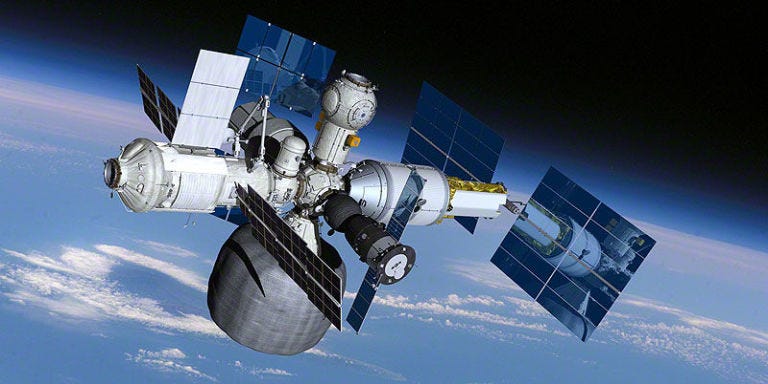
Depending on the architecture Russia ultimately chooses, the station could start with a small core and expand over time. A realistic early station might include a laboratory or service module, a node module, docking ports, solar arrays, propulsion support, and an airlock. Later modules could add research capacity, Earth observation equipment, storage, or commercial facilities.
Earlier concepts imagined a high-inclination orbit that would give Russia better coverage of its territory and the Arctic. A station derived from the ISS, however, would likely inherit the ISS orbital inclination unless major propulsion resources were used to change it, which would be difficult and costly. This is one of the central trade-offs: reuse hardware and accept certain orbital limits, or build new hardware and target a more customized orbit.
How This Fits Into the Global Space Station Race
Russia is not the only country planning life after the ISS. NASA wants to transition low Earth orbit research to commercial platforms. Axiom Space has worked on commercial modules that could first attach to the ISS and later become a free-flying station. Other companies and partnerships are pursuing private orbital destinations. China’s Tiangong station is already operating. India has discussed long-term plans for its own station. Low Earth orbit is becoming less like a single international clubhouse and more like a competitive real estate market with very strict launch windows.
For Russia, the risk is falling behind. Soyuz and Progress remain proven vehicles, but station construction requires money, manufacturing capacity, modern electronics, reliable launch vehicles, and long-term political commitment. Sanctions and supply-chain pressures add difficulty. The country has world-class experience in space station operations, but experience does not automatically pay invoices or build new modules.
Why the Plan Could Succeed
Russia has a deep bench of station experience. It operated Mir for years, helped assemble and maintain the ISS, and still flies crew and cargo vehicles with an unmatched operational history. The modular design philosophy behind Russian spacecraft is practical and proven. If Russia keeps the first phase modest, focuses on essential systems, and uses existing vehicles wisely, it could preserve a smaller but meaningful orbital presence.
A periodically crewed station might also be more affordable than a permanently occupied one. Crews could visit to install experiments, maintain equipment, unload cargo, and perform upgrades, while the station operates autonomously between missions. This model would not match the ISS as a constantly inhabited laboratory, but it could still support national research and technology development.
Why the Plan Could Struggle
The obstacles are serious. First, schedules in spaceflight are famously optimistic. Second, reusing ISS modules may be technically harder than building a clean new design. Third, Russia’s space industry has faced funding limits, workforce challenges, and project delays. Fourth, any plan tied to the ISS endgame depends on international coordination, because the ISS cannot be retired like an old sofa left on the curb.
The biggest challenge may be timing. If the ISS retires around 2030, Russia needs its next station ready soon enough to avoid a major gap in human spaceflight. If new modules are late, or if reused modules prove too risky, Russia could face a difficult choice: extend ISS participation, accept a gap, or scale down the station plan.
Real-World Experiences and Lessons From Russia’s ISS Spin-Off Plan
The most useful experience connected to Russia’s plan is not just technical; it is human. The ISS has shown that space stations are never finished. They are maintained, repaired, upgraded, negotiated, and occasionally argued with. Anyone who has followed ISS operations knows that a station is less like a finished building and more like a living machine. A pump fails, a cargo ship docks, a crew swaps out hardware, a software update changes procedures, and somewhere on Earth a team of engineers drinks coffee with the seriousness of people defusing a bomb.
One lesson is that modularity is powerful, but it is not magic. The ISS was built from modules, yet those modules became deeply connected over time. That is similar to adding rooms to a house over 25 years. At first, each room may have its own purpose. Later, the wiring, plumbing, Wi-Fi router, storage boxes, and mysterious extension cords make separation complicated. Russia’s spin-off concept reminds engineers and space fans that “designed to dock” does not always mean “easy to detach and reuse decades later.”
Another experience is the value of redundancy. Space stations need backup plans for backup plans. If a station separates from the ISS, it must have independent life support, power, navigation, propulsion, and communications. A missing capability in orbit is not an inconvenience; it is a mission-ending problem wearing a helmet. This is why the NEM power module has been so important in Russian station concepts. Power is the difference between an orbital research platform and a cold metal museum exhibit.
The ISS also teaches a political lesson. Cooperation in space can survive tension, but it cannot ignore reality forever. The station has been a rare bridge between Russia and the United States, even when relations on Earth were icy enough to make Pluto look cozy. A future Russian station would give Moscow independence, but independence also means carrying more of the burden alone. Shared projects spread cost and risk. National projects give control, but they also send the bill to one address.
For students, writers, and space enthusiasts, the story offers a practical way to understand space policy: hardware and politics are glued together. A module is never just a module. It represents factories, budgets, launch vehicles, treaties, engineering culture, national pride, and future strategy. Russia’s plan to spin off a new station from the ISS is fascinating because it sits at the intersection of all those forces.
The final experience is patience. Space plans often look clean in PowerPoint and messy in orbit. Nauka’s long road to launch is a perfect reminder. The module eventually reached the ISS, but only after years of delays. That does not mean future Russian station plans are impossible. It means every date should be treated as a target, not a promise carved into lunar stone. Space history rewards persistence, but it also has a wicked sense of humor.
Conclusion: A Bold Plan With a Complicated Flight Path
Russia’s plan to spin off a new space station from the ISS is bold, logical, and difficult all at once. It makes sense because Russia wants continuity in human spaceflight, independence in research, and a platform for national goals after the ISS. It is difficult because separating and reusing orbital hardware is technically demanding, politically sensitive, and financially heavy.
The most realistic view is neither blind optimism nor dramatic doom. Russia has the experience to operate space stations. It also faces major constraints. Whether the future ROS or ROSS becomes a full national outpost, a smaller periodically crewed platform, or another revised architecture will depend on funding, launch readiness, module health, and coordination around the ISS endgame.
One thing is certain: the ISS has changed how humanity lives and works in space. If Russia manages to turn part of that legacy into a new station, it will be one of the most ambitious recycling projects in history. Most people recycle bottles. Russia is talking about recycling orbital real estate. The bin, naturally, is moving at five miles per second.