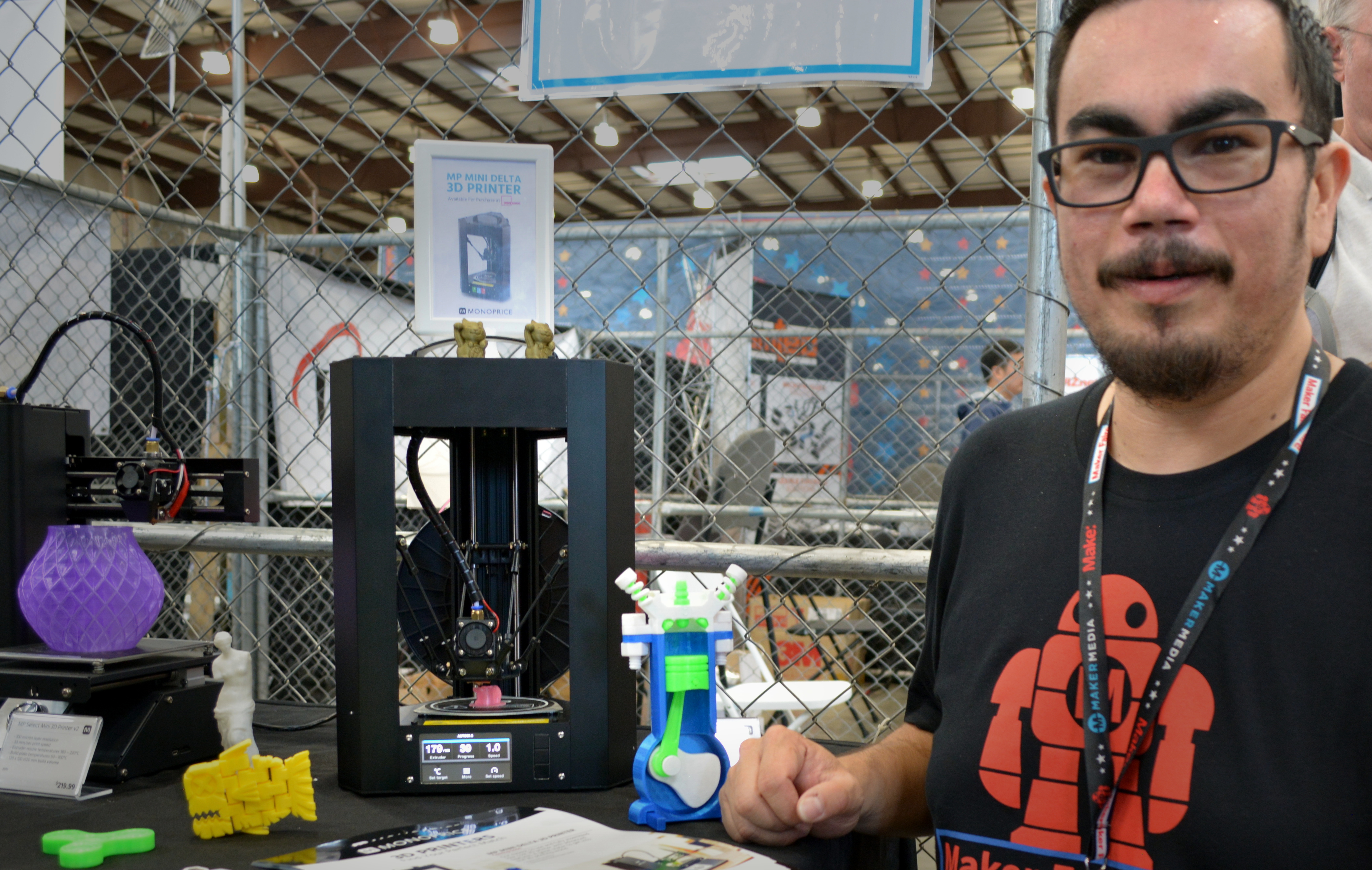
At a crowded maker event, most gadgets beg for attention with blinking lights, oversized banners, or someone on a microphone explaining why the future has arrived and happens to be 17 percent lighter than last year. The Monoprice Mini Delta 3D Printer did something smarter: it simply started printing. Small, quick, and strangely hypnotic, the machine at the Monoprice booth turned filament into tiny models while its three arms danced above a circular build plate like a caffeinated robot tripod.
The scene was not about a massive industrial printer or a boutique machine priced like a used car. It was about a compact delta-style 3D printer that made desktop fabrication feel approachable. The MP Mini Delta arrived with a simple promise: a fully assembled, budget-friendly 3D printer that beginners could unbox, plug in, and use without first earning a minor in mechanical frustration. For hobbyists, students, teachers, and curious tinkerers, that was a big deal.
The Monoprice booth demo mattered because 3D printers are often judged twice: first by the spec sheet, then by the moment people see plastic actually sticking to the bed instead of curling into modern art. Watching the Mini Delta in action helped answer the real question: could a small, inexpensive delta 3D printer be more than a novelty? The answer was mostly yeswith a few charming little caveats, because every 3D printer has at least one personality quirk. It is practically required by law.
What Made the Monoprice Mini Delta Stand Out?
The MP Mini Delta was built around a compact delta design, meaning it did not move like the more familiar Cartesian 3D printers that slide along X, Y, and Z axes in a boxy frame. Instead, three vertical towers and three sets of arms coordinated movement above a round build plate. The result was a printer that looked faster, more animated, and frankly more entertaining than many entry-level machines.
Its core appeal came from a rare combination at the time: low cost, small footprint, auto bed leveling, a heated build plate, a metal frame, and ready-to-print convenience. Monoprice positioned the Mini Delta as a beginner-friendly printer, but it was also interesting to experienced makers because delta printers were usually associated with speed, smooth motion, and slightly more exotic engineering.
Key specs that defined the Mini Delta
The original MP Mini Delta featured a build area of about 110 mm in diameter and 120 mm tall. That is not huge, but it is enough for small figurines, calibration models, brackets, keychains, tabletop gaming pieces, educational objects, and the inevitable army of tiny cats that every 3D printer seems destined to produce.
It used 1.75 mm filament, a common 0.4 mm nozzle, and supported materials such as PLA and ABS. It also offered a layer resolution as fine as 50 microns, a print speed advertised up to 150 mm per second, microSD printing, USB connectivity, and Wi-Fi support depending on setup and model revision. The heated build plate made it more flexible than many bare-bones starter printers, while the assisted filament feed made loading material less intimidating for first-time users.
The Booth Demo: Tiny Prints, Big Attention
At the Monoprice booth, the Mini Delta was seen printing small waving cat models, the kind of adorable test object that makes even serious engineers pause and say, “Okay, that’s pretty cute.” A booth demo is a harsh environment for a 3D printer. There is noise, vibration, constant attention, curious hands, uneven tables, and the pressure of having to perform in public. In other words, it is like karaoke night for machines.
The Mini Delta’s advantage in that setting was its compact, enclosed-feeling metal frame and simple visual rhythm. Delta printers naturally draw a crowd because the motion is easy to see. The arms move rapidly and smoothly, meeting above the bed while the hot end lays down filament one layer at a time. Even people who know nothing about G-code can understand the magic: plastic string goes in, object comes out.
For Monoprice, the booth demonstration was also a statement about accessibility. The company had already gained attention with inexpensive desktop 3D printers, and the Mini Delta pushed that idea further. Instead of asking beginners to assemble a kit, square a frame, adjust eccentric nuts, and pray to the bed-leveling spirits, Monoprice showed a machine that could arrive mostly ready for action.
Why Delta 3D Printers Are So Fun to Watch
Most desktop 3D printers are practical rectangles. They work hard, but visually they are about as dramatic as a microwave with ambition. A delta printer is different. Its three arms move in synchronized patterns, constantly recalculating the position of the nozzle. This gives the machine a lively, almost creature-like motion.
Technically, the design has real advantages. A delta printer typically keeps the print bed stationary while the lightweight print head moves above it. Less moving mass can mean faster travel moves and smoother motion. The Bowden-style extruder setup, where the motor pushes filament through a tube to the hot end, keeps weight off the moving carriage. That helps explain why delta printers are often associated with speed.
However, delta machines also have trade-offs. Calibration matters. The build area is circular, not rectangular. Tall narrow objects are often a natural fit, but wide square parts may waste usable space. On the Mini Delta, the small 110 mm diameter bed means users must think carefully about model size and orientation. This is not the printer for making a full-size helmet in one piece unless the helmet is for a hamster with heroic dreams.
Beginner-Friendly Features That Actually Matter
The phrase “beginner-friendly 3D printer” gets used so often that it can feel like marketing confetti. With the MP Mini Delta, several features genuinely supported new users.
Fully assembled design
The Mini Delta came fully assembled. That removed one of the biggest barriers for beginners: setup anxiety. Many affordable printers require assembly, and while that can be educational, it can also turn a Saturday afternoon into a detective story involving missing screws, vague diagrams, and one mysterious washer that appears to belong nowhere.
Auto bed leveling
Auto bed leveling was another major selling point. Manual leveling is one of the classic beginner frustrations in 3D printing. If the nozzle is too close to the bed, filament may not flow properly. If it is too far away, the first layer will not stick. The Mini Delta’s auto-leveling system helped reduce that problem by probing the bed and compensating before printing.
Heated build plate
A heated build plate helps with adhesion and material compatibility. PLA is usually the easiest filament for beginners, but a heated surface can improve first-layer reliability. ABS is more demanding because it can warp and benefits from a controlled environment, but the Mini Delta’s support for multiple materials gave users room to experiment as their skills improved.
Small footprint and portability
The Mini Delta’s compact size made it attractive for classrooms, dorm rooms, workshops, and small desks. Its metal frame and carry-friendly form factor gave it a “take me to the makerspace” personality. For teachers, that portability was useful. For hobbyists, it meant the printer could live on a shelf without demanding half the room and a tribute of desk space.
Print Quality: Better Than Its Price Suggested
For a budget printer, the Mini Delta earned attention because it could produce surprisingly clean small prints when properly set up. Reviewers and users often found that test models such as Benchy boats, lucky cats, and small figurines came out respectably. Fine details, smooth surfaces, and readable small features were possible, especially with PLA and conservative slicer settings.
That said, expectations matter. This was not a premium Prusa, Ultimaker, or professional resin machine. It was an affordable FFF printer designed to get people printing without draining their wallet. Small imperfections such as stringing, minor blobs, inconsistent adhesion, or slight ringing could appear. In the budget 3D printer world, those are not shocking flaws; they are more like the printer clearing its throat.
The best results generally came from slowing down, using dry filament, keeping the bed surface clean, and tuning slicer settings. A 0.2 mm layer height is a sensible everyday setting for many prints, while finer layers can improve detail at the cost of time. Users chasing the advertised 50-micron resolution needed patience, good filament, and realistic expectations. Ultra-fine layers are lovely, but they can turn a tiny print into a full evening’s entertainment.
Where the Mini Delta Shined
The Monoprice Mini Delta was especially good for small, quick, repeatable objects. It made sense for decorative prints, educational models, simple prototypes, tabletop accessories, and small replacement parts. Its circular bed suited round or compact models particularly well.
In a classroom, the printer’s motion made the technology easy to explain. Students could see the connection between digital design and physical output. In a hobby workshop, it was a convenient secondary printer for small jobs. For beginners, it offered an affordable way to learn the 3D printing workflow: find or design a model, slice it, load filament, start the print, monitor the first layer, and then experience the emotional roller coaster of waiting.
The Mini Delta also had a community advantage. Because it attracted budget-minded makers, plenty of users experimented with Cura profiles, OctoPrint setups, bed surface upgrades, glass plates, firmware tweaks, and calibration improvements. That community knowledge made the printer more useful than its price alone suggested.
Where It Had Limitations
No honest review of the MP Mini Delta would pretend it was perfect. The small build volume was the most obvious limitation. If your dream project involves large cosplay armor, full-size vases, or giant functional parts, this little machine will look at you politely and ask whether you have considered printing in 47 pieces.
Bed adhesion could also require attention. Small printers with heated beds can still struggle if heat distribution is uneven, the surface is worn, or the model has a large footprint. Cleaning the build surface, using proper temperatures, adding a brim, or upgrading the surface could help.
Connectivity was another mixed area. MicroSD printing was often the simplest and most reliable route. USB and Wi-Fi could work, but many users preferred straightforward offline printing or external print management tools. This is common with budget printers: the mechanical parts may be surprisingly capable, while the software experience sometimes arrives wearing mismatched socks.
Mini Delta vs. Typical Cartesian Printers
Compared with common Cartesian printers, the Mini Delta felt more compact and playful. Cartesian printers often provide larger rectangular build plates, easier mechanical intuition, and broad slicer support. Delta printers, meanwhile, offer a distinctive motion system, a stationary bed, and a strong visual appeal.
For beginners choosing between the two, the question is not simply “Which is better?” It is “What do you want to print?” If you need larger parts, a budget Cartesian printer may be more practical. If you want a compact machine for small models, quick demos, STEM learning, and the sheer joy of watching three arms zip around like a tiny factory ballet, the Mini Delta makes sense.
Best Uses for the Monoprice Mini Delta
The MP Mini Delta is best for users who value convenience, compactness, and affordability. It is a smart fit for:
- First-time 3D printing learners who want a low-cost entry point.
- Teachers needing a portable printer for STEM demonstrations.
- Makers who want a secondary printer for small parts.
- Tabletop gamers printing mini accessories, markers, and terrain details.
- Design students testing small prototypes and shape studies.
- Parents introducing kids to digital fabrication with supervision.
It is less ideal for users who need large build volume, high-temperature engineering materials, silent operation, or a polished plug-and-play software ecosystem. The Mini Delta is friendly, but it still lives in the world of hobby 3D printing. You may occasionally need to clean a nozzle, tweak a profile, re-slice a model, or explain to a failed print that it has disappointed the family.
Hands-On Experience: What It Feels Like to Use the Mini Delta
Watching the Mini Delta at a booth is one thing; living with a printer like it is another. The first impression is usually delight. It is small enough to feel unintimidating and mechanical enough to feel serious. When the arms start moving during calibration, the printer seems to perform a little warm-up routine, like a robot stretching before a jog.
The first print is often the emotional hook. You load PLA, select a file from the microSD card, and wait for the bed and nozzle to heat. Then the auto-leveling process begins. The nozzle checks points on the bed, the arms twitch and rise, and the machine prepares itself. For beginners, this is reassuring. Instead of turning knobs under the bed while squinting at a piece of paper, you get to watch the printer handle much of the setup.
When the first layer goes down properly, the Mini Delta becomes addictive. There is something deeply satisfying about seeing a thin plastic outline appear on the build plate. It starts as nothing, then becomes a base, then walls, then a recognizable object. A tiny cat, a small vase, a calibration cube, a game tokeneach print feels like a miniature magic trick with a warm nozzle.
The experience is not completely hands-off. You learn quickly that filament quality matters. Old, brittle, or moisture-filled filament can cause stringing and weak prints. You learn that the bed must be clean. You learn that “fast” is not always “better,” especially if a model has small details. You also learn that support material is both a blessing and a tiny plastic punishment, depending on how easy it is to remove.
One practical habit is to start with PLA. It is forgiving, widely available, and less fussy than ABS. For small decorative prints, PLA usually gives the best beginner experience. ABS can work, but it is more prone to warping and odor, and it generally behaves better in a warmer, more controlled environment. PETG may also be tempting for stronger parts, but it can string more and may require more careful tuning.
Another hands-on lesson is that the Mini Delta rewards modest expectations. Try to print a small bracket, a figurine, or a simple enclosure, and the machine feels clever and capable. Try to print something that barely fits the circular bed, and suddenly you are negotiating with geometry like a stressed architect. The printer can do useful work, but it likes small work best.
The most enjoyable use case is rapid learning. Because the printer is compact and relatively quick, it encourages experimentation. Change infill from 10 percent to 25 percent. Try 0.2 mm layers, then 0.1 mm. Print the same model with and without a brim. Compare PLA brands. Adjust retraction to reduce stringing. Each test teaches a visible lesson, and the small build volume keeps mistakes affordable.
In a booth or classroom, the Mini Delta’s real superpower is attention. People stop to watch it. They ask what it is making. They ask how the file gets into the printer. They ask whether it can print a phone case, a toy, a chess piece, or a replacement knob for a drawer. That curiosity is exactly what an entry-level 3D printer should create. The Mini Delta does not just make plastic objects; it makes people lean closer.
Conclusion: A Small Printer With a Surprisingly Big Role
The Mini Delta 3D Printer in action at the Monoprice booth represented an important moment in affordable desktop fabrication. It showed that 3D printing did not have to be huge, expensive, or frighteningly technical to be exciting. With its delta motion, auto bed leveling, heated plate, compact metal frame, and beginner-friendly setup, the MP Mini Delta helped make 3D printing feel reachable.
It was not flawless. The build volume was small, bed adhesion could require care, and users who wanted large or advanced prints would quickly meet its limits. But as a first printer, classroom demo machine, small-part workhorse, or maker conversation starter, it had real charm. It was the kind of printer that invited people to try, fail, tweak, laugh, and try againwhich is basically the unofficial motto of 3D printing.
For anyone interested in the history of budget 3D printers, the Monoprice Mini Delta remains memorable because it captured the spirit of the maker movement: affordable tools, visible mechanics, hands-on learning, and just enough weirdness to keep things fun. And yes, if a tiny waving cat appears on the print bed, that is not a bug. That is tradition.
Note: This article is based on real manufacturer specifications, maker-event reporting, independent 3D printer reviews, slicing-software documentation, and community setup knowledge, rewritten into original web-ready content without inserting source links.