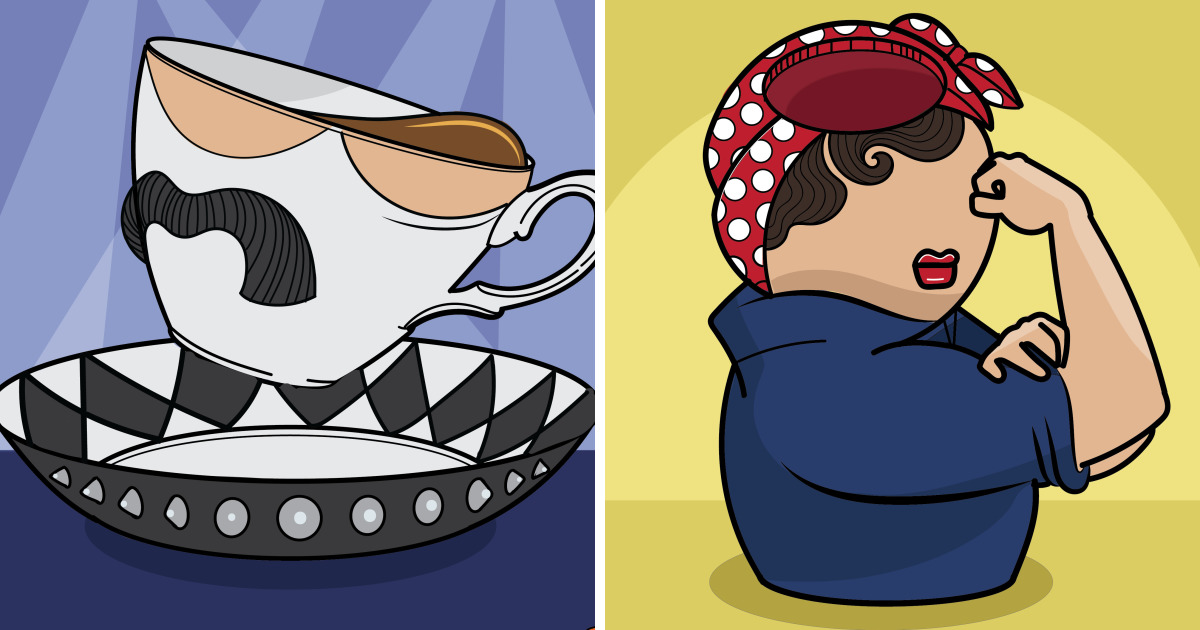
Some mugs hold coffee. Some mugs hold tea. And then there are mugs that look like they are silently judging your breakfast choices, your inbox, and the fact that you said you would “start drinking less caffeine” three Mondays ago.
“I Created Another Set Of Mugs That Look Like People” is the kind of playful art idea that instantly makes sense the moment you see it. A mug already has a “body,” a handle that can behave like an arm or ear, and a curved surface begging for expression. Add a hairstyle, a recognizable outfit, a smirk, a pair of iconic glasses, or one dramatic mustache, and suddenly your morning cup is no longer an object. It is a tiny character sitting on the table, waiting for hot liquid and applause.
This article explores why character mugs are so charming, how human-like mugs connect to a long tradition of face vessels and folk pottery, and why handmade ceramic art continues to win hearts in a world full of factory-perfect objects. The short answer? People love useful things with personality. The longer answer involves clay, humor, nostalgia, design psychology, pop culture, and the universal desire to drink coffee from something that looks like it has a backstory.
Why Mugs That Look Like People Are So Instantly Lovable
A mug is one of the most personal objects in a home. It sits in your hand when you are barely awake. It follows you to work. It shows up in video calls. It carries coffee, tea, cocoa, soup, and occasionally emergency cereal when all the bowls are dirty. Because it is already part of daily life, turning a mug into a character makes the object feel even more intimate.
When a mug looks like a person, it becomes more than drinkware. It becomes a miniature portrait, a joke, a collectible, and a mood. A Bob Ross-inspired mug, for example, does not simply remind people of painting. It suggests soft hair, calm energy, happy little accidents, and the comforting belief that your spilled latte may also be part of the artistic process. A Freddie Mercury-inspired mug can feel theatrical before it is even filled. A Cleopatra mug immediately brings drama, elegance, and a faint suspicion that the tea may have political consequences.
The magic is in recognition. Viewers enjoy the tiny moment when their brain says, “Wait, I know this person.” That spark of recognition is what makes character mugs highly shareable online. They work quickly. They are visual jokes with handles.
The Art Of Turning A Cup Into A Character
Designing mugs that resemble people is not as easy as drawing a face on a cylinder and calling it a day. A good character mug needs balance. It must look funny or expressive, but it still needs to function as a mug. Nobody wants a stunning sculptural masterpiece that pokes them in the eyebrow every time they try to sip coffee.
1. The Silhouette Comes First
The strongest character mugs usually begin with a clear silhouette. Hair, hats, crowns, glasses, collars, facial hair, and clothing details help identify the person before the viewer notices smaller features. A tall hairstyle can transform the top rim into a crown of personality. A painted jacket can turn the body of the mug into a torso. A handle can become part of the design instead of a boring loop attached to the side.
2. Expression Does The Heavy Lifting
Human-like mugs do not need perfect realism. In fact, too much realism can make them less charming. The best designs often exaggerate one or two memorable traits: a raised eyebrow, a dramatic smile, round glasses, sharp eyeliner, an unforgettable mustache, or a calm little grin. These details give the mug life without making it look like a haunted teacup escaped from a Victorian attic.
3. Function Still Matters
A character mug should be comfortable to hold, pleasant to drink from, and stable on a table. This is where ceramic design becomes more than decoration. The rim must feel right. The handle must be usable. The weight must be reasonable. If a mug looks amazing but behaves like a tiny ceramic obstacle course, it becomes a display piece rather than a daily companion.
A Modern Idea With Deep Ceramic Roots
Although internet audiences may see personality mugs as a fresh and funny design trend, the idea of giving vessels human features has a much older history. Across cultures, artists have shaped clay into faces, figures, spirits, symbols, and characters for centuries. In the United States, face vessels and face jugs are especially important in the history of Southern ceramics.
American face vessels are often associated with nineteenth-century pottery traditions in the Edgefield District of South Carolina. These works were created by skilled Black potters, including enslaved and later freed artisans, and they carry deep cultural, historical, and spiritual meaning. Their wide eyes, expressive teeth, and powerful forms are not merely decorative. They are part of a serious artistic tradition that reflects identity, belief, survival, and craftsmanship.
Today’s playful character mugs should not be confused with those historic face vessels, but they do belong to the larger human habit of seeing personality in clay. The connection is simple: clay has always been good at holding a face. It can be pinched, carved, painted, glazed, stretched, and fired into something that feels alive. A mug shaped like a celebrity or fictional character may be humorous and modern, but the impulse behind it is ancient: we like objects that look back at us.
Why Our Brains Love Faces On Objects
There is also a psychological reason these mugs are so satisfying. Humans are extremely good at detecting faces, even where no actual face exists. We see faces in electrical outlets, car headlights, clouds, burnt toast, backpacks, and slightly judgmental bell peppers. This tendency is often called face pareidolia.
Character mugs use that instinct on purpose. Instead of waiting for people to accidentally see a face in an object, the artist builds the face directly into the object. The result feels immediate and delightful. Viewers do not need an art degree to understand it. The mug says, “Hello, I am a person now,” and the viewer says, “Fair enough.”
This is also why anthropomorphic design works so well in home goods. When an object seems to have a personality, people often remember it more easily. A plain white mug may be useful, but a mug that looks like a rock star, painter, queen, office boss, movie character, or historical figure becomes a conversation starter. It is no longer one mug among twenty. It is “the one with the hair.”
Pop Culture Makes These Mugs Even More Fun
One reason this style of mug art performs so well online is that it blends two powerful forces: handmade design and pop culture recognition. People enjoy seeing familiar figures reimagined in unexpected formats. A celebrity as a mug? Funny. A movie character as a mug? Also funny. A historical icon as a mug? Potentially educational, but still funny if the handle looks like an ear.
The best examples do not simply copy a famous face. They translate the character into mug language. A dramatic singer may become a bold shape with strong colors. A painter may be represented through hair texture and soft expression. A film character may be recognized through costume and attitude. A literary figure might appear through clothing, posture, or a clever visual reference.
This translation is where the creativity shines. The artist has to ask: What makes this person instantly recognizable? Is it the eyes? The hair? The quote? The clothing? The energy? The answer becomes the design blueprint.
Handmade Imperfection Is Part Of The Appeal
One of the best things about handmade mugs is that they do not look like they were stamped out by an emotionless machine named Unit 47-B. Handmade ceramics carry small variations. A line may wobble slightly. A glaze may pool differently near the base. A sculpted feature may have the charming asymmetry of something made by actual human hands.
For character mugs, those imperfections are not flaws. They are personality boosters. A slightly uneven eyebrow can make a mug look suspicious. A soft glaze variation can make a painted jacket look more alive. A tiny difference between two eyes can turn a blank expression into a smirk. Handmade ceramics prove that perfection is not always the goal. Sometimes the goal is charm, humor, and a mug that makes people grin before breakfast.
What Makes A Great “Mugshot” Design?
A strong people-inspired mug usually succeeds in five areas: recognizability, humor, usability, originality, and emotional spark. Recognizability gets the viewer’s attention. Humor keeps them looking. Usability makes the mug feel worth owning. Originality keeps it from feeling like a generic novelty item. Emotional spark turns it into a favorite.
For example, a mug inspired by a beloved artist may appeal because it reminds people of creativity. A mug inspired by a musician may feel energetic. A mug inspired by a movie character may carry nostalgia. A mug inspired by a historical figure may feel witty because it places a grand personality into an everyday object. The contrast is part of the joke. Cleopatra on a pedestal is expected. Cleopatra holding your chamomile tea is comedy.
Why These Mugs Work So Well As Gifts
Character mugs make excellent gifts because they feel personal without requiring a heroic amount of research. Everyone has favorites: favorite musicians, favorite shows, favorite artists, favorite fictional characters, favorite chaotic icons. A mug based on one of those favorites says, “I know your taste,” but it also says, “I support your caffeine dependency in a stylish way.”
Personalized and one-of-a-kind gifts continue to be popular because people want objects that feel thoughtful. A handmade character mug fits that desire perfectly. It is useful, decorative, funny, and specific. It can sit on a desk, brighten a kitchen shelf, or become the official mug nobody else in the house is allowed to touch. Every household has at least one sacred mug. This is not science; it is domestic law.
The Online Appeal: Small Object, Big Personality
Social media loves objects that can be understood quickly, and character mugs are built for the scroll. A viewer can recognize the subject in a second, laugh at the transformation, and move on with a slightly better day. That makes these mugs ideal for visual platforms, craft blogs, online galleries, and community sites where people vote for their favorites.
They also invite participation. Once people see a few designs, they immediately begin suggesting more. “Make this actor.” “Make that singer.” “Do the villain from that movie.” “Please make my cat, but as a mug, because he already has the emotional range of a ceramic object.” This feedback loop gives the artist endless inspiration and turns the audience into collaborators.
How An Artist Might Build A New Set Of People-Like Mugs
Creating another set of mugs that look like people usually begins with a list of possible characters. The artist may choose famous figures, fictional personalities, historical icons, internet favorites, or suggestions from followers. Then comes the sketching stage, where the person’s most recognizable features are simplified into mug-friendly shapes.
Next, the design has to be adapted to the ceramic form. A face must wrap around a curved surface. Hair or accessories must not interfere with drinking. Colors must work with glaze behavior. Details must survive firing. Clay shrinks, glaze moves, and kilns have a mischievous sense of humor. A design that looks perfect before firing may emerge slightly changed, as if the kiln had editorial opinions.
After firing, the finished mug becomes both artwork and object. That dual identity is what makes ceramics special. A painting hangs on a wall. A sculpture sits on a shelf. A mug can be held, used, washed, displayed, and loved into daily routine.
The Joy Of Living With Funny Functional Art
There is something wonderfully democratic about mug art. You do not need a giant house, a private gallery, or a climate-controlled room to enjoy it. You need a shelf and a beverage. A character mug brings art into the ordinary parts of life: the early alarm, the late-night project, the rainy afternoon, the awkward Zoom meeting, the quiet tea break after everyone else has gone to bed.
Funny mugs also soften a room. They make kitchens feel lived-in and desks feel less corporate. A serious workspace becomes slightly friendlier when a tiny ceramic Freddie Mercury is holding pens. A bookshelf becomes more playful when a mug with a painted face sits between novels. These pieces remind us that design does not always have to whisper in beige. Sometimes it can sing loudly, wear eyeliner, and demand espresso.
Experience Section: What It Feels Like To Create Another Set Of Mugs That Look Like People
Creating another set of mugs that look like people feels a little like hosting a dinner party where every guest is made of clay and one of them may crack under pressure. The process begins with excitement. You gather ideas, scroll through references, sketch faces, and convince yourself that this time everything will be smooth. Then the clay reminds you that it has its own personality.
The first challenge is choosing the right characters. Some people are instantly mug-friendly. They have bold hair, strong silhouettes, dramatic accessories, or expressions that practically beg to be turned into ceramic. Others are harder. A person may be famous, but if their visual identity is too subtle, the mug risks looking like “generic man who needs coffee.” That is not ideal unless the concept is office fatigue, in which case it may be painfully accurate.
Sketching is where the mug starts becoming alive. A tiny line can change everything. Move the mouth upward and the mug looks cheerful. Move it down and suddenly it looks like it has read the comment section. Make the eyes too large and the mug becomes adorable. Make them too small and it looks like it knows where the cookies are hidden. Every choice matters because faces are emotional shortcuts. People read them immediately.
Then comes the sculpting or decorating stage, which is both satisfying and humbling. Clay allows wonderful detail, but it also punishes impatience. Attach a feature too quickly and it may slump. Carve too deeply and the surface may weaken. Add too much decoration near the rim and the mug becomes uncomfortable to drink from. The artist has to keep asking, “Is this still a mug?” because the temptation to turn it into a full sculpture is very real. One minute you are adding hair; the next minute the mug has shoulders, a hat, a dramatic cape, and no practical way to hold hot coffee.
Glazing adds another layer of suspense. Colors may shift in the kiln. A soft tone can become stronger. A detail can blur slightly. A glossy surface can make a face feel lively, while a matte finish can make it feel calm or vintage. Opening the kiln after firing is like checking exam results, except the students are cups and some of them may have fused themselves to the shelf like tiny rebels.
Photography is also part of the experience. A people-like mug needs the right angle. Turn it slightly and the personality changes. Shoot it from above and it may look shy. Shoot it straight on and it becomes a mugshot in the funniest possible sense. Add coffee, flowers, books, or a neutral background, and the mug suddenly feels like a character with a lifestyle brand.
The best part is audience reaction. People do not simply say, “Nice mug.” They start naming favorites. They compare the designs. They request new characters. They laugh at tiny details the artist worried nobody would notice. That response makes the hours of sketching, shaping, drying, firing, glazing, and photographing feel worthwhile. It proves that small objects can create big connections.
Creating another set also teaches patience. Not every idea works. Some characters look better in sketch form than on ceramic. Some jokes are funny for five seconds but not strong enough to become a finished piece. Some mugs fail technically. But each attempt improves the next one. The artist learns which features translate well, which colors survive firing beautifully, and which shapes make people smile fastest.
In the end, making mugs that look like people is not just about novelty. It is about giving everyday objects a sense of humor and soul. It turns the morning routine into a tiny gallery visit. It makes coffee feel more theatrical. It reminds us that art does not have to be distant or intimidating. Sometimes it can sit in your hand, warm and ridiculous, looking like a famous person who is also ready for tea.
Conclusion
“I Created Another Set Of Mugs That Look Like People” celebrates the sweet spot where handmade ceramics, pop culture, humor, and functional design meet. These mugs are funny because they transform familiar faces into everyday objects, but they are also meaningful because they show how much personality can live in a simple cup. From historic face vessels to modern character mugs, people have always enjoyed objects that seem to look back at them.
In a world overflowing with identical products, a handmade mug with a face feels refreshingly human. It may be imperfect, dramatic, goofy, elegant, or slightly unhinged before caffeine. That is exactly the point. A mug that looks like a person does more than hold a drink. It holds a mood, a joke, a memory, and maybe the quiet confidence of knowing it is the most interesting thing in the cupboard.
Note: This article is written as original web-ready content in standard American English, inspired by real publicly available information about character mugs, handmade ceramics, American face vessels, anthropomorphic design, and contemporary craft culture.