Some studios announce themselves with polished floors, suspiciously tidy shelves, and the faint smell of expensive candles. Adam Silverman’s world at Heath Los Angeles has always suggested something better: clay under the fingernails, glazes behaving like weather systems, and the kind of creative disorder that makes a visitor want to whisper, “Careful, that beautiful object may still be thinking.”
“Studio Visit: Adam Silverman at Heath Los Angeles” is more than a look at a potter in a workspace. It is a glimpse into a rare intersection of California design, modern craft, architecture, handmade ceramics, and the daily discipline of making objects that feel ancient and new at the same time. Silverman, a Los Angeles-based ceramic artist with training in architecture and a career that has wanderedproductivelythrough fashion, design, and fine art, brought a distinct energy to Heath’s Los Angeles studio: part laboratory, part workshop, part quiet rebellion against the idea that tableware has to be polite.
At Heath Los Angeles, his vessels did not simply sit on shelves waiting to be admired. They looked like they had survived volcanic weather, desert wind, and a long philosophical argument with gravity. That is the charm. Silverman’s ceramics often carry rough surfaces, layered glazes, smoky tones, crusted textures, and forms that feel both controlled and slightly wild. They are refined, yesbut not in a “do not touch the sofa” kind of way. More like: “This object has seen things, and it might tell you about them if you pour coffee nearby.”
Who Is Adam Silverman?
Adam Silverman was born in New York and trained at the Rhode Island School of Design, where he studied art, design, and architecture. That architectural background matters. Even when his ceramics look organic, rough, and weather-beaten, they are not accidental blobs wearing fancy glaze jackets. They reveal a deep understanding of structure, balance, proportion, and weight. His pots may swell, lean, crackle, darken, or seem to erupt, but behind the drama is a maker who understands form like an architect understands walls, openings, and load.
Before becoming widely known as a ceramic artist, Silverman worked in architecture and co-founded the influential clothing brand X-Large in the early 1990s. Eventually, clay took over. This career path sounds unlikely only if you think creativity moves in straight lines. In Silverman’s case, architecture, clothing, and ceramics all share a concern with the body. Buildings hold bodies. Clothing covers bodies. Pots are held by bodies, used by bodies, and sometimes seem to have bodies of their own. His work lives in that tactile zone where object, hand, and material meet.
By the early 2000s, Silverman had committed himself fully to ceramics. His Atwater Pottery practice in Los Angeles helped establish his reputation for sculptural vessels and expressive glazes. When he later became deeply involved with Heath Ceramics in Los Angeles, he entered a company with a serious design legacyand found room to push that legacy in unexpected directions.
Why Heath Los Angeles Matters
Heath Ceramics is one of the great names in American ceramic design. Founded by Edith and Brian Heath in Sausalito in 1948, the company became known for durable, modern tableware, distinctive glazes, and a California sensibility that favored usefulness without sacrificing beauty. Heath’s classic pieces are not fussy. They are honest, grounded, and made for actual lifeplates that can handle dinner, not just compliments.
When Heath Los Angeles opened in 2008, it extended that tradition into a new setting. The location was designed with the help of Commune, the Los Angeles design collective known for warm modernism, layered materials, and a relaxed but highly considered visual language. The LA store and studio were not simply a retail outpost. They created a place where customers could encounter Heath’s history while also seeing contemporary clay work in motion.
This is where Silverman’s role became so important. As studio director and artist-in-residence, he brought a hands-on, experimental voice into the Heath environment. The result was a creative tension that worked beautifully: Heath’s clean, mid-century tableware tradition on one side; Silverman’s rough, cratered, unpredictable vessels on the other. One was the perfect dinner guest. The other looked like it had just returned from a moon mission. Somehow, they belonged at the same table.
Inside the Studio: Clay, Heat, and Controlled Surprise
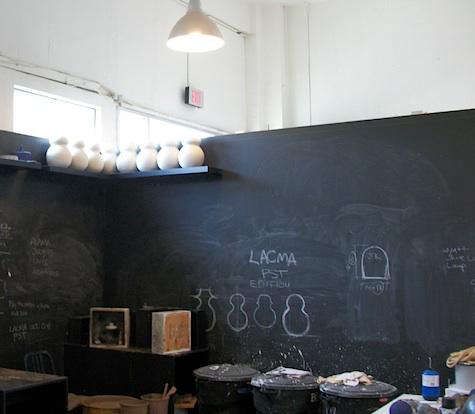
A studio visit with Adam Silverman is really a visit to a process. The shelves, tools, wheels, kilns, glaze tests, and finished vessels are all evidence of decisions made slowly and physically. Ceramics is not a medium for people who need instant applause. Clay must be shaped, dried, fired, glazed, fired again, and sometimes forgiven when it cracks, slumps, or does something dramatic in the kiln. The kiln, as every ceramic artist knows, is both collaborator and mischievous raccoon.
Silverman’s work often begins on the potter’s wheel, but it rarely ends in predictable symmetry. The wheel gives the form discipline; the glaze gives it weather. His surfaces may look mineral, volcanic, mossy, metallic, chalky, or scorched. Some pieces seem excavated rather than made. Others feel like vessels from a future civilization that has wisely decided to abandon plastic.
At Heath Los Angeles, these qualities stood out against the store’s more orderly design language. Silverman’s pots introduced friction, texture, and mystery. They reminded visitors that ceramics are not just products. They are records of earth, hand, fire, timing, risk, and sometimes a tiny bit of kiln-based betrayal.
The Signature Look: Mottled Glazes and Sculptural Vessels
Silverman is widely recognized for richly layered glazes and sculptural forms. His vessels often appear to carry multiple histories on their surfaces. A single pot may shift from pale gray to deep black, from matte crust to glossy run, from smooth curve to rough scar. The effect is not decorative in a conventional sense. It is geological.
That is one reason his ceramics photograph beautifully but reward in-person viewing even more. In a photo, you see shape and color. In person, you sense density, surface, scale, and edge. You notice where glaze gathered, where it resisted, where heat transformed minerals into something almost alive. His pots have the visual complexity of landscape: cliff, ash, tide pool, crater, lichen, shadow.
The pieces made during and around his Heath years often balanced functionality and experimentation. Some objects could live comfortably in domestic settings; others leaned toward sculpture. This blurring of categories is central to Silverman’s appeal. He does not treat “art,” “craft,” and “design” as separate planets requiring passports. He moves between them as if the borders were always imaginary.
Architecture in the Clay
Silverman’s architectural training appears in his ceramics in subtle but important ways. His work is not architectural because it looks like little buildings. It is architectural because it understands structure. Many vessels carry a sense of internal pressure: the form expands, compresses, balances, or tilts as though negotiating with invisible forces.
Architecture also shows up in his thinking about surface. In a building, the skin matters. It protects, communicates, ages, and responds to light. In Silverman’s ceramics, glaze becomes a skin with memory. It can reveal the firing process, emphasize the form beneath it, or create contrast between the vessel’s shape and its outer atmosphere. A pot may be simple in silhouette but wildly complex in surface, like a quiet person wearing a thunderstorm.
This architectural intelligence made his presence at Heath Los Angeles especially fitting. Heath’s own legacy is deeply tied to modern design, material honesty, and useful forms. Silverman did not reject that legacy; he stretched it. He showed that a ceramic object can be useful, sculptural, experimental, and emotionally resonant all at once.
Heath’s California Legacy and Silverman’s Creative Expansion
Heath Ceramics has always stood for more than attractive plates. Edith Heath developed clay bodies and glazes that reflected California’s landscape and modern lifestyle. Her work helped define a regional design language: simple, durable, earthy, elegant, and democratic. Heath dinnerware feels equally at home in a modernist house, a neighborhood restaurant, or a kitchen where someone is reheating leftovers while pretending it is “meal prep.”
Silverman’s work at Heath Los Angeles added another layer to that story. He introduced the studio as a site of active experimentation. Visitors could see that ceramics are not only designed; they are negotiated into existence. The hand matters. The kiln matters. The clay body matters. The accident matters too, although artists prefer to call it “process” because it sounds calmer.
This relationship between tradition and experimentation is the heart of the studio visit. Heath provided the foundation: a respected American ceramics company with deep roots in mid-century design. Silverman brought a restless artistic practice that welcomed imperfection, intensity, and the expressive possibilities of glaze. Together, they created a Los Angeles chapter in which the store, studio, and gallery experience became intertwined.
From Functional Pots to Museum-Scale Ideas
Silverman’s career did not stop at beautiful vessels. His later projects show how clay can become a vehicle for larger ideas. In Boolean Valley, a collaboration with architect Nader Tehrani, hundreds of clay objects formed a topographic installation shaped by architectural logic and digital modeling. The project connected ceramics to landscape, mathematics, and spatial design.
His Common Ground project expanded the symbolic role of clay even further. For that work, Silverman gathered clay, water, and wood ash from all fifty states, Washington, DC, and five inhabited U.S. territories, combining the materials into a unified ceramic body and glaze system. The resulting tableware and ceremonial pots explored national identity, shared meals, division, unity, and the possibility of conversation. In other words, clay became both material and metaphorearth as argument, cup as invitation.
These larger projects make the Heath Los Angeles period feel even more significant. At Heath, Silverman worked close to function, commerce, and everyday use. Later, he pushed into installation, public meaning, and social practice. But the foundation remained the same: clay, form, fire, and the belief that objects can carry stories bigger than themselves.
What Makes a Studio Visit So Compelling?
A studio visit is different from a gallery visit. In a gallery, objects have already dressed for the party. In a studio, you catch them before they have fully decided who they are. There are tests, failures, half-finished forms, tools, dust, notes, shelves, and the quiet tension of work in progress. That is why the idea of visiting Adam Silverman at Heath Los Angeles remains so engaging.
The studio setting reveals the labor behind the elegance. A finished Silverman vessel may look inevitable, but the studio tells another story: experiments, revisions, firings, surprises, and physical repetition. The wheel requires rhythm. Glazing requires patience. Firing requires trust. And trust, in ceramics, is always slightly foolish but absolutely necessary.
For design lovers, the studio visit also offers a richer understanding of Heath Los Angeles. It was not merely a place to buy plates, mugs, and gifts. It was a living design environment where production, retail, craft, and art overlapped. Seeing Silverman’s work there sharpened the contrast between handmade individuality and Heath’s broader design system. The result was not contradiction. It was conversation.
Lessons for Designers, Collectors, and Curious Visitors
1. Materials Have Personalities
Clay is not neutral. Different clay bodies respond differently to pressure, moisture, heat, glaze, and time. Silverman’s work reminds us that materials are not passive ingredients. They have character. The artist’s job is not to dominate them completely, but to guide them without squeezing out the surprise.
2. Imperfection Can Be the Main Event
Many of Silverman’s surfaces celebrate irregularity. Runs, crusts, pitting, scars, and color shifts become part of the visual language. In a culture obsessed with smooth screens and flawless finishes, these pots offer relief. They say: texture is not a defect. It is evidence of life.
3. Function and Art Can Share a Shelf
Heath’s environment made this lesson especially clear. A mug can be useful and beautiful. A vessel can be sculptural and still refer to the act of holding, pouring, storing, or serving. The old debate between art and craft starts to feel a little tired in front of work that is this physically convincing.
4. A Strong Legacy Can Handle Experimentation
Heath’s design heritage did not become weaker because Silverman brought rougher, stranger, more experimental pieces into the conversation. It became more alive. Good design traditions are not museum glass. They can stretch, adapt, and invite new voices.
The Experience: Visiting Adam Silverman at Heath Los Angeles
Imagine stepping into Heath Los Angeles and feeling the shift from retail calm to studio energy. The front of the space offers the pleasures Heath is famous for: stacked plates, clean silhouettes, earthy colors, shelves that make you suddenly believe your kitchen could become a better person. Then, nearby, the studio introduces another rhythm. Clay waits in bags. Tools sit within reach. Glaze tests gather like tiny scientific secrets. Works in progress hold the room in suspense.
In this setting, Silverman’s pieces feel both at home and slightly rebellious. A Heath plate may suggest breakfast in a sunlit kitchen. A Silverman vessel may suggest breakfast after a meteor shower. Together, they create a fuller picture of California ceramics: practical, experimental, relaxed, serious, beautiful, and not afraid of a little weirdness before noon.
The visitor’s eye moves from smooth dinnerware to rugged vessels, from repeatable forms to singular objects. That movement is the point. You begin to understand that ceramics exist on a spectrum. On one end is the dependable bowl you use every morning. On the other is the sculptural vessel that seems to have crawled out of a kiln with a message from the underworld. Between them is a shared language of clay, heat, form, and use.
What makes the experience memorable is not simply seeing finished work. It is sensing the decisions behind it. You notice scale: the way a pot’s foot anchors it, the way a shoulder swells, the way an opening changes the personality of the whole piece. You notice color behaving unevenly, which is to say beautifully. You notice how a glaze can soften a form, attack it, cloak it, or reveal it. If you are lucky, you leave wanting to touch everything, which is also when museum etiquette must be summoned like a responsible adult.
A studio visit also changes how you see your own home. After time with Silverman’s ceramics, ordinary objects become more interesting. A cup is no longer just a cup. It is a small architecture for the hand. A plate is not merely a flat place for toast. It is a landscape. A vase is not decoration. It is a body with balance, posture, and attitude. This is the secret power of craft: it trains attention. It makes the everyday visible again.
For artists and designers, the visit offers a practical kind of inspiration. Silverman’s path shows that a creative life can have chapters. Architecture, fashion, pottery, studio leadership, gallery work, public projectsnone of these cancel the others out. They accumulate. Skills migrate. Ideas return in new materials. A background in buildings can shape a pot. A clothing brand can sharpen an understanding of culture and use. A production studio can teach discipline while leaving room for strange beauty.
For collectors, the experience clarifies why handmade ceramics carry emotional weight. A Silverman vessel is not valuable only because it is rare or visually dramatic. It is valuable because it concentrates process. It records choices, risks, and transformations that cannot be perfectly repeated. Even when two forms are related, their surfaces behave individually. Each piece has its own weather report.
For casual visitors, the pleasure is simpler: the studio is a reminder that beautiful things are still made by human beings standing in rooms, making messes, solving problems, and occasionally arguing with a kiln. In a world of frictionless online shopping, that knowledge feels almost luxurious. It gives the object a pulse.
Leaving Heath Los Angeles after encountering Silverman’s work, you may not suddenly become a ceramic artist. You may, however, become more demanding in the best way. You may want objects with presence. You may want plates with history, cups with warmth, and vases that look as if they have opinions. You may even look at a lump of clay and think, “There is potential here,” which is a dangerous thought. Next thing you know, you are watching pottery videos at midnight and explaining to your family that a kiln is technically an investment.
That lasting spark is what makes “Studio Visit: Adam Silverman at Heath Los Angeles” more than a design story. It is a reminder that craft is not nostalgia. It is active, physical intelligence. It is design with dirt under its nails. It is art that knows how heavy it is. And in Silverman’s hands, it becomes something rare: an object that feels both made and discovered, both domestic and monumental, both ancient and unmistakably Los Angeles.
Conclusion
Adam Silverman’s studio presence at Heath Los Angeles represents a meaningful chapter in contemporary American ceramics. It brought together Heath’s modern California heritage and Silverman’s experimental, architecture-informed approach to clay. The result was a creative environment where visitors could see the difference between buying an object and understanding how an object comes into being.
His work reminds us that ceramics are never just “things.” They are encounters between earth, hand, heat, patience, and risk. At Heath Los Angeles, that encounter became visible. Silverman’s vesselswith their layered glazes, rugged surfaces, and sculptural confidenceexpanded the conversation around what handmade pottery could be. They belonged to the table, the shelf, the gallery, and the imagination.
In an age of disposable design, Silverman’s ceramics ask for slower looking. They reward attention. They make imperfection feel intelligent. And they prove that a studio visit can do what the best creative experiences always do: send you back into the world with sharper eyes, warmer hands, and a dangerous new respect for mud.