Military haircuts are the rare corner of men’s grooming where style meets inspection pressure. You want a cut that looks sharp, feels clean under a cover, survives PT, and does not make a first sergeant, chief, gunny, or commander pause mid-walk and say, “Let’s talk about your hair.” Nobody wants that meeting.
The good news: regulation-friendly military haircuts for men do not have to be boring. The best military hairstyles are neat, balanced, professional, easy to maintain, and short enough to work with headgear and protective equipment. Across U.S. branches, the common themes are simple: keep hair clean, controlled, natural-looking, tapered or faded, off the ears and collar where required, and free of eccentric designs, extreme shapes, unnatural colors, or trendy experiments that scream “barber shop TikTok challenge.”
Note: Grooming rules can vary by branch, command, training environment, medical waiver, and policy update. This guide is built from current U.S. military grooming principles and practical barbering knowledge, but service members should always confirm the latest local guidance before inspection day.
What Makes a Haircut Military-Regulation Friendly?
A regulation haircut is not just “short.” It is a haircut that supports a professional military appearance. That means it should look controlled from the front, sides, back, and under headgear. A cut may be stylish, but if it creates bulky sides, wild texture, hard designs, uneven lines, or hair hanging over the ears, it is moving into danger territory.
General Rules to Keep in Mind
Most military grooming standards focus on five things: neatness, cleanliness, safety, uniformity, and military image. For men, that usually means the hair should be tapered or faded on the sides and back, should not interfere with the proper wear of headgear, should avoid excessive bulk, and should not include shaved graphics, mohawks, horseshoe shapes, unnatural color, dramatic asymmetry, or spiked styling.
When in doubt, choose a clean taper, short top, natural part, and conservative finish. That combination has passed more inspections than any miracle styling product ever invented.
22 Best Military Haircuts for Men That Meet Regulations
1. Induction Cut
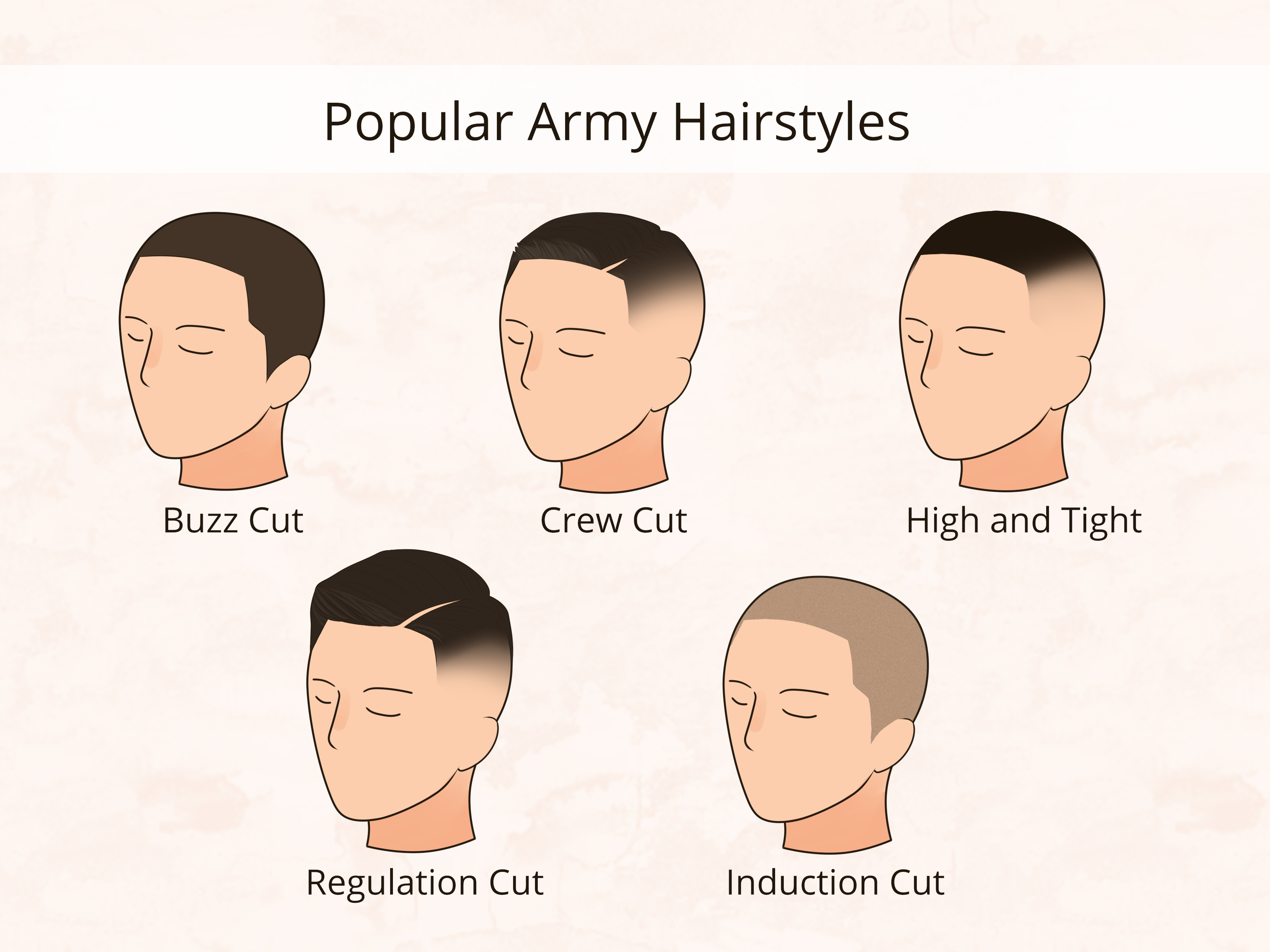
The induction cut is the classic recruit haircut: extremely short, even, and simple. It became famous because it is practical, hygienic, and fast to maintain. For men who want zero styling time, this is the ultimate low-maintenance military haircut.
Best for: boot camp, hot climates, thick hair, active duty routines, and anyone who prefers a no-nonsense look.
Regulation tip: Keep it even all around and avoid patchy self-cutting. “Fast” is good; “my roommate did it with tired clippers” is not.
2. Burr Cut
The burr cut is slightly longer than an induction cut, usually clipped evenly with a short guard. It gives the scalp a little more coverage while keeping the military look crisp and clean.
Best for: men who want the ease of a buzz cut without going nearly bald.
Regulation tip: Ask for an even clipper length with clean edges around the neckline and sideburns.
3. Butch Cut
The butch cut is another buzz-family favorite, but it leaves a touch more length than a burr cut. It works especially well for men with straight or slightly wavy hair because the top stays uniform and controlled.
Best for: thicker hair, square faces, and service members who want a sturdy, masculine shape.
Regulation tip: Keep the top short enough that it does not puff up under a cap.
4. Classic Buzz Cut with Taper
A classic buzz cut with a taper is one of the safest military haircuts for men. The top is clipped short, while the sides and back are tapered neatly instead of left blocky.
Best for: nearly every face shape and hair type.
Regulation tip: A taper makes a buzz cut look more polished and less like an emergency bathroom haircut.
5. Crew Cut
The crew cut is a military legend for a reason. It keeps the top short but allows a little shape in front. The sides stay tight, the neckline stays clean, and the whole haircut says, “Yes, I know where my cover is.”
Best for: men who want a professional cut that still has some personality.
Regulation tip: Keep the front controlled. A tiny lift is fine; a mini-pompadour is asking for attention.
6. Short Crew Cut
The short crew cut is a more inspection-friendly version of the classic crew. The top is clipped closer, the sides are tighter, and the overall look is clean enough for formal uniform wear.
Best for: service members who want a sharp haircut with almost no styling needs.
Regulation tip: Ask your barber for a short, blended top instead of a long, textured one.
7. Ivy League Cut
The Ivy League cut is basically the crew cut’s polished older brother. It leaves enough length on top to comb slightly to the side, while the sides and back remain neat and tapered.
Best for: officers, professional settings, ceremonies, and men who prefer a more refined look.
Regulation tip: Keep the part natural and the top conservative. Too much length turns this from military-smart to boardroom-floppy.
8. Regulation Cut
The regulation cut is one of the most traditional military hairstyles. It features a neat side part, short tapered sides, and enough length on top to comb cleanly. It is formal, professional, and timeless.
Best for: men who want a classic haircut that works in uniform and civilian clothes.
Regulation tip: Avoid a hard shaved part unless your branch and command allow it. A natural part is safer.
9. Classic Side Part
The classic side part is clean, controlled, and easy to wear. It looks especially good with a low taper and short top. This cut gives structure without looking trendy.
Best for: straight, fine, or medium-density hair.
Regulation tip: Use a light product with a natural finish. If your hair shines like a polished boot, you may have gone too far.
10. Low Fade with Short Top
A low fade keeps the fade line near the lower sides and neckline. It is subtle, clean, and generally more conservative than a high fade. Pair it with a short top and you have a modern military haircut that still looks professional.
Best for: men who want a fresh look without pushing regulations.
Regulation tip: Make sure the fade blends smoothly. Harsh, disconnected fades can look unprofessional.
11. Mid Fade Crop
The mid fade crop gives a little more contrast than a low fade while keeping the top short and practical. The cropped top can be lightly textured, but it should not look messy or spiky.
Best for: thick hair, coarse hair, and men who like a modern barbered finish.
Regulation tip: Ask for controlled texture, not a “just rolled out of a Humvee” finish.
12. High and Tight
The high and tight is one of the most recognizable military haircuts. The sides and back are clipped very close, while the top remains short and neat. It is bold, clean, and easy to maintain.
Best for: Marines, soldiers, athletes, and anyone who likes a sharp, aggressive silhouette.
Regulation tip: The top must blend properly into the sides. Avoid a disconnected island of hair.
13. High and Tight Recon
The high and tight recon is an even more extreme version, with very close sides and a narrow strip or compact panel of hair on top. It has a tough look, but it must be handled carefully because some extreme versions can resemble prohibited styles.
Best for: men who want a very short, rugged look.
Regulation tip: Keep the top natural, blended, and not mohawk-like. If it starts looking like a landing strip, rethink it.
14. Flat Top
The flat top is a disciplined, squared-off haircut with a level top and tight sides. It has deep military roots and works best for men with dense, upright hair.
Best for: thick straight hair and strong face shapes.
Regulation tip: Keep the height conservative. A clean flat top is sharp; a skyscraper flat top is a zoning violation.
15. Short Flat Top Fade
This version combines a short flat top with a blended fade. It looks modern but still disciplined when the top is kept low and the sides are smoothly faded.
Best for: men who like structure and do not mind regular barber visits.
Regulation tip: Schedule maintenance often. Flat tops lose their shape quickly.
16. Caesar Cut
The Caesar cut uses a short, even top with a small forward fringe. It can work within military grooming standards when the fringe is very short and does not touch the eyebrows.
Best for: receding hairlines, straight hair, and men who want a simple style.
Regulation tip: Keep the fringe cropped high. Bangs hanging forward are a regulation problem.
17. French Crop
The French crop is similar to the Caesar but often has more texture on top. For a military-friendly version, keep the top short, the fringe controlled, and the sides tapered or faded.
Best for: thick hair, wavy hair, and men who want a modern but practical haircut.
Regulation tip: Avoid heavy texture or a long fringe. The goal is “clean crop,” not “fashion week recruit.”
18. Short Textured Crop
A short textured crop gives the top a little movement while keeping the haircut controlled. It is a good option for men whose hair does not sit perfectly flat.
Best for: wavy, thick, or slightly unruly hair.
Regulation tip: Use matte product sparingly. Texture should look natural, not chaotic.
19. Tapered Comb Over
The tapered comb over is a conservative style with short sides and a neatly combed top. It works well for men who need a professional haircut that transitions easily from duty to civilian life.
Best for: fine to medium hair and oval or rectangular face shapes.
Regulation tip: Keep the top short enough that it does not collapse over the forehead.
20. Skin Fade with Short Top
A skin fade can look extremely clean, but rules vary by branch and command. When authorized, it should be smoothly blended into a short top without designs, lines, or dramatic disconnection.
Best for: men who want a crisp barber-shop finish.
Regulation tip: Confirm whether zero fades or skin fades are allowed in your environment. When unsure, choose a low taper instead.
21. Taper Fade with Natural Part
This haircut combines a natural side part with a smooth taper fade. It is stylish without being loud and works well for inspections, office settings, and formal events.
Best for: men who want balance: not too severe, not too casual.
Regulation tip: The part should follow the natural direction of the hair. Avoid shaved designs or oversized hard parts.
22. Shaved Head
A shaved head is clean, direct, and regulation-friendly in many military settings. It is also a strong option for men with thinning hair who would rather own the look than negotiate with a receding hairline every morning.
Best for: balding men, very active schedules, hot weather, and minimal grooming routines.
Regulation tip: Keep the scalp clean and protected from sunburn. A red, peeling head under a cover is not the tactical advantage people imagine.
How to Ask Your Barber for a Regulation Military Haircut
The easiest way to get a military haircut that meets regulations is to be specific. Do not simply say, “Give me a military cut.” That could mean anything from a recruit buzz to a high and tight to a flat top that looks ready to hold a coffee mug.
Instead, tell your barber your branch, your inspection expectations, and the level of conservatism you need. Use phrases like “short blended taper,” “off the ears,” “clean neckline,” “no designs,” “natural part,” “short enough for headgear,” and “keep the top controlled.” If your command has exact length rules, bring those numbers with you.
Useful Barber Instructions
Try these examples:
- “Give me a short crew cut with a low taper, clean around the ears and neckline.”
- “I need a regulation-friendly high and tight, blended into the top, nothing disconnected.”
- “Keep the top short and conservative, with no bulk under headgear.”
- “Natural side part only, no shaved design.”
- “I need this to pass inspection, not win a nightclub lighting contest.”
Military Haircut Maintenance: How Often Should You Get a Cut?
Short military haircuts grow out fast. A style that looks inspection-ready on Monday can look fuzzy by the following Friday, especially around the neckline, sideburns, and ears. Most men maintaining military grooming standards should plan on a haircut every one to three weeks, depending on hair growth, branch expectations, and how sharp the cut needs to stay.
High fades, skin fades, flat tops, and high and tight cuts usually need more frequent maintenance. Crew cuts, Ivy League cuts, and low tapers can stretch a little longer if the top stays controlled and the edges remain clean.
Common Mistakes That Can Make a Military Haircut Fail Inspection
Too Much Bulk on Top
Even if the sides are clean, excessive top length can make the haircut look sloppy under headgear. If the top bulges, flops, or requires heavy product to behave, it may be too long.
Hair Touching the Ears or Collar
This is one of the easiest issues to spot. A clean haircut should stay off the ears and neckline where required. The back should be tapered, not squared into a heavy block.
Unnatural Hair Color
Military grooming standards generally expect natural-looking hair color. Bright blue, neon green, silver-purple, or “energy drink red” may be fun on vacation, but they are not built for formation.
Shaved Designs and Extreme Parts
Lines, graphics, lightning bolts, stars, logos, and dramatic shaved designs are risky and often prohibited. Keep the haircut professional and balanced.
Over-Styling
Spikes, tall volume, wet-look gel walls, and messy texture can turn a safe haircut into a questionable one. A regulation haircut should look controlled even before product.
Best Military Haircuts by Hair Type
For Thick Hair
Choose a crew cut, high and tight, short textured crop, or flat top. Thick hair needs structure, so ask your barber to reduce bulk while keeping a smooth blend.
For Fine Hair
A buzz cut, burr cut, Ivy League, or short side part works well. Fine hair often looks cleaner when kept short and lightly shaped.
For Curly or Coarse Hair
A short crop, tapered buzz, or high and tight can keep curls controlled. The key is avoiding bulk that extends too far from the scalp or interferes with headgear.
For Thinning Hair
Buzz cuts, shaved heads, burr cuts, and short crew cuts are excellent choices. They reduce contrast between thinning areas and fuller areas, creating a cleaner overall appearance.
Real-World Experience: Living With a Regulation Military Haircut
The first thing most men learn about military haircuts is that “short” does not automatically mean “easy.” A clean haircut is easy to wash, yes, but it also exposes every detail. If the fade is uneven, the neckline is crooked, or one sideburn is trying to start its own unit, everyone can see it. That is why the best regulation military haircuts are not just short; they are precise.
In daily life, the most practical military haircut is usually the one that matches your schedule. A high and tight looks outstanding when fresh, but it can start to look grown-out quickly. If you cannot get to a barber often, a short crew cut with a low or mid taper may be easier to manage. It grows out more naturally and gives you a little more time before the sides start looking fluffy.
Another real-world lesson: head shape matters. The same buzz cut can look completely different on two men. One guy gets a clean action-hero look; another discovers a mysterious ridge on the back of his skull that apparently filed for permanent residency. That does not mean buzz cuts are bad. It means a good barber should adjust the length and taper to your head shape, hair density, and hairline.
Hair texture also changes the experience. Straight hair may lie flat and pass inspection with minimal effort. Thick or coarse hair may need more frequent trimming because it grows outward, not just downward. Curly hair can look bulky even when it is technically short, so the barber has to shape it carefully. Fine hair may need less thinning and more clean structure.
Product should be used like seasoning, not concrete. A small amount of matte paste, light cream, or low-shine pomade can help a side part or Ivy League cut stay neat. But heavy gel can make hair look unnatural, stiff, or overly styled. A good rule: if your hair could survive a wind tunnel but your dignity could not, use less product.
For inspections, timing matters. Do not get a brand-new haircut five minutes before a major event unless you fully trust the barber. A fresh cut can show clipper marks, redness, or mistakes. Getting trimmed a day or two before an inspection often gives the haircut time to settle while still looking sharp.
The best experience comes from building a relationship with a barber who understands military grooming standards. Once they know your branch, preferred length, head shape, and inspection needs, the process becomes simple. You sit down, give the usual instruction, and avoid the dangerous phrase “surprise me.” In military grooming, surprises are rarely good news.
Final Thoughts: The Best Military Haircut Is Clean, Practical, and Consistent
The best military haircuts for men are not about chasing trends. They are about looking professional, staying comfortable, and meeting regulations without needing a legal briefing every time you visit the barber. Whether you choose an induction cut, crew cut, high and tight, regulation cut, Ivy League, flat top, or short taper fade, the winning formula stays the same: clean lines, smooth blending, controlled length, natural appearance, and no unnecessary drama.
If you want the safest choice, go with a short crew cut, classic buzz with taper, regulation cut, or low fade with short top. If you want something sharper, consider a high and tight, flat top, or skin fade only if your branch and command allow it. If you want the easiest routine, the induction cut, burr cut, or shaved head will keep mornings simple.
In short, a great military haircut should help you look squared away before you even say a word. And if your haircut can pass inspection, fit under headgear, survive PT, and still look good in civilian clothes, congratulations: you have found the sweet spot.