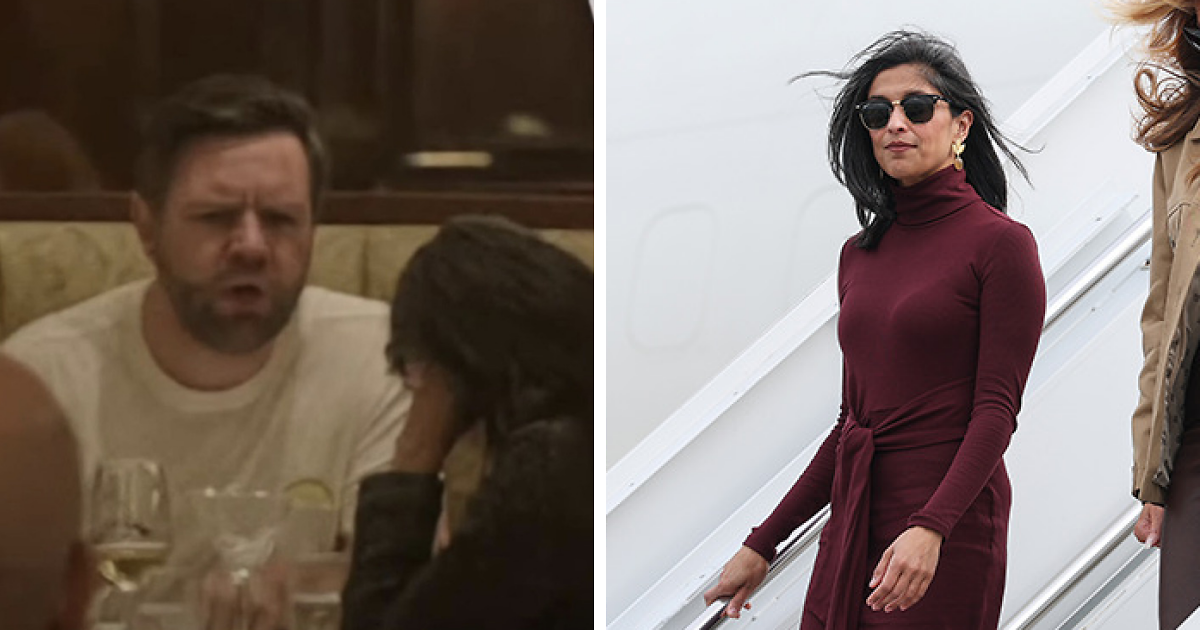
Editorial note: This article discusses viral online rumors involving public figures. The restaurant image and the claim that JD Vance was “yelling” at Usha Vance have not been established as factual. The piece below treats the episode as a case study in modern political gossip, social media amplification, and how quickly a single image can become a full-blown internet courtroom with snacks.
When a Viral Photo Becomes a Political Soap Opera
In the current internet ecosystem, it takes roughly three seconds for a blurry photo to become a headline, a meme, a conspiracy thread, and someone’s 47-part TikTok analysis. That is exactly the kind of atmosphere surrounding the latest JD Vance and Usha Vance marriage rumors, after an unverified image circulated online that appeared to show the vice president seated across from his wife in a restaurant while looking upset.
The claim spread with dramatic wording: JD Vance had allegedly been spotted yelling at Usha Vance in public. Then came the social media interpretation machine. Some users connected the image to earlier speculation about Usha appearing without her wedding ring. Others brought Erika Kirk into the discussion, reviving commentary about Vance’s viral hug with the widow of conservative activist Charlie Kirk. And, because the internet loves a messy plot twist more than a cat loves knocking a glass off a table, phrases like “He wants Erika Kirk” began circulating in posts and comments.
Vance’s response was not a lengthy press release, a solemn podium moment, or a “please respect our privacy” statement. Instead, he used sarcasm. Reacting to the viral claim, he joked that he always wears an undershirt when going out in public to have a loud fight with his wife. The joke landed as a direct hit at the image’s questionable authenticity and at the eagerness of online commentators to turn a still frame into a marriage diagnosis.
The Restaurant Image: What Is Confirmed and What Is Not
The most important word in this story is “allegedly.” The photo was not verified as an authentic scene of JD and Usha Vance arguing. Some reports described it as unverified, while others noted that social media users and detection tools questioned whether the image was AI-generated or manipulated. That distinction matters. A photo that “looks like” something is not the same as proof that something happened.
In political media, images often travel faster than context. A person’s facial expression can be interpreted as anger, exhaustion, concentration, or indigestion from an overambitious appetizer. Without verified location, date, source, photographer, and surrounding context, the image remains a rumor object, not a confirmed incident.
That did not stop social platforms from doing what they do best: assigning motives, writing imaginary dialogue, and treating a single visual as if it were a live broadcast from inside a marriage. For public figures, this is now part of the job description. One awkward photo can become a cultural Rorschach test, where people see exactly what their politics already trained them to see.
Why Erika Kirk Became Part of the Conversation
Erika Kirk entered the rumor cycle because of a previous viral moment involving JD Vance at a Turning Point USA event in October 2025. Erika, the widow of Charlie Kirk, introduced Vance onstage during an emotional event after her husband’s death. The two shared a warm embrace that drew intense online attention. Some users analyzed hand placement, body language, facial expressions, and the length of the hug as though they were reviewing security footage for a federal case.
Erika later explained the hug as a human moment of grief, gratitude, and support. She said touch is part of how she expresses care. The setting also mattered: she was a recently widowed woman appearing publicly in a difficult moment, and Vance had been close to the Kirk family. Still, the internet often has the emotional subtlety of a microwave beep. A compassionate embrace became, for some viewers, fuel for speculation.
The phrase “He wants Erika Kirk” appears to come from that online speculation, not from verified reporting about Vance’s intentions. There is no credible public evidence proving an affair, a romantic pursuit, or a hidden relationship. The phrase functions more like a viral accusation than a fact. For SEO purposes, it is part of what people are searching. For responsible publishing, it must be framed as rumor, not reality.
Usha Vance’s Missing Wedding Ring and the Rumor Engine
The restaurant-photo claim did not appear in isolation. It followed weeks of online chatter about Usha Vance being seen at public events without her wedding ring. For many people with normal offline lives, forgetting a ring is about as scandalous as misplacing car keys. For the spouse of a vice president, apparently, it can become national gossip.
A spokesperson for Usha explained that she is a mother of three young children and sometimes removes or forgets her ring while doing everyday tasks such as dishes and bath time. That explanation is deeply ordinary, which may be why the internet had trouble digesting it. Ordinary explanations do not trend as well as dramatic ones. “Busy mom forgot jewelry” simply does not have the same algorithmic sparkle as “marriage crisis in Washington.”
JD Vance also addressed the ring speculation in an interview, saying that he and Usha found some of the online chatter amusing. He said their marriage was strong and described the scrutiny as one of the sacrifices that come with public life. His framing suggested that the couple understood the absurdity of the rumor cycle but also recognized that constant attention can be difficult for a family.
How JD Vance Used Humor as a Defense Strategy
Vance’s “undershirt” response is a classic political-counterpunch move: do not over-explain, do not sound defensive, and do not give the rumor more oxygen than necessary. By joking about the obvious weirdness of the image, he tried to make the accusation look unserious. In online politics, ridicule can sometimes travel farther than denial.
This approach has benefits. A sarcastic reply is short, memorable, and easy for supporters to share. It turns critics into the punchline. It also avoids the trap of validating every rumor with a formal response. If a public figure writes a five-paragraph denial every time someone posts a questionable image, the rumor wins by forcing the conversation.
But humor has risks too. Sarcasm can satisfy supporters while leaving skeptics unconvinced. People who already believe the rumor may interpret the joke as evasive. People who dislike Vance politically may see it as deflection. That is the strange math of modern public relations: the same sentence can be “brilliant clapback” to one audience and “suspicious dodge” to another.
Why Marriage Rumors Stick to Political Couples
Political marriages have always fascinated the public because they sit at the intersection of power, image, loyalty, and performance. A candidate’s spouse is expected to appear supportive but not staged, visible but not too visible, independent but not inconvenient. That balancing act is difficult even before social media turns every gesture into a referendum.
JD and Usha Vance are especially interesting to observers because their marriage contains several storylines that media outlets often find irresistible. They met at Yale Law School. She has a high-powered legal background. He rose from author and venture capitalist to senator and vice president. They have an interfaith marriage, with Vance publicly discussing his Catholic faith and Usha’s Hindu background. Add national politics, young children, and partisan tension, and you have a public couple that people project onto constantly.
The problem is that projection is not proof. A ringless hand, a hug, a facial expression, or a sarcastic post can all be real events without proving the dramatic narrative attached to them. Public curiosity is understandable. Public certainty based on fragments is not.
The Bigger Lesson: Viral Gossip Is Not Journalism
The JD Vance, Usha Vance, and Erika Kirk rumor cycle shows how easily online conversation can blur categories. There is verified reporting. There is informed analysis. There is opinion. There is satire. And then there is the digital swamp where someone squints at a screenshot and announces a divorce prediction like a weather forecast.
For readers, the smart approach is simple: ask what is actually known. Was the image verified? Who posted it first? Is there a reliable source? Has anyone involved responded? Are multiple reputable outlets reporting the same facts, or are they merely repeating the same viral claim? These questions are not glamorous, but they are the seatbelt of media literacy. Nobody cheers for a seatbelt, but you are grateful for it when the internet drives into a ditch.
For publishers, the responsibility is equally clear. Headlines can acknowledge what people are searching for without laundering rumors into facts. A headline may include a viral phrase, but the article must immediately explain the limits of the evidence. That is especially important when the story involves a marriage, children, grief, religion, and personal reputation.
What This Says About JD and Usha Vance’s Public Image
The Vances have become one of the most watched political couples in America. Usha’s role as second lady has drawn attention not only because of her professional background but also because she appears more private than many modern political spouses. That privacy can create a vacuum, and the internet hates a vacuum. It fills one with theories, jokes, accusations, and occasionally a meme that refuses to retire.
JD Vance’s public persona is combative, media-savvy, and comfortable with verbal sparring. Usha’s public presence is quieter and more reserved. That contrast can lead observers to invent narratives about tension, even when ordinary personality differences explain far more. Some couples are not matching campaign posters. Some are one microphone and one calm person wondering when they can go home.
Later verified family news also complicated the rumor narrative. In January 2026, JD and Usha Vance announced that they were expecting their fourth child, a boy due in late July. That announcement did not magically reveal the private state of their marriageno public update can do thatbut it did remind readers that internet speculation often races ahead of reality.
Why the Erika Kirk Angle Became So Sensitive
The Erika Kirk angle is sensitive because it mixes grief with politics. Charlie Kirk’s death was a major event in conservative politics, and Erika’s new role at Turning Point USA placed her in a very public position during an intensely painful personal period. Her appearance with Vance came in that emotional context.
When viewers stripped that context away and treated the hug as entertainment gossip, the story changed shape. Instead of a widow, a political ally, and a public tribute, the internet saw a potential scandal. That says less about the people in the video than it does about the way audiences consume political imagery. We are trained to search for hidden meaning, even when visible meaning is already there.
There is also a gendered element. Women near powerful men are often dragged into narratives they did not create. Usha becomes the supposedly wronged wife. Erika becomes the alleged object of desire. Both are flattened into roles in a drama centered on a man’s political celebrity. A more responsible reading allows them to remain full people: one a second lady navigating public scrutiny, the other a widow and organizational leader managing grief under a spotlight.
Experience-Based Reflections: What This Story Teaches Anyone Living Online
Most people will never be vice president, never appear onstage at a Turning Point USA event, and never have strangers inspect their wedding jewelry like detectives with Wi-Fi. But almost everyone understands the smaller version of this experience: someone sees one moment, misunderstands it, and builds a whole story around it.
Maybe a friend sees you looking annoyed in a group photo and assumes you were angry. Maybe someone notices you did not reply to a message and decides you are upset. Maybe you are tired, distracted, or thinking about whether you left the oven on, and suddenly your face becomes “evidence.” The human brain loves patterns, but sometimes it connects dots that are not part of the same picture.
The Vance rumor cycle is a celebrity-scale version of that everyday problem. A ringless hand becomes a marriage theory. A hug becomes a romantic accusation. A questionable restaurant image becomes proof of a public fight. Each step feels small, but together they create a narrative that can be hard to unwind.
For readers and social media users, the practical lesson is to slow down before sharing. Ask yourself: would I want strangers making this claim about me based on the same evidence? If the answer is no, maybe do not throw gasoline on the post. The internet already has enough gasoline. At this point, it needs a responsible adult and possibly a fire extinguisher.
For couples, especially public couples, the lesson is that privacy now requires active protection. Not every joke needs clarification. Not every rumor deserves a response. But when a false or misleading claim gains traction, a brief, confident reply can sometimes be more effective than a long explanation. Vance chose humor. Whether people liked it depended largely on whether they liked him already.
For content creators and publishers, the experience lesson is about restraint. Trending topics bring clicks, but careless framing can damage reputations. Writing about rumors requires clear language: “alleged,” “unverified,” “circulating online,” “no evidence has confirmed,” and “the person involved denied or mocked the claim.” These phrases are not boring legal padding. They are the guardrails that keep a newsy article from becoming a rumor delivery truck.
Finally, this story is a reminder that public figures are still people with families. Political criticism is fair game. Policy debate is necessary. Public accountability matters. But turning every spouse, widow, hug, ring, shirt, or facial expression into a scandal can make civic life dumber and crueler. And frankly, American politics already has plenty of both. It does not need help from a suspicious screenshot in a restaurant booth.
Conclusion: The Rumor Says More About the Internet Than the Marriage
The headline may be loud, but the facts are quieter. JD Vance did respond to online claims about an alleged restaurant argument with Usha Vance. His response was sarcastic and dismissive. The image at the center of the claim was not verified, and some reporting questioned its authenticity. The broader marriage rumors grew from a mix of Usha’s missing wedding ring, Vance’s public remarks about marriage and faith, and the viral hug with Erika Kirk.
What remains is not a proven scandal but a useful snapshot of how modern political gossip works. A fragment appears. Partisans interpret it. Social media adds dramatic captions. Search interest rises. Articles follow. Then everyone argues about what the story “really means,” even when the foundation is softer than a diner pancake.
The responsible takeaway is this: curiosity is fine, but certainty requires evidence. Until verified facts show otherwise, the JD Vance, Usha Vance, and Erika Kirk conversation is best understood as a media rumor cyclenot a confirmed account of a private marriage.