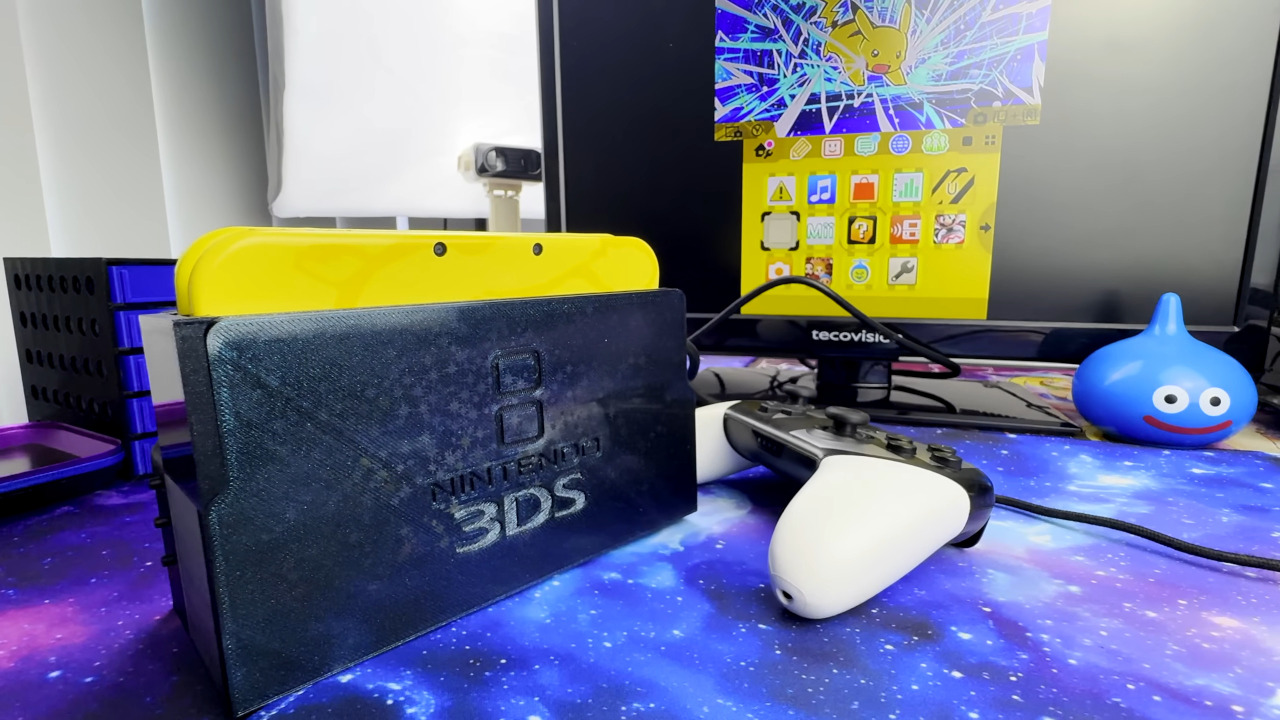
The Nintendo 3DS was never supposed to live under a TV like a home console. It was built for backpacks, lunch breaks, late-night Pokémon sessions, and that very specific childhood ritual of lowering the 3D slider until your eyes stopped negotiating with your brain. Yet here we are: one lucky 3DS has received a Switch-style dock, complete with HDMI output, USB-C power, and wireless controller support. Somewhere, a drawer full of old charging cables just felt personally attacked.
This custom Nintendo 3DS dock is not a simple plastic stand. It is a full hardware-modding project that turns a beloved dual-screen handheld into something that behaves surprisingly like a Nintendo Switch. Slide the console into the dock, connect it to a monitor or TV, grab a controller, and suddenly the tiny 3DS feels like it wandered into the living room and decided to stay.
The project has caught attention because it taps into a dream many handheld fans have quietly had for years: what if the 3DS had received the hybrid-console treatment before the Switch made it famous? The answer is charming, complicated, and wonderfully nerdy.
What Is the Switch-Style 3DS Dock?
The Switch-style 3DS dock is a custom-built docking station designed for a heavily modified Nintendo 3DS. In concept, it works like the Nintendo Switch dock: the handheld slides into a base, receives power, sends video to a larger display, and supports controller-based play. In practice, it takes far more wizardry than simply printing a shell and shouting “HDMI!” at the motherboard.
The modded unit reportedly uses an internal USB-C capture setup, a Raspberry Pi board to help convert video output to HDMI, and additional hardware to support wireless controller input. The dock itself is 3D printed and shaped to recreate the satisfying slide-in experience that made the Switch dock feel so simple. That simplicity is the magic trick. Underneath it is a jungle gym of soldering, tiny boards, careful alignment, and enough patience to make a repair technician whisper, “Respect.”
Why This 3DS Dock Feels So Special
The Nintendo 3DS family sold tens of millions of units worldwide and built a massive library of games, including Mario Kart 7, The Legend of Zelda: A Link Between Worlds, Animal Crossing: New Leaf, Fire Emblem Awakening, and several Pokémon titles. It was a successful handheld, but it belonged to an era before Nintendo fully committed to the hybrid idea.
The Switch made docking feel normal. You play handheld, drop the system into a dock, and continue on the TV. The 3DS, meanwhile, had two screens, a clamshell body, a unique stereoscopic display, and no official HDMI-out option. It was proudly portable. That is exactly why seeing it treated like a Switch is so delightful. It feels like a timeline glitch from a universe where Nintendo experimented with hybrid handhelds a few years earlier.
How the Custom 3DS Dock Works
HDMI Output Through a Capture-Based Setup
The 3DS does not natively output HDMI like a modern console. To make TV play possible, the console needs internal video capture hardware. A capture board can pull the display signal from the handheld and send it out over USB-C. From there, a small computer board such as a Raspberry Pi can help turn that signal into something useful for an HDMI display.
That matters because it separates this build from ordinary charging docks. A basic 3DS charging cradle only gives the system power. This dock turns the 3DS into a living-room device. The top and bottom screens can be shown on a monitor, letting players enjoy 3DS and DS games without hunching over the console like a goblin guarding digital treasure.
USB-C Power for a Modern Touch
USB-C is one of the most practical upgrades for aging handhelds. Original Nintendo 3DS chargers are still around, but they are not exactly the cable you find first when digging through a drawer. Modern USB-C charging makes the system easier to use, easier to dock, and much cleaner in a contemporary gaming setup.
The 3DS already used charging contact points in some official cradle designs, so powering the handheld through a dock is not the hardest part of the project. The real challenge is making the whole system behave elegantly: slide in, charge, output video, and respond to external controls without looking like a science fair project that escaped into the living room.
Wireless Controller Support
Controller support is where this mod becomes especially impressive. The 3DS was designed around its own buttons, Circle Pad, touchscreen, and physical layout. A Switch Pro Controller cannot simply connect and command the handheld like it owns the place. The build needs additional internal hardware to translate controller signals into inputs the 3DS understands.
That means the dock is not just moving video to a TV. It is changing the entire play style. Instead of holding the 3DS, the player can sit back with a wireless controller. For games like Mario Kart 7, Super Street Fighter IV: 3D Edition, or classic DS titles, that changes the feel dramatically.
Why Nintendo Never Made an Official 3DS TV Dock
It is easy to look at this mod and ask, “Why didn’t Nintendo do this?” The answer is probably a mix of hardware limitations, product strategy, cost, and design philosophy. The 3DS was not engineered as a hybrid console. Its dual-screen experience was central to its identity, and many games used the touchscreen in ways that would become awkward when played entirely from a couch.
There is also the matter of resolution. The 3DS was designed for small screens. Blow that image up on a large display and it will not suddenly become a native 4K masterpiece. It may look charming, nostalgic, and perfectly playable, but nobody should expect it to transform into a modern remaster. The pixels will be visible. The pixels will bring friends.
Nintendo also had the Wii U during part of the 3DS era, and later the Switch became the company’s true hybrid system. By the time the Switch proved how powerful the docked-handheld idea could be, the 3DS was already moving toward the end of its commercial life.
The Bigger Retro-Modding Trend
This Switch-style 3DS dock is part of a larger movement in retro gaming: preserving old hardware while making it easier to use in modern setups. Players are adding USB-C charging to older handhelds, replacing tired batteries, installing IPS screens, building HDMI mods, creating flash storage solutions, and designing 3D-printed replacement parts.
The motivation is not only nostalgia. It is usability. A handheld from 2011 can still be fun in 2026, but old charging ports, dim screens, aging batteries, and limited display options can make the experience feel clunky. Smart mods reduce friction while keeping the original hardware alive.
That last part is important. Emulation is convenient, but original hardware has its own personality. Buttons feel different. Screens behave differently. The clamshell snap of a 3DS closing at 2 a.m. has emotional value. A dock like this preserves that identity while adding a modern layer of convenience.
Is This 3DS Dock Practical for Most Players?
For the average player, no. This is not a weekend project for someone whose soldering experience begins and ends with “I watched one video and bought a cheap iron.” The build requires internal console modification, capture hardware, controller input handling, 3D printing, wiring, testing, and troubleshooting. One small mistake could damage a rare or beloved handheld.
But practicality is not always the point. Some projects exist because they ask a fun question and then answer it with engineering. A Switch-style 3DS dock may not become a mass-market accessory, but it proves what is possible when passion meets skill. It is less “buy this for everyone” and more “look what happens when someone refuses to let a great handheld stay ordinary.”
What Games Would Benefit Most?
A docked 3DS setup makes the most sense for games that rely less on constant touchscreen interaction. Racing games, platformers, RPGs, and action titles could feel surprisingly natural with a wireless controller and TV output.
Great Candidates for Docked 3DS Play
- Mario Kart 7: A natural fit for controller play and a larger screen.
- The Legend of Zelda: Ocarina of Time 3D: A couch-friendly adventure that already feels console-like.
- Star Fox 64 3D: Fast, colorful, and fun on a bigger display.
- Metroid: Samus Returns: A strong candidate for players who prefer a traditional controller grip.
- Fire Emblem Awakening: Turn-based strategy works well when displayed clearly on a monitor.
- DS classics: Many Nintendo DS games could benefit from bigger-screen capture, especially for streaming or recording.
Games that depend heavily on stylus input may be less comfortable. Titles built around drawing, tapping, dragging, or rapid touchscreen use could still work, but the docked experience would be less seamless. The 3DS library is wonderfully weird, and not every weird thing wants to sit politely on a TV.
Why the Build Looks So Clean
The most impressive part of the project may be how finished it looks. Many hardware mods work but look like a bowl of wires had an argument with a plastic case. This dock appears intentionally designed. The 3D-printed shell gives it a consumer-product feel, while the port placement echoes the Switch dock enough that the concept is instantly recognizable.
That visual polish matters. A clean mod changes how people react. Instead of seeing a technical experiment, they see a product that feels like it could have existed. That is the secret sauce of great modding: not only making something function, but making it feel inevitable.
What This Says About the 3DS Legacy
The 3DS is no longer Nintendo’s active handheld platform. Its eShop purchasing features ended, and online services for most Nintendo 3DS and Wii U software have been discontinued. Yet the system remains deeply loved. The hardware is compact, the library is rich, and the dual-screen format still feels unlike anything in the current console market.
Projects like this dock show that the 3DS is not just surviving through nostalgia. It is being reimagined. Modders are treating it as a platform worth improving, not a museum object to be sealed behind glass. That gives the system a second life, especially for collectors, streamers, preservationists, and players who still believe handheld gaming peaked when consoles had hinges.
Could a Future Handheld Bring Back the Dual-Screen Docking Dream?
The success of the Nintendo Switch proved that hybrid gaming has enormous appeal. Players like flexibility. They want handheld play, TV play, and fewer cables. The 3DS dock mod suggests there may still be appetite for stranger hybrid designs too: dual screens, clamshells, modular displays, and unusual controller options.
A modern dual-screen hybrid would be challenging, but not impossible. Foldable displays, wireless casting, cloud saves, and modular controllers have all improved since the 3DS era. Whether Nintendo ever revisits the idea is unknown, but the fan community is already experimenting. As usual, modders are out there building the things companies only hint at in patents, dreams, and suspiciously vague investor Q&A sessions.
Experience Section: Living With the Idea of a Docked 3DS
Imagine setting up a docked 3DS on a desk beside a modern monitor. The console slides into a small base, the HDMI cable runs quietly to the display, and a USB-C cable handles power. You pick up a controller, launch Mario Kart 7, and suddenly a game once played inches from your nose becomes something you can enjoy from a chair. It feels familiar, but also slightly forbidden, like the 3DS has discovered a loophole in its own destiny.
The first thing you would probably notice is the charm of scale. 3DS games were not designed for giant screens, so the image has a crisp-but-retro personality. It is not about technical perfection. It is about comfort, novelty, and seeing familiar games from a new angle. Old tracks, menus, character models, and UI elements feel different when they are no longer trapped inside a clamshell.
There is also a surprising social benefit. Handheld systems are personal by nature. Someone sitting next to you usually watches from an awkward angle, politely pretending they can see what is happening. A docked 3DS changes that. Friends can watch races, battles, shiny hunts, puzzle-solving, and boss fights on a shared screen. For streaming and recording, the advantage is even clearer. A clean HDMI-style workflow makes it easier to capture footage without balancing cameras, reflections, and the eternal curse of fingerprints.
The controller experience would be the biggest adjustment. Some games would feel instantly better with a full-size controller. Racing, platforming, and action games benefit from relaxed posture and larger grips. Other games would remind you that the 3DS is proudly strange. Anything that demands the touchscreen may pull you back toward the handheld itself. That tension is part of the fun. The dock does not erase the 3DS identity; it stretches it.
For collectors, a dock like this also changes how the console fits into a room. Instead of hiding in a case, the 3DS becomes part of a gaming station. It sits beside a Switch, Steam Deck, PlayStation, or retro console setup and says, “Yes, I am small, but I contain entire summers.” That kind of emotional design is hard to measure, but it is exactly why retro hardware remains meaningful.
Still, anyone tempted by a similar project should be realistic. This is advanced work. Internal capture mods are delicate. USB-C conversions require care. Controller input translation is not magic. 3D-printed parts need proper tolerances. Heat, cable strain, connector alignment, and power delivery all matter. The dream is beautiful, but the path involves tiny screws, steady hands, and the ability to remain calm when a ribbon cable looks at you wrong.
That is why this particular dock is so exciting. It packages a difficult idea into something that looks easy. It gives the 3DS a Switch-like ritual: dock, display, play. The result is not just a modded handheld. It is a love letter to a system that still has more to give.
Conclusion
One lucky 3DS getting a Switch-style dock is more than a cool hardware trick. It is a reminder that great consoles do not stop being interesting when companies move on. With enough creativity, soldering skill, 3D printing, and stubborn affection, a handheld from the early 2010s can step into the modern living room and act like it was invited all along.
This custom Nintendo 3DS dock combines HDMI output, USB-C power, wireless controller support, and a polished slide-in design that feels inspired by the Nintendo Switch. It is not an easy mod, and it is not something every player will build. But as a proof of concept, it is brilliant. It shows how retro gaming culture can preserve the past while giving it new ways to shine.
The 3DS always had personality. Now, thanks to projects like this, it can also have a dock. Not bad for a little clamshell that once fit in a jacket pocket and somehow still refuses to retire.