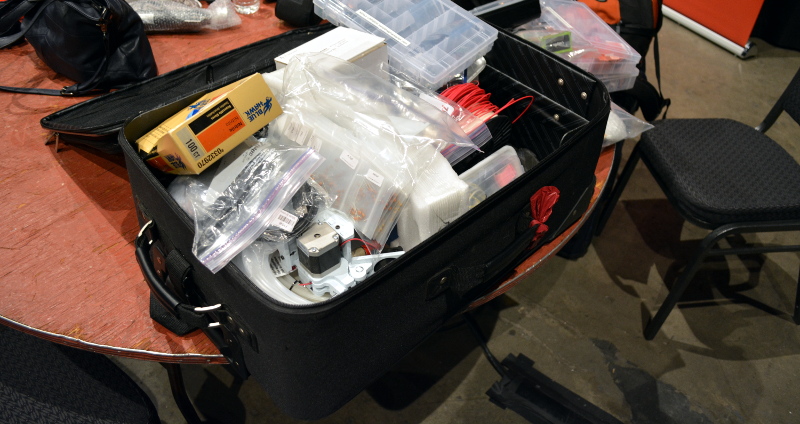
Some people arrive at a hackathon with a laptop, a charger, and enough confidence to power a small refrigerator. Kenji Larsen arrived with what looked like a portable hardware lab that had swallowed a workshop, politely zipped itself shut, and rolled into TechCrunch Disrupt NY ready for business. His famous “Hack Pack,” covered by Hackaday in 2015, was not the shadowy cybercrime suitcase that Hollywood keeps trying to sell us. It was far better: a deeply organized, road-ready maker kit built for hardware hacking, rapid prototyping, emergency repairs, creative problem-solving, and saving other people’s projects at 2 a.m.
That distinction matters. In the real maker world, “hacking” usually means understanding how things work, improving them, adapting them, repairing them, and building something new from messy constraints. It is curiosity with a soldering iron. It is engineering with a deadline. It is the art of turning “we do not have that part” into “give me ten minutes and a suspiciously labeled compartment box.” Kenji Larsen’s ultimate hacking kit became memorable because it showed what serious preparation looks like when creativity meets hardware.
What Made Kenji Larsen’s Hack Pack So Legendary?
The first impressive thing about the Hack Pack was not merely the number of items inside it. Anyone can throw random tools into a bag and call it a kit. That is not preparation; that is a drawer with wheels. Kenji’s setup stood out because it was organized around real hackathon needs: fabrication, electronics, power, measurement, fastening, debugging, repair, prototyping, and improvisation.
According to the original Hackaday coverage, the rolling bag included materials such as acrylic and metal stock, battery-powered and plug-in rotary tools, compartment boxes filled with sensors and passive components, batteries and battery chargers, wireless modules, BeagleBone Black boards, breakout boards, development boards, precision hand tools, magnification gear, and even a compact 3D printer. In other words, it was not just a toolbox. It was a miniature ecosystem for making things happen.
That is why people still remember it. The kit represented a principle every hardware hacker eventually learns the hard way: the missing five-cent part can destroy a thousand-dollar idea. A resistor, a connector, a standoff, a sensor, a battery lead, or the correct tiny adapter can determine whether a prototype demos beautifully or sits on the table blinking in existential despair.
The Real Meaning of an “Ultimate Hacking Kit”
Let’s be clear: an ethical hacking kit is not about breaking into systems, stealing data, bypassing protections, or being the villain in a hoodie who types faster than physics allows. A real, responsible hacking kit is about learning, testing with permission, building prototypes, repairing devices, and understanding technology from the inside out. The best hackers are not reckless. They are disciplined, curious, and annoyingly good at labeling things.
Kenji Larsen’s kit leaned heavily toward hardware hacking, which lives at the intersection of electronics, mechanics, embedded systems, sensors, software, and fabrication. That makes it different from a purely digital cybersecurity toolkit. Instead of focusing on intrusion, it focuses on making devices work, talk, move, measure, sense, display, and survive the chaos of an all-night build session.
In that sense, the “ultimate” part of the kit was not the 3D printer, the development boards, or the fancy compartments. It was the thinking behind the whole thing. Kenji was prepared for uncertainty. He knew that a hackathon is a strange beast: part engineering sprint, part talent show, part sleep-deprivation experiment, and part group therapy for people who have just discovered that their sensor library hates them.
Why Organization Beats Raw Gear Every Time
The most underrated feature of any great hacking kit is organization. A messy bag full of expensive tools is still a messy bag. When the clock is ticking, you do not want to dig through wire clippings, mystery screws, and one suspiciously sticky USB cable just to find a header pin. You want categories. You want visibility. You want the confidence of a person who knows exactly where the heat-shrink tubing lives.
Kenji’s Hack Pack worked because it appears to have been arranged by use case. Sensors had a place. Boards had a place. fabrication materials had a place. Power supplies and chargers had a place. Small components were separated so they could be found quickly. That kind of setup turns a kit into a workflow.
For makers, this is a powerful lesson. The best gear is not always the newest or most expensive. The best gear is the gear you can find, understand, trust, and safely use when your project is misbehaving. A cheap component in the correct compartment is more valuable than a premium component buried under cables like a fossil from the Age of Bad Planning.
The Essential Categories Behind a Serious Hardware Kit
1. Prototyping Boards and Embedded Computers
Development boards are the brains of many hackathon projects. Boards such as the BeagleBone Black, Raspberry Pi-style single-board computers, Arduino-compatible microcontrollers, and wireless modules let builders connect sensors, actuators, displays, and software quickly. Kenji’s kit reportedly included multiple BeagleBone Black boards and many Moteino modules, which made sense for a hardware-focused environment where teams needed flexible computing and wireless communication options.
The point is not that everyone needs the same boards. The point is that a good kit includes platforms the builder already knows well. Hackathons are not the ideal place to discover that your favorite board requires a driver, a ritual, and three forum posts from 2012 before it will cooperate.
2. Sensors, Passives, and Breakout Boards
Sensors turn a prototype from “box with dreams” into “device that reacts to the world.” Temperature, motion, pressure, light, distance, sound, and position sensors can transform a weekend idea into something interactive. Passive components such as resistors, capacitors, diodes, and connectors may seem less glamorous, but they are the quiet crew members keeping the show from collapsing.
Breakout boards also deserve applause. They make tiny or complex components easier to use during prototyping. In a time-limited build, the difference between a bare chip and a breakout board can be the difference between “demo ready” and “we learned a lot, emotionally.”
3. Power, Charging, and Battery Discipline
Power is where many prototypes go to discover humility. Batteries, chargers, USB cables, power banks, regulators, and adapters are not accessories; they are survival gear. A brilliant device that cannot stay powered long enough for a demo is basically a decorative paperweight with ambition.
A responsible kit keeps power gear organized and treats batteries with respect. That means avoiding damaged cells, keeping charging equipment appropriate, and thinking through runtime early. The safest and most professional makers do not improvise recklessly with power. They plan, label, test, and keep the dramatic sparks where they belong: in cartoons.
4. Fabrication Tools and Materials
The Hack Pack reportedly included rotary tools, acrylic, metal stock, precision tools, rulers, magnification, and even a small 3D printer. That is a dream combination for physical prototyping. Software can be changed with a few keystrokes; physical parts sometimes need cutting, drilling, fitting, measuring, mounting, or replacing.
Fabrication tools also come with safety responsibilities. Sharp tools, rotary tools, heat, dust, and small parts should be handled carefully, especially in shared event spaces. The best maker is not the person who works fastest. It is the person who finishes the project without damaging the table, the device, or anyone’s fingers.
Hackathons Reward Prepared People
TechCrunch Disrupt NY 2015 was an intense environment, with teams building under pressure and presenting projects on a short timeline. In that kind of setting, a mentor with a complete hardware kit becomes more than helpful. They become infrastructure. They are the human equivalent of finding free Wi-Fi, coffee, and the exact adapter you forgot at home.
Kenji was at the event as a mentor, not a competitor, which made the kit even more valuable. Instead of using the Hack Pack only for his own build, he could help other teams solve uncommon hardware problems. That is a major part of maker culture: sharing tools, knowledge, components, and encouragement. A good hardware village is not just a room full of equipment. It is a community with solder fumes, strange ideas, and at least one person who knows where the multimeter went.
Why This Story Still Matters Today
Technology has changed since 2015. Boards are faster. 3D printers are more polished. Online tutorials are easier to find. Cloud platforms, AI tools, and low-code systems have changed how prototypes are built. Yet Kenji Larsen’s Hack Pack still feels relevant because the core problem has not changed: builders need readiness.
The modern version of an ultimate hacking kit might include USB-C testers, updated development boards, safer battery storage, compact measurement tools, modular sensor kits, spare cables, documentation, and perhaps a small laptop loaded with legal learning environments. But the philosophy remains the same. Know your tools. Organize your parts. Build ethically. Test responsibly. Help others. Bring snacks if you want to become a legend.
Ethical Hacking: The Boundary That Keeps Creativity Useful
Because the word “hacking” can be misunderstood, it is worth setting a firm boundary. Ethical hacking requires permission, clear scope, and responsible behavior. In cybersecurity, testing should happen only in systems you own, control, or are explicitly authorized to evaluate. In hardware, modifying devices should respect safety, law, warranties, and other people’s property. Curiosity is wonderful; trespassing is not a personality trait.
Frameworks from organizations such as NIST, FTC, OWASP, and CISA emphasize risk awareness, protection, testing, response, recovery, and education. Those ideas fit surprisingly well with the maker mindset. A good hacker does not simply ask, “Can I make this work?” A better hacker asks, “Can I make this work safely, legally, reliably, and in a way someone else can understand later?”
That is the difference between a clever prototype and a useful invention. The former gets applause for five minutes. The latter can survive being used by someone who did not build it.
What Beginners Can Learn From Kenji Larsen’s Kit
Beginners do not need a rolling super-lab on day one. In fact, trying to copy an advanced kit too early can create more clutter than capability. The smarter lesson is to build a kit gradually around the projects you actually make. Start with safe basics: a breadboard, jumper wires, simple components, a beginner-friendly microcontroller, a few sensors, a notebook, protective storage, and a clear labeling system. Add tools only when a real project demands them.
The goal is not to own everything. The goal is to remove friction between idea and prototype. When your kit helps you move from “what if?” to “let’s test it,” it is doing its job. When it becomes a museum of unopened gadgets, it is just expensive confetti.
Specific Examples of Kit Thinking in Action
Imagine a team trying to build a smart safety reminder device during a weekend hackathon. They may need a microcontroller, a simple sensor, a display, a small enclosure, wires, fasteners, power, and a way to mount everything. Without a prepared kit, the team spends half the night asking strangers for parts. With a thoughtful kit, they can focus on the user problem, the interface, the reliability, and the story they will present.
Or picture a student project that needs a quick enclosure for a sensor. A compact 3D printer or access to pre-cut acrylic can turn a fragile breadboard into something demo-ready. Even basic materials such as foam tape, zip ties, standoffs, and small screws can make a prototype look intentional instead of “held together by optimism.”
These examples are not glamorous, but they are real. Great prototypes often depend on small practical choices. The magic is not only in the code or the circuit. It is in the whole system: idea, parts, assembly, power, safety, documentation, and presentation.
Experience Notes: What a Great Hack Pack Feels Like in the Real World
There is a special kind of confidence that comes from opening a well-stocked maker kit in the middle of a chaotic project. The room may be noisy. Someone may be debugging a demo that worked perfectly fifteen minutes ago, which is the official love language of electronics. Another person may be searching for a cable that definitely existed earlier. But the organized builder has a calm advantage. They can pause, look at the problem, and reach for a practical option instead of spiraling into the traditional hackathon prayer: “Maybe the venue has one.”
The best experience with a kit like Kenji Larsen’s is not the joy of owning tools. It is the joy of being useful. A spare sensor can unblock a teammate. A charger can save a prototype. A magnifier can help inspect a tiny connection. A ruler and a scrap of material can turn a loose board into a mounted component. A labeled box of small parts can prevent a full hour of panic. These moments do not always make the highlight reel, but they are often what make a project possible.
There is also a social magic to a serious hardware kit. People gather around it. They ask what something is. They trade ideas. They borrow parts and return with stories. In a good maker space, a kit becomes a conversation engine. It says, “Yes, we can try that.” That attitude matters because invention is fragile at the beginning. Many ideas die not because they are bad, but because the first obstacle feels too annoying. A prepared kit lowers that barrier.
Of course, experience also teaches restraint. Not every project needs the most powerful board, the fanciest sensor, or a custom enclosure. Sometimes the smartest move is the simplest one. A blinking LED, a clear button, a reliable battery, and a clean demo can beat an overcomplicated build that collapses under its own ambition. The mature maker learns when to reach into the kit and when to leave half of it alone.
Another real-world lesson is documentation. Labeling parts, noting what worked, keeping small bags for components, and writing down assumptions may sound boring, but future-you will be grateful. Future-you is tired, holding a board with three identical-looking wires, and wondering why past-you was such a mysterious goblin. Good documentation is kindness across time.
Finally, a kit like Kenji’s reminds us that hacking is not only technical. It is cultural. It is about generosity, readiness, and playful seriousness. The people who make events better are often the ones who bring not just tools, but patience. They know how to explain without showing off, lend without hovering, and solve without taking over. That is the real ultimate hacking kit: preparation plus judgment, curiosity plus ethics, skill plus community spirit.
Conclusion
Kenji Larsen’s ultimate hacking kit became memorable because it captured the soul of hardware hacking: practical creativity under pressure. It was organized, portable, generous, and built around real problems. More importantly, it showed that the best makers do not rely on luck. They prepare for uncertainty, respect safety, help others, and understand that the smallest part in the box might become the hero of the demo.
For anyone interested in ethical hacking, electronics, or maker culture, the lesson is simple. Do not start by trying to build the biggest kit. Start by building the smartest one. Learn your tools. Keep things organized. Work only on systems and devices you are allowed to test or modify. Share knowledge freely. And when possible, be the person who has the spare adapter. History may not build a statue of you, but at a hackathon, that is pretty close to sainthood.