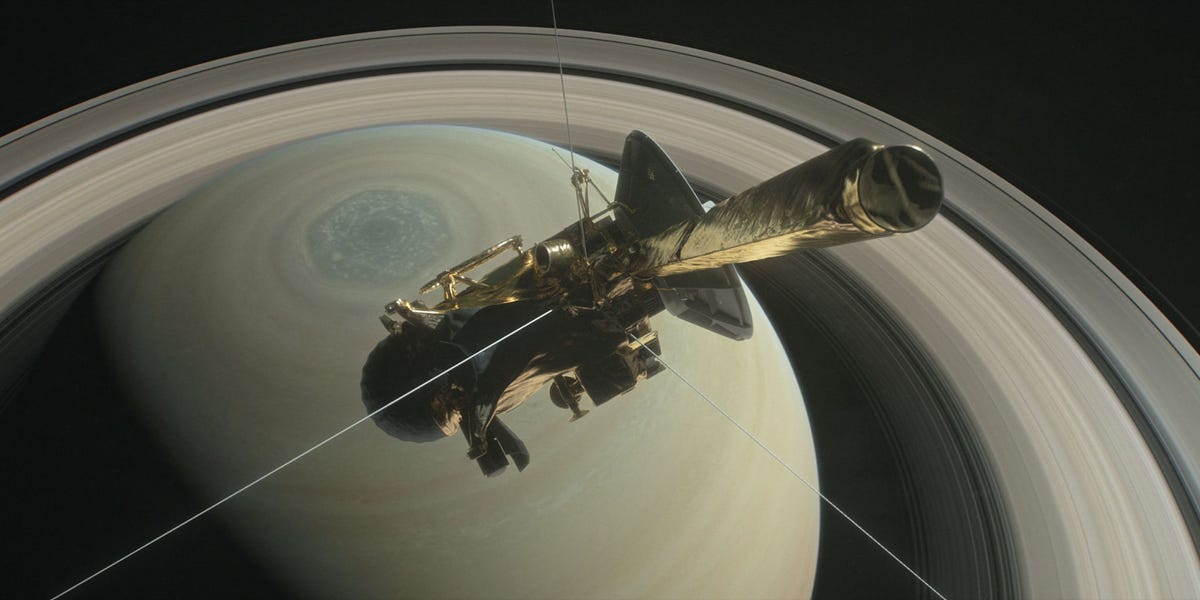
NASA’s Cassini Saturn orbiter did not die because it failed. It died because it succeeded spectacularly.
After nearly 20 years in space and 13 years orbiting Saturn, Cassini ended its mission on September 15, 2017, by plunging deliberately into Saturn’s atmosphere. That final act, known as the Cassini Grand Finale, was not a Hollywood-style accident, a sudden malfunction, or a cosmic “oops.” It was a carefully planned, scientifically valuable, and emotionally unforgettable farewell designed to protect Saturn’s most intriguing moons.
In its last months, Cassini performed 22 daring dives through the narrow gap between Saturn and its rings, a region no spacecraft had ever explored before. Then, with its fuel nearly gone and its job beautifully done, the spacecraft became a meteor in Saturn’s sky. If spacecraft could bow, Cassini did it with a gold-foil cape and a data stream.
What Was NASA’s Cassini Mission?
The Cassini-Huygens mission was one of the most ambitious robotic space missions ever launched. A joint project of NASA, the European Space Agency, and the Italian Space Agency, it was designed to study Saturn, its rings, its magnetic environment, and its remarkable family of moons.
Cassini launched on October 15, 1997, and arrived at Saturn in 2004 after a seven-year interplanetary journey. The spacecraft carried 12 science instruments, while the Huygens probe, built by ESA, carried instruments of its own for a historic descent onto Titan, Saturn’s largest moon.
For more than a decade, Cassini turned Saturn from a distant, golden postcard into a complex planetary system. It watched storms swirl across Saturn’s atmosphere, measured the planet’s gravity and magnetic fields, mapped rings with astonishing detail, and revealed that some of Saturn’s moons are not frozen dead rocks but active, fascinating worlds.
Why Cassini-Huygens Became a Mission of Firsts
Cassini became the first spacecraft to orbit Saturn. Huygens became the first probe to land on a moon in the outer solar system when it touched down on Titan in January 2005. Together, they gave scientists a close-up look at places where methane behaves like water, ice acts like rock, and ocean worlds may hide beneath frozen crusts.
That sounds like science fiction, but Cassini made it science fact. Titan has rivers, lakes, seas, weather, and a thick nitrogen-rich atmosphere. Enceladus, a small icy moon, shoots plumes of water vapor and icy particles into space from a global ocean beneath its crust. Saturn’s rings, meanwhile, turned out to be active, structured, and dynamic rather than simple flat decoration. In other words, Saturn was not wearing a ring; it was hosting an entire physics festival.
What Was the Cassini Grand Finale?
The Cassini Grand Finale was the final phase of the mission, beginning in April 2017 and ending with Cassini’s intentional plunge into Saturn on September 15, 2017. During this phase, Cassini flew through the gap between Saturn and its innermost rings 22 times.
This region was scientifically irresistible but risky. Earlier in the mission, engineers avoided sending Cassini there because unknown ring particles or debris could have damaged the spacecraft. At the end, however, the risk made sense. Cassini had already completed its main mission and two major extensions. Like a veteran explorer stepping into a forbidden cave on the last day of the expedition, it could finally go where caution had previously said, “Not today, buddy.”
The Role of Titan in Cassini’s Final Path
Cassini’s last chapter was shaped by Titan. In April 2017, a close flyby of Titan used the moon’s gravity to bend Cassini’s path and place it on the ring-gap trajectory. This gravity assist acted like a celestial steering maneuver. Engineers had used Titan many times throughout the mission to adjust Cassini’s orbit, but this time the moon essentially handed Cassini the keys to its final adventure.
After that flyby, Cassini began its series of weekly dives between Saturn and the rings. These orbits allowed scientists to gather data that had been too dangerous to collect earlier, including close measurements of Saturn’s gravity, magnetic field, ring particles, and upper atmosphere.
Why Did NASA Choose to Destroy Cassini?
The short answer: Cassini was running out of fuel, and NASA wanted to protect worlds that might have conditions suitable for life.
By 2017, Cassini had used most of the propellant needed to control its course. If mission operators lost the ability to steer the spacecraft precisely, Cassini could eventually drift into an uncontrolled orbit. That created a small but unacceptable risk: someday, the spacecraft might crash into Enceladus or Titan.
That might sound harmless. After all, Cassini was not carrying space zombies, alien eggs, or a tiny espresso machine full of Earth bacteria. But spacecraft are built on Earth, and even with strict cleaning procedures, some hardy microbes can potentially survive for long periods. Because Enceladus and Titan are important targets in the search for habitability, NASA chose to avoid any chance of contaminating them.
Planetary Protection: The Science of Not Making a Mess
Planetary protection is the practice of preventing biological contamination between Earth and other worlds. It matters because future missions may search for signs of life. If a spacecraft accidentally carries Earth microbes to a potentially habitable moon, scientists could later face a cosmic mystery with a very awkward answer: “Congratulations, we found lifeand it hitched a ride from Florida.”
Sending Cassini into Saturn solved the problem. Saturn is a gas giant with no solid surface for Cassini to land on and no environment where Earth microbes could survive. The spacecraft would burn up, break apart, and disappear into the planet’s atmosphere. It was a clean ending, scientifically and ethically.
How Cassini Died in Saturn’s Atmosphere
Cassini’s death was fast, fiery, and carefully scripted.
On September 15, 2017, the spacecraft entered Saturn’s upper atmosphere at roughly 70,000 miles per hour. It hit the atmosphere at about 10 degrees north latitude, on Saturn’s day side, near local noon. At first, Cassini used its thrusters to fight the increasing atmospheric drag and keep its antenna pointed toward Earth.
That antenna orientation was crucial. During its final plunge, Cassini transmitted data in near real time instead of storing it for later. There would be no later. The spacecraft’s instruments, especially its Ion and Neutral Mass Spectrometer, sampled Saturn’s atmosphere and sent home information about its composition as long as communication remained possible.
The Moment Contact Was Lost
As Cassini descended deeper, Saturn’s atmosphere pushed harder. Eventually, the drag overwhelmed the spacecraft’s attitude control system. Cassini began to tumble, its antenna drifted away from Earth, and the radio signal vanished.
NASA predicted loss of contact at about 7:55 a.m. EDT, with Cassini entering Saturn’s atmosphere roughly one minute earlier. Because radio signals from Saturn took about 83 minutes to reach Earth at the time, the spacecraft had already met its fate before mission control received the final silence.
Within about 30 seconds after losing signal, Cassini began breaking apart. Within a couple of minutes, the spacecraft was expected to be completely consumed by Saturn’s atmosphere. There was no wreckage to recover, no crater, and no final resting place. Cassini became part of the planet it had studied for 13 years.
What Cassini Learned During the Grand Finale
The Grand Finale was not just a dramatic goodbye. It was a bonus mission packed into six intense months.
During the 22 ring-gap dives, Cassini gathered data that helped scientists better understand Saturn’s interior, rings, magnetic field, and atmosphere. The spacecraft measured the planet’s gravity with unusual precision, which helped researchers study how Saturn is structured inside. It also helped scientists estimate the mass of the rings, a key clue in the ongoing debate over how old the rings are and how they formed.
Close-Up Science from a Dangerous Neighborhood
Cassini’s particle detectors sampled material from the rings as it fell into Saturn’s atmosphere. Its cameras captured close views of ring structures and cloud features. Its magnetometer studied Saturn’s magnetic field, while plasma and radio science instruments helped reveal the environment between the planet and the rings.
One of the Grand Finale’s major achievements was turning a dangerous orbital path into a scientific gold mine. The spacecraft was not merely saying goodbye; it was working until the last possible moment. That is a strong résumé bullet, even for a robot.
Why Enceladus and Titan Made Cassini’s Ending Necessary
Two moons shaped the moral logic of Cassini’s final plunge: Enceladus and Titan.
Enceladus is small, icy, and dazzlingly bright. Before Cassini, scientists did not know it was one of the most exciting places in the solar system. Cassini discovered geyser-like jets erupting from fractures near its south pole. Those plumes contain water vapor, ice particles, salts, and organic molecules from a subsurface ocean. Evidence also suggests internal heat and possible hydrothermal activity.
Titan, meanwhile, is strange in a different way. It has a dense atmosphere, methane rain, rivers, lakes, and seas. Its surface is far too cold for liquid water to flow, but methane and ethane play a role similar to water on Earth. Beneath its icy crust, Titan may also hide a water ocean.
A Mission Ending That Protected Future Discoveries
NASA’s decision to destroy Cassini was an act of scientific patience. Cassini had found places worth protecting, so the mission ended in a way that preserved them for future exploration. That choice is one reason the Grand Finale is remembered not simply as a death scene but as a responsible handoff to the next generation of planetary missions.
Cassini’s Greatest Discoveries Before the End
Cassini’s legacy is enormous, but several discoveries stand out.
First, Cassini transformed Enceladus into a prime target in the search for life beyond Earth. The discovery of a global ocean beneath the icy crust changed how scientists think about habitable environments in the outer solar system.
Second, the mission revealed Titan as one of the most Earth-like worlds ever explored, despite its alien chemistry. Titan has weather, seasons, dunes, lakes, rivers, and seas. It is like Earth written in a different chemical alphabet.
Third, Cassini showed Saturn’s rings to be active and complex. The rings contain waves, gaps, clumps, spokes, embedded moonlets, and subtle structures shaped by gravity. They are not static jewelry; they are a laboratory for understanding disk systems, including the disks that form planets around young stars.
Fourth, Cassini studied Saturn’s atmosphere and storms, including the planet’s famous hexagon-shaped jet stream at the north pole. It also observed seasonal changes over a long period, giving scientists a rare view of how a gas giant evolves over time.
What the Cassini Grand Finale Means for Space Exploration
The Cassini Grand Finale matters because it shows how modern space exploration balances ambition with responsibility. NASA did not simply squeeze the last drop of science from Cassini and then forget about the consequences. The mission team designed an ending that produced valuable data while protecting potentially habitable moons.
That combination is important. As space agencies plan missions to ocean worlds such as Europa, Enceladus, and Titan, planetary protection will become even more central. The more we learn about possible habitats beyond Earth, the more careful we must be when visiting them.
A Spacecraft That Became Part of Its Planet
There is also something poetic about Cassini’s final act. The spacecraft spent years studying Saturn from orbit, circling the planet like a careful scientist with a clipboard. In the end, it entered the atmosphere and became part of the world it had revealed. That may sound sentimental, but space exploration has always been part engineering, part science, and part human wonder wearing a lab coat.
Experience: What It Felt Like to Follow Cassini’s Final Hours
Following the Cassini Grand Finale felt different from watching an ordinary space event. Launches are full of nervous hope. Landings are full of clenched jaws. Flybys feel like cosmic sightseeing. Cassini’s final dive felt like saying goodbye to an old explorer who had been sending postcards from Saturn for more than a decade.
For many space fans, the most powerful part was not the explosion, because there was no dramatic video of Cassini burning up. Saturn was too far away, and Cassini was too small against that enormous planet. The emotional punch came from the signal. Mission control watched data arrive from a spacecraft that, because of light-time delay, had already been destroyed. It was like hearing the last note of a song after the musician had left the room.
Teachers used the Grand Finale to explain gravity assists, orbital mechanics, atmospheric entry, radio communication, and planetary protection. Students could see that science is not just a list of facts in a textbook. It is a chain of decisions, trade-offs, and carefully managed risks. Cassini had to die because it had discovered worlds important enough to protect. That is a surprisingly mature lesson for a spacecraft covered in gold insulation.
For writers, the mission offered a rare story arc: launch, long journey, arrival, discovery, aging, final courage, and purposeful sacrifice. For engineers, it was a master class in extracting value from a machine operating nearly a billion miles from home. For scientists, it was a final chance to taste Saturn’s atmosphere directly and measure a region no probe had sampled before. For the public, it was a reminder that robotic missions can become emotionally meaningful even though they do not have faces, voices, or tiny robot eyebrows.
One of the best ways to experience the Cassini story today is to look at its images in sequence. Start with Saturn hanging in darkness, then move to Titan’s orange haze, Enceladus’s icy plumes, the ring shadows, the polar hexagon, and finally the last images taken before the plunge. The sequence feels like a travel diary from a place humans have never visited but somehow came to know intimately.
The Grand Finale also changes how we think about endings. Cassini’s end was not failure; it was mission design. It was not waste; it was protection. It was not silence; it was data until the final second. In a culture that often treats endings as losses, Cassini offered a better model: finish the work, protect what matters, and leave the next explorers a cleaner path.
Conclusion: Cassini’s Death Was a Final Gift
NASA’s Cassini Saturn orbiter died by design. After transforming our understanding of Saturn, its rings, Titan, Enceladus, and the outer solar system, the spacecraft made one last contribution by diving into Saturn’s atmosphere and protecting moons that may hold clues to life beyond Earth.
The Cassini Grand Finale was daring, practical, and deeply symbolic. It gave scientists unique measurements from the space between Saturn and its rings, returned atmospheric data during the final plunge, and ensured that future missions can study Enceladus and Titan without wondering whether Cassini got there first in the messiest possible way.
Cassini did not simply vanish. It completed a 20-year story with purpose, precision, and a final transmission across the solar system. Not bad for a spacecraft that never asked for applause.
SEO Tags
Note: This article is written in original standard American English for web publishing and is based on established NASA/JPL Cassini mission information.